One Resin, Infinite Possibilities 💡🧪 | Programming Matter with Light in Next-Gen 3D Printing episode artwork

EPISODE · Mar 2, 2026 · 20 MIN

One Resin, Infinite Possibilities 💡🧪 | Programming Matter with Light in Next-Gen 3D Printing

from The Deep Dive Lab: Unraveling Materials Science · host Son Hoang

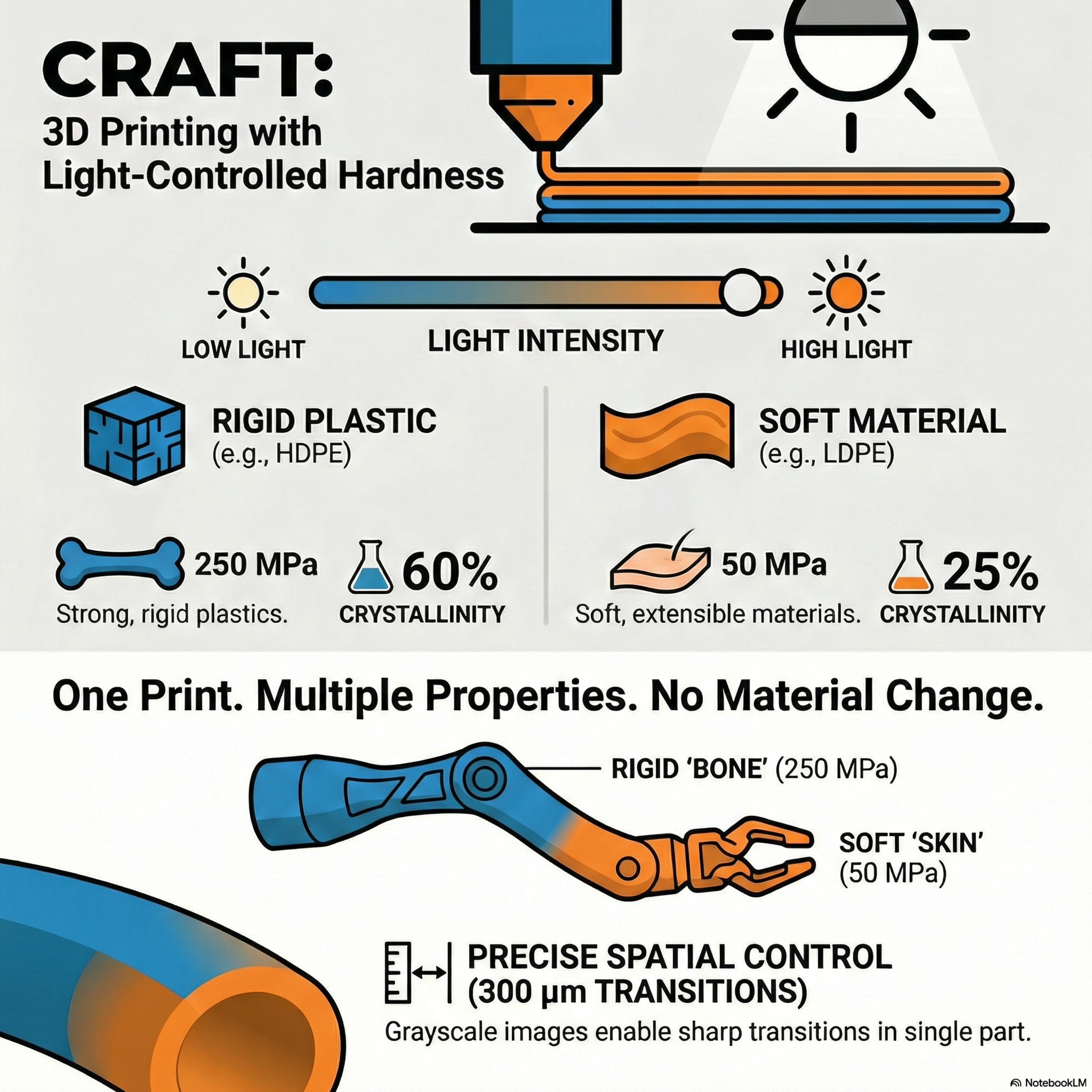
What if a single drop of resin could become bone, skin, tendon—or something entirely new—just by changing the light?Traditional 3D printing has long suffered from the “monolithic problem”: one print, one uniform material property. But a groundbreaking platform called CRAFT (Crystallinity Regulation in Additive Fabrication of Thermoplastics) shatters that limitation.Published in Science (29 Jan 2026, Vol 391, Issue 6784, pp. 511–516), the paper “Lithographic crystallinity regulation in additive fabrication of thermoplastics (CRAFT)” reveals how researchers used varying light intensities (11–168 mW cm⁻²) to control polymer stereochemistry inside a single resin—cis-cyclooctene (COE).With nothing but grayscale light modulation, they achieved voxel-level mechanical programming—switching between soft, transparent cis-pCOE (~120 MPa modulus) and rigid, opaque trans-pCOE (~250 MPa modulus).They printed:🦴 A bio-inspired multi-material hand (bones, tendons, ligaments, skin—all from one resin)🎨 A Mona Lisa reproduction made purely from crystalline contrast📈 “Staircase” stress-strain structures that control failure sequence🦐 Bouligand architectures inspired by mantis shrimp for vibration dampingThis isn’t multi-material printing. It’s programmable matter.Light doesn’t just cure the resin anymore—it writes its mechanical identity.📚 Source Paper:Lithographic crystallinity regulation in additive fabrication of thermoplastics (CRAFT), Science, 29 Jan 2026, Vol 391, Issue 6784, pp. 511–516.#3DPrinting #MaterialsScience #ProgrammableMatter #PolymerPhysics #AdditiveManufacturing #SoftRobotics #NatureInspiredDesign #VoxelEngineering #FutureOfManufacturing #deepdivelab

What if a single drop of resin could become bone, skin, tendon—or something entirely new—just by changing the light?Traditional 3D printing has long suffered from the “monolithic problem”: one print, one uniform material property. But a groundbreaking platform called CRAFT (Crystallinity Regulation in Additive Fabrication of Thermoplastics) shatters that limitation.Published in Science (29 Jan 2026, Vol 391, Issue 6784, pp. 511–516), the paper “Lithographic crystallinity regulation in additive fabrication of thermoplastics (CRAFT)” reveals how researchers used varying light intensities (11–168 mW cm⁻²) to control polymer stereochemistry inside a single resin—cis-cyclooctene (COE).With nothing but grayscale light modulation, they achieved voxel-level mechanical programming—switching between soft, transparent cis-pCOE (~120 MPa modulus) and rigid, opaque trans-pCOE (~250 MPa modulus).They printed:🦴 A bio-inspired multi-material hand (bones, tendons, ligaments, skin—all from one resin)🎨 A Mona Lisa reproduction made purely from crystalline contrast📈 “Staircase” stress-strain structures that control failure sequence🦐 Bouligand architectures inspired by mantis shrimp for vibration dampingThis isn’t multi-material printing. It’s programmable matter.Light doesn’t just cure the resin anymore—it writes its mechanical identity.📚 Source Paper:Lithographic crystallinity regulation in additive fabrication of thermoplastics (CRAFT), Science, 29 Jan 2026, Vol 391, Issue 6784, pp. 511–516.#3DPrinting #MaterialsScience #ProgrammableMatter #PolymerPhysics #AdditiveManufacturing #SoftRobotics #NatureInspiredDesign #VoxelEngineering #FutureOfManufacturing #deepdivelab

NOW PLAYING

One Resin, Infinite Possibilities 💡🧪 | Programming Matter with Light in Next-Gen 3D Printing

0:00 20:48

No transcript for this episode yet

We transcribe on demand. Request one and we'll notify you when it's ready — usually under 10 minutes.

No similar episodes found.

No similar podcasts found.

Frequently Asked Questions

How long is this episode of The Deep Dive Lab: Unraveling Materials Science?

This episode is 20 minutes long.

When was this The Deep Dive Lab: Unraveling Materials Science episode published?

This episode was published on March 2, 2026.

What is this episode about?

What if a single drop of resin could become bone, skin, tendon—or something entirely new—just by changing the light?Traditional 3D printing has long suffered from the “monolithic problem”: one print, one uniform material property. But a...

Can I download this The Deep Dive Lab: Unraveling Materials Science episode?

Yes, you can download this episode by clicking the download button on the episode player, or subscribe to the podcast in your preferred podcast app for automatic downloads.
URL copied to clipboard!