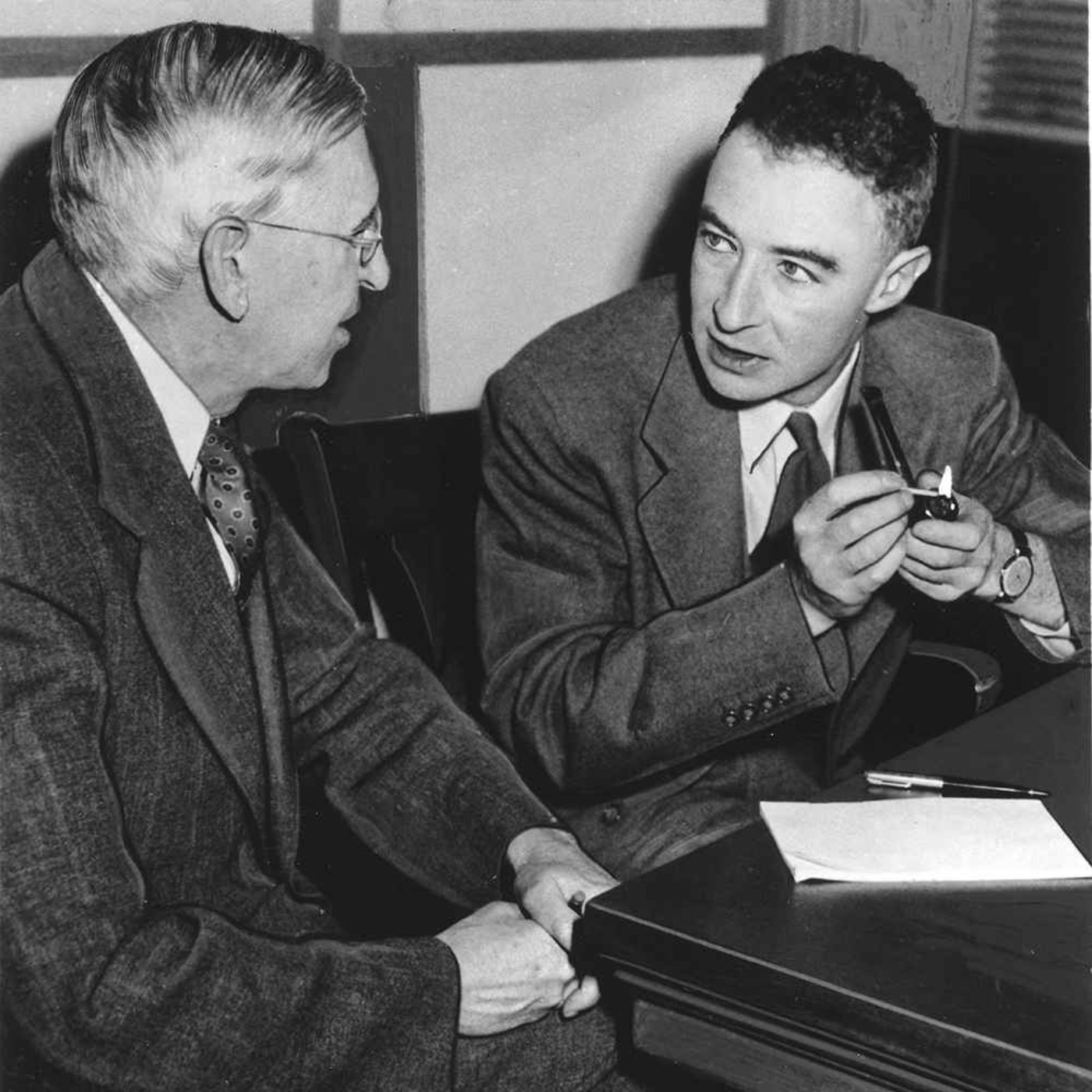
Oppenheimer's Berkeley years episode artwork

EPISODE · Aug 16, 2023 · 1H 27M

Oppenheimer's Berkeley years

from Berkeley Talks

In Berkeley Talks episode 177, a panel of scholars discusses theoretical physicist J. Robert Oppenheimer and how his years at UC Berkeley shaped him, and how he shaped the university.Oppenheimer, the subject of Christopher Nolan’s summer 2023 film Oppenheimer, came to Berkeley in 1929 as an assistant professor and over the next dozen years established one of the greatest schools of theoretical physics. He went on to direct the Manhattan Project’s Los Alamos Laboratory during World War II, during which the first nuclear weapons were developed. He’s often referred to as “the father of the atomic bomb.”“Exceptional students and postdocs flocked here to Berkeley to work with him,” began Cathryn Carson, a Berkeley professor of history and a specialist in the history of 20th century physics, who moderated the July 28 discussion at Berkeley.“As we’ll hear today,” she continued, “the style of work that Oppenheimer unfolded at Berkeley was collaborative, pointed, directed at hard problems, not always successful. His modus operandi, you could say, was, ‘Work hard, play hard.’“He landed in the Bay at a time when much else was in ferment. At the same time that he devoted himself to physics, he got engaged with contemporary left-wing politics. In the Bay Area in the 1930s, that included the fight against fascism in Nazi Germany and Spain and struggles for economic justice and labor in California. The Communist Party was part of that setting, and Oppenheimer immersed himself in the life of the Berkeley faculty, efforts to unionize it and intellectual currents across the university — this broad liberal arts institution that fed his roving mind.”Panelists include:Cathryn Carson, chair and professor of Berkeley’s Department of History, whose research includes nuclear history and the history of 20th century physics. She co-edited a volume of papers about Oppenheimer, Reappraising Oppenheimer: Centennial Studies and Reflections.Mark Chadwick, chief scientist and chief operating officer for weapons physics at Los Alamos National Laboratory, who edited and published a suite of papers on the technical history of the Trinity test.Jon Else, professor emeritus of Berkeley’s Graduate School of Journalism, who created the documentary The Day After Trinity: J. Robert Oppenheimer and the Atomic Bomb.Yasunori Nomura, a Berkeley professor of physics and director of the Berkeley Center for Theoretical Physics.Karl van Bibber, professor of nuclear engineering at Berkeley, who spent 25 years conducting nuclear energy research at Lawrence Livermore National Laboratory.Listen to the episode and read the transcript on Berkeley News (news.berkeley.edu).Photo by Roy Kaltschmidt, courtesy of Lawrence Berkeley National Laboratory.Music by Blue Dot Sessions. Hosted on Acast. See acast.com/privacy for more information.

In Berkeley Talks episode 177, a panel of scholars discusses theoretical physicist J. Robert Oppenheimer and how his years at UC Berkeley shaped him, and how he shaped the university.Oppenheimer, the subject of Christopher Nolan’s summer 2023 film Oppenheimer, came to Berkeley in 1929 as an assistant professor and over the next dozen years established one of the greatest schools of theoretical physics. He went on to direct the Manhattan Project’s Los Alamos Laboratory during World War II, during which the first nuclear weapons were developed. He’s often referred to as “the father of the atomic bomb.”“Exceptional students and postdocs flocked here to Berkeley to work with him,” began Cathryn Carson, a Berkeley professor of history and a specialist in the history of 20th century physics, who moderated the July 28 discussion at Berkeley.“As we’ll hear today,” she continued, “the style of work that Oppenheimer unfolded at Berkeley was collaborative, pointed, directed at hard problems, not always successful. His modus operandi, you could say, was, ‘Work hard, play hard.’“He landed in the Bay at a time when much else was in ferment. At the same time that he devoted himself to physics, he got engaged with contemporary left-wing politics. In the Bay Area in the 1930s, that included the fight against fascism in Nazi Germany and Spain and struggles for economic justice and labor in California. The Communist Party was part of that setting, and Oppenheimer immersed himself in the life of the Berkeley faculty, efforts to unionize it and intellectual currents across the university — this broad liberal arts institution that fed his roving mind.”Panelists include:Cathryn Carson, chair and professor of Berkeley’s Department of History, whose research includes nuclear history and the history of 20th century physics. She co-edited a volume of papers about Oppenheimer, Reappraising Oppenheimer: Centennial Studies and Reflections.Mark Chadwick, chief scientist and chief operating officer for weapons physics at Los Alamos National Laboratory, who edited and published a suite of papers on the technical history of the Trinity test.Jon Else, professor emeritus of Berkeley’s Graduate School of Journalism, who created the documentary The Day After Trinity: J. Robert Oppenheimer and the Atomic Bomb.Yasunori Nomura, a Berkeley professor of physics and director of the Berkeley Center for Theoretical Physics.Karl van Bibber, professor of nuclear engineering at Berkeley, who spent 25 years conducting nuclear energy research at Lawrence Livermore National Laboratory.Listen to the episode and read the transcript on Berkeley News (news.berkeley.edu).Photo by Roy Kaltschmidt, courtesy of Lawrence Berkeley National Laboratory.Music by Blue Dot Sessions. Hosted on Acast. See acast.com/privacy for more information.

NOW PLAYING

Oppenheimer's Berkeley years

0:00 1:27:34

No transcript for this episode yet

We transcribe on demand. Request one and we'll notify you when it's ready — usually under 10 minutes.

Carnivores Don't Get Sunburn - Carnivore Diet Talks Carnivores Don't Get Sunburn - Carnivore Diet Talks Welcome to “Carnivores Don’t Get Sunburn,” where we have fun and explore the carnivore diet and its transformative power. Join us as we uncover real stories from individuals who have thrived on this diet, defying convention and embracing optimal health. Plus, stay tuned for our upcoming documentary featuring diverse carnivores overcoming health challenges. Learn more at www.carnivoredietdocumentary.com.Excitingly, we’re working on an upcoming documentary where we’ll feature carnivores from various walks of life, conquering diverse health challenges. Join us on this journey and learn more at www.carnivoredietdocumentary.com.Join us in uncovering the power of the carnivore diet. Prepare to be inspired, informed, and empowered to embrace optimal health and well-being.Welcome to “Carnivores Don’t Get Sunburn: Unveiling Real Stories of the Carnivore Diet.” Stay tuned for our upcoming documentary. Discover how this lifestyle can transform lives. Learn more at www.carnivoredietdocumentary.com IT IS WHAT IT IS with SHALLZ - SHALLY ZOMORODI Shally Zomorodi What?  "It is what it is" with ShallZ – Shally ZomorodiWhen? WeeklyHow long? 35 minutesEvery week, Mother of 4, wife, morning TV news anchor and ultimate hostess, Shally Zomorodi talks about life - its up's and downs and how to stay on track in her weekly podcast, ‘It is what it is.’  Known for her high energy, infectious smile and ability to see the cup as half full Shally talks about all things in life and how to work through its challenges. From parenting, marriage, friendships, current events to how to smile when it just seems impossible ‘It is what it is’ is the perfect podcast to help inspire you to dance through the rain. Tracking Nuclear Weapons Programs Center for Strategic and International Studies The CSIS Proliferation Prevention Program talks to experts about transparency and nuclear weapons. Cover Stories with Chess Life US Chess Chess Life Editor John Hartmann talks to the authors of each month's Chess Life cover story.

Frequently Asked Questions

How long is this episode of Berkeley Talks?

This episode is 1 hour and 27 minutes long.

When was this Berkeley Talks episode published?

This episode was published on August 16, 2023.

What is this episode about?

In Berkeley Talks episode 177, a panel of scholars discusses theoretical physicist J. Robert Oppenheimer and how his years at UC Berkeley shaped him, and how he shaped the university.Oppenheimer, the subject of Christopher Nolan’s summer 2023...

Can I download this Berkeley Talks episode?

Yes, you can download this episode by clicking the download button on the episode player, or subscribe to the podcast in your preferred podcast app for automatic downloads.
URL copied to clipboard!