
EPISODE · Jun 30, 2026 · 32 MIN
Orthodoxy - 01 - Chapters 1-3
from Discipleship for the Present Podcast · host Kanu Emeruwa
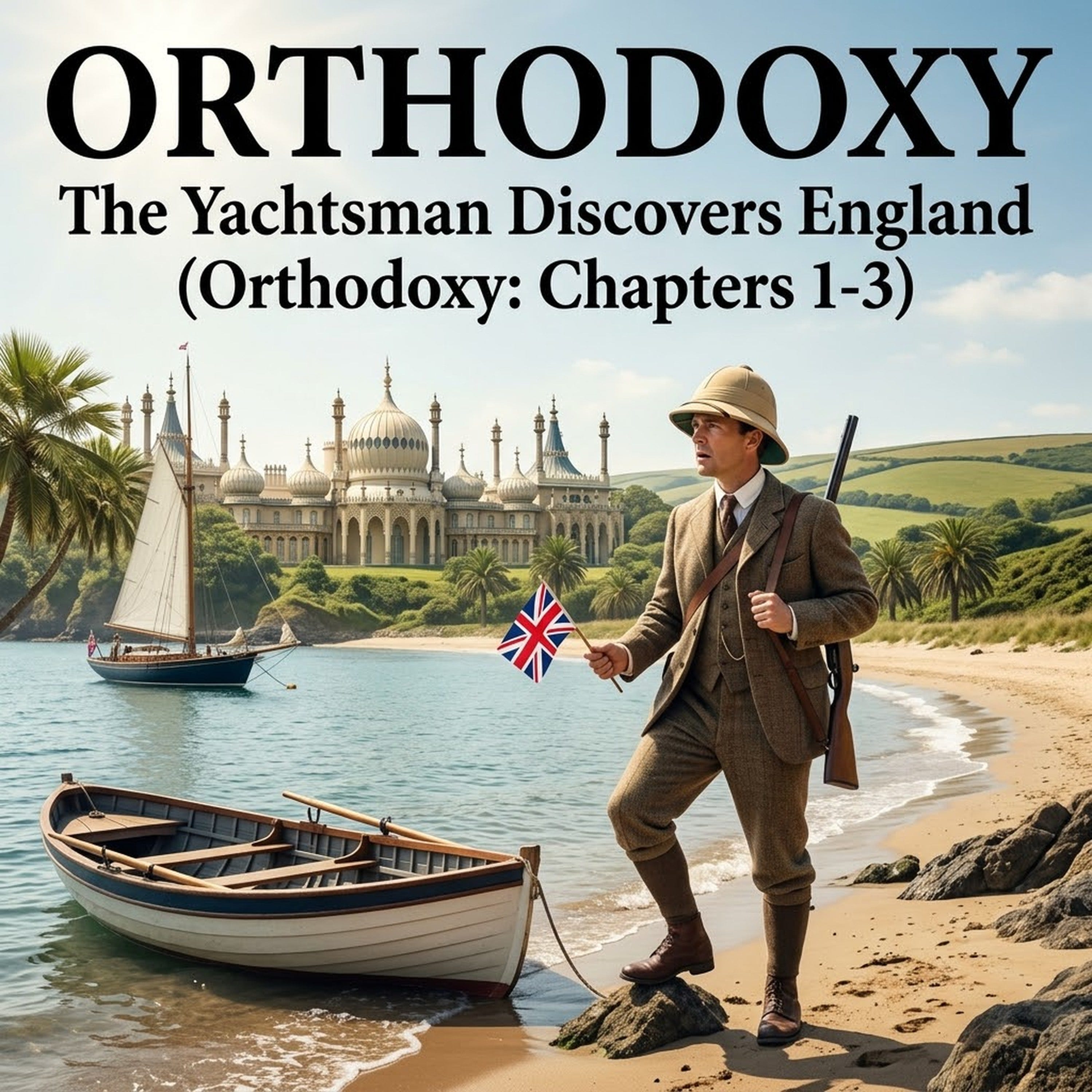
Most of us assume that madness belongs to the wild, the unrestrained, and the deeply imaginative. But what if the people most likely to completely lose their minds are actually the strictly rational thinkers?The episode opens by stripping away the illusion that logic is the ultimate stabilizing force. Exploring the first three chapters of G.K. Chesterton’s Orthodoxy, we look carefully at late 19th-century Europe—a landscape violently shifting under the weight of strict materialism and scientific determinism. It is here we find Chesterton trying to build a shelter for the modern mind, searching for what he calls "practical romance": the dual capacity to view the world as an astonishing, alien wonderland while simultaneously feeling entirely at home in it.That search for grounding leads to a devastating blow to the modern ego: the illusion of originality. Much like the comic image of the English yachtsman who proudly "discovers" his own country, Chesterton confesses that his grueling attempt to invent a groundbreaking heresy only resulted in a sloppy, inferior copy of ancient Christianity. The episode draws this realization into modern spiritual life, exposing how the idol of hyper-individualism exhausts us. We exhaust ourselves trying to be ten minutes in advance of the truth, when peace actually requires the intellectual submission of repentance.At the center of this diagnostic puzzle is the Hanwell Asylum and the pathology of pure logic. Chesterton famously argues that "the madman is not the man who has lost his reason; the madman is the man who has lost everything except his reason." The episode unpacks how a purely mathematical approach to reality creates a suffocatingly small cosmos. The materialist’s universe may be logically complete, but it entirely leaves out the vast, messy, soaring reality of human existence. This contrast is visualized geometrically: the circle represents pure reason—a closed, infinitely narrow loop—while the cross embraces the paradox of intersecting lines, extending its arms outward into the four winds.From there, the episode turns to the concept of "wandering virtues." When ancient truth is shattered, virtues go rogue like a spiritual autoimmune disease. We see truth isolated from pity, which results in literature that acts as moral torture. We see pity isolated from truth, which destroys human agency and accountability. But the most dangerous dislocation is humility. Modern modesty has migrated from its rightful home. Instead of doubting our own capacity and marveling at the magnificent truth of the world, modern people assert their own feelings with absolute certainty and apply their skepticism strictly to objective truth itself.Finally, the episode shifts to the paralysis of the modern mind. Without objective truth, society turns to the worship of the boundary-free will. Yet, as the episode illustrates, every choice inherently requires limitation—you cannot draw a giraffe without accepting the boundaries that make it a giraffe. The antidote to this paralysis is found in the historical figure of Joan of Arc. Unlike the armchair philosophers endlessly theorizing about the abstract nature of goodness, she embraced the severe limitations of obedience and acted like a thunderbolt. She embodies the profound cost, and the ultimate sanity, of fruitful discipleship.In This EpisodeWhy purely logical, rational thinkers are actually more prone to madness than imaginative creativesThe "English yachtsman" and the profound human need for "practical romance"How the modern idol of hyper-individualism masks an exhausting illusion of originalityThe Hanwell Asylum and why pure logic, divorced from mystery, becomes a psychological pathologyThe circle versus the cross: the difference between a closed loop of reason and a universe that embraces paradox"Wandering virtues" and the spiritual autoimmune disease of truth without pity or pity without truthThe dislocation of humility: how modern skepticism became a toxic refusal to believe in objective truthWhy the worship of a boundary-free will actually leads to the complete paralysis of actionJoan of Arc, the necessity of limitation, and the true cost of fruitful actionThe danger of tearing the "seamless garment" of Christ's character into isolated, palatable stripsPractical ReflectionWhere in your own spiritual life are you exhausting yourself trying to invent a novel, custom-made way to follow God rather than resting in the stability of the ancient path?Are you caught in a cycle of overanalysis, trying to logically map out every spiritual problem until your world shrinks to the size of a claustrophobic closet?Where are you standing paralyzed at the crossroads of endless options, waiting for perfect freedom instead of embracing the fruitful limitations of obedience today?Suggested Substack ExcerptMost of us assume that logic is the ultimate stabilizing force, but what if pure reason is actually a recipe for madness? Exploring the profound insights of G.K. Chesterton’s Orthodoxy, this episode unpacks the pathology of modern intellectualism, the illusion of originality, and the spiritual autoimmune disease of wandering virtues. Join us as we examine why true sanity requires us to step outside the closed loop of our own logic and embrace the expansive mystery of God’s kingdom.AI DisclosureThis episode was created using Google NotebookLM Audio Overview, based on human-curated source material, structured guidance, and editorial review. AI is used as a tool for clarity and delivery, not as a replacement for thoughtful study or engagement with the original texts.Copyright© 2026 Discipleship for the Present / Kamashcu Production Studios. All rights reserved. This is a public episode. If you would like to discuss this with other subscribers or get access to bonus episodes, visit discipleshipforthepresent.substack.com
Embed this episode
Ready to play
Orthodoxy - 01 - Chapters 1-3
No transcript for this episode yet
Similar Episodes
No similar episodes found.
Similar Podcasts
No similar podcasts found.