
EPISODE · Jul 14, 2026 · 43 MIN
OSU Agronomy Farm: What Changes, What Stays
from Red Dirt Agronomy Podcast · host Dave Deken, Brian Arnall Ph.D., Josh Lofton Ph.D., Wade Thomason Ph.D.
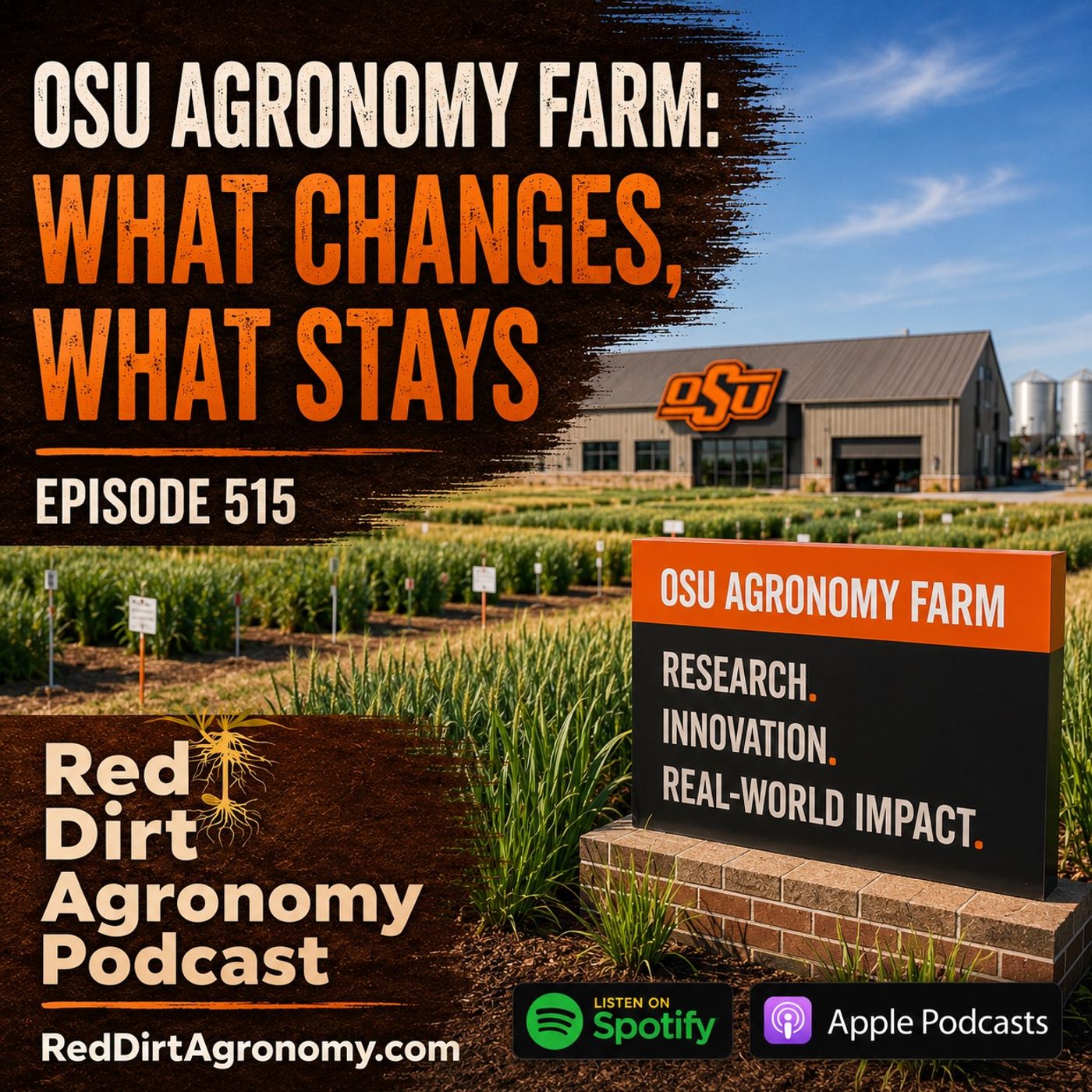
A new veterinary hospital is coming to one of OSU’s most visible agricultural sites, but the crop research Oklahoma producers rely on is not going away. OSU Department of Plant and Soil Sciences head Wade Thomason, Ph.D., joins Dave Deken, Brian Arnall, Ph.D., and Josh Lofton, Ph.D. to explain what is changing at the Agronomy Research Station, which long-term plots will be protected, and why good soil, irrigation, and proximity to campus cannot simply be replaced. They also walk through plans for new greenhouses, field laboratories, teaching space, soil and forage testing, plant disease diagnostics, and a possible summer 2028 move. Key takeaways: The historic Magruder Plots and other long-term fertility trials are not planned for development. The veterinary hospital is expected to use the area where the current agronomy buildings stand. Approximately 20 to 50 acres of other research ground may need to be replaced nearby. New facilities could bring wheat breeding, crop quality testing, field research and diagnostic services into a more efficient system. The modernization is designed to improve research, hands-on student education and service to Oklahoma producers. Detailed timestamped rundown 00:00–01:54 — Episode setup and field event invitation Dave introduces the debate over the Agronomy Research Station, the veterinary hospital project and the future of research and teaching at the site. He also previews the July 27 Summer Crop Demo Day near Chickasha.01:54–02:32 — Participant introductions Brian Arnall and Josh Lofton are introduced before the recorded conversation with Wade Thomason begins.02:32–04:18 — What is happening to the agronomy farm? The group addresses months of concern and confirms that the veterinary hospital is expected to occupy the footprint where the existing agronomy buildings stand.04:18–05:59 — Are the Magruder Plots safe? The long-term fertility trials are identified as irreplaceable scientific resources. The discussion makes clear that the Magruder Plots and other longstanding trials have not been offered for development.05:59–08:29 — Why agronomy cannot simply move anywhere Thomason explains the requirements for productive research ground: proximity to campus, student access, suitable soil, little slope, a location outside the floodplain and dependable irrigation supplied through the OSU water system.08:29–10:12 — Why the plots must remain near campus The station supports hands-on classes, weed identification, breeding programs, frequent crop observations and technologies such as drone imagery. Moving those activities farther away would reduce efficiency and student access.10:12–12:29 — The original farm layout had a purpose The group explains how soils, slope, wind direction, water and animal needs shaped the placement of agricultural programs. The land was not assigned randomly.12:29–14:45 — Prime real estate and agricultural history Dave describes the corner as emotionally significant to people connected with OSU agriculture. The group acknowledges that reaction while explaining the university’s effort to create room for both agronomy and veterinary medicine.14:45–17:03 — The rebuild is three connected projects Plans include a greenhouse and headhouse complex, new agronomy research operations and an education and laboratory center. Wheat breeding, wheat pathology, Extension, turfgrass and ornamental horticulture are among the programs discussed.17:03–19:13 — New homes for producer services The proposed education center could include classrooms, conference space, the Soil, Water and Forage Analytical Laboratory and the Plant Disease and Insect Diagnostic Laboratory. Both laboratories currently face significant space and access limitations.19:13–22:14 — Proposed locations and the 2028 target The conversation covers possible locations on the existing sheep and goat property, the likely order of construction and the need to move agronomy operations before the existing buildings can be removed. The target is summer 2028.22:14–23:43 — Learning from other land-grant universities The planning team studied facilities at Kansas State, Purdue, Nebraska, Texas A&M, Georgia and Tennessee to identify useful designs and avoid problems those institutions encountered.23:43–27:22 — Designing around the work, not old walls The proposed greenhouses may have less total square footage but greater usable capacity through rolling benches, better lighting and ventilation. Other improvements include a pull-through seed warehouse, integrated wheat quality space, improved cotton processing, chemical storage and shared drying and grinding areas.27:22–31:27 — Shared space, compromises and adaptation The faculty discuss the benefits and frustrations of shared work areas. Some programs may gain more than others, but the experience of OSU’s newer Agricultural Hall suggests shared facilities can improve communication and the student experience.31:27–34:34 — Balancing program needs and limited space The conversation continues into how researchers will adjust their workflows, which needs must be prioritized and how the new construction will affect existing research acreage.34:34–35:57 — How much land could be displaced? The working estimate is approximately 20 to 50 acres. Options include nearby purchases, existing OSU land and other research sites; the department does not expect to replace the entire 185-acre main station.35:57–37:09 — Other research locations and sheep facilities Land near Perkins and a university property east of Billings could provide additional research opportunities. The project may also accelerate plans for a new sheep and goat facility.37:09–39:09 — State funding and possible federal support The episode describes a $40 million legislative allocation tied to a $10 million OSU match. The team also plans to pursue a federal research-facilities grant of up to $30 million, which could bring the potential project budget near $80 million. The federal award was not guaranteed at the time of recording.39:09–41:42 — Private support and practical details Previously pledged greenhouse support is discussed as part of OSU’s match, followed by lighter conversation about equipment, refrigerators and the research team’s preferred ice machine.41:42–43:36 — A working name and final thoughts The group closes with the working name “Agronomy Research Discovery Center,” thanks Wade for the update and directs listeners to Red Dirt Agronomy for future information. RedDirtAgronomy.com
Embed this episode
What this episode covers
One of Oklahoma agriculture’s most recognizable pieces of ground is entering a new chapter—but the research farmers depend on is not being paved over. Oklahoma State University’s new veterinary teaching hospital is expected to be built on the footprint now occupied by buildings at the Agronomy Research Station in Stillwater. That announcement raised understandable concerns about the future of the farm, its teaching plots and long-term experiments, including research that has been underway for more than a century. In this episode of Red Dirt Agronomy, OSU Department of Plant and Soil Sciences head Wade Thomason Ph.D. joins Dave Deken, Brian Arnall Ph.D. and Josh Lofton Ph.D. to separate settled decisions from questions that are still being worked through. The historic Magruder Plots and other irreplaceable long-term fertility research are being protected. OSU also expects to retain much of the main research ground, although approximately 20 to 50 acres used by other programs may need to be recreated nearby. The change also creates an opportunity to replace aging buildings with modern greenhouses, field laboratories, shared seed and sample-processing areas, improved research storage and a producer-friendly education center. That center could provide a new home for soil, water and forage testing as well as plant disease and insect diagnostics. For Oklahoma producers, this is more than a construction story. It is about preserving unbiased crop research, strengthening Extension services, improving wheat and crop breeding, giving students meaningful field experience, and making the university’s diagnostic resources easier to use. The current target is to move agronomy operations into their new facilities during the summer of 2028, although final land and funding decisions remain in progress.
Ready to play
OSU Agronomy Farm: What Changes, What Stays
No transcript for this episode yet
Similar Episodes
Dec 11, 2025 ·33m