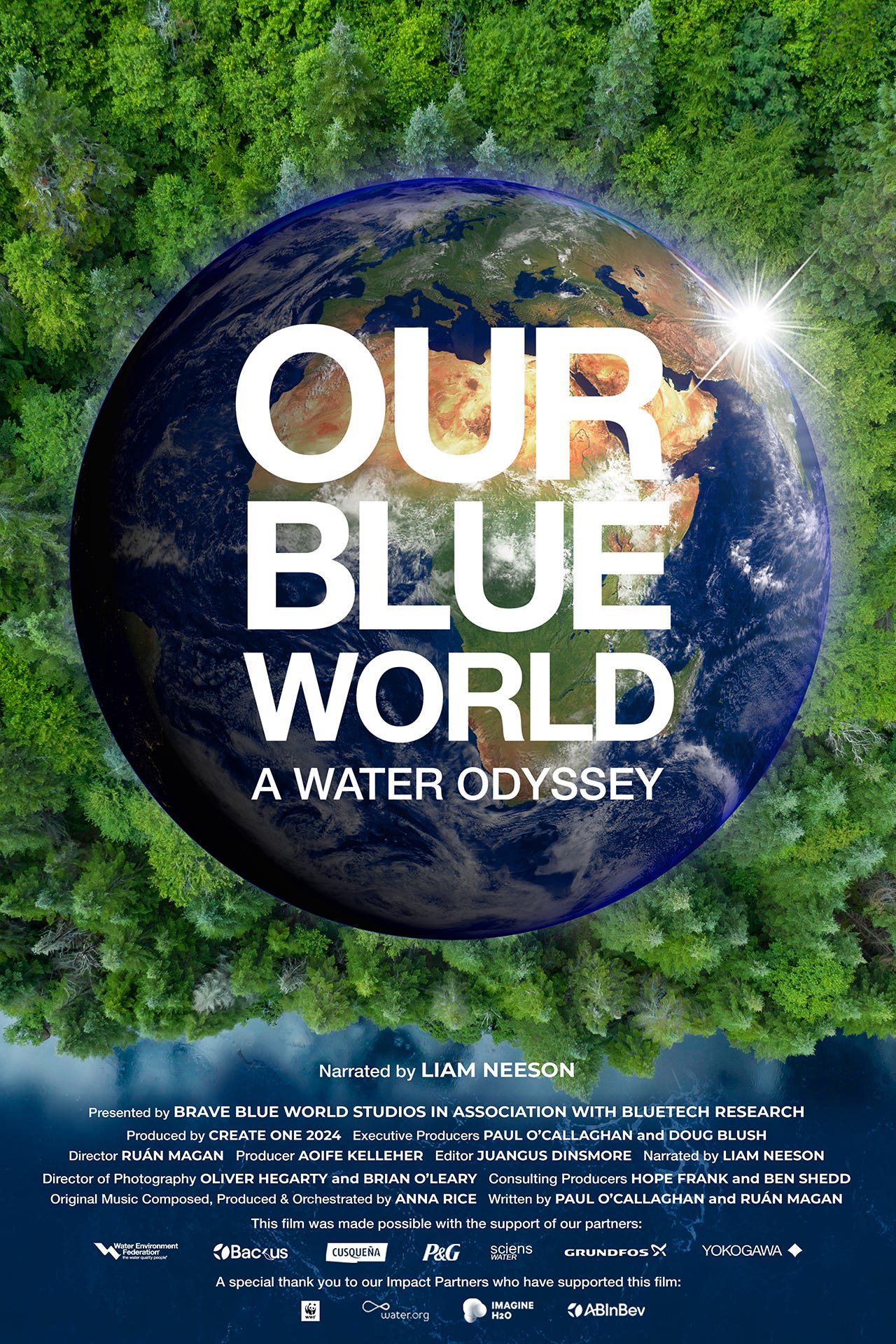
'Our Blue World' documentary : Paul O'Callaghan
from Climate Water Project Hosted by Alpha Lo
A wonderful new documentary, Our Blue World, is out, and it offers a panoramic exploration of how communities across the globe are learning to live in greater harmony with water. The film highlights a wide range of innovative and traditional practices—from China’s sponge city initiative, to New Zealand’s recognition of the Whanganui River as a legal person, to the ancient Peruvian techniques for guiding water into mountains so it reemerges as springs. It also delves into the Biosphere 2 project, where twelve people lived in a sealed dome for two years and had to rely on constructed wetlands to purify their water. The documentary further explores the shift along the Mississippi River from a levee-centered approach to one that embraces wetland restoration, as well as efforts to restore Ireland’s bogs—offering a hopeful vision of how we can reimagine our relationship with water. The film is produced by Paul O’Callaghan, directed by Ruan Magan, and narrated by Liam Neeson (the action movie actor) in his voice that oozes gravitas. The movie has beautiful images, and wonderful music that connects us to the local geography and culture. [Peru: still from movie]. I think documentaries are a great way to movie the word out about the water cycle, so I was glad for the chance to chat with producer Paul O’Callaghan about the movie. Trailer: Here are some abridged excerpts from our conversation, which covered topics from the movie: On sponge cities Paul: The idea of a sponge city was very evocative. It captures your imagination. It's like, what is it? It's these two words that you're familiar with, but not together in that context. So anytime I would have talked about this, people became very curious. I was really lucky that we got introduced to Kong Jin. And I remember the day we had the call. It was chaotic in my house at the time. But we had this really great call with Kong Jin and struck up a very good rapport with him. And he kindly was willing to take part in the film. This was just post COVID-19. So China was locked down pretty much for two plus years. We were at the embassy trying to get our visas and get in, which wasn't easy. Kong Jin is a revolutionary, a visionary, something of a rebel, and a landscaper architect who felt that China was going in the wrong direction. They were following the West blindly. They were pouring concrete at an absolutely incredible race. And when he looked at that, he thought, that's not the right way to go. [Kong Jian : still from movie} He'd grown up in the 1960s in China, where it was a beautiful wonderland. It was a paradise. But nobody listened to him when he said we should embrace traditional ways of managing water like rice paddies, for example, which are stepped and terrest, the nearly room for water to ebb and to flow. That was how people lived for 5000 years along the banks of the Yangtze, the Pearl and the Mekong, where in actual fact, the fitness to govern in China was correlated with your ability to control water or at least live with the ebbs and the flows of those mighty, mighty rivers. So it's always been something fundamental to Chinese philosophy and political systems. He wrote 500 letters to 500 mayors and it landed on deaf ears. He was cast out as a pariah. Until one mayor, who later became a minister for the environment later on reached out back out to him and said - I'd love to try that idea that you had in Hainan. That was where the first sponge city was created. And these things look beautiful. When you think about China, oftentimes we think of concrete high rises, skyscrapers, maybe a lot of road traffic and air pollution. Well, these aren't like that at all. Certain parts of the city have tree lined along the streets. They may have mangroves on the coast. There large areas that are allowing rivers to ebb and flow, with constructed wetlands that look like parks. Alpha: Yeah, it's amazing that he had the persistence to do 500 mayors. It's like sometimes to make these paradigm shifts in work, you really have to push. It reminds me of little Peter Andrews, the Australian guy who did natural sequence farm. He just kept pushing, pushing against and all these people say no. But yeah, it's interesting. Not everyone has that ability to push so hard. And sometimes it takes that to get it out there. Paul: And you never know, it only has to land with that one mayor, 499 would never have listened to him. When you write these letters, when you advocate, when you communicate, none of us can really understand the wrinkles that are going to take effect downstream of this. He engendered a spirit of pride in a harkening back to perhaps a wisdom of a 5,000 year old culture. In doing so, he wasn't alienating people with some theory that they wouldn't understand. He was advocating for traditional wisdom. Alpha: And what is some of that traditional Chinese wisdom? Paul: We've been trying to flatten a variable signal, particularly in monsoon type climates in South Asia, where you get these incredible flows, certain times of the year, which can cause rivers to burst their banks. Nowhere is that more true than in China. They had names for these rivers. One was called the Scourge of the Sons of Han. People began to come together and work together in collaboratives, particularly in an agrarian society where the most fertile places are along the banks of these rivers. We saw that in Egypt along the Nile, which, you know, sustained a very rich culture for hundreds, if not thousands of years. And China for five thousand. One of the reasons they haven't had a collapse, like many civilizations have had, is because the rivers constantly replenish nutrients on the lands. They do that by flooding and edding and leaving room for the river. The concept was don't try to canalize it, channel it, control it, straighten it, put it underground and make it move in straight lines. That's not what water wants to do. And Erica Gies, extremely eloquently, captures this in the idea that ‘water always wins’. It's about the power of a tree to break the fall of the water, slow it down. In the root zone of these plants, you've got at least the same area taken up as the complete canopy, not to mention the mycorrhizae structure in the root zone, which is acting like an incredible sponge to hold water. He has been able to integrate this into modern cities. He's got at least over 50 sponge cities, if not more now. Others adopting and embracing the same idea, Bangkok and Thailand. You'll see examples in South Korea. I would say what we see happening in New York, and Copenhagen. Same as in Hamburg, in Germany, New Orleans. And that was one of the interesting things about this film project—you always learn something. We saw stuff that you could join, but they were arising independently, in synchronicity with one another, without anyone really having got together and come up with any particular master plan. What they found was a swampy area that maybe was low-value property—you know, nobody wants to live there. It was kind of almost wasteland, duck land. But when they went in and regenerated it, rehabilitated it, actually the price of the property increased dramatically—because people now wanted to live there. In China people were embracing this. Elderly people are out there in the morning, in this wetland natural park, where you can eat fruit from the trees, and there are fireflies buzzing. It sounds idyllic. You’d see young couples on a date walking together, holding hands through this area. You know, people pushing strollers with babies. The city came alive—through a combination of walkways and boardwalks—in an area that was functioning to protect the city from the disastrous effects of flooding. It was also purifying water. And if you come from a background in water engineering, and you look very closely, you can—you can totally see how the levels are being adjusted, and how it’s flowing from one pond to the next pond, and how it’s all connected. But you know, f… This is a public episode. If you'd like to discuss this with other subscribers or get access to bonus episodes, visit climatewaterproject.substack.com/subscribe
Embed this episode
No transcript yet.