
EPISODE · Jun 14, 2026 · 22 MIN
Palantir Series: Foundry: Erecting the Modern Enterprise Ontology 🛡️
from Robert Joodat Podcast · host Robert Joodat
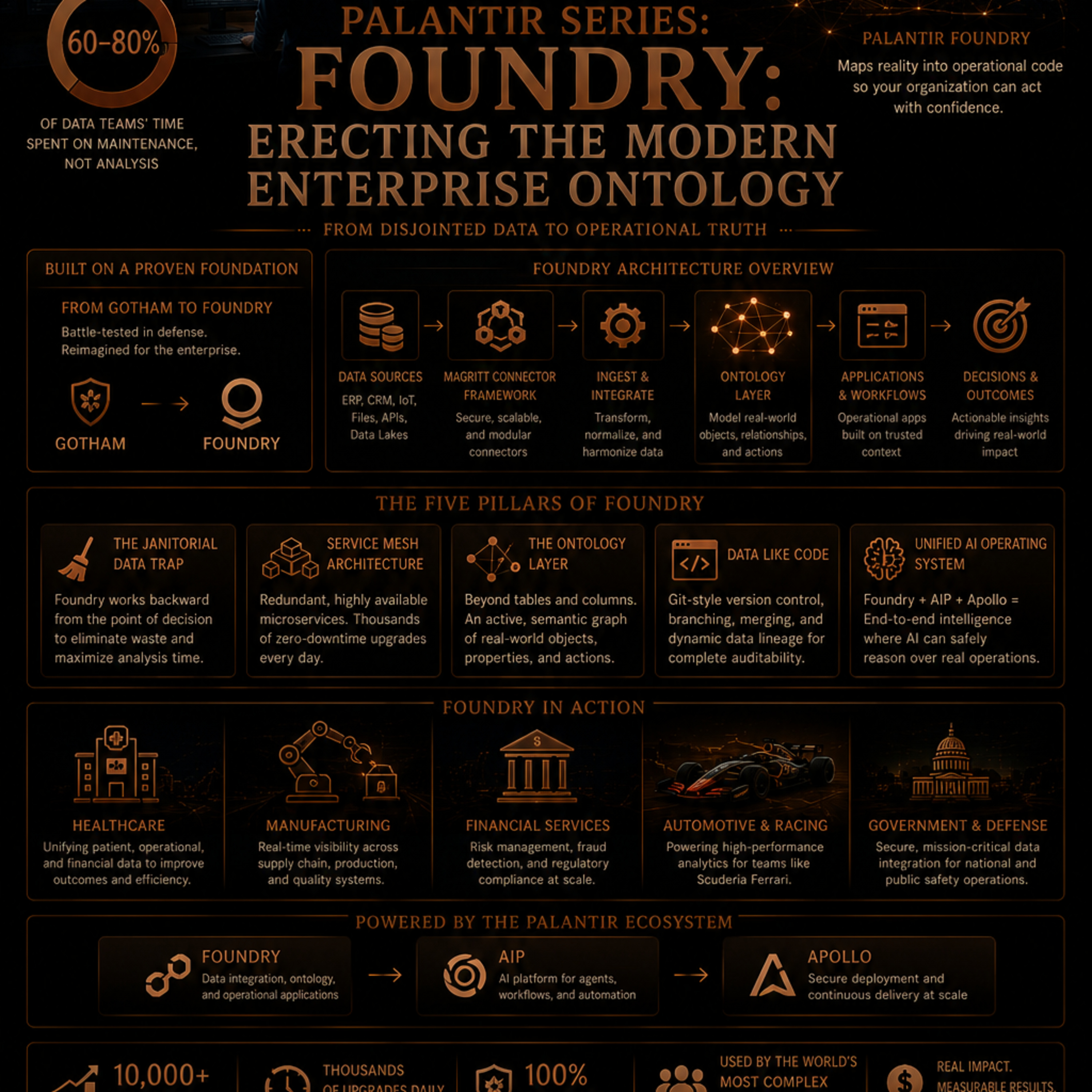
Your organization is likely drowning in more data than it has ever collected in its history. Yet, somehow, your teams are still forced to make critical calls based on gut feel, disconnected spreadsheets, and whoever can shout the loudest in the meeting room.According to industrial research, modern enterprises spend somewhere between 60% and 80% of their data teams' time just finding, cleaning, and manually reconciling disjointed pipelines, leaving barely any room for real analysis.In this deep dive of The Robert Joodat Podcast, we crack open Palantir Foundry. We trace its commercial roots back to its defense-grade predecessor, Gotham, and look closely at why its architectural philosophy is fundamentally distinct from typical cloud data lakes. From the Magritt Connector Framework to its signature Ontology layer, discover how the world’s most complex institutions, from massive hospitals to Formula 1 teams, are mapping their reality directly into operational code.Key Takeaways from this Episode:The Janitorial Data Trap: Why modern data teams spend the vast majority of their time on maintenance rather than actual analysis, and how Foundry works backward from the point of decision to close that gap.Deconstructing the Service Mesh: A look at Foundry's redundant, highly available microservices architecture that allows for thousands of zero-downtime upgrades every single day.What is the Ontology? Moving past tables and columns to explore an active, semantic graph of real-world objects, nouns, properties, and strictly governed action types.Treating Data Like Code: How Foundry brings Git-style version control, branching, merging, and dynamic data lineage directly to data pipelines.The Unified AI Operating System: How the integration of Foundry, AIP, and Apollo creates an end-to-end ecosystem where generative AI can safely query and reason over real business operations.
Embed this episode
NOW PLAYING
Palantir Series: Foundry: Erecting the Modern Enterprise Ontology 🛡️
No transcript for this episode yet
Similar Episodes
No similar episodes found.
Similar Podcasts
No similar podcasts found.