
Every episode of NPR's It's Been A Minute Podcast starts with a question about how culture shapes our lives. Are we spending too much on other people's weddings? Is social media bad for your mental health? We're here for your right to be curious.
One big question at a time. Follow It's Been A Minute wherever you get your podcasts. This is fresh air, I'm Tanya Mosley, and my guests today have each paid a profound price on opposite sides of a conflict that has lasted more than a century, with no signs of stopping. One is Israeli, the other is Palestinian.
They call themselves brothers. And what brought them together is grief, and a decision each of them made about what to do with it. Mao Zedinan's parents were murdered by Hamas on October 7, 2023, among the 1,200 Israelis killed that day, and the deadliest attack on Jewish people since the Holocaust. In the war that followed, more than 75,000 Palestinians were killed.
The U.S. helped arm and funded, and the violence has now spread into Lebanon and Iran. But within days of his parents' murder, Mao spoke. His family was not seeking revenge.
Instead, they were seeking peace. Those words reached Palestinian peacemaker Aziz Abu Sarah. Years before, when Aziz was only nine, his own brother had been arrested and tortured in an Israeli military prison for allegedly throwing stones at soldiers. He later died from his injuries, and Aziz says he recognized Moses' grief and decided to write him.
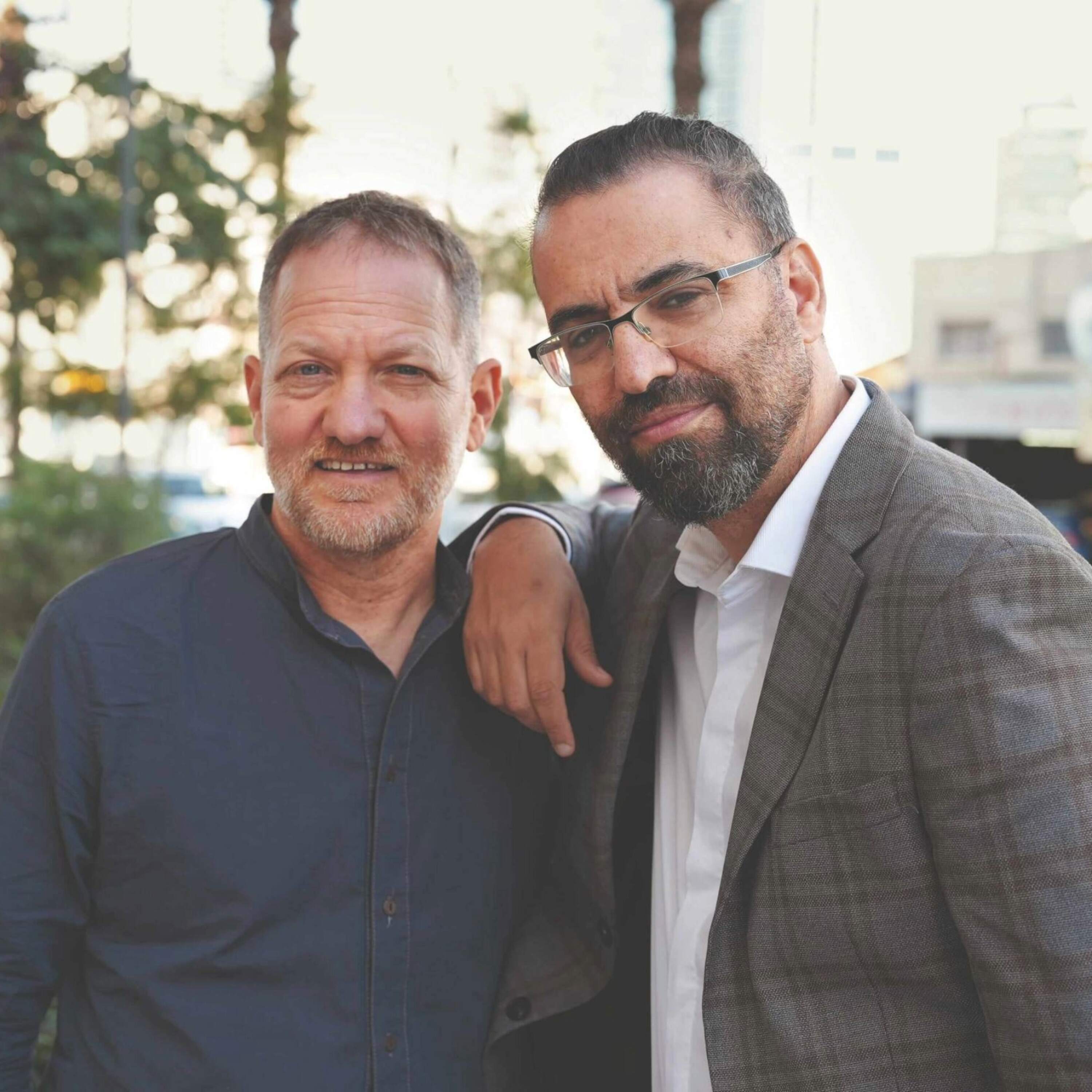
What grew between them has become a brotherhood, a TED talk seen by millions, and eventually a journey. Ten months into the war, the two of them got in a van together and drove for eight days across Israel and Palestine, through checkpoints, holy cities, refugee camps, and separation walls. They wrote everything down in a book called The Future Is Peace, a shared journey across the Holy Land. Mo's Inan and Aziz Abu Sarah, welcome to fresh air.
Hi, Tanya. It's great to be here with you. Thank you for having us. I first want to offer my condolences, mayo's on the death of your parents, and Aziz, the loss of your brother.
Thank you so much for sharing your stories with us and sharing your pain. Thank you. For us, sharing the pain is part of our personal healing process, and it's still been going on for Aziz for a few decades, and for many nearly three years, and here we are today. Well, let's spend a moment on what led you to each other.
The overwhelming response on October 7th has been rage and retaliation. Israeli cabinet members called for the total destruction of Gaza, and so mayo's the world would have accepted your rage. You lost your parents, and instead you called for peace. Why did you decide to send that as your first message out to the world?
First, it wasn't just my message, it was a family message. I agreed between my sisters, my young brother and myself, and we took it only two days after losing my parents. Every morning of the Shiva, the 7-day Jewish morning of the death of a loved one. And on the second morning, it was Monday morning, we were sitting, the five of us, early in the morning, and my young brother again asked us to make a decision, to take a family decision, that we are rejecting revenge.
And he explained us that by avenging the death of our parents, we are not going to bring them back to life. That's it, they are dead. And by avenging the death, we are only going to escalate the cycle of bloodshed, of pain, of suffering that we, Palestinian and Israel, has been trapped within for a century. And he told us that it is within our family mission and legacy, to continue the legacy of our beloved parents, Bill and Jacobi, that we must break this cycle and we must take an alternative path, a path to peace and a conciliation.
And we took the decision because we knew what's going to happen. We knew how the state of Israel is going to retaliate, and we knew the destruction is going to come to Gaza. But we also knew that this destruction is not going to bring the hostages back, it's not going to bring security or safety, and it's not going to take Hamas out of power. And unfortunately, we were accurate.
That was a tremendous decision to make, understanding all of the considerations that you just laid out here. And I want to ask you, Aziz, something, because, you know, most of us see or read about terrible things happening every day, and we might feel something, but ultimately we keep going about our lives. What made you decide to take the time to write MOS? I think you're right.
Most people see how horrible things are, and decide to go on because we feel we've been told this idea that there's nothing we can do. There is no influence we have and the world around us. And I know it from my own life. My brother was killed when I was a kid.
Nobody reached out to me then. I was 10 years old. No one reached out to me. And it took eight years of me, you know, living under occupation, having to pass checkpoints, being frisked at checkpoints.
I think first time I was shot at, I was seven or eight years old, and I was very angry as a kid. And then I went to study Hebrew in Ulpan, and my Hebrew teacher was Israeli Jewish woman, and it was the first time somebody reached out to me. It was the first time somebody was Israeli Jewish, who treated me truly like a human being, saw me as an equal. And so it stuck with me that I want to do the same.
People I can go and realize, one small action, one kind word, you never leave the person, you meet the same after you've interacted with them. And I wanted to do that for my own and for others. I love my own, but he wasn't the only person I sent this message to, because I didn't even know MOS at the point. I knew him, met him only once a few years earlier.
But the two of us realized we have so much in common, and most importantly, we have the same goal. MOS, do you remember how you felt reading that first message? Yes, very much, very clearly and vividly. And this message came to me after receiving something else the night before.
The night before I received a vision as I was crying in bed at night, and I was crying so much I'm crying very easily. So I was lying in bed crying, and my entire body suddenly was in pain that I never witnessed before. And through my tears, I could see the entire humanity crying with me. And our tears went down, our bodies and our tears healed the wounds, healed the burns.
And as our tears were washing our bodies and healing it, they started going down to earth. And the earth in my vision was soqueous blood we could not see grass, we could not see flowers or sand only blood. And then as we cried and cried, our tears start washing the blood away, purifying the land. And then I've seen a beautiful path on the beautiful land.
I could see the path of peace and reconciliation. And I realized that in order to heal myself from and save myself from drowning in an ocean of soil and pain, it was a metaphor. It was literally drowning in an ocean of soil and pain after receiving the horrible news that my both parents were in their life. And I made a decision that in order to heal myself, I must take this path.
And few hours after, I received a message from Aziz. And I immediately realized that I'm not the only one on this path. And now I can say I lost my parents and I lost many of my childhood friends and people who knew my entire life on October 7. But I also want Aziz.
I also want Aziz as a brother. We can't overstate the loss that you experienced. And Aziz, I mean, grief has a language that doesn't even need translation. You had been living with the death of your big brother to see her for many years by this moment.
He was taken by soldiers in the middle of the night for allegedly throwing stones at soldiers. Can you tell us what happened to him? Yes, he was Ramadan. We just got up to do the pre-fast meal.
And a group of soldiers founded on our doors came into my room, which I shared with my brother. And I actually shared a bed. They see her as nine years older than me. I'm the youngest.
And he's the one just older than me. And they took him for questioning with the allegation that he threw rocks. We didn't know where he was, what prison, what any information about him for quite a while until eventually we figured out that he was being interrogated and eventually confessed to the charges that were assigned to him. He refused to confess in the beginning.
And so he was tortured for quite a bit. And it caused significant damage to his health. He was released from a prison ten months later soon after we ended up taking him to a hospital. He ended up dying from his injuries in the hospital.
And it's like you say, there are no words that can describe it. Important to say, like I said, my brother is the only person I know who was killed. Our next door neighbor just died and being killed who was next to his best friend. Just before that, my dad's cousin was killed by settlers a few years after that and other friends and other family members as well.
And this is what we know. We tell people all the time, look, you might think this hasn't happened to me. So I don't have to go through this experience. I don't feel like you feel.
And we say, you think it's never going to happen to you until it does. Don't wait until something horrible happens to someone in your family to wake up and realize none of us are immune. And so it's very important that people realize every day we wait in dangerous all of us. You two have turned all of this understanding of grief into this journey, this book that chronicles eight days traveling across the land that made you both who you are.
There's this moment in the book where you all visit the gravesite of your grandmother, Moses. Is that right? And Aziz, you place a stone there. That's a Jewish tradition of remembrance for Palestinian to do that from my understanding on that land in the middle of this war.
It's kind of astounding. And I want to know what was moving through you in that moment. I don't think it was a sounding for me. I thought it was a normal thing to do.
I think you build this brotherhood and you get to know each other. And that's what Moses and I did. And you recognize each other. And when you start recognizing and caring for each other, this kind of action becomes normal because I think one of the most things we lack today, this is true in America, this is true in Israel and Palestine, is a bit more empathy.
It's a bit more recognition. It's a bit more kindness. It's a bit more, I want to show you and I want to respect you. I want to show you some respect.
And that's what I did. His grandma is that it is the right thing to use the Jewish tradition in me, you know, honoring my friend and his family. It didn't feel that I was, to me at least in the moment, it didn't feel that I was doing something incredible or something else. I mean, it felt I was doing what was right.
I think a lot of people listening will want to believe what you two represent is possible. But then there's probably also a thought, are you two just exceptional people with an extraordinary capacity for forgiveness? Are you all the exception and not the rule? What do you say to that?
We are being trapped in a slightly long conflict. We are now the fourth generation that are traumatized, that are in pain, that's suffering loss. And unfortunately, we are led by naive politicians that fall asleep and lying to us, that walls will bring us, will defend us, that wall will bring security and bombs will bring quiet. But this story proves again and again all the time throughout human civilization that it never walks.
The only way to achieve security and safety is through dialogue, through negotiation, by building trust, by working together. But there are many like us Israelis and Palestinians. And as these 20 years ago was the co-chairman of the parent's circle family from a group of Palestinian Israelis, families that suffered loss through the conflict. And it's more than 800 families now.
And there is the growing demand, the growing momentum to achieve a lasting peace. We are not willing to compromise for a ceasefire or to prepare for the next wall. No, we are preventing the next wall. And we are happy to talk to everyone.
And we think the future is peace is one of the tools to raise those messages and to break them to the public. Now, we're not claiming we are the majority. People can see polls and they know we are not necessarily the majority right now. But not being the majority doesn't mean you give up because at no point, almost in any conflict, in any war, in any atrocities that happened in the world, we're the majority of people usually on the side, on our side, on the side of solution.
And eventually, those places found a way to peace. And so we create that model. We say, look, the two of us. We have every reason to hate each other.
People would assume the natural order of things is that we are enemies, and yet we are not. Not only we are not, we see each other as family, as brothers. Then everybody else can. Then it is a possibility.
And let's imagine that reality together, where every Israeli, every Palestinian in the future is an equal person, lives in a reality of equality. Regardless of what solution we have to say to one state, a confederation, equality is something important. And if we can do it among ourselves, if we can show each other dignity, if we can model forgiveness, then we can definitely inspire those around us to believe in this way. And we know that everyone is there yet, but that's exactly why this work is even more needed today.
So peace is the grounding of this book, but the book is honest that peace for you has to also come with accountability. You write that as far as you were concerned, Hamas and the Israeli government are two sides of the same coin, both are accountable for your parents' deaths. Take me inside that belief. So I was born and raised in Kibbutzniram.
It's about a mile away from Gaza. My father was born in Kibbutz, my grandparents established it at the beginning of 1941. They were both immigrants from Eastern Europe, Besserabia, filling the earth, start checking Binnistan, as the Nazi regime was gaining more and more power. And they were within the Zionist movement, of course, and together with my parents, my mum, grandparents, they both, from my both sides, they established two Kibbutz in the Negev, maybe 10 miles away from each other, and that's the community where I was born and raised.
And we will always learn to believe that there is going to be another war, but the next war will be the last war that will gain us with security and safety. And there is always another war, and I remember there was another cycle of violence in 2021, and again, the Israeli government in general promised us that Hamas got no tunnels anymore, and that his military power is destroyed, and they are retired, and security and safety was brought to the Gaza envelope communities. And me and my family and unfortunately my parents knew we were full to be lived in this promise. So when October 7th happened, I wasn't surprised, because Hamas on this day, Hamas was doing exactly what was written in his chatel to destroy, to kill, and to fight with Israel.
And it was the Israeli government that be played in my family in our communities, and I was raged. I wanted to punish the Israeli government, I want them to pay the price for the way they betrayed my parents and my friends, and I wanted to do everything I can in order to take them down. I started a protest only a month after October 7th, with another Israeli-believed father, Ula Sizan, also an October 7th opposite of the Knesset in Jerusalem, and we called everyone to come and join us to take this government out of the office, out of power. And one afternoon I shared with my family, close family and three friends, how I'm literally going to act in order to take the government down.
And they told me, it's a good plan, but you might go down with them. So we need you to create hope, and they taught me that I can choose forgiveness. I can choose forgiveness in order to save myself from the feelings of revenge, because revenge is not feeling the whole in your body that was created when I lost my parents and friends. Revenge will only make this all bigger and bigger, and then I realize it will become big enough to be my grave.
Our guest today are Palestinian Peace Activists Aziz Abu Surah, an Israeli entrepreneur and peace activist Maus Enon. Their new book is The Future Is Peace. We'll be right back after a short break. I'm Tanya Mosley, and this is fresh air.
One of the things that I was really astounded by were the education gaps, the information gaps that both of you had. Growing up in such close proximity to each other, Maus growing up near the Gaza border, there were enormous gaps in what you knew about Palestinian history. When did you start to understand what you had not been taught? I traveled a lot, and I traveled twice around the world visiting Australia, New Zealand, Asia, South America.
And I learned so much about indigenous community, about their lifestyle, heritage, culture, fate. And then in the summer of 2004, traveling in South America, and I said, we know nothing about the Palestinians. And between the Jordan River and the Mediterranean Sea, there are 7 million Palestinians and 7 million Jews, 14 million. So I learned that we lived all our life within total ignorance of the other of the Palestinians.
And realizing that when there is ignorance, there is fear. And when there is fear, there is hate. And when there is hate, unfortunately, mankind, humanity can do horrible things to each other. So traveling in South America, we say to ourselves, no, make my wife and I, why not building bridges and use tourism as a way for dialogue, for interaction, for creating a shared vision between Israelis and Palestinians.
And then that's why in 2005, when I was 30, I went for the first time to Nazareth, the city of pronunciation, the largest Palestinian city within Israel. But we've never been there before, and we just fell in love. It was love from first sight. And few months after, we opened the first guest house to have her in the old city of Nazareth, who was the first pioneering tourism enterprise that paved the way to many local entrepreneurs.
So in the last 20 years, I've been involved in learning and being educated about the Palestinian narratives, about the Palestinian struggle, pain, suffering, and recognizing the Palestinian suffering, it doesn't mean that I'm erasing my own people suffering, but I recognize and acknowledge that there is another narrative on the land. Right. And I think if you're an Israeli Jew, you don't meet any Palestinian in class, in schools. If you're a Palestinian, you don't meet any Jewish kids in classroom.
There are only a few schools that are joined in the whole country. This is how little kids know about each other. So you grow up only learning your own language with people who, you know, the same as you. And so that division is normal.
And when I grow up, obviously in our school, I can tell you we learn more about Europe than we learned about our own history. We learned about more medieval and what you call it, the nation states in Europe. But I knew nothing about the Holocaust because I think for many Palestinians, learning about the Holocaust is a scary thing. If you learn about the Holocaust, does that justify the Nakba?
Does that us accepting what Israel has done to us in 1948? And so I didn't learn about it. My family never learned about it. And I took a decision to go to Yad Vashem to the memorial, the Holocaust memorial when I went to study Hebrew, because I felt I was actually my teacher helped me into that decision, said, if you want to really learn what Israelis think and their way of thinking and the trauma that every Israeli has, you have to go to the Holocaust memorial.
And so I did that. And I was only Palestinian. I knew at the time who did it. This is back in the late 90s.
And it was scary. I got there. And I remember seeing soldiers because every Israeli soldiers go to the Holocaust memorial. And I almost turned around.
I was like, they don't want me to be here. They're probably looking at me. They probably know I'm Arab and they're probably judging me. But eventually I decided to do it.
And I went in. And a few minutes after, you forget you, Palestinian, you forget, not that you forget who you are, but you forget this is about us versus them. And so that's I think what all of us have to go through. And my dad, when I started doing peace work, I invited my dad to an event when I was at the parent circle, the bereaved family forum.
And he came to an event, his first peace event, and his first question in front of hundreds of people was about the Holocaust. And it wasn't, you know, oh, I want to learn. It was like, did the Holocaust tap it? Or is it, you know, because Israel keeps justifying its actions against us using the Holocaust?
And it was a very hard question. Nobody wanted to answer it. People, you can look at people's faces like, oh, I can't believe he asked that question. And it was one of those moments you kind of, everybody is going like, how are we going to deal with this?
And eventually one of the members of the parent circle whose father was in Auschwitz, Ramen Hanan, he stood up and he told my dad, he said, look, I don't expect you to believe in something you've never learned. This is absurd. So I want you to learn about the Holocaust. Can my dad, a Holocaust survivor, take you to Yad Vashem?
And my dad said, yes, and suddenly 70 other Palestinians in the room said, we want to go to. And so they went. It was not easy. It was extremely hard.
They had tons of questions, questions that sometimes would be considered offensive. But it was important to talk about those questions because if you don't, then you're not having real dialogue. And after the Israelis who saw us doing that said, we want to come and learn about your narrative. Can you take us to a Palestinian village from 1948?
Tell us what happened from your story. And it wasn't to compete. It wasn't to compare because we need to learn each other narrative. We are so ignorant about what happened to the other.
Let's take a short break. My guests are Aziz Abu Surah and Mawuz Inan. Their new book is called The Future is Peace, a shared journey across the Holy Land. We'll be right back.
This is fresh air. I want to take a moment here because I want to talk about why this conflict is so intractable. And we have to go back to 1948, which you write about in great detail in the book. May 15th of that year is Israel's Independence Day.
And Aziz, I think it would be good for you maybe to talk briefly about what that date actually means for Palestinians. Yeah, 1948, May 1948 is a catastrophe for Palestinians. It's the date where we lost our homeland. It's the date where we 750,000 Palestinians became refugees, some in Lebanon, some in Egypt, some in the West Bank, some in Jordan, all over the world.
It's a day that we still commemorate as the saddest day of our history. And only few thousands were left there after 1948. Everyone was pushed into the boats and ended up through the sea going to Gaza. So many of the people who are suffering in Gaza today are originally refugees from Jaffa.
So yeah, there are no words that can describe it, but important to also say that my family didn't end up being refugees in 1948, but they became refugees in 1967. And that's another one of those catastrophes. Half of my family live in Jordan. My uncle lives in Jordan.
I have cousins. I barely knew growing up because I enjoyed. And my dad, half of his cousins family, ended up in Jordan were not allowed to come back home to Jerusalem after the war in 1967. So it's one after another.
We've gone through this already. Moza, I have a question. You know, Tel Aviv was the heart of the Zionist movement and your grandparents helped build it. And for them, it was about saving lives.
It was a refuge for Jewish people fleeing persecution. But today, many people, including some Israelis, look at the settlements, the conditions in Gaza and argue that Zionism has produced its own form of displacement and suffering. And so I just wonder how do you reconcile that origin with what the world is watching right now? What I realized is we cannot bring justice into the past.
We can recognize it. We can acknowledgement. But there is no way to make it just past. There is no justification for losing his brother, for the 10,000s of Palestinians being killed in Gaza.
There are also hundreds of Palestinians being killed in the West Bank, just in the last since October 7th. For the atrocious happening in Lebanon, in Iran, we cannot justify it. But we can create a just future. And we do need to learn our narratives and sometimes to confess to our self-at-list that what we were born and raised upon wasn't the most accurate story.
And this is, I remember from my primary school classroom that there was a big sign on the board with the Jewish people without land, came to a land with no people. This is the Zionist narrative I was born and raised upon. But we're sharing the first or second map in the book. We opened the book with six maps.
That in 1948, between the Jordan River and the Mediterranean Sea, there were 1.4 million Palestinians and 600,000 Jews. But even nowadays, some Israelis will speak to them and they will tell you, Jewish Israelis will tell you, there is no such a thing as Palestinian people. So instead of arguing with them, instead of debating, we are here to win lives. We are here to work together.
We are here to create a just future. As ease, you use the word genocide to describe what's happening in Gaza. But a lot of people, and many Israelis reject that framing entirely. So how do you two stay as peacemakers in the same conversation with people when you cannot agree on what to call what's happening?
So I'll just start with saying, I talk to everybody. Whether you think it's a genocide, you don't think it's a genocide, you think it's war crimes, you think it's terrible, you think I'll talk to everyone. And what I want is, even if you don't think it's a genocide, if you just think it's war crimes, if you just think it's bad actions, atrocities, mistakes, whatever you want to call it, that you want it to stop. That to me is what matters.
And that you don't force me to say whatever language you want me to say. That both of us can use different languages. I don't want somebody to say certain words, genocide just because to please me. And I don't want them to tell me what I can and what I cannot say.
And I think that's healthy. That's good. That's how dialogue happens. We're sharing different perspectives, how each sees what's happening.
And it's fine if you disagree. But if you're not going to talk to somebody because you don't agree at all with terminologies, with how we see the reality, then nothing is going to change. I also wonder, I mean, do you believe that multiple histories can be true at the same time that the Jewish people need a homeland after the Holocaust and that the Palestinian has had the experience of dispossession? And if both are true, what does that demand of us?
First, I don't believe, I know that there are more than one truth on the land. And what is needed from us, and this is, I think, the biggest compromise. Both people on the land and also in the diaspora, the Palestinian and Jewish in the diaspora, the biggest compromise will be to acknowledge that there are two people living on the land. Two people that call this land my homeland.
And they are both connected through their history, through their legacies, through their religion and culture. They are connected deeply and profoundly to the land. And when we'll recognize and acknowledge that, the following steps will be much easier. I remember I told Mao's story yesterday where we had a tour and this tour had this group who came and they ready to argue about 1948.
And they had an Israeli and a Palestinian tour guide with them and they kept asking our Palestinian tour guide. But you guys did this and you guys did this and you guys did this. And she was trying to first answer factually from her knowledge and give them stories and try to show them the Palestinian narrative. And she told me that she was like, after about an hour, I realized there's nothing I could share about the past that would change their mind, nothing.
And so at some point, I just looked at them and said, you are right, every problem in history is caused by Palestinians. Fine, we were wrong all along. So what do we do now? And she said, none of them could answer because they were so focused on the past, they cannot see the future anymore.
I think there are some justices that can be done to the past, they can bring somebody back to life, but there are things that can be done to improve the lives of those who've gone through so much horrible realities and the refugees or the families of people in Gaza. You know, there's a lot we have responsibility of doing for them. But in the same time, we also cannot only live in the past. You just said something really interesting.
We said, we may disagree that you can go back and write the wrongs of the past, which made me curious how the two of you had conflicts with each other or disagreements about what's true and what's needed and how did you work through it? We mostly, the argument was about the music we listened to while doing our journey. But that was the biggest argument we had so far. Myose has a terrible taste of music.
I have a very good American taste of music. I'm a big fan of country music. Western country music is my favorite thing in the world. Yeah.
What was on your playlist driving through the land? Well, for me, it's everything from Johnny Cash, to Brad Paisley, to Tim McGraw, to Miranda Lambert, to all these country music singers. Myose was putting Fela Kuti, the Nigerian musician and founder of the Africa Beat. Very different.
Our taste of music is very different. Look, the reason we might have different histories and we might not fully agree on the histories, but it never turned into an argument. I'll give you an example. We've had this discussion before about justice.
Can't justice be applied to the past or not? That was a discussion. It wasn't an argument. And both of us can change our mind about, okay, I'm learning from what Myose is saying and he's learning from what I'm saying and we go back and forth.
And if we don't agree on it, then we don't agree on it. I think if you suddenly say you either agree with me on everything or I'm not going to talk to you, I don't think I'll have any friends. Yeah, thank you, Aziz, for bringing justice to the interview because I think in the first year of our shared walk, Aziz would say, I'm supporting the values of the future. It would say justice and I don't know about justice.
So you can say it, but I'm not going to say it. And I was born in the most secular Jewish community and Jewish family that can be. There was no synagogue, ethnicity in our keyboards. I never prayed.
But in the last two years, I also learned a lot about Judaism. And what I learned is that there are only two orders in Judaism from the six orders that we are commandant to follow, including the Shabbat and Koshel food and prayers, only two orders that Judaism command us to pursue justice and peace. And after learning that, now I can also say that I do believe in justice before that I could not. But now I definitely believe that we can and should and will create a just peace and we will all live within justice.
Let's take a short break. My guests are Aziz Abu Surah and Mawuz Inan. Their new book is called The Future is Peace, a shared journey across the Holy Land. We'll be right back.
This is fresh air. President Trump has established what he's calling a Board of Peace for Gaza and are either of you part of that. No, we are not. And I can tell you from a Palestinian side, no Palestinians are on the Board of Peace, which is interesting how you can have peace without including one of the parties.
But I think the idea of having a Board of Peace is wonderful. But who's on the table is very important. You can't have peace without bringing the stakeholders. And even the worst among the stakeholders, you can't have peace without the Israeli government.
You can't have peace without the Palestinian government, which I'm not a fan of either. You can't have peace without Hamas being on the table without the Iranians being at the table. I think we should be willing to bring everyone there. That's the only way to have peace.
And we need to push our governments to make that change. Why aren't you meeting with peace makers? President Trump, by the way, invited Israelis, victims of violence from October 7th. He then invited the peace makers, the same with President Biden.
And this is where we need Americans to support us. We need you to push for our voices to be heard. Why do you think peace makers are not brought to the table or seen as kind of incidental or a side project? I think people think we are naive and we don't get it, which is not true.
We are not naive. We are the realist. I'll give you an example. If you meet somebody who works on research for cancer and they tell, yeah, I'm working on research, you're finding a vaccine for cancer and you say, oh, well, you haven't been successful.
Therefore, we're not going to talk to you. We're not going to celebrate those kinds of people who are trying to make that change. We interview them, we platform them, we support them, they have money for research until recently with the current administration. But war is an illness, is an illness to humanity.
And if we view it this way, then people will be platforming the peace makers because we are the same as somebody who's trying to find a vaccine for other illness. That's exactly what we're doing. And the moment we all realize that and we start bringing more women to the table, you know, there are no, almost no women at the board for peace, even though research shows peace without women fails. There are no peace makers in it.
The moment you bring those people, you bring peace makers and you bring women, you will see change. You all heard, just last week, our President Trump threatened to bomb Iran back to the Stone Ages before a ceasefire was reached right before that deadline. And you've said throughout our entire conversation that these wars must end, Gaza, Iran, all of it. As someone who lives here in the United States, I mean, my question is, well, what happens if they don't?
I know you can't live in that world because you're peace makers, but it's also a reality that you contend with. I've been working in peace building for years. I've worked in Syria, worked in Afghanistan, worked in many conflicts around the world. And one of the things I learned, every war usually prepares away for the ones after it.
And the Iraq war have given us so many other conflicts in the region. It came with a promise that if Saddam Hussein falls, then we can have democracy all over the Middle East. No one saw that happen. I didn't see democracy happen.
I see Afghanistan where I spent a lot of time there. We back to having Taliban. And I look at the promises around Iran. I'm like, how can we believe the same lies again again?
And this is not because I'm a fan of the regime there. I think it's a horrible regime. But change doesn't happen. Sustainable change doesn't happen through bombs.
We create a world that believes that violence is away. And if you have the power, then you go on and do it. You don't need allies. You don't need an international law.
You don't need to listen to anyone. You just can't do it. And this is not the world we want to live in. We need to remember hope is a form of resistance.
Believing that we can make a change is a form of resistance. But the moment you give in to that despair and say, my voice doesn't matter, that's what those who believe in bombs want you to believe. It's that, you know, your voice doesn't matter. But ours does.
And one of my favorite poems is from Semihal Qasun. And in it, he says, even when I'm killed, I'm not leaving my hope, that I'm still not giving into despair. And it's kind of a crazy sentiment. Maybe that's one of the most powerful.
And the poem is called Travel Tickets, where he said, the day I'm killed, my killer rifling through my pockets will find travel tickets. One to peace, one to the fields and the rain, and one to the conscience of a humankind. So I beg you, my dear killer, don't ignore them. Don't waste such a thing.
But they can use the tickets. Please, I beg you to go traveling. And this is our hope of everyone who reads the book is that you take those tickets and you act upon it. You can do something.
We can't be silent and let somebody else use our voices. Aziz, Abu Surah, and Maus Inan. Thank you so much. Thank you.
Thank you. Thank you. My guest today, Aziz, Abu Surah, and Maus Inan. Their new book is called The Future is Peace.
Fresher is executive producer, Sam Bregar. Our technical director and engineer is Audrey Bentham. Our interviews and reviews are produced and edited by Phyllis Myers, Roberta Shorok, Anne Marie Baldonato, Lauren Krenzel, Theresa Madden, Monique Nazarith, Susan Yucundi, Anna Bauman, and Nico Gonzalez Whistler. Our digital media producer is Molly C.
B. Neser. They are a challenger directed today's show. With Terry Gross, I'm Tanya Mosley.