
EPISODE · Aug 26, 2025 · 22 MIN
Paper trails and memory: Exploring Central Asia’s archives
from CAPS Unlock Podcast · host Peter Leonard
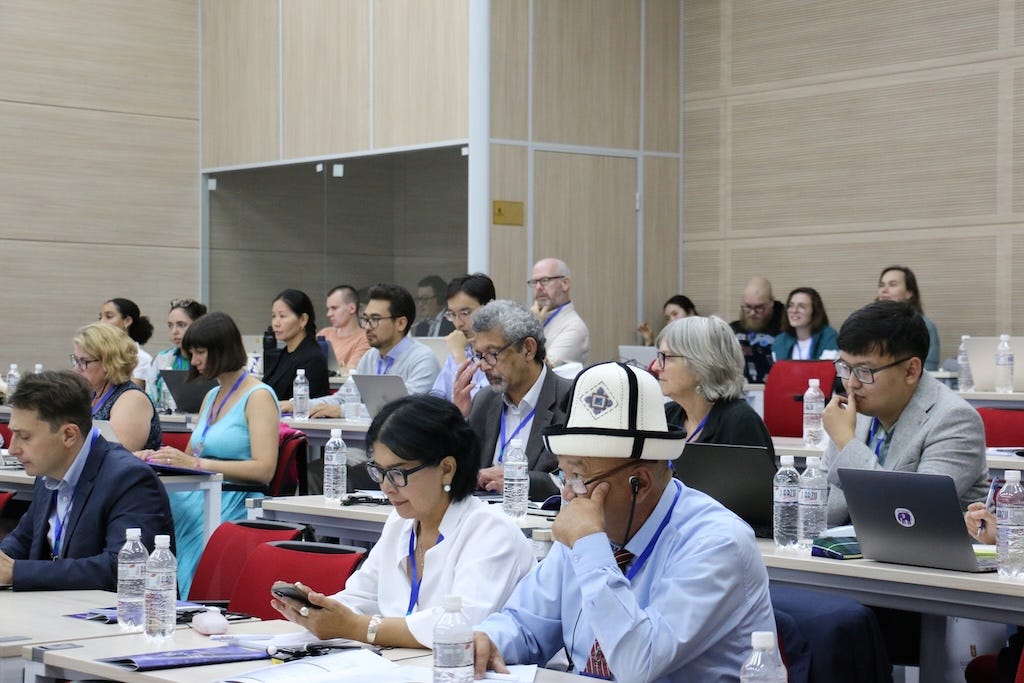
In this episode of the CAPS Unlock podcast we temporarily step away from our usual format for the first in a short series recorded on the sidelines of the international conference, Toward New Transnational/Transimperial Histories of Central Asia: Sources, Directions, Interpretations, which took place at Nazarbayev University in Astana, Kazakhstan, on August 20–22.We speak to Roman Osharov, a DPhil candidate at the University of Oxford whose work examines how the Russian Empire produced knowledge about Central Asia in the nineteenth century; Daniel Scarborough, Associate Professor of Russian History and Religion at Nazarbayev University; and Gavin Slade, Associate Professor of Sociology at Nazarbayev University and co-lead of the Central Asia’s Gulag project.The conversation centred on the nuts and bolts of doing history from the archives. We discuss how access varies across the region; the relative ease of Kazakhstan (with longer lead times and embassy paperwork), the difficulty and unpredictability of Uzbekistan’s main historical archive in Tashkent, and the near-impossibility of working in Turkmenistan, and why professional conduct in reading rooms matters for everyone’s access. Our guests offer pragmatic advice for younger researchers: start with national libraries and home-institution holdings; learn (and use) non-Russian languages where possible; and plan for multi-month stints once you do enter archives.We also look beyond the archive. Slade explained how archaeological survey, mapping, museum studies, and oral history can “triangulate” fragmentary files on sites like Karlag (one of the largest Gulag labour camp systems in the Soviet Union, located in central Kazakhstan) yielding grounded insights into camp layouts, daily labour, and living memory in former Gulag villages. Scarborough reflects on the dominance of Russian-language materials and ways to recover Central Asian voices; Osharov describes manuscript collections and periodicals in Persian and Turkic that can rebalance the record, and the challenge of doing so while working within “Russian history” as a field.We close on the state of play: a moment of opportunity in Kazakhstan (and, to a degree, Kyrgyzstan), tempered by fragility elsewhere, and a gentle plea to researchers not to jeopardise that access.Stay tuned for more conversations from the Toward New Transnational/Transimperial Histories of Central Asia conference in coming episodes. Get full access to Havli - A Central Asia Substack at havli.substack.com/subscribe
Embed this episode
Ready to play
Paper trails and memory: Exploring Central Asia’s archives
No transcript for this episode yet
Similar Episodes
No similar episodes found.
Similar Podcasts
No similar podcasts found.