
EPISODE · Feb 11, 2026 · 20 MIN
Parallel Revolutions: The Shared Evolution of Bitcoin and EVs
from eMotors: Electric Revolution · host eMotors Electric Revolution
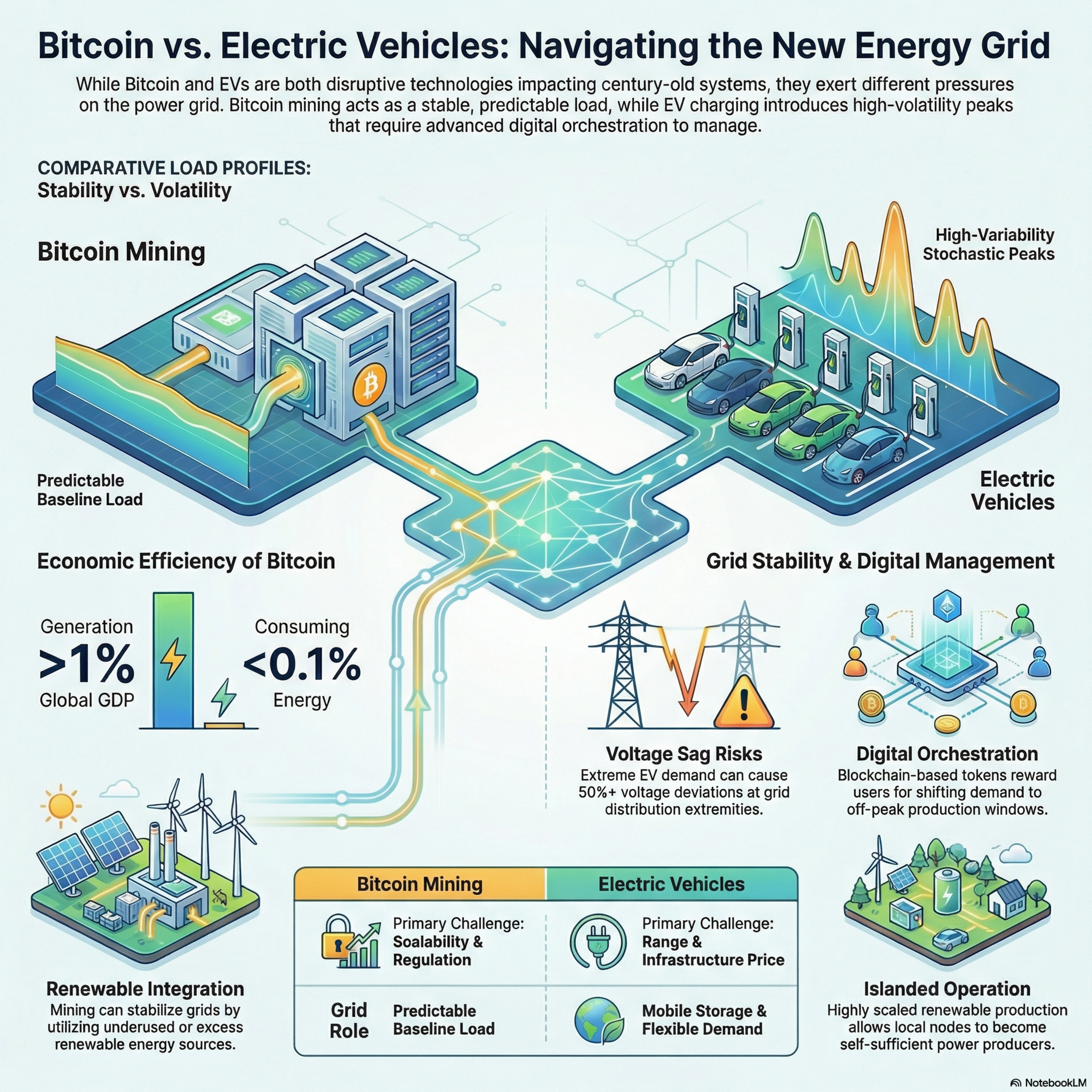
These disruptive technologies—primarily Bitcoin mining, Electric Vehicles (EVs), and Blockchain—challenge established global status quos by dismantling centralized models of finance, energy distribution, and economic development.1. Challenging Financial and Monetary AuthorityBitcoin acts as a revolutionary technology that reshapes the understanding of money by operating on a peer-to-peer network free from government control or central authority. It directly challenges the status quo of central banks and fiat currencies. Unlike traditional economic structures that often leave specific regions behind, Bitcoin's decentralized nature allows anyone, anywhere, to participate in the network, potentially leading to a more equitable economic system.2. Transitioning from Centralized to Distributed EnergyThe global power landscape is shifting from a 1960s-era centralized architecture of predictable demand and fossil-fuel reliance to a decentralized, multidirectional distribution paradigm.• The Rise of the "Prosumer": As the grid becomes digital, the lines between "utility" and "customer" blur. Individuals are transitioning from mere ratepayers to becoming their own utility companies, using EVs as mobile batteries and legacy heaters as digital assets optimized by IoT.• Energy Autonomy: High-production renewable scenarios allow local nodes to "break away" from central dependence, achieving "Islanded Operation" where neighborhoods function as independent energy ecosystems.• Tokenization of Energy: Blockchain enables the "tokenization" of energy savings and peer-to-peer (P2P) trading, bypassing traditional utility intermediaries to reward behavioral efficiency directly.3. Redefining Industrial and Environmental StandardsDisruptive technologies like EVs challenge the century-old dominance of the internal combustion engine and the petroleum industry. While both Bitcoin and EVs face scrutiny for their energy use, they challenge the "hypocrisy" of traditional industrial standards. For example, Bitcoin mining is often vilified for its energy consumption, yet it can act as a catalyst for renewable energy by providing a steady demand for underutilized or "wasted" power from wind, solar, and hydro sources.4. Reshaping Grid Stability and Load ManagementThe integration of these technologies forces a move away from quantifying "total demand" to analyzing "Behavioral Profiles".• Bitcoin as a Stability Anchor: Contrary to public perception, technical analysis reveals Bitcoin mining can be a "low-variation" anchor for the grid. Because it operates with a consistent 24-hour energy pattern, it provides a predictable baseline that helps operators manage the high-variability spikes and "voltage swings" caused by EV charging.• Incentivizing Flexibility: Blockchain-based "Pay-for-Performance" (P4P) systems challenge traditional billing by aligning consumer behavior with real-time grid capacity, rewarding users for shifting demand during peak periods.5. Socioeconomic Revitalization of Underserved CommunitiesBitcoin mining challenges the spatial status quo of economic opportunity by bringing investment and employment to abandoned or rural areas. Examples include the revitalization of Rockdale, Texas, and the use of excess hydroelectricity in Quebec, Canada, to lower local electricity costs. This decentralization allows communities with abundant natural resources but limited infrastructure to tap into global wealth independently.
Embed this episode
NOW PLAYING
Parallel Revolutions: The Shared Evolution of Bitcoin and EVs
No transcript for this episode yet
Similar Episodes
No similar episodes found.
Similar Podcasts
No similar podcasts found.