Thank you. Shalom and welcome to another edition of Parsha Talk. I'm Rabbi Elian Malamit. We can't forget them. We can never forget them, even though it almost seems like things are moving on without them. But they're still with us. That really is true. When we cross the year, and when they killed Sinoir, you know, you thought that maybe...
He thought that maybe a deal was going to come, but that's certainly not how it came down. Look, it's also hard to sustain this because it's just so much anguish. But we are thinking of them and we pray for them. We pray for them every day in our services and every Shabbat, every time we have the Torah, we have our special prayers and we're praying for them. Also, we're praying for lots and lots of bereaved families over the last two weeks too. Soldiers, young, beautiful soldiers who have been killed, ambushes and other kinds of operations to their families. Only comfort, but it's an anguish, an anguish that we're all going through and that we share even here. And we share it and we try and express through Torah.
the comfort and to try and get insights if we're successful on some weeks, more or less, we try at the very, very least. This week we're reading Parsha Noach. Noach is all about trying to bring comfort to the world. That's how he's introduced this one. You have to point out that he's misnamed. He's misnamed. He should have been Nachum. Right. So we know the story of Noach, generally. And we've done different aspects of the story over the course of these years that we're doing the Parsha Talk. And we don't have to...
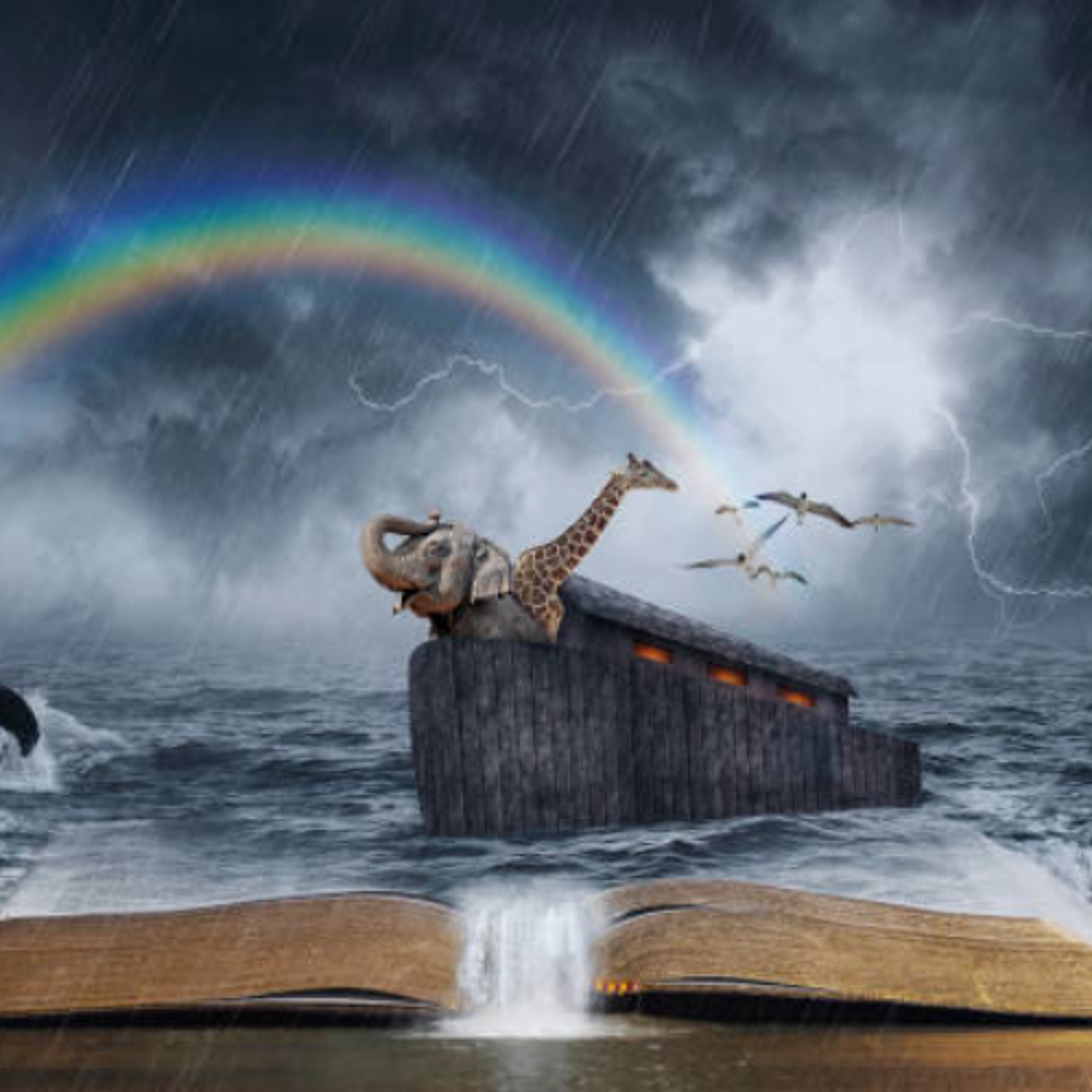
kind of rehash this. God is disappointed and God wants to destroy the world. And the world gets destroyed through a big flood. I want to focus with the two of you on what happens just afterwards. When Noah comes out of the ark, and you get the feeling that he can breathe. There is this kind of, the ark is open and the animals and everything kind of will dissipate and there's the sense that things can begin again. I just want to stop you for a moment because
you know we read these stories most of us i think with one or two senses and the one sense seeing and hearing and the one sense that we almost never have is no no and you have to imagine that The world did not smell particularly good. In the ark. And that, I think, when we get to the sacrifice with the Reach Nichoach, that's what gives it its pungency. Interesting. Okay, so we're going to get to that. There's a pungency there. All right, so Noah builds an ark, builds an ark, builds an altar. Interesting that I made that slip, but that's, you know, instead of an ark, he builds an altar. Then it says, He selects, he selects from all the pure animals, from all the pure birds. He sacrifices burnt offerings on the Mizbeach.
we recall the technical aspect of a burnt offering is that it's an animal that's offered completely. It's completely burnt, which means that you don't get to eat any of it. And it's an ola, all right? So I want to stop there and just kind of freeze this frame where Noah is selecting, well, it doesn't tell us how many. Abenezra says there are 10 animals. It's really irrelevant, but it's a selection of animals. It's almost like it's a mixed grill, mixed grill of sacrifices to God. But the thing that it reminds me of first is Sukkot, because on Sukkot,
As I'm glancing here at the book of Numbers, chapter 28, it's lambs, rams, bulls, and goats, which are all pure animals. And so there's selection. And the main theme of all of those sacrifices on Sukkot was universality, humanity, that the total number of animals brought to the altar in the temple on the holiday of Sukkot was 70, 70 corresponds to 70 nations. And not that Noah here is sacrificing 70 animals, but it's almost like a kind of hint that I represent humanity and I'm offering to you. a kind of expression of humanity and i want to say i i don't know what the purpose is other than to say either he's saying thank you for saving me or he's saying maybe i'm i i'm in need of some kind of you know new start uh and it's after that that god makes a declaration to himself okay so i'm inclined to interpret this as this is a symbolic moment where where noah is eliciting a divine response and the divine response is not issued to noah himself
The divine response is issued to God. And you can weigh in on this at any moment, which is said, like, maybe Noah's not worthy of a divine response, but here's the response, and I'll get you to react to it. So God says, as the text says, he inhales this, which doesn't mean that he inhales it. You know, this is very anthropomorphic language about God. I think President Clinton understood that. I think I was going to say that too. God inhaled the pleasing odor and said to himself, he says to his heart,
Another anthropomorphism. I'm never going to do it again. I'm not going to doom the earth because of man. Since the devisings of man's mind are evil from his youth, nor will I ever again destroy every living being as I have done. So we have to really kind of unlock that text and try and understand what it is that the Torah is saying that God is saying to himself. And the fact that God is saying it to himself and not saying it to Noah is interesting. The fact that the writer here is reporting this, of course, is an example of dramatic irony.
What is God saying? And so I'm going to say something and have you react, which is that God is making a declaration, and this is a declaration, and it may not wear well on God, but now you react. But just read 22 as well, because the declaration continues. Of course, okay, I'm sorry, that's good, thank you. So long as the earth endure, sea time and harvest, cold and heat, summer and winter, day and night shall not cease, which is, of course, a pledge that I'm never going to destroy the world again. I'm going to keep the normal systems.
of the seasons in their place and and that the world will go on the way i intended it to go on so i'm saying that that you know god has realized that that human beings are this way and that there's nothing that god can do to change that and that god now has come to terms with that that seems to limit god in the way that i don't know that i'm entirely comfortable i want to offer a slightly different reading when it says that you understood that libo was the heart of god But we can also read it as being the heart of Noah, that it was not a verbal declaration, but somehow it pierced Noah's heart to impress upon him the gravity of God's words, that the destruction was over. And, you know, while he's leaping through to get to the verses that you had mentioned, you know, at some point, I think in the beginning of chapter eight, we come across a phrase, that God remembered Noah, and that will set in motion the abatement of the water so that Noah and his family and the animals can lead the ark. And what struck me, as I've been struck mostly this year in considering the Parsha, is Noah is mostly a passive figure.
He does not interact with any people that we're aware of, and he does not interact with the other people in the world, including his relatives, his grandfather, Mithushelach, at least according to the rabbis, dies in the flood because he dies the same year as the flood. And the sacrifice that Noah offers is one of his first actions in his life. other than to build the ark into father children. And it strikes me that the significance of the sacrifice is that Noah understands that God is not a dictator, not in the sense of dictating, but God is a listener, as it were, someone that needs human beings to approach so that God can respond. And I think that God's hope always...
at least today, remain committed to a hopeful God, is that human beings will change. They are bad from their youth, that's said more than once, but the expectation is that they will live into adulthood and perhaps can change their ways as adults. Jeremy? I would say a couple of observations. One is really not, you know, so relevant to the deep things we're talking about now, just an observation that the concept of behematahora, a pure animal, by which we presumably mean those animals which will later be designated as kosher animals, it's like you know, in my own religious life as a Jew, I feel like the rules of Kashrut are kind of arbitrary. Like, you could imagine some alternate, you know, set of rules, but this passage cannot imagine an alternate set of rules. There's a behematahora and an of tahor. There are kosher, there are pure land animals and pure birds. And that's like kind of natural and not just cultural, which just strikes me as weird. You know, like, why is it that this animal is kosher and that animal is straight? Well, for our writer in this passage, it's kind of natural that certain things are just that way. Now, I think,
The fact that it's an ola, that Noah offers an ola, which is different from a chatat, you know, or a shlamim. Chatat is that you have done something wrong and you need to re-reconcile with God. Shlamim are celebrations of things that you will eat. An Ola is entirely, I don't know that I can actually prove this all the way down the line, but there's something not self-interested, there's something selfless about giving a gift of gratitude that's not about my own celebration, that's not about my own regret, it's just gratitude that makes good sense to me about this particular gift of Noah. And I would say also, you know, I will never again curse the world because of humans, and I will never again blot out.
all the light on the earth because of the human wickedness, the human propensity for Hamas, which doesn't mean Hamas, the terrorist group, it means, you know, violence, robbery, cheating. It could just as well mean that, sorry. It could just as well. Hamas is full of Hamas, but it's not the same word. Hamas, the terrorist group, isn't happening. Yeah, it is, but like all through our period of saying Psalm 27, like, you know, the wicked people are, they breathe out Hamas. How could you not think of Hamas this whole last couple of months? But this concludes on verse 22.
A lot of these mythic stories at the very beginning of Genesis are just-so stories. They sort of explain how things work. Why is it that the snake has no legs? Well, let me tell you. And why is it that there are 70 different languages in the world? Well, let me tell you. There was this tower. And this one is a just-so story, but in a unique kind of way. This one says, why are the seasons so regular?
And why is it that despite all the changes and all the violence and all the ups and the downs of human life, it exists within a frame that is orderly, expectable, and not at all? Like, you know, in the Bible, God comes in and intervenes all kinds of times. In this story, it's almost like, you know what? I've decided that your wickedness is not worth me intervening. Things are going to go. Winter and summer, planting and reaping, cold and hot, day and night.
you're going to live in an orderly world. And I think that this part speaks to me as kind of religiously accurate, which is, you know, you wonder, I mean, the rabbis ask, how is it possible that if two people commit adultery, that there could be a pregnancy from this? How is it possible that if you steal seed and plant it, that it should grow? That's against God's law. Why is it that those things just happen? And the answer is, the world goes on in its own way, and not every act of human wickedness is going to elicit God tinkering. And I think that's kind of...
At least this part, the story of Noah, which is that no matter how bad you get, I'm going to make you live in this world and see if you can't get it right next time. I'm going to just want to object to one, not object, but maybe argue with one aspect, which is if it's gratitude. then, you know, I have a technical problem with it as a sacrifice of gratitude because he doesn't eat it. Okay, fine. How about this idea? Worshipfulness. Okay, so maybe it's awe. I am expressing awe that I'm alive, okay? Number one. Number two is, you know, God has spoken to Noah at several points in the story. At the beginning of the story, he tells him to build the ark, you know, and during the story, you know, there's no contact. There's lots of symbolism at the end of the story, but at the very end, he says, which is back at...
Chapter 8, verse 15, 16, God says, you can leave the ark, come out of the ark. That's the last thing that God says to Noah at this point, okay? So I have a theory. The theory is that... people make sacrifices when they want to hear from God. I think that that's what's going to happen in next week's Parsha with Abraham. Abraham is constantly building altars all over Canaan to try and get God to say something to him. And God really doesn't speak to him at Abraham's wish. God speaks to him when God wants to speak to him. So here Noah is trying to elicit a divine response and God doesn't respond to Noah directly. God responds to himself. And I think that this is because God understands that Noah is, I'll say it this way, he's a good guy. He's a decent guy, but he's no Abraham.
He's a decent guy, but he's not a prophet. And he's not going to have the wherewithal to bear this message. I'm going to tell myself this. I'm smelling this offering, as it were. I'm responding to the universe about the world. And at some point, I will say to Noah, I'll make a covenant with Noah, which is already in the next chapter, I'm going to uphold my covenant with you, and I won't destroy the world anymore. I won't cause a flood. That's God speaking to Noah. And fine.
So, but in this moment, God is very much alone and Noah is very much alone. And so the relationship, although Noah's trying to elicit the relationship from God, it's not there. It's not there. And I think there's what to be said about this. It's a moment. It's also, I mean, to be critical of God, you know, for one second, which is, you know, come on, God, didn't you know? Didn't you know that people were awful? You know, did you have to destroy everybody to discover this? And is this just ratifying?
something that you've learned over the course of the past year of the flood, so to speak? This is a perennial religious question. One of the most famous midrashim in Breshit Rabbah has the angels personified as peace and truth or righteousness and justice, arguing about whether or not human beings should be created. I think maybe every homo sapiens, you know, at least for X many thousands of years reflecting on the status of human beings, has said, you know, were we worth it? You know, we have such an outsized role and we're so dominant in this planet. And, you know, were we worth it? And as a religious person, to me, the answer has to be be a blessing, be holy, choose life. Yes. Yeah. But there's a little voice in the back of everybody's head. Human beings are just awful.
Right. But maybe he's saying, look, how did we want to, are we reading it and saying, God says to himself, I'm taking issue with Barry's reading and disagreeing there. I'm not going to curse the ground because of Adam. Despite the fact that it's, that I have every inclination to do that. Right. Instead of saying, you know, I promise not to do it despite the fact that I could. I'm not going to do it again. I understand what I've created. And despite the fact that the human being can be so awful.
I have compassion. And I'm going to validate, at terrible, terrible expense to humanity, the human being's freedom to be evil. It comes at a terrible price. But it also comes... The chapter 8, which we've been reading, is sort of one version of God reconciling and calming down. And the thing we read about the sacrifices and God's smell of this is this lovely passage in the Gemara and Tractate Erebin that says, anybody who feels better after a glass of wine is a little like God. If you allow yourself to just be... But you want to hope that you don't feel like Noah. Exactly. But, you know, you have a little bit of God's personality in it. But then the next one, in 9, is essentially a similar kind of story. And that's where God shows Noah the rainbow sign.
And this rainbow is beautiful. And Kabbalat's got a lot of meanings, which we don't have to go through here, which are not for the kiddies. But, you know, you have this affirmative, beautiful bow in the sky. You know, Nachmanides says it's like a warrior has turned the bow upside down. If the warrior had the bow, you know, facing Earth, you think you're going to get shot again. Now the warrior has turned the bow. So you're totally safe.
And I will not, this is chapter 9, verse 11, I'll keep my covenant, and all flesh will not be cut off because of the flood, and never again will a flood destroy the earth. Well, this gives rise to that very famous piece of, you know, black, the black church culture. God told Noah on the rainbow sign, no more water, fire next time. And they read that in that song as part of, oh Mary, don't you leave, no more. in this incredibly ironic way. Okay, that was a totally rabbinic midrash, right? The black spiritual read that in a totally midrashic way. Okay, there won't be another flood, but there's going to be something. Well, there is fire with Sodom and Gomorrah. And the fire leads to the fire on the mountain. That's our way of recognizing the recent passing of Phil Lesher, the Grateful Dead. Yeah, the fire on the mountain, Grateful Dead song. But I want to come back to a couple of things that Jeremy said earlier. And one of them had to do with the fact that the chathat, the sin offering, is often offered with an ola, because you cannot...
make this repair or this atonement without some selfless act. And the way I would understand the Allah is that it's gratitude in the sense of being selfless because the offer gets no benefit. from the sacrifice itself. No one eats from it. It's consumed on the altar itself and the smell goes to God. It is a way of recognizing that our atonement requires acts of selflessness. And what leads us into sin oftentimes are acts of selfishness. So it provides a nice counterpoint. The other thing I would draw our attention to is this, is that in the passage that Jeremy quoted earlier, God is not going to disturb natural law. We have in the world natural law and moral law. The laws of nature remain fixed.
And therefore, one of the things that strikes me in the early passages in Genesis is the ideological nature of the stories which Jeremy has mentioned. And this comes to remind us that the world is less unpredictable than we sometimes think. Sometimes we're so caught up in the weather that we think that it's more than it actually is. But as Ecclesiastes reminds us, there's a season for everything. But on the other hand...
twice a day as religious Jews, we recite the second paragraph of the Shema where we believe our actions do affect the weather and do affect the natural order of things. So it leads me to this just brief observation that the hero in a sense of last week's Parsha was Adam, the first man. The hero this week is Noah, the remnant of Adam. And next week the hero is going to be Avram, who we'll refer to as the first Jew, more properly the first Hebrew, because there's this winnowing of the generations as we move forward. And God is going to...
put his onus and impetus on a single man to work not within the confines of the whole world, but within confines of first a family and then a people in order to carry his message into the world. So, you know, good that you moved us to the end of the Parsha, which deals with generations. Noah is the progenitor of all of these generations. The rabbis will tell us, and of course, the Torah says this without this kind of interpretation. They're 10 generations from Adam to Noah and 10 generations from Noah to Avram. And it's in the proliferation of all of these generations that we get the nations of the world. The children of Shem, Cham, and Yafet are identified.
by the biblical author as the nations that inhabit Asia, Africa, and Europe. Yapheth is Europe, Ham is Africa, and Shem is basically Asia, Mesopotamia, like Middle East, Near East, all of those nations. I guess it's, you know, we'd like to say that this is the Torah's way of imprinting the idea of family on humanity, that we're all related, that, you know, and we were talking about, you know, the fact that it won't be too long in computational history that we would be able to input a lot of data from DNA and establish with relative confidence the relationships of generations. It's already happening. I mean, if you have sent your DNA to ancestry.com or DNA, whatever.
uh you you do get a whole web of relationships that um that of people that you relate to by dna so it's quite possible i think with greater computational power that we will be able to establish through artificial intelligence um lots and lots and lots of different people that were related to going back several hundreds of years but uh will we be better for that i guess the question of course is what does it mean and the story at the end with the not only the generations but as you mentioned the various peoples of the world remind me of one of the great events of the medieval world which was the first treaty ever done signed in 843 by three of Whoa! That's impressive. We have Charlemagne's grandsons who each spoke a different language. So even though they're first cousins, they cannot communicate in each other's languages such that the treaty had to be written in three languages. Who were they? I can't remember. I think it was Charles de Bald was the one who goes on to become the father of the Holy Roman Empire, but it's been a while since I dabbled in medieval history. Charles de Bald, not Charles de Baldi, although he is bald. No, he was a descendant, though. Okay, Charles de Baldi.
Moish the loudmouth? Peter the lame. Peter the lame. But the point is that, you know, the biological connections are not enough because there has to be some kind of intrinsic meaning in the connection. And biology itself, at least from the humanists among us, is not an intrinsic meaning. You know, I just want to throw in this. I want to affirm what you just said and with a particular relevance to us and our jobs. So over the years, when I've had conversion people,
They often, I think of a few individuals in particular, they will be very happy if they discover, you know, that they're 7% Spartac Jew or something like that. I had a conversion candidate in the Philippines. It was incredibly meaningful to her that she discovered that she had some ancestry who presumably left Spain. You know, I spoke to another conversion candidate just today also from, had some Hungarian non-Jewish ancestors who turned out not to be non-Jewish. And they really find that meaningful.
am resistant as a as a rabbi resistant to assigning any meaning to that because a i really don't want i think down that road lies a kind of a racial attitude that there are real jews who have jewish ancestors and then there are like big jews who converted which worries me very much and i don't want it to be racially tinged in any way that, you know, that if you're, you know, black or Asian or whatever, somehow you're at arm's length from the Jewish people. And I just, and it also means, you know, as I once had somebody say to me, totally non-Jewish Scandinavian person, I discovered that there's like 15% Jewish. And the person thought it was tremendously meaningful, like totally not Jewish person.
They thought it was meaningful. I said to myself, you know what that means? It means that you had some ancestor who totally quit the Jewish people, who moved away and had no context and connection. And that bums me out. You know, I wouldn't take it as critical of you. You know, there's a little poetry. I mean, I'm a big fan of the Henry Louis Gates show. I don't watch it, you know, obviously regularly, but every time I see a clip of it on YouTube where someone pulls out, you know, I mean, I loved it when Alanis Morissette, you know, they showed that her great-grandparents were Jewish. You know, she's from Ottawa.
Okay. Those of you who are from Canada know who Alanis Morissette is. Isn't it ironic? Ironic that she's Jewish. So I actually wrote her and I said, welcome to the, I didn't get an answer, but it's okay. I'm a big fan. It was the non-Jewish part of her that didn't answer. But, you know, you mentioned poetry. She said, I always had a feeling towards the Jewish people, you know, whatever. Okay. You mentioned poetry. So I think it was Yehuda Halevy, one of the great medieval Jewish poets who thought that what differentiated the Jews from other people was the loose bone, this bone that Jews have in their back that no other people have. And in his view, as I recall,
the people that convert were actually Jewish at one point, and then somehow in the... passing of the generations ended up outside the Jewish people until their Jewish neshama, what we call it in the Eastern Europe, the Pentel Ayyid, surfaced and they rejoined the people. I'm a huge Yehud HaLevi fan. His poetry is so gorgeous. And this is exactly why I am unhappy about this mode of thinking, because what those folks are saying, Yehud HaLevi said like this, and the Maharal of Prague said like this, and Chabad says like this, and even Rav Kook, who was a great universalist in some respects, said like this. Rav Kook, the elder. The elder.
say that Jewish is what you are in your constitutional makeup, and because if you weren't really Jewish, then you couldn't convert because you're like cosmically Goyish. And that's not, I can't go there. You know, in the Kuzari, he's got a metaphor. All of human, I mean, this is really so funny in its, if I may say such a thing about a great sage, in its cluelessness. All of humanity is a single organism. And all the different people constitute, all the different peoples constitute a different organism. And some nations are like the toenail of the macro of humanity. And some people are the heart. Blessedly, the Jews are the heart of humanity. Nah, I'm not going. But I wanted to suggest, though, I think the response is to note that we refer to ourselves as an I'm a people, not as an ethnos. The ethnos would be the biological part of us and the people anyone can join. And I think that the open-ended...
Go on. I was going to say, we always have an affinity. I was just away for a few days and I met other Jews. It was wonderful. It's wonderful to be with people that you have a deep connection that is...
you're not able to really express it. There's no question about that. But on the other hand, I think we have to recognize that, you know, the basic unit of social discourse is a family. And within reason, obviously, anyone can marry into the family. Yeah, that's true. We all know families where that isn't true. But on the other hand, it's something I think that we have to remind ourselves of. Well, that's a good note to close on to our family of listeners and viewers. We have to thank you. We thank you for viewing, listening, watching, spending time with us, enjoying Torah today on the 391st day. And we look forward to...
Having many, many opportunities to discuss freshers in the future next week also. We'll see you next week in the next edition of Freshers.