Thank you.
We're still counting the days, noting that of the hostages, bodies who are remaining, remain still, Rangvili, Sutinak, Rintalak, they are still in Gaza, and nothing will be completed until their bodies are returned, knowing that. And so we're in this particular moment. Of course, our minds in the United States are... turning towards the holiday, wishing at the outset to our viewers and listeners a really joyful Thanksgiving, a Thanksgiving that is blessed with family and friends and food, good food around the table. And for some of us, non-turkey food, but that's okay. We enjoy the vegan varieties. And to all our vegans watching or listening out there, you know, there's plenty to enjoy in the feast of Thanksgiving without the turkey, although I will freely admit that...
that I could certainly... I've enjoyed it in the past. Do you miss it? Of course I do. Of course I do. I'm making a mushroom bourguignon because several of my kids are not eating any animal flesh. So I'm making a, it's like, it's like, you know, as if it was beef bourguignon, but the mushrooms are beef bourguignon. You might try as a compromise for those who won't eat animal flesh, animal skin. Well, okay. That's a good way to segue to our Parsha. Not because there's animal skin there, but there are animals in the Parsha. But before we get to the animals, let's just talk about Vayetze. Parsha Vayetze. Jacob has left.
departed Canaan, departed Be'er Sheva, and he is going to Haranah. Barry, you want to just give us the little kernel of wisdom from the Rashi on that first verse? So the opening verse, this is my Bar Mitzvah portion, a mere 57 years ago. Boom. Jacob left Beersheba and he went to Haran. And as Rashi notes, the Torah actually only needed to say that he went to Haran. No need to tell us he left Beersheba because we knew that from the end of last week's Parsha. So what he says is, he asks the question, of course, why I mentioned the departure.
That when a tzaddik is in a city, he makes an impression, he is its glory, its splendor, and when he leaves, that glory and splendor leave with him. And I like to use this in the context of a senior minyan, because the seniors are getting ready to leave the school, and it's an invitation for them to think about what they are taking with them. when they leave at school, but I suggested this morning that it's also an opportunity to think about what they want to leave behind. As we know, when we travel, the person that travels tends to lose sight of where he's coming from, and the people that remain behind are the ones that sometimes have a tougher time negotiating the loss because the absence is real in a way that it's not for the person that leaves. So it's a way, I think, that we can find ourselves in a proper place, which in a sense is the theme of the Parsha, which opens with a divine encounter, and we'll conclude with an invitation to another divine encounter.
You know, to some listeners, it might be striking to hear Jacob described as a tzaddik. And, you know, this is our problem with reading the Torah, reading the surface of the Torah. We have read that story where Jacob not only purloined the birthright from his brother, but stole the blessing from him. He's not quite the tzaddik. So I beg to differ with you for one reason. And I think this goes to definitions. So the question I sometimes pose is, when does a serial murderer...
or become a serial murderer? Is it the second, the third, the fourth? So we tend to think of a tzaddik as someone who's flawless, but that's not the way that the rabbis understand the term. The tzaddikim all have flaws, and the question we have to ask ourselves when we recognize Jacob's flaws, do they become his defining characteristic, or is he able to transcend them? And here I think it's useful to compare Yaakov with David, another greatly flawed individual in the Bible, but I think one that we can say was truly great, and a truly great religious figure.
Well, let's see how it plays out in the Parsha and see what kind of character he is. I'm gravitating more to the biblical depiction and want to put the rabbinic midrashic portrait of Jacob a little to the side. Not that we don't learn from that. We certainly can learn all the things that you have pointed out. I think it's a good rush. No question. No one's going to object to the homiletical quality of it. But I don't know. It's not what we feel. It's not what we think about it. A question if I might.
What's a one-word description of Yaakov for you? You know, like Sadiq, which we understand. So let's have another word in this place. Calculating. Calculating. Calculating is, I mean, I'm going to kind of side with Barry on this point a little bit. It's not that Jacob is not calculating, is not wily, and doesn't have to, you know, the two major episodes of the previous parasha, when he takes manipulative advantage of Esau over the food, and when he, Rebecca's prompting, deceives his blind father to receiving the blessing. Those are both, by any definition, you know, bad, manipulative, and...
Esav is clearly not leadership material. Yaakov clearly is leadership material. And so, Tzadik, if you say, is this person a saint? No, they're not a saint, but they are the great religious figure who will wrestle with an angel, who will become the eponym of B'nai Yaakov or B'nai Yisrael. And so I'm inclined to agree. Whatever the particular rabbinic explanation of, you know, whatever the particular textual problem that that little piece of Midrash resolves.
I do think that he's the main character. He's the character around whom the story rotates. And that when he leaves Eretz Yisrael to go to Mesopotamia, Eretz Yisrael is a little diminished because Esau is the coolest guy there. And he's not so cool. So when Yaakov is going to come back and the action will shift once again to Eretz Yisrael, then I feel like the Oseh Roshem that makes an impression when you're there, makes an impression when you're not there. I do feel that that too is a biblical story, even though he may have done some bad stuff in the past. The biblical story itself is going to...
give midah, pay him back measure for measure, when he now gets deceived with a little clothing trick. And Laban is going to be a little, you know, he's going to be, as Ripa says, go be with my brother Laban, because they're a good match, those two. And Yacob, yeah. Go ahead, just finish your point. So I do think that the Bible is telling us a story, not that somebody is a flawless saint, but he is the core religious figure of the British narratives. Okay, so my reaction to both of you is that it's not that I see it darker, I want it darker. Although you do. Although I do.
There's a tragic dimension to his life that we're already seeing here. And I can't overcome the introduction of the story without feeling a sense of the tragic nature of his predicament. Wait, outside a few of them. He leaves home, no mother, no father, unknown, nothing. He's got nothing to go for. He barely, you know, where a skin of oil appears for him to anoint the piece of rock that he lies on, we don't even know. He's got nothing. He didn't even get a sandwich from his mother, okay? Number one. Really, she packs it up. He got a granola bar.
A granola bar. Okay. Second, he sees when he gets to Haran and he sees Rachel, he bursts into tears and he cries and he's a very, very emotional person. He falls in love with her. Again, very tragic. And then I can't read the story without knowing how the story ends. The story ends with Rachel dying. Tragedy. The story goes on to...
you know, a whole dissolution in the household and Joseph, etc. So there is a tragic dimension to his story that's already encoded at the very beginning. So I understand the homiletical desire to create the persona and even to use the categorization of Jacob as a religious figure, as a religious leader. All of that, you know, works in religion. But in the story, this man is alone. This man has nobody. He doesn't know where he's going. And here he gets...
The disclosure that comes to him brings him a certain amount of information and also a certain amount of comfort. I don't know if you have a response to that because let's go into the latter scene. So this is my response. I have a question for you. Is there anyone in the Bible that is not a tragic figure? The only possibility I can think of is Yahushua. But everyone faces tragedy. This is true. Everybody does face tragedy.
overall repeated story is exile and homecoming. And so exile is always going to be, you know, Abraham had to journey, Rebecca had to journey, Jacob had to journey, Joseph had to journey, the whole people had to journey, Moses has to journey, all the journeys will be incomplete. I agree with Barry's observation. Everyone has a tragic element that is embedded in a story of exile and homecoming. But I'm going to just object a teeny bit, Elliot, to the grudging respect of calling something homiletical, which homiletics is great. But I just want to point out also that in the story,
in what is certainly the most spiritually and religiously, maybe this is not correct, but I'm going to say it and you can tell me if you think I'm being exaggerated, the most spiritual stories in all of Grishit involve Jacob wrestling with an angel, and that's next week. And this week, he discovers that to his surprise, God is right there at the nexus point of heaven and earth. This is none other than the house of God and the gateway to heaven. Jacob is the person to whom that is revealed, or, I want to be a little bit even more laudatory of Yaakov Avino, Jacob is the one who wakes himself out of his sleep to realize what he had failed to see. And he pays attention, just like Moses pays attention to the burning bush, Yaakov discovers that this is Shara Shavayim. And I feel like that is also part of the pshat. Yes, it's true, his mother sent him off with not even a sandwich, and his brother's trying to kill him, and he's a total fugitive on his own.
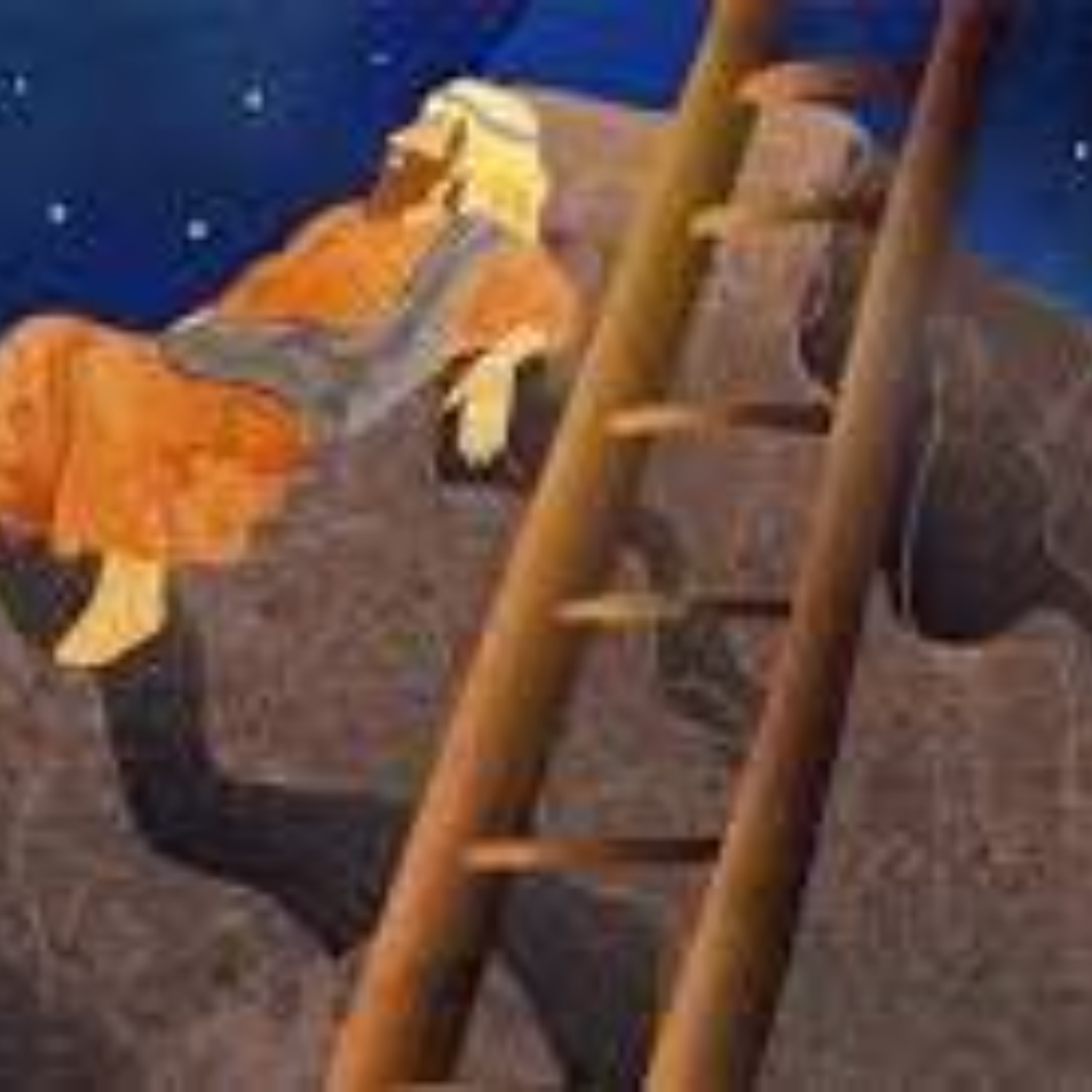
But he's a fugitive who also sees the ladder to heaven. And Malachi Elohim, the divine angels ascend and descend on, and this part is clearly homiletical, but a very powerful one, which is they go up and down on the ladder. But they could be going up and down on him. He is the connection between earth and heaven. All right. So good. We've advanced to that story. He follows us. It's nightfall. He finds a place to sleep. He sleeps. And in his sleep, he has this dream, the dream of angels ascending and descending on a stairway, stairway to heaven, a ladder, however we translate the word sulam. And God makes some kind of message, gives him a message and says, relates to him the promise of Abraham that I'm going to give you this land. You're going to...
burst forth, to the west, to the east, to the north, and to the south. Through you, all of the families of the earth shall be blessed. I will be with you. I will guard you. And everywhere you go, I will bring you back to this land. I won't abandon you until you do what I'm saying. And then he wakes up. That's what you said. He woke up and he had this start. He was startled by this appearance, okay? And he says, there's God here. I didn't know. And then he has awe. He says, this place is awesome.
And this must be the house of God, and this is the gateway to heaven. So then what happens? Okay, so I'm going to read between verse 17 and 18, because verse 18 is, He gets up in the morning, which implies that he goes back to sleep. Now, you could argue, yeah, it's a composite text, and there are two different stories here, but I'm reading it as one text. And he was startled in the middle of the night by this awesome revelation, awesome picture of a divine gateway to heaven, and he fell back asleep.
What do you think it means, though? And I don't think it's a problem if he went back to sleep. Because I think the significance is, the way I think that you painted the story, is that he's incredibly alone. And the fact that God is present means he's not alone. And when he goes back to sleep, he realizes he's no longer alone.
So it's not the same degree of sleep that he had when he first went to bed. Okay. So I have, I guess, at this point, only one strategy in reading biblical stories, which is I want to see myself inside the story and ask myself, what would you do? What would you do? And I don't, I mean, I sleep pretty well. I guess I can go back to sleep after God reveals himself to me. I don't know. I would probably stay up. I would probably be confused. I mean, you know, we're all parents. We all stay up for all sorts of reasons. Okay. You know, and there are things that keep us up at night and things that enable us to go back to sleep. And, you know.
Okay, but I think the religious experience of the Bible is that you can go back to sleep after. In other words, there's not necessarily a degree of agitation with divine visitation, which I think many of us suspect that there should be. So this is kind of, you know, to borrow a phrase from the late Max Caducean, a kind of normal mysticism. This is like in the normal day-to-day life, God appears in the Bible. That's what makes the Bible so great, and in a certain sense, our lives so impoverished, because God is hardly ever here when we want Him to be.
It's hard to relate to because this doesn't happen in our experience. And I would expect in our experience of awe and wonder that we might have a different response. But nevertheless, okay, I'll let that go. I want to just fast forward to the scene where he comes to Levan's household. You know, we note that he does make a vow. He wakes up and he makes a vow. And he basically, he subtly changes what God says. God said, I will guard you. I will watch over you. Everywhere you go. And he says, If you watch over me on the path that I'm going to. And I...
I find that fascinating. I find it fascinating that he makes this subtle shift. God says, wherever you will go, and he says, I want you to guard me on the path that I go, which I see, I interpret here as a certain kind of defiance and a certain kind of resolution. And here I will concede to both of you in the sense that what makes this character great is that this character understands that he has a mission and that at least one of his missions is to find a wife. Another part of the mission is now...
to find safety, but another part of the mission is to go there and to fulfill and to come back and to fulfill the promise. So this is a moment where he really begins to understand that, and that's what that means. So let's fast forward to where he meets Rachel. And he's at the well, and there's a lot we can say about the meaning of Yaakov and the different shepherds of that area. But she comes out, and he sees her, and he asks who, he says, he's told that Rachel is coming. He does not know yet that she is the younger of the daughters. He doesn't really know that there are many daughters. As opposed to his mother, who gives the servant all, and the camels, lots to drink. It's Jacob that does all the...
watering of the sheep here. And she goes home, she tells her father, and he runs to greet him. I'm in verse 13 of chapter 29. He runs to greet him. He hugs him. He kisses him. He brings him into the household. And so he talks. He basically tells his story, though the Torah never tells us what his story is. And so...
A little irony there. You're my own blood and you're my bone and my flesh. And he stays with him for a month. So then, Lavan says to Jacob, you're my brother. You're working for free. Tell me what you want. And then it says, Lavan has two daughters. The older one is named Leah and the younger one is named Rachel. Give me your best translation on the eyes of Leah are...
soft, kind, beautiful. I don't know. I mean, the contrast is with the safe of the verse, right? The safe of the verse, the second clause is, now Rachel was incredibly beautiful. What's interesting is her eyes are not described. The body is described. The question is...
Is it possible, like, the eyes of Leah are weak, and she's blind, or she's whatever, but is it possible that, you know, the word ein, ayin, or in contract form, ein, like ein ha-bedolach, or ein ha-techelet means the appearance of crystal, or the appearance of whatever bedolach is in the Bible, or the appearance of the blue color, is it possible that it's the appearance of Leah was not so hot? And in contrast, Rachel ha-eta, ifat tohar, ifat tohar, ifat tohar. I wonder if the way it's set up, the suggestion is that the only part of Leah is... that was striking with her eyes. What do you think of my daughter Leah? Great eyes. Okay, so Rachel's beautiful. This is, by the way, this is a lovely recapitulation of...
you know, the steady conflict of siblings. This is Ishmael and Isaac, and there's Esau and Yaakov, and Esau, you know, he comes out as a baby, and he's a little bit of a hairy oaf, and Yaakov's whatever he is, and you have a recapitulation here, is that whatever it is, whether it's the, you know, optic nerves and organs of Leah or her appearance or whatever, but it's the same story of the unwanted or unloved elder and the slightly younger hero or heroine of the story, and in all these cases, Ishmael and Esau and Leah, and perhaps with Joseph's brothers, the Torah, by telling the story this way, it awakens our sympathy for Leah Imenu, who is, of course, a great hero heroine in the story because she's going to be the mother of six tribes and all that.
We should like Leah. I personally like Leah, and I feel her pain, and it's the same damn story. So can you imagine being Rachel's older sister? Can you imagine if you're Beyonce's older sister? Like, that's not easy. Well, I would even provide some textual support for your position, because in the Jacob and Esau story, it says, Isaac loved Esau, and Rebecca loved Yaakov. But in this story, nobody loves Leah.
it's absent. And it's a big blank. I just, I'm looking at a chart here. I'm going to show it to you. Okay. So you see in the chart, and it's hard for our non Hebrew readers to read this, but you see the blank space, you know, right over here where there's, there's nobody who loves her. And, and when the text later says, right, that she's hated, I mean, it says exactly what you just said, which is, this is,
it's not only hated, but despised, overlooked. It's funny, the New York Times has these obituary series, Overlook No More, right? And it's hard to describe Leah as overlooked, but here, I think going into the emotional valence of her character, this is a person that is suffering because nobody loves her. This is exactly right. The three, the oldest four children that she has, with Ruvain, it says, God sees my pain. The second one is,
God hears how I'm unloved. This is Reuven is because God sees. Shimon is because God hears. The most painful one is Levi because this time, oh, this time it's going to be great. The third time, this time he's really going to be connected to me. And all three of them are frustrated. And the fourth one is the beautiful one. She says, once again is pregnant, once again has a child. And she says, this time I'm going to thank God because I've basically given up on this lump of a husband who, no matter how many children,
He's just not interested. All right, so we'll do the balance of the story quickly. Jacob loved Rachel, and he says, I will work for her for seven years for your little girl, for your youngest daughter. And Lavon says, and this is a beautiful line. Okay. All right, I'll give her to you. Better that I should give her to you than I should give her to another person. Stay with me. And then Yaakov works for her for seven years, and these seven years went by as seven days. This is the beautiful Shir Hashirim moment in the story, in his love for her. And then verse 21, this is not Shir Hashirim talking. This is a guy who is seven years, you know,
Seven years of desire, unconsummated desire for the desired object of his love and the beautiful woman. And he says to her in what can only be described as a vulgar phrase. Let me have my wife. Days are up, time's up. And it doesn't mean we're going to go out to 7-Eleven.
It doesn't mean we're going to have a date. You know, I want her now. And this is not, this is unbecoming of our patriarch here in this moment. I don't think it's a flattering moment for him. And what's the anger here? And what's the, and it gets worse. Let's go to the next one. He doesn't respond. Lavan doesn't respond to him. It just says, he gathers up all the people and he makes a party. He makes a feast, a drink feast. It's at night. He takes Leah, his daughter. He brings her to her. And we're missing all of the play on words.
And he comes into her. And then it says, parenthesis, he gives her Zilpah the maiden. Verse 25, it's a morning. And behold, he's lying next to Leah. It's Leah.
Why did you cheat me? And, you know, part of the irony, we're the audience, so we know exactly what's going on. And the irony of this is that everybody's in on it, and Jacob is not in on this. And do you not think that he would have sized up Levon? So what do you make of Levon's decision, though, to substitute Leah for Rachel? It seems to me that...
But Levan is operating under the principle that the family is what's most important. And by giving Leah to Yaakov, he resolves the issue of her marriage as well, so she's not going to marry out either. And Jacob is not motivated by family. He's motivated by lust, I think. And I think that by Yahweh Rachel, after she's described as being beautiful, could be understood as lusting for her rather than love. And, you know, I don't know that Levan comes off quite so bad here compared to Yaakov.
I think Levan comes off pretty bad here. Compared to Yago, because look at the answer, okay? When he says, Why did you deceive me? And Levan says, We don't do it here. We don't do it here. It's key. We don't subvert the hierarchy over here. So you, I know what you did. You did the clothing trick. And the point of the clothing trick was to subvert the age hierarchy in your patriarchal family. Okay, we know Levan is a trickster and he's not a good guy and he's going to mistreat Yaakov and mistreat his daughters.
But he plays an important role in the narrative progression, which is midah k'neged midah, which is the Bible's favorite narrative technique, which is that everybody gets their karmic payback. And Jacob's karmic payback for having been a clothing-based deceiver to subvert the age hierarchy is that there's a clothing-based deception which restores the age hierarchy, and now he gets it smack in the face. All right. So here we have to bring it to a close. But I want to leap inside the skin of Yaakov at this moment and say, first of all, the empathy.
of humiliation, that there is a moment of tremendous humiliation here, and that humiliation can brew in terms of the desire for revenge. And perhaps we could see his actions at the end of the Parsha, a comeuppance, a revenge, or just basically saying to Lavan, look, you've been cheating me and I'm doing justice here by... by exiting your space with your two daughters, my 11 sons and one daughter at this point, and a whole set of flocks that I've created underneath you. I've emerged. I snuck the flocks out from under you. Exactly. But I can't help but feel this is humiliation. And I think rather than feel embittered by it, although there is a lot of bitterness, he has to learn this because he understands that he has to live with them.
I'm going to offer a slightly different interpretation. It seems to me that when Levant says, we don't do this bimkomenu in our place, that he's reminding Jacob that this is not his place. Jacob is a displaced person. And as long as he's been there, he hasn't become part of the place. And perhaps this is what will lead Jacob to realize that he has no place here, and he'll have to go back home, which is his place.
All right. And speaking of our place, this is the place where we're going to bring it to a conclusion. First, I want to thank all of our viewers and listeners for watching, spending time with us. Always an honor and a privilege to share Torah with you. Say I'm turning a certain age tomorrow, so it's my birthday. Happy birthday. That was what we can say. Listen, every summer we can rent a cottage on the Isle of Wight. We will scrimp and save. We'll still love you. We'll still need you now that you're 64. When I'm 64. Okay, good.
All right, everyone, watchers, viewers, and listeners, happy Thanksgiving and a good Shabbos. See you all in the next edition of Barshan. Bye-bye.