Passive and active RADAR using Software Defined Radio (WHY2025) episode artwork

EPISODE · Aug 11, 2025 · 48 MIN

Passive and active RADAR using Software Defined Radio (WHY2025)

from Chaos Computer Club - recent events feed (high quality) · host Jean-Michel Friedt

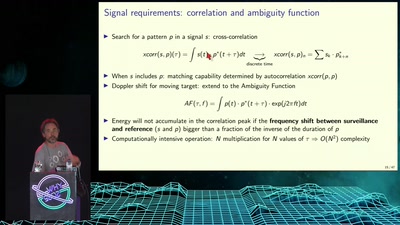
RAdio-frequency Detection And Ranging (RADAR) aims at using electromagnetic signals for detecting target location and motion. We demonstrate in this talk various RADAR architectures using dual-channel coherent Software Defined Radio (SDR) receivers and the associated signal processing techniques relying heavily on cross-correlations. Embedded systems are tackled, with a Raspberry Pi providing enough computational power for recording and post-processing. RAdio-frequency Detection And Ranging (RADAR) aims at using electromagnetic signals for detecting target location and motion. Being constantly illuminated with electromagnetic smog, we can benefit from existing radiofrequency emitters meeting RADAR requirements -- strong power and wide bandwidth -- for passive RADAR measurements where no active emitter is needed, using only coherent passive dual-channel Software Defined Radio (SDR) receivers for passive recording of existing signals. If existing signals are unsuitable, we can use the same principle with non-cooperative emitters such as a Wi-Fi dongle in an active RADAR setup. All processing flowcharts are implemented using GNU Radio for real time acquisition, and GNU/Octave or Python for post-processing: generic principles will be demonstrated, applicable to all sorts of receiver hardware. We will conclude with Synthetic Aperture RADAR (SAR) where antenna motion is used to simulate wide aperture receiving antennas, adding azimuth resolution to range resolution. Supporting documents are found a https://github.com/jmfriedt/SDR-GB-SAR or https://github.com/jmfriedt/passive_radar or https://github.com/jmfriedt/sentinel1_pbr Addendum following feedback on the presentation: 1/ I should have made it clear that the first part of the presentation (pulse, FMCW, FSCW) involved emitting a signal which is often not legal, while the subsequent part involves PASSIVE radar using existing emitters, and hence becoming legal. 2/ the core parameter determining maximum target range is NOT emitted power but isolation between emitter and receiver (especially on a monostatic setup). Increasing TX power if saturating RX and hence reducing RX gain does not help: this is especially true in the VNA implementation when selecting between S11 measurement (limited by the circulator isolation) and S21 (limited by emitting/receiving antenna coupling) 3/ the rail system presented in the SAR part of the discussion uses a WiFi dongle broadcasting random signals as illuminating signal, halfway between passive (a WiFi signal can be many other things than for RADAR measurements) and active (we are controlling the WiFi emission) Thank you for attending or looking at this followup. Reach me (email on the front slide) for more information or corrections. Licensed to the public under https://creativecommons.org/licenses/by/4.0/ about this event: https://program.why2025.org/why2025/talk/YMLNME/

RAdio-frequency Detection And Ranging (RADAR) aims at using electromagnetic signals for detecting target location and motion. We demonstrate in this talk various RADAR architectures using dual-channel coherent Software Defined Radio (SDR) receivers and the associated signal processing techniques relying heavily on cross-correlations. Embedded systems are tackled, with a Raspberry Pi providing enough computational power for recording and post-processing. RAdio-frequency Detection And Ranging (RADAR) aims at using electromagnetic signals for detecting target location and motion. Being constantly illuminated with electromagnetic smog, we can benefit from existing radiofrequency emitters meeting RADAR requirements -- strong power and wide bandwidth -- for passive RADAR measurements where no active emitter is needed, using only coherent passive dual-channel Software Defined Radio (SDR) receivers for passive recording of existing signals. If existing signals are unsuitable, we can use the same principle with non-cooperative emitters such as a Wi-Fi dongle in an active RADAR setup. All processing flowcharts are implemented using GNU Radio for real time acquisition, and GNU/Octave or Python for post-processing: generic principles will be demonstrated, applicable to all sorts of receiver hardware. We will conclude with Synthetic Aperture RADAR (SAR) where antenna motion is used to simulate wide aperture receiving antennas, adding azimuth resolution to range resolution. Supporting documents are found a https://github.com/jmfriedt/SDR-GB-SAR or https://github.com/jmfriedt/passive_radar or https://github.com/jmfriedt/sentinel1_pbr Addendum following feedback on the presentation: 1/ I should have made it clear that the first part of the presentation (pulse, FMCW, FSCW) involved emitting a signal which is often not legal, while the subsequent part involves PASSIVE radar using existing emitters, and hence becoming legal. 2/ the core parameter determining maximum target range is NOT emitted power but isolation between emitter and receiver (especially on a monostatic setup). Increasing TX power if saturating RX and hence reducing RX gain does not help: this is especially true in the VNA implementation when selecting between S11 measurement (limited by the circulator isolation) and S21 (limited by emitting/receiving antenna coupling) 3/ the rail system presented in the SAR part of the discussion uses a WiFi dongle broadcasting random signals as illuminating signal, halfway between passive (a WiFi signal can be many other things than for RADAR measurements) and active (we are controlling the WiFi emission) Thank you for attending or looking at this followup. Reach me (email on the front slide) for more information or corrections. Licensed to the public under https://creativecommons.org/licenses/by/4.0/ about this event: https://program.why2025.org/why2025/talk/YMLNME/

NOW PLAYING

Passive and active RADAR using Software Defined Radio (WHY2025)

0:00 48:56

No transcript for this episode yet

We transcribe on demand. Request one and we'll notify you when it's ready — usually under 10 minutes.

No similar episodes found.

LIGHTS, CAMERA, SMILE! Creatives Club Media Lights, Camera, Smile, is a podcast for anyone with a dream to share something with the world, out of the overflow of themselves - be it their mind, their heart, their personalities, and much more. Each of us are alive in this moment in time, with an innate ability to have ideas and create various things to benefit both ourselves and the people around us for a reason, and here, you will find the encouragement, the inspiration, and the motivation to do just that. Hosted by Cicily, founder of Creatives Club, she dives into various topics surrounding creativity and business. Exploring entrepreneurship for creatives in a corporate reality, sharing tips and tricks in a media centered company, answering questions regarding what a creative actually is are just a few of the things discussed on this podcast. Be encouraged to create for yourself as Cicily gets vulnerable by pivoting the camera to herself for the first time.To submit questions for Cicily to answer, or have her address certain t Chewing the Fat with WorkForge WorkForge Bite-Sized Conversations for Building a Stronger Workforce Welcome to Chewing the Fat, a podcast delving deep into the world of food manufacturing. Dive into real conversations around critical topics like staffing, retention, onboarding, and career development in this essential industry. Subscribe now to gain insights from your peers, subject matter experts and more on the biggest issues facing food manufacturers today: -Hiring and retaining employees -Addressing the challenges of the Silver Tsunami -Improving time to productivity of new employees -Engaging employees from hire to retire And more... Tune in to Chewing the Fat, a WorkForge podcast, and join the conversation on how to build and sustain a resilient, high-performing workforce in food manufacturing. Sermons | Countryside Bible Church Countryside Bible Church At Countryside Bible Church, we equip believers to joyfully live holy lives, to serve one another, and to share the gospel of Jesus Christ, all to the glory of God. We are committed to a high view of God, and a high view of Scripture. The PFN Cincinnati Bengals Podcast Pro Football Network The PFN Cincinnati Bengals Podcast is where you can stay up-to-date with the latest news and analysis on the Cincinnati Bengals! Our hosts, industry experts Jay Morrison and Dallas Robinson, provide weekly coverage of all the latest rumors and updates about the Bengals. Don’t forget to follow the show to receive new episodes directly in your podcast feed and leave a rating and review to let us know your thoughts.

Frequently Asked Questions

How long is this episode of Chaos Computer Club - recent events feed (high quality)?

This episode is 48 minutes long.

When was this Chaos Computer Club - recent events feed (high quality) episode published?

This episode was published on August 11, 2025.

What is this episode about?

RAdio-frequency Detection And Ranging (RADAR) aims at using electromagnetic signals for detecting target location and motion. We demonstrate in this talk various RADAR architectures using dual-channel coherent Software Defined Radio (SDR) receivers...

Can I download this Chaos Computer Club - recent events feed (high quality) episode?

Yes, you can download this episode by clicking the download button on the episode player, or subscribe to the podcast in your preferred podcast app for automatic downloads.
URL copied to clipboard!