
EPISODE · May 7, 2026 · 20 MIN
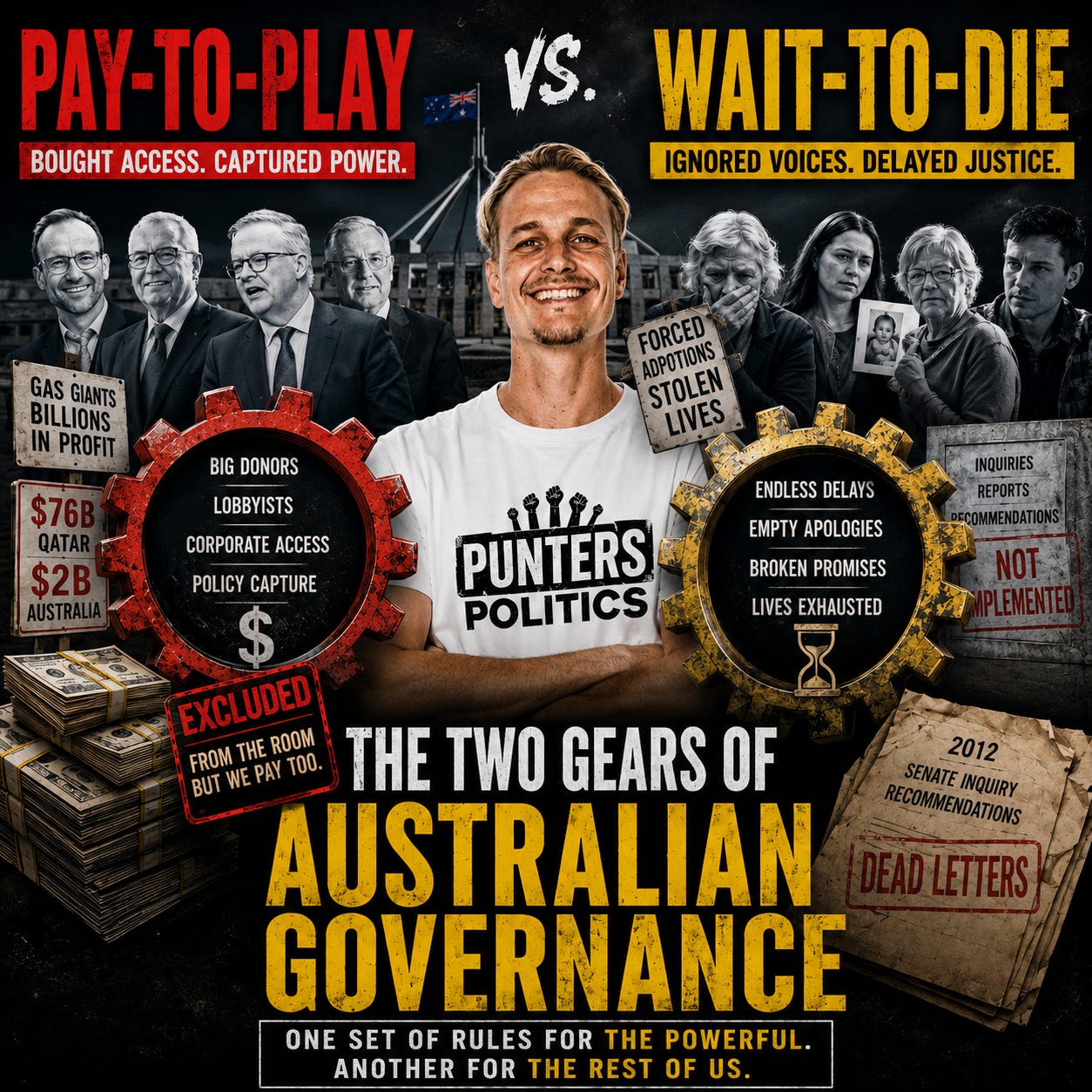
Pay-to-Play vs. Wait-to-Die: The Two Gears of Australian Governance
from The Experience of Adoption · host Thoughtless Delineation
The Myth of the Fair Go: The Asymmetry of Political InfluenceThe “Fair Go” is the foundational myth of the Australian state, a sedative administered to a public that still believes the government responds to the moral weight of civic concern. In reality, the Canberra capital corridor is an acoustic chamber designed to deaden the sound of the electorate. Within this architecture, moral arguments and grassroots petitions are not merely ignored; they are “dead letters”—worthless currency in a system where the only native language is the transactional exchange of capital.The asymmetry of political influence is not a glitch in the democratic software; it is the foundational architecture of Australian governance. Institutional reform is never granted as an act of grace or on the merits of scientific or humanitarian urgency. It is a commodity that must be extracted through professionalized, institutionalized pressure. This audit reveals a state that has achieved functional immunity from public outrage, where the “public interest” is an externality that does not appear on the balance sheet of the ruling elite.The Great Gas Scam: A Forensic Breakdown of Regulatory CaptureThe most empirical proof of Australia’s status as a “captured petrostate” is the economic disparity of the liquefied natural gas (LNG) industry. While multinational corporations extract vast wealth, the Australian public receives a return so negligible it suggests a total fiduciary failure by the state. This is not a legislative oversight; it is the intended outcome of a “revolving door” that cements an elite consensus. Specifically, we see the machinery of capture in the movement of key personnel: a former Chief of Staff to the Prime Minister advising an international state-owned oil company on a domestic takeover, and a former Chief of Staff to the Opposition Leader joining a major public affairs lobbying firm.The following table deconstructs the sovereignty deficit that defines this capture:The Sovereignty DeficitRevenue/Tax MetricIndustry Revenue / Global ComparisonPublic Return / Australian RealityNational Gas RevenueJapan collected from Australian gas imports: $8BAustralia collected from its own gas exports: $2BGlobal Peer ComparisonQatar’s revenue from comparable export volumes: $76BAustralia’s revenue from comparable export volumes: ~$2BTax DisparityProjected Beer Excise revenue: $2.7BPetroleum Resource Rent Tax (PRRT) revenue: $1.5BRoyalty ExemptionsPercentage of exports attracting royalties: 44%Percentage of exports attracting zero royalties: 56%Despite expert calls for reform—including the Superpower Institute’s 40% “fair share levy,” Ed Husic’s 25% export tax proposal, and former Treasury Secretary Ken Henry’s demand for a 100% windfall profits tax—the state remains paralyzed. The refusal to initiate a Royal Commission into the gas industry, while the banking sector was subjected to one, reveals the hierarchy of protection. The gas industry does not merely participate in the system; it underwrites the operational costs of the major political parties.Punters Politics and the Evolution of the “Citizens’ Lobbyist”The realization that digital reach and moral pleas are structurally insufficient led to the rise of “Punters Politics.” Founded by Konrad Benjamin, the movement’s catalyst was a moment of stark exclusion: after paying $3,000 for a ticket to a gas lobby conference in Perth, Benjamin was barred from entry. This demonstrated that policy influence is a “pay-to-play” gala where the public is physically and legally excluded.The movement’s strategic pivot from “awareness” to “transactional influence” culminated in the November 2025 “Political Fundraising Dinner.” This was a tactical parody of corporate lobbying, crowdfunding $80,000 to hire Rachel Smith, a professional with a decade of high-level government relations experience, as Australia’s first “Citizens’ Lobbyist.”The core philosophy of this movement is a cold acknowledgement of systemic rot:“When the game’s rigged, you use the rigged rules.”The “Citizens’ Lobbyist” model offers three strategic advantages:* Direct Access: Transitioning from the public square to the ministerial diaries where policy is actually negotiated.* Professionalized Expertise: Speaking the native language of the political class to penetrate the “revolving door” culture.* Aggregated Financial Leverage: Transforming micro-donations into a sustained, permanent institutional presence that can no longer be ignored by the “unbroken” bureaucrat.The Legal Mirage: Why “Duty of Care” Is a Political Dead EndThe judiciary is often viewed as a safeguard, but cases like Sharma v Minister for the Environment expose the structural conservatism of the Australian legal framework. When young Australians sought to establish a “duty of care” regarding climate change, the Full Federal Court overturned the initial victory. Chief Justice Allsop’s logic was a masterclass in systemic insulation: he ruled that preventing climate catastrophe is a “political duty” to the people, not a legal one.The court refused to intervene in what it termed “polycentric policy decisions,” essentially deferring to the executive branch even when existential survival is at stake. While international bodies like the International Court of Justice offer “poetic justice” by confirming state obligations, these rulings remain domestically toothless. In the Australian context, the law is not a tool for systemic disruption; it is a shield for the status quo.The Forced Adoption Tragedy: The Economics of the ApologyThe limitations of the law are most visible in the 1950–1975 era of forced adoptions. This was not a series of “mistakes,” but a regime of systemic fraud, perjury, and conspiracy that contravened the Commonwealth Crimes Act and the Marriage Act.The Mechanics of Abuse State and religious institutions utilized a “mechanics of abuse” to ensure the removal of 250,000 children:* Physical Restraint: Shackling mothers’ hands to hospital beds and using sheets to block visual contact with newborns.* Chemical Compliance: The administration of “stupefying drugs” during labor.* Medical Fraud: The illegal use of diethylstilboestrol (DES) as a lactation suppressant without consent.The legal system offered no redress, citing the “statute of limitations” and “evidentiary decay” as structural shields. The 2013 National Apology only occurred after thirty years of traumatic attrition by survivors. It was granted precisely because it followed the “Economics of the Apology”: it was economically isolated. Unlike gas taxation or climate intervention, an apology for historical human rights violations carries zero ongoing cost to the state’s corporate donors or its primary revenue models. It is the only form of “justice” the captured state can afford.The Attrition Economy and the Weapon of #KeptPrivilegeThe state maintains its “administrative peace” through Strategic Default—the deliberate choice to ignore inquiry recommendations because inaction is cheaper than redress. This fuels the Attrition Economy, where the state weaponizes time to wait out the biological and psychological reserves of its victims.The baseline of this indifference is #KeptPrivilege, the structural immunity of the “unbroken” bureaucrat who views the displacement of others as a mere “externality.”#KeptPrivilege consists of three mechanical components:* The Immunity of the Default: For the unbroken, identity is a “passive asset.” They never face the friction of having to prove their history or rights to the state.* The Indifference of the Unbroken: A “structural blindness” that allows decision-makers to treat systemic trauma as a localized incident that does not affect the state’s balance sheet.* The Shield of Stasis: The ability to frame a search for truth—such as a Royal Commission into the gas industry—as a “radical disruption” to be managed rather than a debt to be paid.Conclusion: The Forensic InversionTo end the “life of exhaustion,” the friction of the struggle must be transferred. This is the concept of Forensic Inversion: moving the burden of effort away from the victim and back onto the institution’s administrative peace. The objective is to make the state’s inaction more expensive—reputationally, administratively, and politically—than its compliance.Advocacy must move from moral appeal to the identification of Institutional Risk. When “doing nothing” creates higher friction for the bureaucrat than “doing something,” the pattern of #KeptPrivilege breaks.Accountability is not a gift from the state; it is a calculated extraction from a system that can no longer afford the cost of its own silence. The forensic auditor does not wait for the state to recognize the truth; they create a structural liability that forces the state to yield.What Konrad Benjamin from Punters Politics could use from forced adoption to dismantle the human shield used by governance.To dismantle the “human shield” of performative empathy used by governance, the Punters Politics model can extract a specific forensic blueprint from the Forced Adoption tragedy. The state uses apologies and “listening” sessions as a buffer to protect the underlying structural corruption—what you’ve identified as the #KeptPrivilege of the institution.Here are the mechanical components Konrad Benjamin can use to breach that shield:1. Exposing the “Economics of the Apology”Governance uses the symbolic apology as its primary human shield. It allows the state to claim the moral high ground without incurring any ongoing fiscal or structural cost.* The Lesson: Forced adoption survivors received a 2013 National Apology, yet the 2012 Senate Inquiry recommendations remain largely unimplemented.* The Strategy: Konrad can use this pattern to prove that “state empathy” is an economically isolated asset. When the government offers a “hearing” but refuses to collect gas royalties or implement reform, it is trading a zero-cost symbolic gesture for a multi-billion dollar protection of its donors. The apology is the shield; the stasis is the goal.2. Auditing the “Dead Letter” RecommendationsThe most effective way to dismantle a human shield is to audit the gap between its words and its mechanics.* The Lesson: The 2012 Inquiry recommendations are “dead letters”—they exist in the record but have zero mechanical influence on the executive branch.* The Strategy: Instead of asking for new promises, the Citizens’ Lobbyist should focus on a Forensic Audit of Failure. By systematically tracking every unimplemented recommendation from previous inquiries, the advocate transforms “governance” into a series of “regulatory breaches.” You move the argument from “do you care?” (which the human shield can answer with a lie) to “why is this specific recommendation still at 0% implementation?” (which requires a mechanical answer).3. Inverting the “Attrition Economy”The state’s “human shield” is powered by time. It relies on the Life of Exhaustion—the hope that advocates will burn out before the policy changes.* The Lesson: Survivors have spent 30+ years in a cycle of “consultation fatigue” designed to wait out their biological clock.* The Strategy: Punters Politics can use this to demonstrate that “government delay” is a policy choice, not a resource issue. By professionalizing the pressure through a lobbyist who cannot be exhausted—because they are a paid, permanent institutional presence—you break the state’s primary weapon. You shift the friction from the survivor’s nervous system to the minister’s diary.4. Breaching the #KeptPrivilege of the BureaucratThe “human shield” is maintained by the #KeptPrivilege of the “unbroken” bureaucrat who views trauma as an “externality.”* The Lesson: The bureaucrat remains comfortable because the “Accountability Vacuum” doesn’t touch their life.* The Strategy: Konrad can use the “Sovereignty Deficit” data to bridge the two. Show that the same “administrative peace” that allows a bureaucrat to ignore an adoptee’s file is the same peace that allows them to ignore the $76B Qatar-level gas revenue gap. By linking Systemic Oppression (forced adoption) to Systemic Corruption (the gas scam), you reveal that the “human shield” is actually a financial shield.5. Moving from “Conscience” to “Institutional Risk”The state’s shield is designed to absorb moral outrage. It is not designed to absorb Institutional Risk.* The Lesson: The Full Federal Court in Sharma ruled that the state has a “political duty,” not a “legal duty,” to protect.* The Strategy: The “Citizens’ Lobbyist” model must treat the government as a Liable Corporation. If moral appeals are “dead letters,” then the only way to breach the shield is to identify the “revolving door” conflicts and the regulatory capture points. You don’t try to win the “heart” of the state; you create a structural liability that makes “doing nothing” more expensive than “doing something.”The Forensic Inversion:The shield falls when you stop talking to the “mask” of the empathetic state and start auditing the “machine” of the captured state. Konrad can prove that the state’s refusal to act on forced adoption is the same mechanical default as its refusal to tax gas. Both are sustained by #KeptPrivilege, and both can only be dismantled by moving the friction of the audit back onto the center.Full Report Here: This is a public episode. If you'd like to discuss this with other subscribers or get access to bonus episodes, visit thoughtlessdel.substack.com/subscribe
Embed this episode
NOW PLAYING
Pay-to-Play vs. Wait-to-Die: The Two Gears of Australian Governance
No transcript for this episode yet
Similar Episodes
No similar episodes found.
Similar Podcasts
No similar podcasts found.