
EPISODE · Feb 26, 2026 · 1H 19M
Paying your fair share (Nathan et al 2026) | FT50 JAE
from Revise and Resubmit - The Mayukh Show · host Mayukh Mukhopadhyay
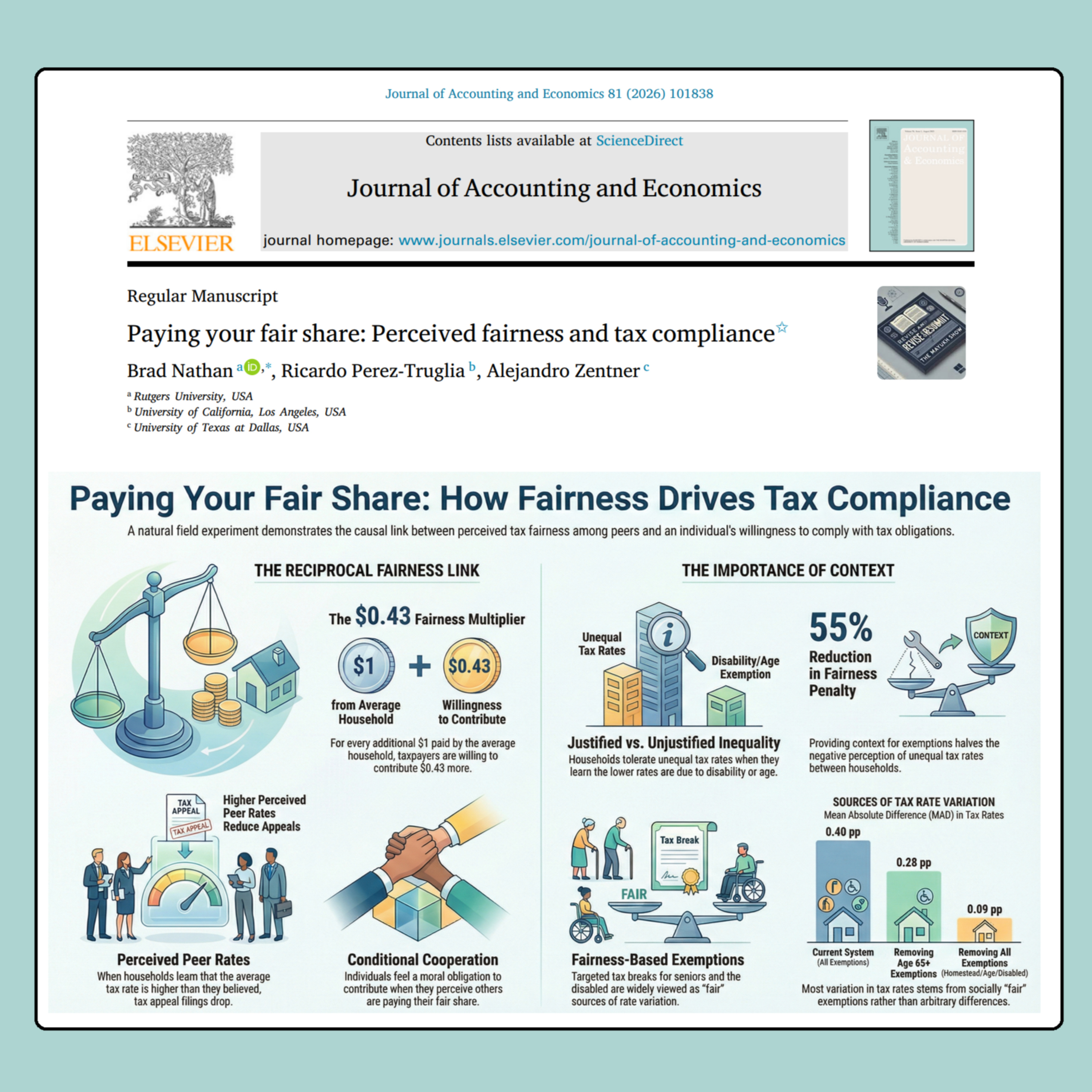
English Podcast Starts at 00:00:00Bengali Podcast Starts at 00:16:07Hindi Podcast Starts at 00:36:11French Podcast Starts at 00:53:26ReferenceNathan, B., Perez-Truglia, R., & Zentner, A. (2026). Paying your fair share: Perceived fairness and tax compliance. Journal of Accounting and Economics, 101838. https://doi.org/10.1016/j.jacceco.2025.101838Youtube Channelhttps://www.youtube.com/@weekendresearcherConnect over linkedinhttps://www.linkedin.com/in/mayukhpsm/Welcome to Revise and Resubmit 🎙️✨ the show where serious research meets real life, and where the footnotes often point straight back to the heart.Picture a quiet street in Dallas County. Lawns trimmed. Mailboxes upright. Neighbors waving like they always do. And then, somewhere between the grocery receipt and the school pickup, a thought sneaks in that can change everything: “Am I paying more than everyone else?” 🤔💸 Not “Do I owe taxes?” but “Is this fair?” Because taxes are never only numbers. They are stories we tell ourselves about belonging, responsibility, and whether the system is treating us like a sucker or like a citizen.Today’s episode dives into a brand-new paper published online on 20 February 2026, titled “Paying your fair share: Perceived fairness and tax compliance” by Brad Nathan, Ricardo Perez-Truglia, and Alejandro Zentner 📄🔍 in the Journal of Accounting and Economics, a prestigious FT50 journal 🏛️📚.Here is the human hinge of the study. The authors run a natural field experiment around U.S. property taxes, using an information-disclosure intervention that shifts what households think other people pay. Not a lecture. Not a moral scolding. Just a nudge of knowledge. And what happens when people believe the average taxpayer is paying more? They see the system as fairer, and they become less likely to file a tax appeal ✅🧾. The numbers are striking: for every additional $1$1 people believe the average household pays, a taxpayer is willing to contribute about $0.43$0.43 more. That is not just compliance. That is conditional cooperation, the quiet bargain of community 🤝🏘️.But fairness, as always, has context. In the experiment, people learn the average rate, but not the reasons it differs from theirs. Then the survey comes in with the twist: when households learn others might pay lower rates because of exemptions, like disability or advanced age, they tolerate inequality more readily ❤️🩹👵. Many support those breaks, yet a meaningful share still prefers the clean symmetry of equal rates, no matter the story. It is a reminder that “fair” can mean “equal,” and “fair” can also mean “merciful,” and those two meanings sometimes wrestle in the same mind ⚖️🧠.If you want research that speaks to policy, to psychology, and to the everyday friction of comparing yourself to the neighbors, you are in the right place 🔔🎧.Subscribe to Revise and Resubmit on Spotify, and also follow us on YouTube at “Weekend Researcher” ▶️📌. You can also listen on Amazon Prime and Apple Podcast 🍎🎙️.And with sincere thanks to the authors, Brad Nathan, Ricardo Perez-Truglia, and Alejandro Zentner, and to Elsevier, the publisher of this article 🙏📘, let me leave you with a question that lingers: if your willingness to pay depends on what you believe others pay, what does that say about taxes, and what does it say about us? ❓✨
Embed this episode
Ready to play
Paying your fair share (Nathan et al 2026) | FT50 JAE
No transcript for this episode yet
Similar Episodes
No similar episodes found.
Similar Podcasts
No similar podcasts found.