People, Power and Participation
from Ideas Untrapped Hosted by Tobi Lawson
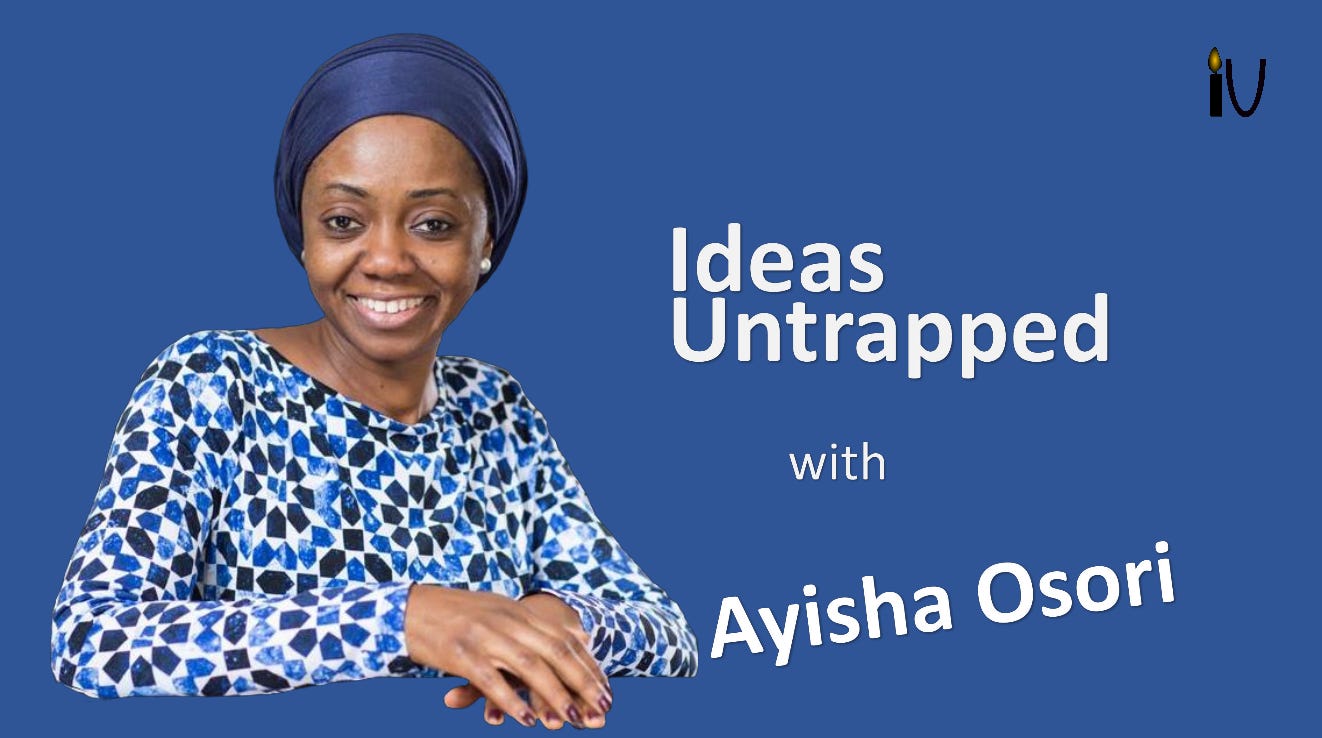
I spoke to Ayisha Osori about our political structures and the various ways it is unaccountable to the electorates. She is the current Executive Director of the non-profit Open Society Initiative for West Africa (OSIWA). She also contested for a seat on the House of Representatives for Abuja in 2015 and has documented her experience in an eloquently written book. I enjoyed this conversation, and it was a pleasure to learn from Ayisha’s experience and knowledge. You can listen and download on any of your preferred platform here or the player above. You can also rate us here. This helps other people find the show. Transcript TL: Welcome to Ideas Untrapped and today I am speaking with Ayisha Osori. Ayisha is a lawyer and she is the former CEO of [the] Nigerian Women's Trust Fund. She has consulted for various international development organisations, and she is currently the Executive Director of Open Society Initiative for West Africa. You're welcome, Ayisha. AO: Thank you, Tobi. It's a pleasure to be here. TL: I read your book... very very fascinating. And one thing that jumped at me straight away is the tension or the balance between political agents and systemic governance in Nigeria. In your experience, and of course from your analytical perspective in observation, where do you think the true power lies in our system? Is it with individual actors or with the structure that they've built around them via the party or their various networks? AO: That's a very fascinating question. And it will be hard to say that it's one or the other. It's both. It's the individuals and it is the structures and I can explain. When I say structures I would be referring to something including the culture of what politics means and what political parties are designed to do or have been doing in Nigeria, some might say, from the 60s. So that DNA, the hard wiring of what a political party should be, the understanding of how it should be structured, how it should work, how it should be manipulated, all those things are part of the structures. The structures are beyond the internal mechanisms of the party, whether it's the National Working Committee or the National Executive Council, it's beyond those structures. So, when I refer to structures, I will be referring to, as I said, the DNA, the history, the hard wiring in our consciousness (both the public and the politicians) of our political parties should behave, what's expected of political parties...all those things help determine how power is obtained and our power is used in Nigeria. And then the individuals come in in that they are the ones who know how to manipulate and manage (depending on how you want to look at it manipulate is one way, manage is another) these structures for their benefit largely, the benefit of their close associates and a handful of hangers-on. And then maybe, you would argue, their communities where there's a trickle-down effect. I'll explain why the individuals are important. We don't have to go too far, we can just start with 1999. In a way you would actually even argue that our parties have deteriorated in terms of structure - AO If you look at some of the most powerful individuals in any of the parties whether it was PDP, whether it was ANPP, whether it was AC or AD, you'll find a pattern in the names and faces and where they go, who they align with and how the party sort of evolves. So AD moved to ACN, ACN did a merger with CPC to become the ruling party now, APC. So you find the individuals who are powerful within these structures. They're the ones who understand this hardwiring of how political parties should be. They're the ones who have been in the system for a long time and understand it. That's why I'd say it's both of them. And when these individuals decide to leave parties, they typically go home with almost everyone and the party doesn't survive after they leave which shows how powerful they are. It's also a reason why you see the same actors in the different parties because the individuals who know how to, let's just say, be politicians have the same ethos. Regardless of what the name of the party is, they have the same outlook toward how political parties should be run, how power should be gained and how power should be used. TL: One thing you talked about quite early in the book is the role of ideology in politics and how it is missing (it's almost non-existent). One good example is a case of Kogi State where you have two senators, running against each other, four years apart, in different parties. There's the case of Edo where the upcoming elections would actually have, basically, the same people on the ticket of the two main parties, but now they've more or less switched sides. Cross-carpeting is the colloquial word we use for it, would ideology really help bring some stability and, hopefully, sanity to our politics? Because it feels like our politicians do not stand for anything. AO: They would argue with you that they do stand for something and I'm sure many of the politicians that are in APC today will tell you that they consider themselves progressives (maybe left-of-center). I don't think PDP as described itself as center or right-of-center. Right being more conservative, Left being more progressive, but I've heard APC politicians describe themselves as more progressives anyway. Some of them would argue with you that they do have ideologies, but of course we know that it doesn't seem that way because of how easy it is for them to move between parties which I mentioned earlier. So if, as you point out, once upon a time, Ize-Iyamu didn't have the characteristics and values of what an APC person should be, you would have to ask what has changed in four years that suddenly he's able to be the ideal candidate for the APC despite everything they had said about him four years ago. You would like to think that as they present Ize-Iyamu now as a brand for APC that there will be some sense of how he has been rehabilitated from his prior point of views, his prior values that make him now aligned to APC. But there's no pretence in doing that because they know that, in a way, nobody cares, so to speak. And it could be that, is it that nobody cares (that us the public)? Or are we apathetic? Do we no longer care, did we care once upon a time? Did we never care? For me, those are the more interesting questions, because this idea that you have parties where you don't know who your members are, that's been something that's been going on for years and years. It wasn't this bad in the run-up to the 60s when we had the old parties that were led Awolowo, Ahmadu Bello and Nnamdi Azikiwe NCNC or [the] inheritors of those parties, the National People's Congress (NPC) that started as the Northern People's Congress...so, in a way, you would actually even argue that our parties have deteriorated in terms of structure, but those parties had some modicum of membership, they had some modicum of order. But as time went on where the lines between public and private or the lines between, let's say, governance and the treasury (public officials and the treasury) became more blurred, the more being in government became a route to access to fantastic riches... the more important it was to be in politics, the more important it became to capture power because that was your route to fantastic riches. So, the point I'm trying to make in a roundabout way is that the parties right now have no incentive to change their DNA or to change the way they've always done things. The formula has worked for them so far they would say. They win power, they might be out of it for one or two election cycles. PDP had said they would rule for 60 years, thankfully, they were out in 16. Now, APC probably has the same feeling that they will rule for 60 years but it's quite likely that they will not. The faces don't change, and even when the faces change, the behaviour and the values don't change. The culture of what politics is doesn't chan… This is a public episode. If you would like to discuss this with other subscribers or get access to bonus episodes, visit www.ideasuntrapped.com
Embed this episode
No transcript yet.