
EPISODE · Jul 27, 2026 · 54 MIN
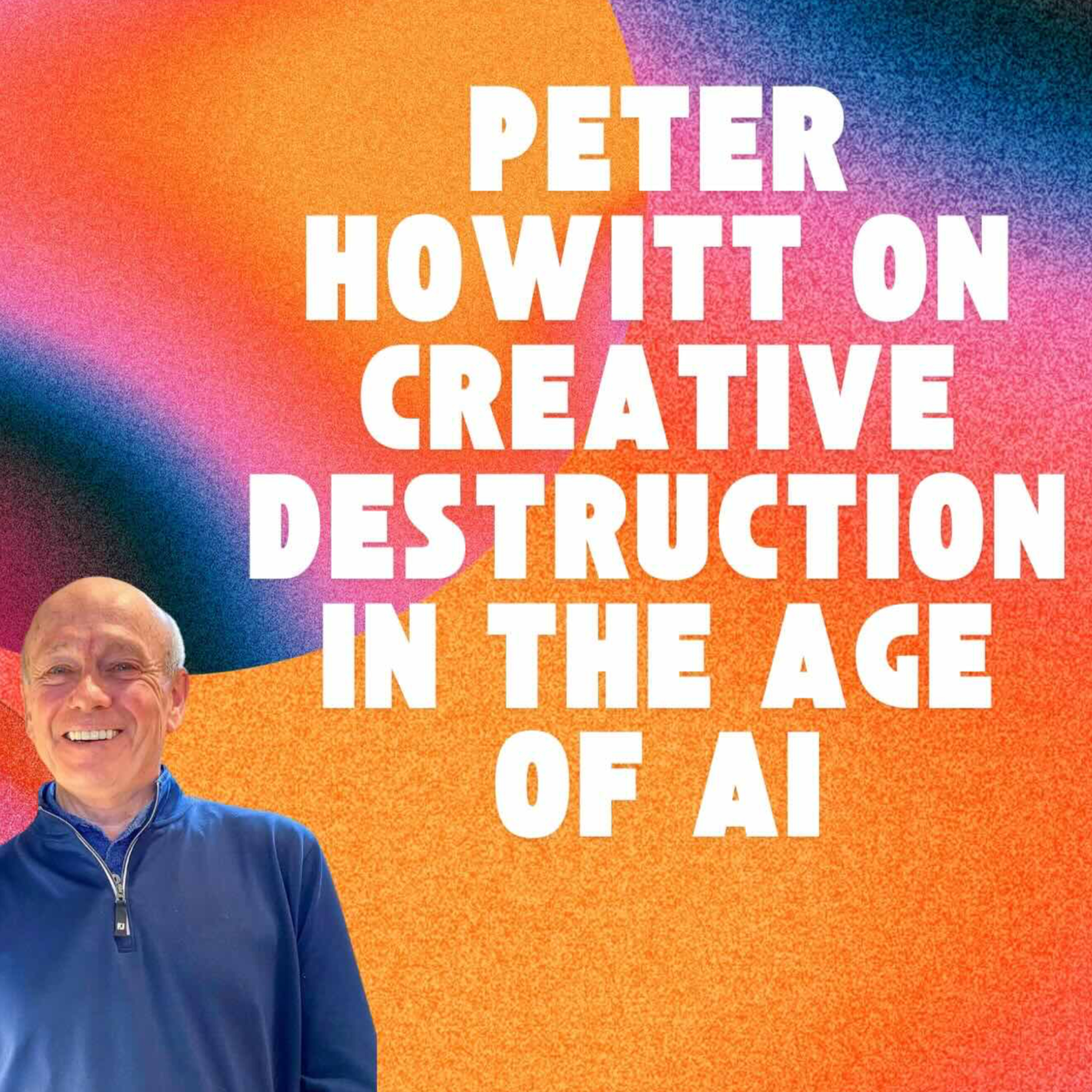
Peter Howitt on Creative Destruction in the Age of AI
from Scaling Theory · host Thibault Schrepel
Peter Howitt won the 2025 Nobel Prize in Economic Sciences. The award was for the theory of sustained growth through creative destruction. He and Philippe Aghion gave that theory a mathematical form in 1992.Competition and innovation do not move together in a straight line. What decides the direction is where a firm sits relative to the technological frontier. Peter also draws the line between a merger that buys innovation and one that removes it, and he describes the route by which an incumbent turns market power into political power. We then turn to agent-based modeling. He is candid about why a method he still defends took thirty years to find readers.Follow me on X (https://x.com/profschrepel) and BlueSky (@ProfSchrepel).***References:"A Model of Growth Through Creative Destruction" (with Aghion), Econometrica 60(2), March 1992, 323–351. https://www.jstor.org/stable/2951599.Endogenous Growth Theory (with Aghion), MIT Press, 1998. https://mitpress.mit.edu/9780262528467/endogenous-growth-theory/"Competition and Innovation: An Inverted-U Relationship" (with Aghion, Bloom, Blundell, Griffith), Quarterly Journal of Economics 120(2), May 2005, 701–728. https://academic.oup.com/qje/article-abstract/120/2/701/1933966."The Effects of Entry on Incumbent Innovation and Productivity" (with Aghion, Blundell, Griffith, Prantl), Review of Economics and Statistics 91(1), February 2009, 20–32. https://direct.mit.edu/rest/article/91/1/20/57753/The-Effects-of-Entry-on-Incumbent-Innovation-and."The Emergence of Economic Organization" (with Robert Clower), Journal of Economic Behavior & Organization 41(1), January 2000, 55–84. https://www.sciencedirect.com/science/article/abs/pii/S0167268199000876."Banks, Market Organization, and Macroeconomic Performance: An Agent-Based Computational Analysis" (with Ashraf and Gershman), JEBO 135, March 2017, 143–180. DOI 10.1016/j.jebo.2016.12.023."How Inflation Affects Macroeconomic Performance: An Agent-Based Computational Investigation" (with Ashraf and Gershman), Macroeconomic Dynamics 20(2), March 2016, 558–581. https://www.cambridge.org/core/journals/macroeconomic-dynamics/article/abs/how-inflation-affects-macroeconomic-performance-an-agentbased-computational-investigation/DC3AF3CA750F82FDE20164B36935FA1F."Getting at Systemic Risk via an Agent-Based Model of the Housing Market" (with Geanakoplos, Axtell, Farmer and others), American Economic Review 102(3), May 2012, 53–58. https://www.aeaweb.org/articles?id=10.1257/aer.102.3.53.
Embed this episode
Ready to play
Peter Howitt on Creative Destruction in the Age of AI
No transcript for this episode yet
Similar Episodes
No similar episodes found.
Similar Podcasts
No similar podcasts found.