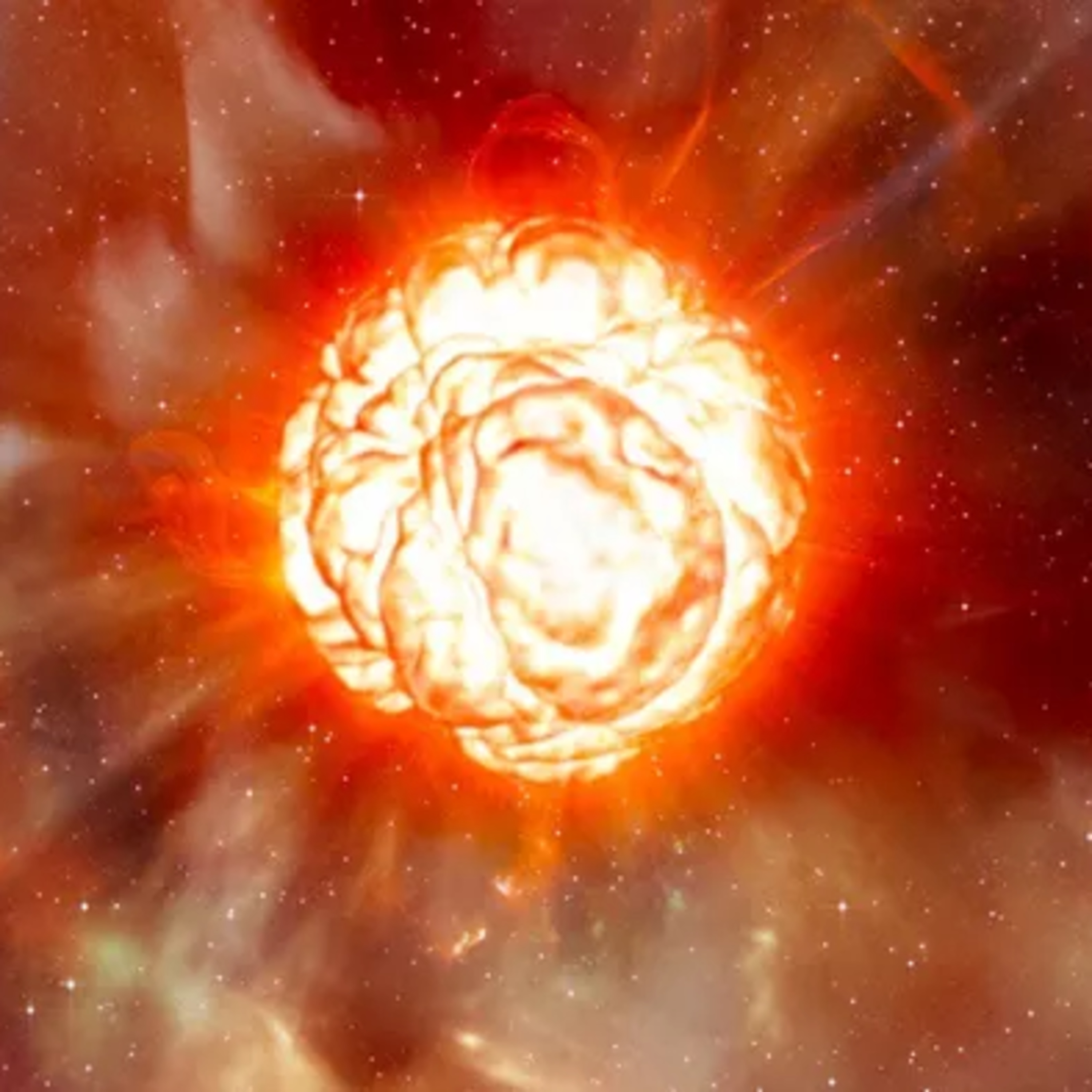
PeV Power from Stellar Explosions: The Role of Dense Environments episode artwork

EPISODE · May 3, 2025 · 14 MIN

PeV Power from Stellar Explosions: The Role of Dense Environments

from Multi-messenger astrophysics · host Astro-COLIBRI

The research investigates how supernovae exploding into dense circumstellar environments, specifically those with dense shells of material, can potentially accelerate particles to energies of a few PeV, thus acting as "PeVatrons" and contributing to the "knee" feature in the cosmic ray spectrum.Supernova remnants (SNRs) have long been considered prime candidates for the sources of Galactic Cosmic Rays (CRs) up to energies of a few PeV. However, despite decades of gamma-ray astronomy, there hasn't been clear observational proof that standard SNR models can accelerate particles beyond approximately 100 TeV. Young SNRs like Tycho and Casiopeia A, initially expected to be strong accelerators, show even lower cutoff energies.The presented study explores a different scenario: supernovae that expand into **much denser circumstellar material**, including dense shells ejected by the progenitor star shortly before explosion. These dense shells are thought to be present around massive stars like Luminous Blue Variables (LBVs), which can undergo brief episodes of very high mass-loss rates (up to 1 M⊙/yr). Type IIn supernovae, associated with LBVs, make up about 5% of core-collapse supernovae.The researchers used spherically symmetric 1D simulations with their time-dependent acceleration code called **RATPaC** (Radiation Acceleration Transport Parallel Code). This code simultaneously solves the transport equations for cosmic rays, magnetic turbulence, and the hydrodynamical flow of the thermal plasma in the test-particle limit. Unlike models that assume a steady state for magnetic turbulence, RATPaC accounts for the time needed for turbulence to build up, which often leads to lower maximum energies in standard scenarios.**The key finding is that the interaction of the supernova shock front with these dense circumstellar shells can significantly boost the maximum energy** of the accelerated particles.Specifically, the simulations show that:* **Interactions with shells that occur earlier post-explosion lead to a greater increase in maximum energy (Emax)**.* If the interaction happens within the first **5 months (approximately 140 days)** after the explosion, the **Emax can increase to more than 1 PeV**.* For very early interactions, around **0.1 years**, Emax can even surpass **10 PeV**.This significant energy boost is attributed to several mechanisms during and after the shock-shell interaction:1. **Enhanced Particle Escape:** The shock slows down considerably during the interaction with the dense shell, which temporarily enhances the "precursor scale" (the region upstream where particles diffuse back towards the shock, given by D(E)/v_shock). This increased scale provides more time for turbulence to grow. Enhanced particle escape also occurs during the onset of the interaction, boosting the CR current.2. **Reacceleration in a Pre-amplified Field:** After passing through the shell, the shock propagates into a medium where the magnetic field has been pre-amplified by escaping cosmic rays during the interaction phase. The shock accelerating into this region with an enhanced field boosts Emax.3. **Interaction with Reflected Shocks:** The collision with the dense shell creates reflected shocks. These can catch up with and interact with the forward shock from behind, leading to sharp increases in the forward shock's velocity and slightly boosting Emax.Acknowledements: Podcast prepared with Google/NotebookLM. Illustration credits: ESO/L. Calçada

The research investigates how supernovae exploding into dense circumstellar environments, specifically those with dense shells of material, can potentially accelerate particles to energies of a few PeV, thus acting as "PeVatrons" and contributing to the "knee" feature in the cosmic ray spectrum.Supernova remnants (SNRs) have long been considered prime candidates for the sources of Galactic Cosmic Rays (CRs) up to energies of a few PeV. However, despite decades of gamma-ray astronomy, there hasn't been clear observational proof that standard SNR models can accelerate particles beyond approximately 100 TeV. Young SNRs like Tycho and Casiopeia A, initially expected to be strong accelerators, show even lower cutoff energies.The presented study explores a different scenario: supernovae that expand into **much denser circumstellar material**, including dense shells ejected by the progenitor star shortly before explosion. These dense shells are thought to be present around massive stars like Luminous Blue Variables (LBVs), which can undergo brief episodes of very high mass-loss rates (up to 1 M⊙/yr). Type IIn supernovae, associated with LBVs, make up about 5% of core-collapse supernovae.The researchers used spherically symmetric 1D simulations with their time-dependent acceleration code called **RATPaC** (Radiation Acceleration Transport Parallel Code). This code simultaneously solves the transport equations for cosmic rays, magnetic turbulence, and the hydrodynamical flow of the thermal plasma in the test-particle limit. Unlike models that assume a steady state for magnetic turbulence, RATPaC accounts for the time needed for turbulence to build up, which often leads to lower maximum energies in standard scenarios.**The key finding is that the interaction of the supernova shock front with these dense circumstellar shells can significantly boost the maximum energy** of the accelerated particles.Specifically, the simulations show that:* **Interactions with shells that occur earlier post-explosion lead to a greater increase in maximum energy (Emax)**.* If the interaction happens within the first **5 months (approximately 140 days)** after the explosion, the **Emax can increase to more than 1 PeV**.* For very early interactions, around **0.1 years**, Emax can even surpass **10 PeV**.This significant energy boost is attributed to several mechanisms during and after the shock-shell interaction:1. **Enhanced Particle Escape:** The shock slows down considerably during the interaction with the dense shell, which temporarily enhances the "precursor scale" (the region upstream where particles diffuse back towards the shock, given by D(E)/v_shock). This increased scale provides more time for turbulence to grow. Enhanced particle escape also occurs during the onset of the interaction, boosting the CR current.2. **Reacceleration in a Pre-amplified Field:** After passing through the shell, the shock propagates into a medium where the magnetic field has been pre-amplified by escaping cosmic rays during the interaction phase. The shock accelerating into this region with an enhanced field boosts Emax.3. **Interaction with Reflected Shocks:** The collision with the dense shell creates reflected shocks. These can catch up with and interact with the forward shock from behind, leading to sharp increases in the forward shock's velocity and slightly boosting Emax.Acknowledements: Podcast prepared with Google/NotebookLM. Illustration credits: ESO/L. Calçada

NOW PLAYING

PeV Power from Stellar Explosions: The Role of Dense Environments

0:00 14:49

No transcript for this episode yet

We transcribe on demand. Request one and we'll notify you when it's ready — usually under 10 minutes.

The 48 Laws of Power by Robert Greene (Full Audiobook) Robert Greene Amoral, cunning, ruthless, and instructive, this multi-million-copy New York Times bestseller is the definitive manual for anyone interested in gaining, observing, or defending against ultimate control – from the author of The Laws of Human Nature.In the book that People magazine proclaimed “beguiling” and “fascinating,” Robert Greene and Joost Elffers have distilled three thousand years of the history of power into 48 essential laws by drawing from the philosophies of Machiavelli, Sun Tzu, and Carl Von Clausewitz and also from the lives of figures ranging from Henry Kissinger to P.T. Barnum.Some laws teach the need for prudence (“Law 1: Never Outshine the Master”), others teach the value of confidence (“Law 28: Enter Action with Boldness”), and many recommend absolute self-preservation (“Law 15: Crush Your Enemy Totally”). Every law, though, has one thing in common: an interest in t API Intersection Stoplight Building a successful API requires more than just coding. It starts with collaborative design, focuses on creating a great developer experience, and ends with getting your company on board, maintaining consistency, and maximizing your API’s profitability.In the API Intersection, you’ll learn from experienced API practitioners who transformed their organizations, and get tangible advice to build quality APIs with collaborative API-first design.Jason Harmon brings over a decade of industry-recognized REST API experience to discuss topics around API design, governance, identity/auth versioning, and more.They’ll answer listener questions, and discuss best practices on API design (definition, modeling, grammar), Governance (multi-team design, reviewing new API’s), Platform Transformation (culture, internal education, versioning) and more.They’ll also chat with experienced API practitioners from a wide array of industries to draw out practical takeaways and insights you can use.H MTG PodQuest Echoblade Studios Podcast reporting events relating to Magic: The Gathering Puzzle Quest, and specifically covering ”The Gods of Theros” multi-coalition for the online game Magic: The Gathering--Puzzle Quest. Can be enjoyed by any players of MTGPQ or anybody with ears. Maybe.TRIGGER WARNING: A LOT of nerdy stuff. Possibly an occasional vulgarity, though we keep that to a minimum. Passive Investing Podcast The Real Estate Women The Passive Investing Podcast is a round table discussion where we teach you how to create a stream of passive income through Multi Family investing. Crystal, Candy, Colleen & Tamara dive into the classroom, board room and living room on Multi Family real estate investing, with Guests Matt Pichney, Rod Khleif, and Julie Holly pulling up a chair to share stories and insight on their areas of expertise. Whether you’re trying to jump into real estate to free yourself from the grind of the 9-5, to build a stream of passive income or to create generational wealth, join us at the table!

Frequently Asked Questions

How long is this episode of Multi-messenger astrophysics?

This episode is 14 minutes long.

When was this Multi-messenger astrophysics episode published?

This episode was published on May 3, 2025.

What is this episode about?

The research investigates how supernovae exploding into dense circumstellar environments, specifically those with dense shells of material, can potentially accelerate particles to energies of a few PeV, thus acting as "PeVatrons" and contributing to...

Can I download this Multi-messenger astrophysics episode?

Yes, you can download this episode by clicking the download button on the episode player, or subscribe to the podcast in your preferred podcast app for automatic downloads.
URL copied to clipboard!