This podcast is an audio recording of a live event. It may reference visual material that cannot be represented in this recording. It may also contain strong language and adult themes. The opinions expressed in this podcast do not necessarily reflect those of ACMI. Hi, everyone. Thank you for coming. I'm Emma McRae. I'm one of the curators here at ACMI, and I'm very pleased to welcome you to tonight's In Conversation between Philippe Pereno and Dr. Amelia Barrican.
Some introductions. Philip Perino probably doesn't need a lot of introduction for many of you, but he is a key artist of his generation and someone who really has worked as a collaborative artist for many, many years, working with a wide spectrum of artists and curators throughout his career. Philip's work challenges us to re-evaluate the relationship between reality and fiction, and he works across film, sculpture, drawing and text, and takes the exhibition itself as a medium of practice. Philip takes inspiration from many, many areas, including cinema, science fiction, cybernetics and the avant-garde, and he works with sounds, images and lighting and programming to bring to life exhibitions that radically challenge our notions of reality, memory and the passage of time. He's recently opened a show at the Turbine Hall at the Tate Modern in London called Anywen, and in the last few years he has had shows at the Palais de Tokyo in Paris, at Pirelli Hangabicocca, at the Serpentine Gallery in London and at the Park Avenue Armoury in New York.
Dr Amelia Barrikin is a lecturer in art history at the School of Communication and Arts at the University of Queensland, and her research often focuses on the relationship between art and time. Amelia has taught on modern and contemporary art, art theory and curatorship and has published widely. Her book Parallel Presence, The Art of Pierre Huig, was published by MIT Press in 2012, and her co-edited anthology, edited with Helen Hughes, called Making Worlds, Art and Science Fiction, was published by Surplus in 2013. Last year, Amelia co-curated with Victoria Lynn, the Tarawarra International Biennial. featuring Pierre Quig. The title was reversed, but yeah. So please welcome Philippe and Amelia.
Great. Thanks, Emma. Thanks for having me. A special thanks to ACMI for enabling this to occur. It's a great opportunity for me. In fact, I mean, it's been many years since I've been thinking about Philippe's work, but we didn't ever get a chance to talk about it, so this is an excuse for us to do it in public, I think. What we've done is just put together a couple of images, but we're going to rove fairly loosely and widely. It's an improvised nature. We have an hour, so just bear with us while we track through it. But I wanted to first think about, perhaps, before we get into the specifics of this particular exhibition,
that idea of the exhibition as a form in and of itself, and perhaps how that might relate to your early time in Grenoble. You could maybe... I think it's a retrospective, we have to go back in time. Grenoble, yeah, because I grew up in Grenoble and I went to the art school there in Grenoble. And at the time, Grenoble was peculiar because it was, I think at the time, they called it an open city. It meant really nothing about the fact that a lot of political refugees will come to Grenoble.
So there was a sort of a lot of ongoing conversation between the elite of the culture. The culture elite will come from different places in the world. So I was exposed to a lot of ideas. So I was lucky. And then right at the beginning when I joined the art school, an art center was created, a magazine which still exists today. And so I was not really clearly determined to embrace an artistic activity at the time. I was kind of quite sceptic about it.
I started to work as an art handler in the art center and then assisting artists. So I spent time with artists, Larry Winner, Daniel Buren, and these guys, and was basically assisting them to produce specific work for the art center. And then, of course, when the show will end, I will be the one painting the world white again. So my relation to an exhibition was pretty much about flickering form, that thing that would come and disappear. And I came way later interested by MISM. MISM was not for me my cup of tea, you know. So art centers, yes, and theater. There was a place called La Maison La Culture, the House of Culture, where a lot of dancers, choreographers were producing fantastic works. So I was exposed to that. And cinema.
So the corpus of activity. So your sense of an exhibition really was tied to a temporal duration in a way. I mean, you're working with these huge industrial spaces already with dance and cinema in the same kind of frame. And the museum wasn't seen as a place for, I guess, the preservation of objects with the collection, but as a stage or a platform for something to occur in. Yeah, everything for me, a practice of art was a female by nature. You know, it was first of all conversational. So I was engaging with conversation with a young artist and it was a female. I didn't have a studio. I didn't have a, we just talked together and produced ideas. It was an idea based.
production. But at the time, we were appearing as a group, and the name of the group will change according to the project. This is with Dominique. So we called each other Ozone, and then it was the first time we worked together, and then there was another group called Hyper Hyper. We changed all the time, Siberia was another one. So we changed the name of the group by naming it after the project. So I was pretty much obsessed by the project and completely...
And for me, an object was an old idea, a 19th century idea. I didn't have any relation to it. It took me a lot of time to understand its value. You do make some objects, though. No, I do, yeah, absolutely. But I like to contradict myself. I mean, you have drawings, you have the marquees are very sculptural, you do have made things that are quite material as well as film. I think it's really important to emphasise, I mean, although this is ostensibly a retrospective of your film projects, the films themselves only play maybe one third of the role of the exhibition as a whole. So, the balance. Yes, the thing that we looked at them again, when we had to try to...
put some sound with it. And so I watched them again. I didn't see them for many years. And some of them are not really interesting. And because they were not planned to be a, they were really documents, you know. I was telling you that I doubt about being an artist. I really doubt every part of it. I mean, everything for me was problematic. So to produce a work was problematic. To name it was problematic. To assign it was even more problematic. So a lot of things were construction that will, for example, I did a film that we decided not to show because it was not really interesting to watch since it was a document of a.
I was invited to do a work. I was a young artist for the opening of a new museum in France, in Marseille. And I decided not to produce any works, but just to work on the ritual of the opening ceremony of the museum. So I knew that the Minister of Culture would come and give a speech. So what I did is I asked a famous impersonator who was famous on TV because he had a sort of a TV show where he was commenting on the political kind of...
events of the day, using the voice of the politicians. So I asked him to come and give a speech, and open with the scissors, cut the ribbon, and open the museum before the Minister of Culture will come. Which caused a bit of a riot, but we succeeded to do it. And you see, I was succeeded by something quite... Well, it was funny, because it was funny. He cut the ribbon, and he went to the podium, and started to talk about the meaning of what it means today to open the museum.
with the voice of the minister of culture, making a parody or a discourse. And then when he finished, we saw all the officials coming in, and they have to take back to Robin. And then the weird one came, did the same thing, and when he started to talk, everybody laughed. And the reason why, so this was short, but of course the film doesn't have any... This is in the 80s, or early 90s. Early 90s, yeah. So I saw the film again, I said the film is not interesting because it's a document shot by, I don't know, somebody did it. And what I was interested by was something which you can't shoot, because it was...
all about the fact that I reversed the order of things where the comment was coming before the event. So I was trained as a conceptual artist. For me, that was my work. I just changed the order. And in fact, the speech he gave was called The Order of the Discourse, which came out from a famous text from Foucault.
You see, so then the film is there, but the film doesn't really matter, you know, because what you see is a guy making a clown, and then people are vaguely laughing, and then it's a bit of autofocus, and you see a mist of catch-up. No, you didn't need a film of it. So, you don't need a film of it, but then it's always, you know, to tell, you know, so most of the film and most of the stuff I was doing at the time were really focusing on most problematic, you know, what it is, what's in an image, in a large spectrum, what is an event, how do you report it, you know. Well, maybe we should look at some pictures. Should we do that, Jay? If I just press this, will it? Yes, thank you. So you were thinking about all of these questions while you were going through your old work and trying to choose which ones to show in this.
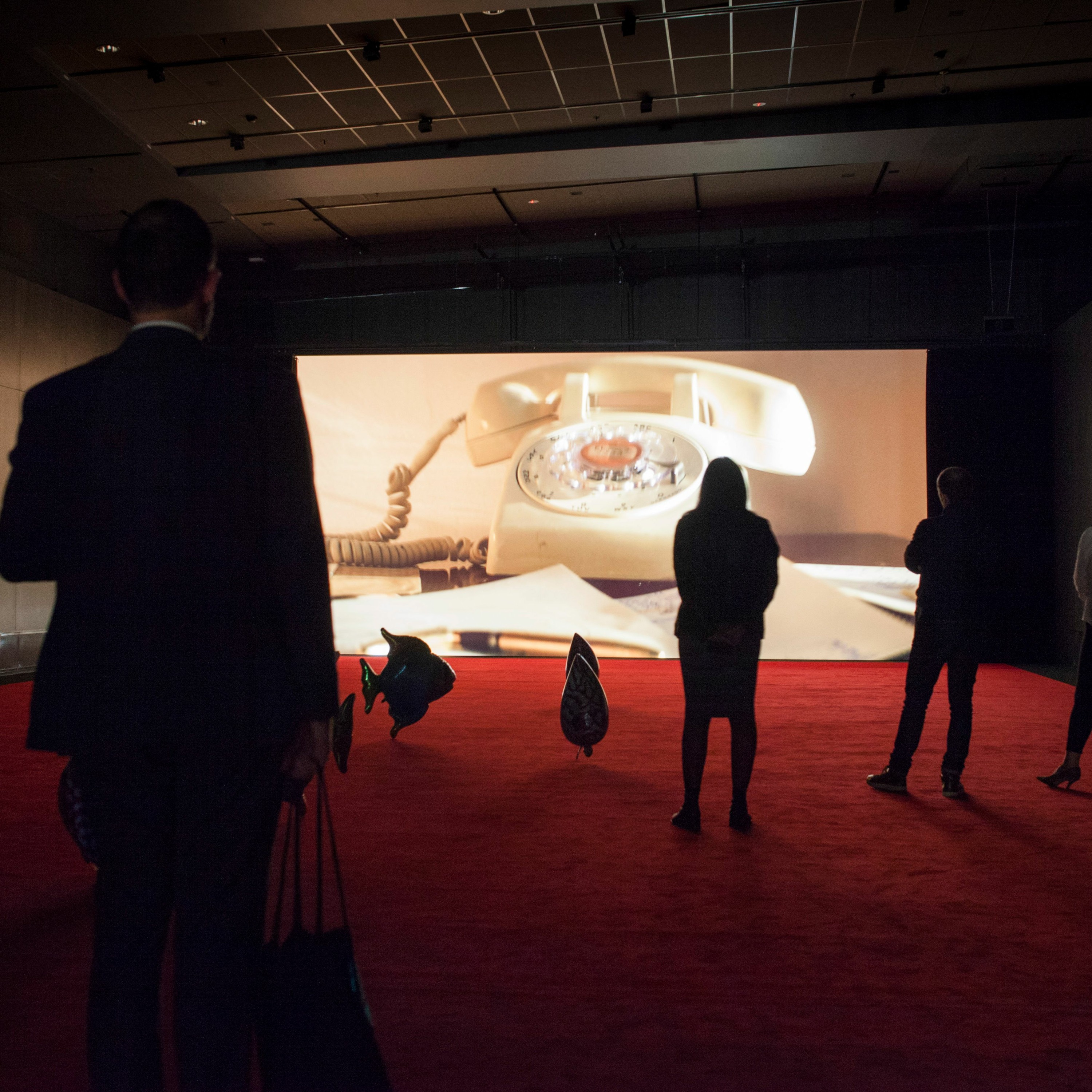
which is, I mean, I think of now, Acme is basically transformed into a music box of some kind. The entire place is filled with sound. It opens with this sequence of flickering lights, and we have these floating... Have most people been downstairs? Yep. These floating fish, and it's only in the second room that we get to be confronted with this enormous projection screen preceded by the booth of the projectionist, which is also, in a way, announcing the event before it happens with the annunciation of the commentary. And on the screen, we have a selection.
randomly programmed in between other sections of lights from the marquee of, I think, 33 or 34 of your films. So obviously it's impossible to see the films. In fact, you probably, even if you came back every day, because they're all randomly selected by the projectionists, you'd never really be able to necessarily cover all of the cinematic material in this space. So there is a sense that the material is exceeding the temporal frame of... Maybe if you could talk a little bit about how this... It is funny. Actually, there's a heap of humour in this.
that you can't see it all because it's too, as you say, it's too much, you know, so it's like... Well, one screen to hold 34, one screen with the capacity to hold 34 different images, but also with the curtains going in and out to, you know... Yeah, so what's your question again? Ah, the question. Oh, I was just thinking about, could you tell us a bit about how this exhibition came into being and the relationship between the different elements and, yeah. The question of the programme was a, sort of, became the problem since a long time, in fact, how to, we talked about that earlier, but how to...
inscribed into a time frame, you know, how to trigger events. So we had at the beginning to work with a white noise, you know, a timeline that was running, you know, a noise that was running, and then we hang on that time code events. And that was a protocol of any of the shows that were doing at the time. And then slowly I tried to get rid of that and operate differently, either by Adetate, now we have Yeast that control the show. And, yeah, we have people controlling it. You might want to say something about that. I mean, yeast controlling the exhibition is a...
obviously it's a way for you to step back as a choreographer and displace the responsibility onto a microorganism, which has its own challenges, I imagine. Yeah. Well, now they seem to be stuck into a sort of a loophole, so everything is static and doesn't move. Because the... Because they are like in a... Because the yeast is happy? They have a statue of statu quo, you know, they don't grow and they don't die, so they're just like there and they freeze. So the show freeze is kind of interesting. In that case, yeah, it's a... I've been thinking about that for Tate as well. We talked about this idea of having a figure that appears in the...
Indonesian theatre called Dalong. Dalong is a puppeteer that operates Shadows puppets. But also he conducts an orchestra. And he's able to play like that for 10 hours. So he has a training. And I think it would be quite interesting to start to work with non-actors acting.
But then it didn't happen for Tate, so I tried out here. So we called them the projectionists, which is kind of an interesting idea of the projectionists. So the people, I've got a picture of that, I think. We have an image of the projectionists. So this is the screen with a marquee. Are you calling it a marquee? I mean, I'm presuming it's related to the marquee. It's a marquee, yeah.
Because before, you were making quite explicit, very, I mean, they look like marquees, the kind of entrances that you'd find above a cinema that would announce the coming of a programme, also to signal that there is a doorway, I guess, you know, the big flashing lights. Yeah, but you see, I didn't really start to, now, yes, it's what it is now, literally, but I didn't start, I don't think like that, you know, I started at the beginning to do a, it was for the show in Arc, I believe, the show where Jean Lannier was, who invited Jean Lannier to work with me, I had labels, you know, because it's a museum, so you have to get labels, so I decided to make them flickering. Because, you know, of what we talked before about, you know, it was uncertain about everything of titling and stuff. So I start to flicker. The label was flickering. And then I did another show where there was no work, but only a big label, basically, you know? And then the marquee came from a show I did in Berlin where there was nothing inside. Well, I believe there were blinds moving up and down. But there was the marquee outside, you know?
flickering. Actually, it kind of reminds me of some pieces that Buren did. I can't remember which year it was, but he did that amazing piece with the striped... The Guggenheim. No, no, no, before then, that you had to... If you wanted to enter the museum, you would have had to destroy the work because it covered the doorway of the... Yeah, must be one of his strategies. Yeah. Yeah. Yeah, I don't remember. So I did that... So I don't want to say... So the marquee basically... I mean, the label took the place of the artwork that was supposed to be labelled, right? So...
And so they came like that, and then I started to develop them because it was an interesting thing to do. And partly because it's occupied in our space, which is quite decorative. So it quite looks good. And occupied space is not really occupied by art, you know, it's between the ceiling, you know. And then when it comes together, and that's the part where I go back to my feet, you know, when I come together in an exhibition, they are...
It's an instrument, you know, so I can play them. Meaning that when they go back to their collection where they belong, they're decorative objects, they don't do much, you know, they lose their performativity, that they gain only when they get to be exhibited. So that's how I approach that series of objects. So this one here for ECMI is new? It's a proto-object. I don't even know where it's going to... And does it go with the screen or does it not go with the screen? I mean, it's behind the screen. Would you ever exhibit it without the screen? Because the screen is obviously also functioning as a projection screen. Yeah, maybe we'll see. I have to think about that. So maybe we'll see. I'm going to do that. If I keep doing something like that again, that would be it. I'm not sure.
So let's come back to the projection booth then, shall we? With this projectionist, who I think also, I mean, you've used various kinds of words for the projectionist, sometimes also puppeteers and hosts. But they're doing a lot more than choosing the films, which I believe you're leaving up to them largely, or how they're also announcing the works. I kind of like through the projectionist, maybe it's the right word, because it's introduced also this nice idea of séance. All right, yeah, yeah, okay. You know? And...
which I think is a lovely word, séance. And it's, because he says about cinema, séance to cinema, he also says a sense of psychonalism, you know, it's the same word, it's a séance, because it comes with screens, you know. And we talked about that earlier, because a séance, in terms of this idea of a floating attention, there's something that floats in a séance. A séance is a moment given where there's a, possibly something may happen, no? Something may occur in a séance. That's the definition of a séance.
It's an interesting word. So projection is a good one. Let's stick to that one. Well, they both have the screen association. I mean, I think for English, maybe projectionist does a similar function. Yeah. But the role of the voice. So they're not just choosing the films. They're also speaking them into being. I mean, they're telling stories about the films, right? Like you refuse to have the labels or the labels stood in for themselves or the labels glow in the dark. In this case, the labels are spoken. And if you're not there when they're spoken, then you miss the narrative.
Yes, the... Are they labels? I mean, I kind of thought of them as being like spoken... They're like labels, yeah. They're labels, yeah. And they also give a bit of a... They don't put credits in films, you know, so it's also a way to maybe name people when they are to be named. And it's also to give a context in which a film may be known. There's always in a film, there's always a meta story, you know? There's a film and there's a film of the film, so if you want some time, I'd like that part. Because the film, you can experience it, you can like it or dislike it, but it's there, you know? But what you may not know is the structure behind, you know, that produced it.
Make sense? Yes, but you didn't answer my question. That's okay. I'm going quickly through this so we can also have time to actually talk about some of the individual works, which I think is useful and interesting for us both to do. But the fish, maybe we could revisit the fish in relation to that idea you were talking about earlier of floating attention and these elements that, I mean, if you're making the museum into a temporary enclosure, like an aquarium, for example, or a music box, then there are these elements that in this particular installation, or not installation, sorry, you hate that word.
animated by the people who are inside that frame, but also they are themselves animating us because there is an interaction there. Yeah. And you used the fish also at the Tate. I used fish at the Tate. I used it before in the show in New York. And I used them before, even early on, for an exhibition called Vicinato I did in Milan with Carsten Heller and Wicker Tilleran. There was also fishes floating in the space at the time. Which was actually very early, like 95. Yeah. And the fish. No, they're interesting because it's...
I'm not sure about the metaphor of the aquarium, really interesting, but it's more a form of animism, you know, that they move, they look like something with eyes, so you can, of course, have an empathy with things with eyes, you know, and they make you aware, if you're not, of the vortex, you know, so it's more like to see what you feel, you know, and so that's how they appeared for the first time into the shows, you know. It's more this awareness of... Of air change or current. Of atmosphere. Of the building. I mean, it's kind of architectural as well in response to the space. Absolutely. They're getting trapped near the air conditioning ducts I noticed below. I don't know. And then they sit at the front and watch the movies with everyone. It's nice. But you have a lot of animals in your work. I mean, you have the yeast, you have microorganisms, you have the water buffalo in the boy from Mars, you have a cephalopod, you have many different kinds of animals. And what is with that generally?
I have a character, and Liz is also an animal to me. She is? In a way, yeah, because there's something about, well, she's not human, and it's, no, because I see, the way I think we approach that with Pierre at the time was really much, there was two aspects of the project. One was to say, it's a sign, and a sign can produce a connectivity, was the way around, no? So that was one aspect of it. But the other aspect was the fact that we dealt with a fictional being, you know, but with a being, nevertheless, you know?
And by giving to the being its own right, copyright, you know, it became, yeah, it started to have a sort of weird status, you know, and I kind of was interested about that because there's something about that and it becomes a monster a little bit, you know. There's a monstrosity that was interesting in the project only. Like Frankenstein kind of. A little bit, yeah. Because you start to, you start to, you start to blur, which I think is an ongoing history that we are, and today we are doing that clearly more and more. We are, in fact,
the relation between the fiction and the real are much more blurry, you know, than the hour before. So it's... And I'm interested by that, by that blur, you know. What about the whole, you know, post-truth Trump era where maybe it's a problem that the fiction and reality are a little bit too interchangeable? But if you were... No, of course, but that's a contingency of today, but that's not so interesting, I think. I mean, it's interesting, but you see what it is and we have to suffer from... We don't have to talk about it anymore, but it's... No, but in fact, you can see that in our daily life. If, for example, you say...
an hurricane is announced, you know, on the radio, you know, and you spend your day kind of like thinking that this possible future, you know, will basically change your now, you know, the time of your present, you know. So in a way, the fiction, and we talked about fiction and science fiction, the future, in a way, change your present, or your sense of the present, you know. So in that way, I'm talking about it. I'm talking about that we're much more aware that we actually are affected by fiction on a daily life, you know. How do you think that's changed? I mean, you've been working with these ideas since the 90s. And if the awareness is getting more intensified, how does it change, I don't know, one's relationship to form, to time? I think that we have to negotiate our presence every day, all the time. And so it's a form of an ongoing negotiation, which I found quite fascinating. We talked about that earlier with time.
being no longer a measurement, you know, for pulse. Yeah, pulsing time. Pulsing time, yeah. Because I guess in a lot of your works and also in your exhibitions, I mean, there is this playing with temporality in a science fictional kind of way. Like this is CH said, continuously habitable zones. And I think it is exactly what you're talking about, about this idea of the reality and the fiction merging because it comes from the creation of a garden that was made only for the purpose of being filmed. Yeah. It's that. It's also what we talked about the Marquis before. It's a bit also there's something perverse in it that way, you know,
It's literally a film that was produced by a garden, a garden produced a film, so that two headed beasts, you know, that I did before with a... Another film, Boy for Mars, where an architecture produced a film and the film produced the architecture. But what I like... You mean that very literally. I think we need to explain a little about what that actually... I mean, it sounds extremely poetic, a garden produces a film, but you're very literally making a garden that produces a film because the garden is a set. Yeah. So maybe you could talk a little bit about the production. In that case, a garden was produced with only black vegetation and it was, you know, following up the hypothesis of photosynthesis in the wolf planet. Black photosynthesis, you know. Yeah, such a great thing. With the... With the...
with the hypothesis of a planet exposed to a dwarf sun. And it's true, it's a true hypothesis right here. Because you wouldn't have green foliage. Yeah, so I found it interesting. But this was the science fictional aspect of it. But then what I liked about it, there was two added bits. There was on one side a film that will be exposed in museums and be collected.
But then there was like this growth, you know, the garden that will survive. Which is really in a site in Portugal, yeah. And so when you, so you have two, the object basically is never, it's not a garden, it's not a film, it's somewhere in between. And so you have the film in a collection, but then you don't really have, you just have a film, you know. So there's something else linked to it, which is an excess, you know. The film has an excess, it leaks out in the real, you know, and it survive, or try to survive, you know.
It's own production. And, I mean, you've described the garden also as a kind of monster leakage waste product of this production of fiction by reality. I mean, where is this garden? Could you go there and visit it? Yeah, it's in Portugal, yeah. But if I say I wanted to go there, would it be very difficult for me to find it? No, I will send you the address. No, I mean, not like actually practically. Although maybe it would be interesting. Yeah, but the thing is that it's not, I mean, you could, we can go and see it.
But it's not so interesting. It does have black plants. You did find plants. Well, the plants are now sort of like trying to get, I mean, they get polluted by the other plants. So the image is slowly fading away. And that plus the fact that it was shot, it was plant and organized through the point of view of the camera. So some of the shot doesn't make sense when you walk. Because it's a bit like a weird anamorphosis, you know, if you don't have the point of reference. It's just like a blurb, blurb, blurb, you know, can inform kind of like.
So it's not really so interesting, but I like that. Anamorphosis is quite a good way to talk about it. It's anamorphosis. It's on one side you have a film and on the other side you have this thing. That doesn't make any sense, you know, because you lose, you lost your point of origin. So, I mean, doesn't that suggest that you need to create a single point that the spectator inhabits then? And that's the camera that does that? It sort of imposes this or unifies these two different temporal, physical, the future, the present, the what if unified by the camera? Yeah. Yes, because it's not only one, unlike anamorphosis, it's only one point of view.
I don't know, many scenes we have, 10 or 15 scenes, so we have a lot of different points of view. So it becomes a sort of a weird topological elaboration, you know, with... It also does very strange things with scale, because when you're watching this film, it feels like you're completely disembodied in a way. You're sort of travelling along these tangled black topiary tunnels emerging into these crystalline rivers of... I don't even know what that is, but... Scratch glass, bottles. But you artificially created, which also looks like the surface of an alien planet, or there's this sense of scale changing and shifting. It's quite close. In fact, when you look at it, it's quite close to a sort of polluted kind of area. It's a bit like something a bit strange, which I really like a lot, you know.
Yeah, because it doesn't have this kind of idea of a pristine kind of a small. That's why I was thinking in excess, it's quite better, you know, it leaks out and it's not like, it's not pretty, you know. That is beautiful. Yeah, as an image, it's beautiful, but in the real, it's less pretty. In the real, it's yucky. Here's the, so this is the field. I mean, I'm imagining that this would be relatively close to how it might look, right? Yeah, that's quite big. But how is that different from a set, for example? I mean, all sets for films are made for the perspective of the camera in a certain way. Like, we might think about this in relation to what you did for Marilyn. Yeah, but then the set disappears, you know.
Except for this one, from Zatterboy for Mars. This still exists, although it lost completely its functionality because it doesn't produce any electricity anymore. So this was a project you did in 2003 in Chiang Mai. Oh, sorry, on the land, on recreates property in the north of Thailand. And the building was producing the electricity that was...
used to make the film. So there's this sort of loop between the energy and the image. At the beginning, there was a need for this project to have an architecture that will produce electricity for the students to come and be there. So there was a need for building with electricity. And in order to build it for them, I decided to make a film that I could sell. So that was the story. So unlike the garden, this had another purpose. It lost relief because the project was faded away. And that also was left abandoned. So it became sort of a...
left over. And I saw it recently, a few years ago, it's not pretty. It's left over. But I like that dichotomy between the fiend that we see and something else that survives it. Yeah. This is from the cephalopod. This is related to the earlier question with the animals. So you actually have a cephalopod in your studio at the moment. Yeah, I do have a... I have a shot in the studio.
The Cephalopods came into my life for a show I did in Paris, and it was my first survey show as an artist, and I was wondering precisely how to program the exhibition. So I asked a guy that always wanted to meet, who was the inventor of the virtual reality world, and invented that. The data glove, you know, the goggles. He was a fantastic inventor. He was also a musician. So I asked him to come and help me to program the exhibition. And we talked a lot, but he didn't program anything. But he came with this, at the time, he was working on a new computer model that he called an anthropic, a computer that will work with all the software. So it will be worked by contact. If a user uses it, then the computer becomes smarter, you know?
and pretty much like an instrument. So he was working on that and he said, I don't want to program anything, especially not for you, but we can maybe address it by having maybe a form appearing each time something happened into the exhibition. And we talked about the Cepard-Lepot, the chromatophore, the change colors and change forms, you know, according to the contact, you know, besides the computer he wanted to build. And he had this idea, so it would be great if when something happened to the show... this creature appear. And so we did that. It was a contribution to the... And these creatures haunted me since then. So at the end of last year, I decided to build an aquarium and to have them with me. So they stay in the studio now. And you made a film, which is, I guess, not the live version of the event triggering the appearance of the cephalopod, but using the program, which is also downstairs. The film is downstairs. The film is downstairs. Can you explain a little bit more about how the cephalopod and the contact works? It's a...
Jarron was talking about the fact that cephalopods, they don't have a... They have what he called a post-symbolic way of operating, meaning that instead of using a word to say something, they become the thing. And so a cephalopod sees an algae or touches an algae and becomes the algae, because his instinct is to blend in and to become invisible. Like literally, with the camouflage. Yeah, with the camouflage. And then all the studies have been run through them. We understood that they also...
can synchronize patterns, you know, to each other, to produce weird pictures for the predators. So a shark comes and two people come together and start to synchronize patterns and the sharks are afraid because they see the weird creature. So they do fantastic stuff like that. And I was impressed by them because it becomes an ultimate form of artist. that can morph and change. But it's not representing something. I think it's that post-symbolic bit that you're really interested in here, this idea that it's not a representation of an algae or a rock or an environment, but it's actually an extension of it. And that extension is made through contact, which is something that leaks out of this work and into other parts of your practice. Yeah, it's an environmentality, you know. Viral. Yeah, it's sort of like it becomes conscious of its surroundings. It becomes him all the way around, you know.
I found it quite fascinating. In fact, they do have a fantastic brain all over the body. They have many brains, don't they? They have many brains. Yeah, they have a fantastic way they touch more than we do and better than we do. The only problem they have is that they don't last long. They don't have a culture either. So that's kind of not good. To rule the world, you need a culture. So they don't have a culture. But that's what we try to do. We try to teach them so they could have a culture. If they have a culture, they can rule the world. This is an alien invasion. Yeah. I'm working on it. Yeah.
Just coming back to that idea of the, I mean, this was the first time that you thought about using an external agent, we might say, to influence the presentation or sequence or duration of the elements that are inside the museum frame. So there is, I think, this continuing tension between having the rules or the program or the choreography and having this aleatory chance random. elements that can't be controlled, for example, with the yeast. Could you talk a bit about how you might... It came out from... Nicola, maybe, is there some designer I've worked with since many years? And in fact, we started to do stuff like that by... You talked about the box earlier. One of the many problems I had with art is precisely the fact that modernity created boxes for everything.
a box to look at moving pictures, a box to listen to music, a box to think inside, a box for things. And by trying to, because sound is an element important to the work, we try to open a little bit the box. So the box or the museum starts to become... conscious of its surroundings. So sound will be, you know, the sound of the outside will come inside. So you did that literally at Bayer with the water lilies, right? Yeah. But we did that before in Bobo. You know, we did that at Bing. It was really simple to place the microphone outside. And then it became more complex. You know, Nicolas came for this fantastic idea of digging the ground and taking the waves, you know, at the centre of the earth. Which became the soundtrack for CAC. Yeah. But you have that in Bayer that shakes a little bit. So we started to
to expose the space, the box, to its contingencies. When the plane is passing over, you can hear the plane going through the ring. So it's no longer a closed box, but it's open. And so that also produces chances and situations. And live elements. I mean, one thing, we do have humans in this show walking around and talking and doing things, but it's, I think, less theatrical than some of your other presentations. There is this element of theatre, of choreography, of scripting, which we might talk about in relationship to ventriloquism or puppetry or control. I mean, who's pulling the strings on those? These are recurring threads. Yeah.
The ventriloquist, the character. Yeah, ventriloquist. The ventriloquist is interesting because especially today with the technology, it's some kind of a weird kind of dying art, you know. But I was fascinated by the fact that one of the most well-known ventriloquists, back in the last century, was well-known because he had a radio show, which I found is fascinating. Yeah. So in that case, we have a voiceover picture, you know, but we have a...
I mean, a lady that talks without opening her mouth, but it's a film, so it could be, you know. So I kind of like this, it's funny. And he has a sort of, as a ventricist, who had beginning a priest, you know, he was making the God speak. And so it's kind of interesting to go back there a little bit, you know. And for Marilyn, it was the same. There's also the recreation of the voice that Nicola did, which is also kind of a weird thing to do, because it's a...
Of Marilyn's voice? Of Marilyn's voice, yeah. Should we talk about that a bit? Yes. I know we're so jumpy, but sorry, people are like bang, bang, bang. We're okay though, right? I'm fine. It's okay. Narrative. You're the doctor. You should be more structured. I just don't have it in me. Let's talk about this one. So this is Marilyn, which also has this element of ventriloquism, which is also, I think, going back to this idea you mentioned earlier about seance, and we have sort of elements of phantasmagoria, these 19th century Victorian supernatural almost.
aspects to your practice, which sit very strangely at some times with the techno, with the technological, but are both related to technology as an apparatus for making things appear, making things visible and making things invisible. So in this film, like the camera with CHZ, we see through the eyes of Marilyn, a space that she inhabited in the 1950s in New York, the hotel room in the Waldorf Astoria. And you created three automatons, you said, for the making of this movie. We had made the voice. The project really started by... I was intrigued by the fact that maybe...
Because I went through the notes of this book about the notes, it was published recently, the notes she wrote during her life. And I was fascinated to read that because I realized that the disease, she was suffering from a massive depression. But at the end, you could say that it's the first time maybe where it was clear that an image could kill a person. She was killed by her own image. And so the film was, for me, that was the starting point, to say. And I wanted to make a Fantasmaléria séance in a way that I wanted to remake.
to liberate the image, you know, from that traumatic event. And so what we did is that we, what we did, what you normally do when you do a fantasimaguration, is that you bring the element that belongs to the person. Did you do this, for real? Yeah, we had, the day before, some weird people came to, yeah, it was spooky. What did you have of hers? We had, well, we created, we recreated, we recreated, so, handwriting.
which was a complex thing to do, maybe the most complex thing to do, because it's difficult to imitate human handwriting, for all the reasons you can imagine. So that was a long process. We did that in Germany with a lab. You made a machine. We made a machine. So as you can see, if you would notice, you're writing an A before an L. It's not the same thing than an A before a T. And an A before a T at the end of a sentence is not the same than an A before a T. A lot of parameters. So it was really long and complicated. And then plus, of course, the randomness of friction of the paper and so forth. So it was a complex thing to do. And then we had that.
And then Nicola did the voice of Marlin, which was basically did with, he worked with IRCAM, the National Center of Research in Music in Thais, and reproduced the prosody of the voice. And we mapped that prosody of the voice onto a puppeteer, who was an actress, who would say the word, no, with intonation, so. And you wrote a script? Yeah. No, there was no script. It was more the voice basically describes what the eyes see, what you see. And then there's the camera. And then what the camera is the eyes. But you see the camera, the handwriting, and the voice, they all operate on the same algorithm. So it's basically an algorithm that brings a person alive. And if you have the signature, the handwriting, the eye, and the voice, you have basically a biometric portrait.
So it's enough for a computer to decide that you're alive, you know? Or you have a passport or whatever, you know? So that was the project, yeah. A bit spooky. It's one of my favourite films in this particular...
iteration. But what I also like about it is the way the machine... I mean, the entire film is a machine and it is machinic in its vision. But when it is inserted into a space like this with the automation of the system around it, there's a way that it relates to its own context. And I also like the way it's so anthropomorphic. I mean, there's this moment in the film where it's almost like the machine starts to lose its mind. It stops having the capacity to produce script as if writing or the logos or the word is this sign of its...
you know, selfhood, in a way. But it becomes this lost, I mean, it's very dramatic. It's a super dramatic, very romantic movie, right? At the beginning, of course, you want to, you say, great, it's a fiction, you know, it's nice, it's cozy, you know, and then, not because fiction is cozy, you know, it's kind of nice, you have a distance between you and that, you know, and then slowly you understand that, because you want to believe, you know, you want to believe that the environment was voiced, you want to believe that, but then you start to realize that the automaton presides, because the automaton can do anything but repeat itself, you know, so the words start to come back. again and again and then after a while you start to realize that you are into this weird and canny valley where it looks human but it's not human you know and therefore spooky Psychosis. And, I mean, the woman who was destroyed by her becoming an image is then brought to life through image technology and it falls apart as it is made mechanical in some way. So there's, again, all these boundaries between what is alive and what is dead. That particular border between the living and the reality and what does it mean for an image to be alive is something that I find, I mean, that's really interesting to me. What are the parameters there? This was the last one that we wanted to talk about. That's our time. OK. So this is Li Yan.
I also picked it because it's one of my favourites but I mean it's in some ways a sequel to The Invisible Boy which we didn't really talk about but is in the film but I just wanted to flag it here mainly because unlike your other film projects this work incorporates elements of your other films inside as if they were characters almost so this film is like a retrospective of your film that's how I see it a mini retrospective within just that filmic duration yeah it's again there's always a few layers in things but with respect to the film, is that the fact that I would think about that when I did a show at Armory, when I presented a few films on the screen, and I would think that maybe the space of either will be a typical film, it should be a film, you know, it should be a film. So I started to work on this idea. And since I always re-edit a film that I do, I know I started to play again with the former footage, and I introduced them to this one, and then there were a few iterations of it. The first time the film was shown last year was a totally different version. This was a new edit.
So it's also that today it's easy to edit films constantly. So Marilyn, there's a lot of version of it. And now we screened the one with Morten Feldman's music, but at the beginning there was music by... After Lindsay, the editing was quite different. The crowd also had a lot of different versions of it. What does that do for the people who are collecting your work? It's a nightmare. Do you send them the new version? Yeah, I do. I keep sending them an upgraded version. The 3.0 version. That's great. But it's a small problem for art historians because you don't know exactly. And even people are confused because you say, which one again I'm going to show you? Which one have I seen as well? Yeah, which one you've seen. So the film changed over time.
And that's something that I will keep doing, you know. It will be harder, I think, to do it with an object because people may freak out. Although, I also, for the Christmas, for the chance, I will paint them. You can do it with the mackets. You can redo the mackets. No, but it's the reason why is that I was fascinated years ago by those as a metaphor, you know, but sometimes they're useful. In Mali, you have this object that was created back in 19th century. Now, you know, you have fake, but for a while, it was really operated really well. And they're called...
I don't remember the name now. Bully, Bully. And the bullies are these objects that come from men rituals, you know, and they are in shape, they're made of blood and, you know, tissues and fetus and stuff, you know, and they come to the ceremony and they do that part. And then when the ceremony is over, the priest will bring the body back to his house and will be fed by grass, blood, stuff, you know. So when the body will come out for the new ceremony, it will have a slightly different...
form. Right. To eventually, by becoming oblong. So there's a continuity, even if the external... And I like a lot because it's the fact that it says really clearly that each time an object is exposed, it changes. It changes. Duchamp said it many times already, so we know that, but it's literally the case in those ceremonies. And I do believe that art also doesn't really escape the ceremony. It's also a ceremony. It was created, in fact, not so long time, like, what, 200 years ago, people started a museum for art. It's not a long history.
and uh well we have a lot older and uh and uh yeah and uh well you can talk about that well i think we're out of time now yeah so it's uh so it's a form of yes a form of ritual you know the show the exhibition change the object it's supposed to be presented Are we done? Done. Thank you for a fascinating conversation. You've touched on so many different areas of Philippe's work. So thank you everyone for coming. I hope you will all come back many times to see the exhibition, as we've said a few times. Every time you come back, you're going to see something different, so it's a very different experience. And please join me in thanking Amelia and Philippe. Thank you. You have been listening to an ACMI podcast. For more recordings, go to soundcloud.com slash ACMI online or the ACMI website.