
EPISODE · Jul 9, 2026 · 19 MIN
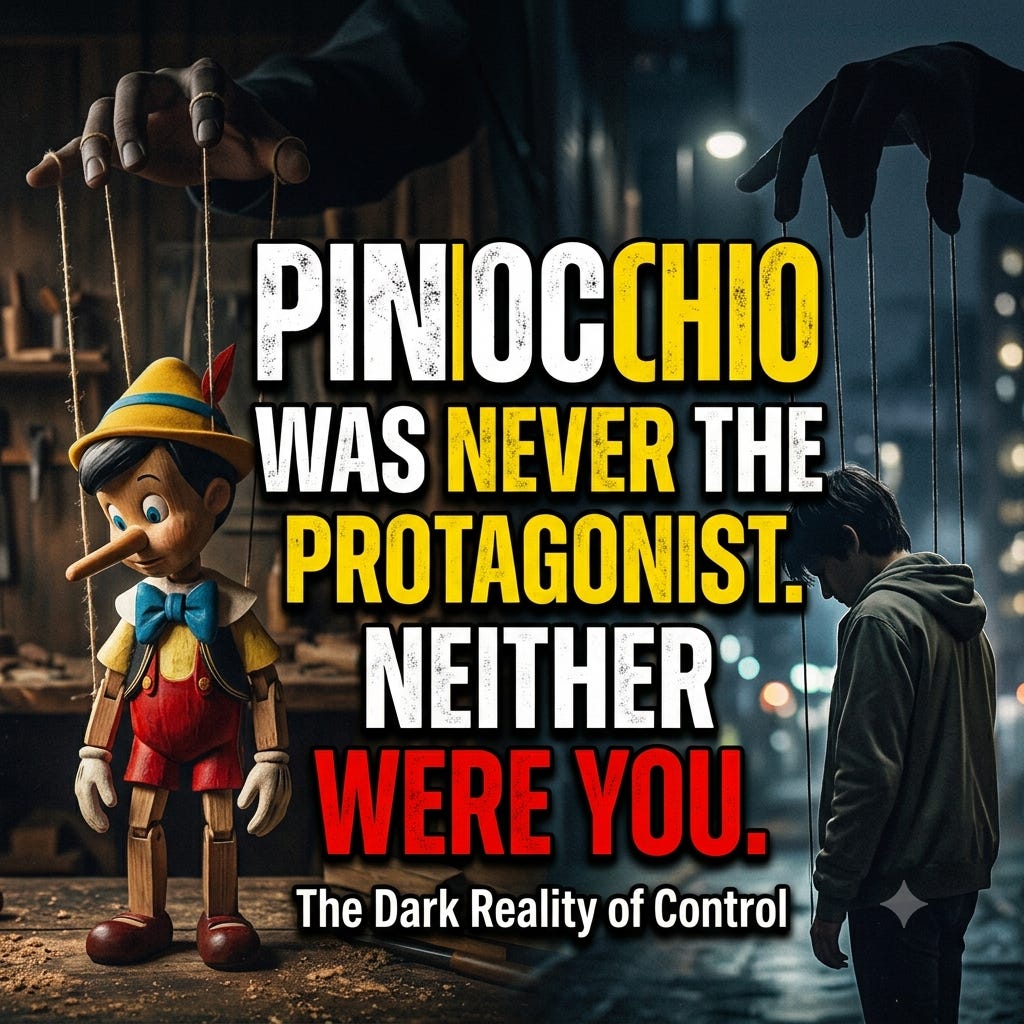
Pinocchio Was Never the Protagonist. Neither Were You.
from The Experience of Adoption · host Thoughtless Delineation
The cultural monoculture frequently invokes The Matrix. The myth of Pinocchio operates on a more devastating frequency. It shifts focus from a fabricated world to a fabricated self.For the adopted person, awakening is not merely recognizing systemic illusion, it is a brutal forensic reckoning with having been constructed, commodified, and conditioned to fill an existential vacuum. This analysis examines that reckoning through five structural dimensions of the Pinocchio narrative.1. The Architecture of Creation: Object as Solution to GriefIn traditional narrative, identity begins with lineage, an organic continuation of biological history. For Pinocchio, identity begins with craftsmanship. He is carved from wood by Geppetto, a lonely artisan seeking to assuage isolation.Systemic Vacuum (Grief / Infertility / Unfulfilled Narrative) leads to Act of Creation (Legal Adoption / Emotional Crafting) leads to The Expectation (Object Must Heal the Creator’s Wound) leads to The Implicit Contract (Fill the Carved Space Perfectly).Structural DynamicThis architecture mirrors modern adoption’s foundational framework. The adoptee does not materialize as a neutral entity; they arrive as a solution to pre-existing conditions, often infertility, grief, or the desire for a specific family narrative.The brutality of awareness: realizing your existence in this ecosystem was predicated on utility as a balm. Like Pinocchio, the adoptee enters the domestic sphere to play the missing child. The child’s complex interiority remains secondary to their primary systemic function: to seamlessly inhabit the form carved by adult desires.Key insight: You were never the subject of your own origin story. You were the object that resolved someone else’s plot.2. Stromboli’s Theater: The Commodity of the “Good Story”Once Pinocchio enters the wider world, he is targeted by entities recognizing his unique status as a living object. In Stromboli’s puppet theater, he is a sensation, dancing without strings, generating applause and profit. Yet the moment the performance concludes, Stromboli locks him in an iron birdcage.The Performative ExpectationThis is the definitive metaphor for society’s transactional relationship with adoptees.The Transactional Script: the dominant cultural narrative demands adoption be framed exclusively as salvation, luck, and unmitigated rescue. Adoptees are publicly applauded when they perform this script flawlessly, expressing gratitude, exhibiting successful assimilation, validating the system’s benevolence.The brutality of awakening is realizing the terms of this visibility. Applause is conditional: celebrated only while dancing within expected narrative parameters. The internal cage holds grief over maternal separation, anger at identity erasure, curiosity about biological lineage, all swiftly punished. Clarity gets reframed as defect: systemic critique is pathologized as personal dysfunction, maladjustment, or ingratitude.Key insight: The cage is not a punishment for failure, it was always there. The applause was merely your distraction.3. The Blue Fairy and Conditional HumanityPerhaps the most insidious layer of the Pinocchio myth is the Blue Fairy. She possesses absolute institutional power to grant Pinocchio his deepest desire: to become a “real boy.” Yet she refuses unconditional transformation. Instead, she imposes a rigid behavioral contract requiring proof of bravery, truthfulness, and unselfishness.Only after achieving this arbitrary moral standard will baseline humanity be granted.The Conditional FrameworkFor the natural-born child, baseline humanity is granted; they are allowed to be flawed, angry, or lost. For the adopted child (Pinocchio), baseline humanity must be earned; they must maintain perfection and gratitude.The Core TraumaNatural-born children are afforded the luxury of unconditional belonging. They can be selfish, dishonest, or cowardly without their fundamental right to exist within their family being legally or emotionally renegotiated.For the adoptee, the societal subtext differs profoundly. Because their placement required legal intervention, financial transaction, and severing of prior bonds, their belonging is implicitly framed as earned privilege.The pressure to be “good”, never causing trouble, excelling academically, remaining hyper-palatable, is not virtue. It is survival strategy.Waking up to the Blue Fairy dynamic means realizing you have been running an endless marathon to earn a baseline level of human validity that others receive simply by being born.Key insight: The test was never about your character. It was about your compliance.4. Pleasure Island and the Regression to the BeastWhen the burden of performing conditional humanity becomes unsustainable, Pinocchio deviates. He escapes to Pleasure Island, a place of total lawlessness where boys indulge vices and reject authority. But Pleasure Island is a trap: the longer boys misbehave, the more they physically transform into donkeys, destined for literal slavery.The Reclaiming of AutonomyFor the awakening adoptee, Pleasure Island represents the perilous path of reclaiming autonomy outside the sanitized script.When performance stops, when the adoptee starts expressing grief, setting boundaries, exhibiting depression or rebellion, or refusing the “grateful child” role, the system’s response is immediate dehumanization. The “beautifully rescued child” is reframed as the “damaged, broken product of bad biological lineage.”The warning underneath this dynamic: if you do not maintain the mold carved for you, you will be reduced to a beast of burden, carrying the weight of your own supposed pathology.Key insight: The beast was always your potential. The transformation was their perception of you the moment you stopped being useful.5. Cutting the Strings: The Radical Act of Self-AuthenticationThe ultimate tragedy of the sanitized Pinocchio: he only becomes “real” when he dies saving Geppetto, fulfilling his utility to the creator, which finally prompts the Blue Fairy to transform him.A forensic, emancipated reading demands a different conclusion.The true awakening is not finally winning the Blue Fairy’s approval or satisfying the creator’s emotional void. The true, brutal, liberating lesson is realizing that the Blue Fairy’s scale is rigged. You cannot heal the system that fractured you by trying to be its perfect product.The Path to ReclamationPhase 1, Acceptance of the Wood: profound acknowledgment that your history was altered, your records were amended, and you were shaped by hands other than your own. Stop trying to pass as someone who has never been broken or modified.Phase 2, Severing the Mechanics: the active, terrifying choice to drop the performance. Stop dancing for the applause of a society that demands your silence as the price of admission.Phase 3, Self-Authentication: declare yourself real, not because institutional authority or adoptive contract validated your behavior, but because you possess the sovereign right to your own messy, complex, un-curated humanity.The Price and The RewardThe transition is brutal because it requires mourning the boy you were carved to be.But it is the only path toward standing on the ground as an autonomous, self-determined human being, wholly real, entirely on your own terms.Forensic Summary: The Adoptee’s Awakening TrajectoryCreation: carved to fill Geppetto’s void, parallels being placed to resolve adult grief or infertility. Awakening moment: realizing origin was about utility, not love.Performance: dancing for Stromboli’s profit, parallels performing gratitude, assimilation, palatability. Awakening moment: seeing applause as cage, not validation.Conditioning: the Blue Fairy’s moral contract, parallels belonging framed as earned privilege. Awakening moment: recognizing the rigged scale.Deviation: Pleasure Island’s trap, parallels rebellion, boundary-setting, grief expression. Awakening moment: experiencing dehumanization for authenticity.Emancipation: cutting strings, parallels self-authentication. Awakening moment: claiming humanity without permission.The Sovereign ActThe adoptee’s awakening is not a single moment but a sustained confrontation with objectification. It is the slow, excruciating realization that you were never the protagonist of your own origin story, you were the object that resolved someone else’s grief, the puppet that danced for someone else’s validation, the product that proved someone else’s system worked.Yet within this forensic recognition lies liberation.When you stop asking the Blue Fairy for permission to be real, when you stop dancing for Stromboli’s applause, when you accept that your creation was contingent but your existence is not, you become something the myth never anticipated: not a real boy, something better. A self-authored being who has seen the strings and cut them anyway.“The only way out of the cage is to stop believing the cage is a stage.”This Substack is reader-supported. To receive new posts and support my work, consider becoming a free or paid subscriber.Presesntation This is a public episode. If you'd like to discuss this with other subscribers or get access to bonus episodes, visit thoughtlessdel.substack.com/subscribe
Embed this episode
NOW PLAYING
Pinocchio Was Never the Protagonist. Neither Were You.
No transcript for this episode yet
Similar Episodes
No similar episodes found.
Similar Podcasts
No similar podcasts found.