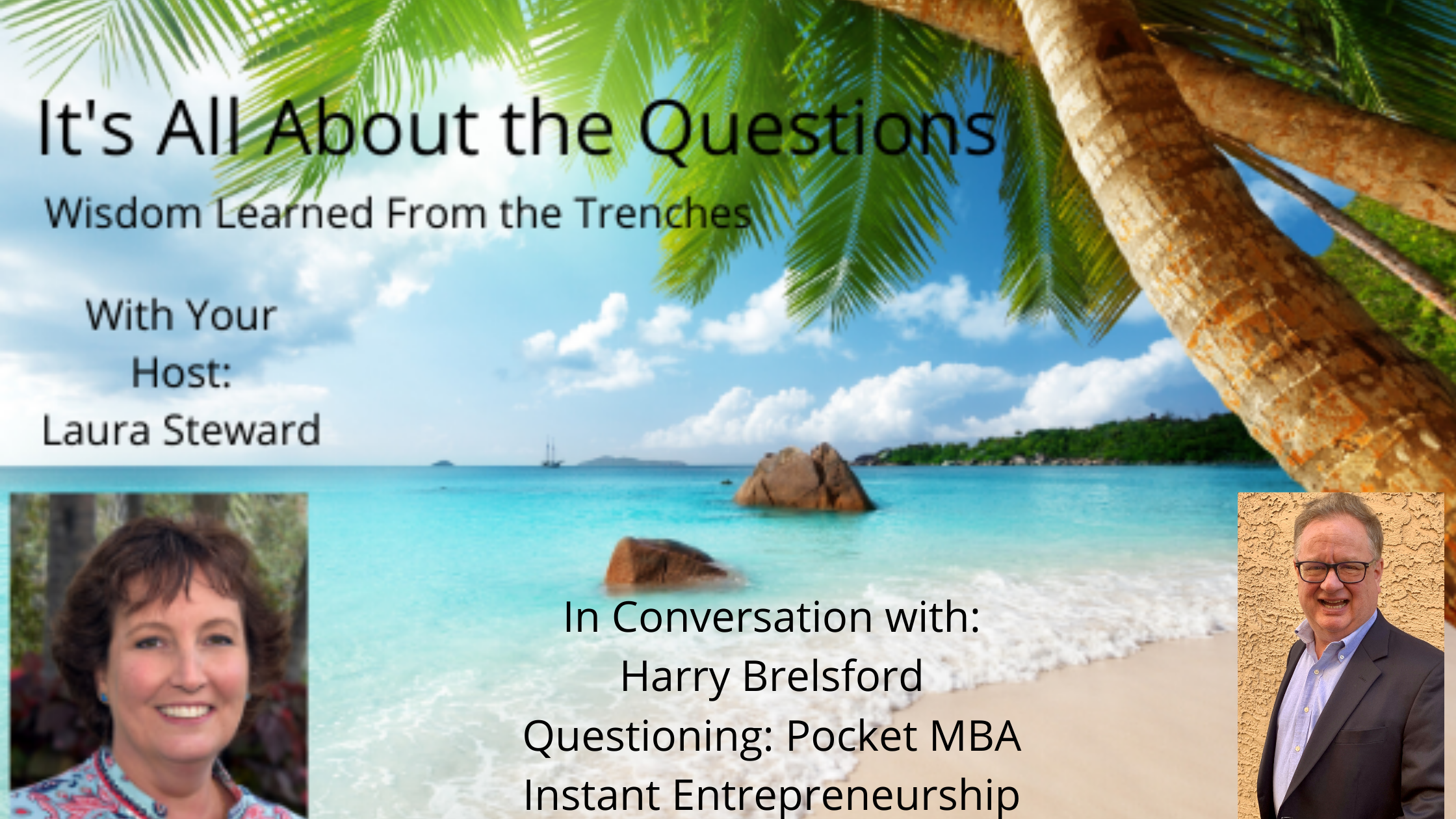
Welcome to It's All About the Questions, where learning to ask the right questions can help you achieve lifelong success. Now, here to help you ask all the right questions is award-winning author, international speaker, and business strategist, Laura Stewart. Good morning, afternoon, and evening, everyone. And welcome, welcome, welcome to the show today, this week. And I am, as always, it is just a joy and a passion to have you here with me this week. And you may notice there's a little accessory that was not here last week. Went to pick up a box and did something to my hand. I see the ortho tomorrow. In the meantime, I've been told, don't move it. So if you see the mouse jerk at any point when I'm trying to do it, understand it is very hard to do that with a solid piece of metal running across the bottom of your hand. But I...
That is not going to stop me from delivering the show today. I have an amazing man on the show with me today who I've known for decades. And he is so prolific when it comes to writing books for helping people that when he told me he had his new book coming out, I just had to have him on the show. Because as you know, the reason for the show is to help you shift your perspectives, to learn something, to help you grow as human beings and as business people, because they are connected. There's very few of us that don't have...
to interject our lives into what we do. And if you're just working for the sake of working, then I wonder, do you feel like you're missing something? There has to be a connection between the two worlds. Otherwise you're going to burn out really fast. So today I've got an amazing man on the show, Harry Burlesford. His latest book is called The Pocket MBA, Instant Entrepreneur. And I love this book. I have my master's in management along with my degree in computer science and technical writing and tons of certifications. And this book, I've dog-eatered, as you can see.
is just chock full of amazing, amazing information. And Harry and I today are going to talk about a lot of different things that you need to be thinking about, whether you are in business, have just started a business, or if you are thinking about starting a business, whether you are in corporate or whether you are an entrepreneur. So let's welcome Harry Burlesford to the show. Harry, thanks for being on. Hey, you caught me at midnight.
See, that is the beauty of live, right? Just never know what is going to happen if it's breakfast time for you. Yeah, it is. It is. And it's just, you're right, boy. It's a Zoom world, let me tell you. You get caught with a bite in your mouth and that kind of thing. But hey, Laura, super happy to be here. Good to see you again. Happy New Year.
Well, thank you. And happy new year to you too. And I love the fact that my listeners are going to get to start the new year with this. I just think this is a book whose time has come and there's so much great information. And it's not like this information is necessarily not available in other places. The beauty of it is it's in all in one place. Yeah.
as well, Harry. I mean, you've been in business for yourself, have worked for other people, and have guided many, many businesses to success. So, I mean, this is not just anybody writing the book. This is somebody who has lived it, breathes it, has been on the ups and the downs of a business. So, what made you finally decide to write down your secrets? Well, so, a couple of thoughts. Really, what this is, is, you know, I'm known for technology books, and this is a brain cut book, and I'll get to that.
But it's really a rewrite of a 2003 book. So just under 20 years ago, I did SMB Consulting Best Practices. And it was how to be a small business server consultant using the Microsoft solution. My favorite product, by the way, small business server. Yeah, those were the days, let me tell you. And so at the beginning of the pandemic, I went over to mini storage. You know, despite what you see up on LinkedIn and Facebook, I had more time on my hands than I realized, just, you know, work from home.
Although I've been doing that for years, but nonetheless, went to ManyStorage, found the CD-ROM with the old Word files, and spent about 90 days rewriting the book. And indeed, it came out as the Pocket MBA Instant Entrepreneur. And the idea was, A, I wanted to do a business book and not a technology book, right? So this book is really light on technology, except for a couple use cases. So anybody can read it. That's the point.
I wanted to get a book out that would address some new audiences, right? That you and I come from the managed services provider community, the IT consulting community. I'm talking about maybe someone that has a food truck and events have been shut down and what can they do with that food truck, right? What kind of pivot, overused word can they make? I love that example you used, by the way. Yeah, yeah, exactly. Federal funding for school lunch programs in a food truck.
So that was my motivation, that I had time, and I wanted to do a book that could be used in centers for entrepreneurship and college curriculum and outplacement offices. Boeing is laying off 25,000 people in the Seattle area, so this might make a great outplacement chatty for somebody that's going to have to start a business. Maybe two more thoughts. Over 50 and exited from corporate happened to a friend of mine just the other day at the Mazars accounting firm, well-known for some other reasons, but he was exited at the start of the year. He bought the book and hopefully, you know, he'll recreate himself. So hope that helps. Laura, hope that paints a picture. It does paint a picture. And it also paints a lot of questions. You know, for me, right, it's all about the questions. You've known me long enough to know that I have a lot of questions. And I don't necessarily, I don't want the...
answers that you think I want. You know, that's something that I think is really important for anybody who's going to get this book who listens to show to understand is that you can ask questions to get the answers you want, or you can ask questions to get the answers you need. And what we should all be focusing on is asking questions to get the answers we need. And that's, that's a skillset. Really, it is a skillset. And when I was reading through the book, I decided that one of the first questions I wanted to ask Harry was, do you think everybody is meant to be an entrepreneur or should be an entrepreneur? No.
No. And I'll give you an example. I mean, I used to think that until – and I thought everybody has an inner entrepreneur. And the observations I did while both writing the book and just observing pandemic behavior is there are people – so a friend of mine back down in central Texas, his mom is a call center employee at Chase. So you call about your credit card. And a pretty good buddy of mine. And so he has – she has been working from home since March.
And she is not an entrepreneur. She likes a J-O-B, a job. She likes the social aspects of her job at the call center. That's been taken away for nearly nine months, work from home as a call center employee. And so she is not, she's probably had happier days. But let's, don't forget, she has a job. So be thankful for that. But Laura, that's my short answer is I have now observed it firsthand.
Some people, they like a job. They like the security of a job. And then maybe most importantly, they like the social aspects of the job, going to work. That is their connectivity. That is their set of friends. Yeah, you know, for years now, I've been thinking about this because, as you know, I consult with companies and I coach people as they go on their entrepreneurial journey. And some people that come to me for help, they just, you know, some days I just want to say to them, look, I really don't think the entrepreneurial journey is right for you. You know, and then I lay out a list of reasons why and they get really mad at me. But if you watch Shark Tank or any of these other shows, you can see that.
Some of these entrepreneurs just really don't have a foundation in how much work it's going to take. And they're not willing to put the work in that it's going to take. And I feel for those people because they really want to do something. I love it when on Shark Tank, I don't know if you've ever seen any of those episodes, Harry, where the sharks just buy out somebody. 100%, they bought them out. And their reason is you have great ideas, but you have no idea how to run a business, nor does it seem like you want to. So there's nothing bad about...
not being an entrepreneur. But I feel like we've created this world, Harry, where everybody feels that if you're not an entrepreneur, you're missing out on something. There is that Hollywood stigma. Yeah. It is true. Yeah. Yeah. And again, it's maybe another example. So my oldest son, Jeff, aerospace engineer, DOD out in the Mojave Desert. And he is not an entrepreneur. I mean, he really likes structure and having a chain of command and bosses. And then Laura, when he logs out for the day, he's done. I mean, he goes biking. He is D-O-N-E done. And I've had people ask me, well, you know, do you have to have to?
work over the holidays. And I said, well, it's not a matter of have to work. It's more, yeah, I took my laptop on a road trip and more or less checked email each day, except, you know, I did get myself Christmas and New Year's Day off. But you get the point. It's not have to, it was want to. And maybe that's another way of answering your question, have to versus want to mindsets. Right. And also this, and you froze. So, okay, you're back. This other idea of when you start out a company, typically as an entrepreneur, you're doing everything yourself. And
Family may take a backseat while you're ramping up. You talk about this a little bit in Pocket MBA, which I think is important for us to bring up. If somebody's thinking about starting a business, what are some things you need to be thinking about based on your, God, decades worth of experience to say, yeah, I'm all in or I'm not all in? Yeah, I think... Again, just telling my own story today. Today they call it a side hustle. Everybody's got a little side hustle going on. So you're the Lyft driver or the Uber driver. Laura, for me, when I left the accounting firm in 99, a great firm, Clark Nuber, Seattle area, they got out of the IT consulting business. And so I exited and I lined up a couple of books from some publishers on small business server, as well as an SBS training video. So Laura, those were side hustles. I mean, clearly, right? But it was my income and it took 99. I'm going to tell you, I didn't really make bank.
with SMB Nation until maybe 2003. It always takes a little longer than you think. Now, when you make bank, it can be very good, right? That's the upside to being an entrepreneur, but to answer your question. Number one, I would say the have a side hustle or have cash or have savings. It's harder than it looks. It takes longer than it looks. And then on the relationship front, you know, that's a tough one. I mean, fortunately, and I was also still teaching at night at the college. So fortunately, we were able to scrape by and my wife could stay home and raise the two boys. And that helped mitigate the hours of, you know, typing until 2 a.m. and then waking back up about 7 or 8.
But that is a tough one. You do pay a price. You know what I'm saying? But for us, it was the right method. And also given the fact I'm not an especially good employee or necessarily employable, it was the only choice we had.
All right. I want to talk about that because you say you weren't necessarily the best employee, employable kind of person. Does that necessarily mean that entrepreneurship is the right realm for everybody that feels that way? Well, probably not. I mean, it's certainly worth taking a look at. But yeah, most entrepreneurs will joke with you a little bit that they couldn't hold a job or they've been fired from every job. It is a different mindset. And I'll tell you, Paul Travis, a friend of mine, and I talked to him about two years ago. I was probably starting to formulate the idea for this book.
But he had been an entrepreneur in a couple of different startups. And then he went back to a professional position at Avalara, the online sales tax calculation company. So he was a marketing executive. And he was noodling around about writing a book called From Employee to Entrepreneur. I said, that's an interesting concept. I'm sorry, did I get that wrong? Entrepreneur to Employee. Okay, the reverse. Yeah, yeah, yeah. Take a sip of a copy here.
And he was noodling around with that, but just the concept was interesting about what it looks like, right, to become an employee again and be a good employee. Getting back to your question, you know, reporting to someone, over-communicating, managing up, that kind of thing. Now, to answer your question in a different way, you know me, I always have like two answers for every question. No, at least three. Yeah. I'll tell you, there's also people that maybe they want to be in the trades, a carpenter, physical work, right? So, Laura, I think there's a...
There's a default mindset in our audience, me and you, maybe to think about an employee as a white collar employee. Not for everybody. Maybe, you know, you're a craftsman. Maybe you want to put in cabinets in a custom home or you want to be a waiter or a chef. And Laura, that can be part of the answers. That's a different mentality.
Yeah, I agree with you. We have a tendency to think entrepreneur as somebody who's developed software or is starting their own services kind of business in a white collar kind of way, like maybe starting their own accounting practice or tech services company or something like that, how I started out as an entrepreneur. But oh my God, I'm on the board of my homeowners association here and I run our Facebook group as well. It is amazing. Does anybody know somebody does hurricane shutters? Does anybody know a plumber? Does anybody know an electrician? I mean, it's like this desperate search for people who have.
skills. I mean, I don't think that will ever, ever go away. And I love the fact that this book totally works no matter what industry you have decided to enter into as an entrepreneur. It's the financial aspects. It's setting up your business. It's clients-focused stuff. How do you bring in clients? How do you engage with them? It's something that you don't see a lot of, Harry. You know what I'm saying? Well, you do because you wrote the book.
Now, I, yeah, yeah, I get it. I wanted this book, try this out for size. As I mentioned earlier, this is my breakout book in the business realm. I don't know if I go quite as far as it's a nonfiction book, but you get the point. It's not a technical manual and a technology book that I'm known for. And the idea was, in my heart of hearts,
Two more goals with this book. One would be I'd be thrilled to death if it made the bookshelf in an airport bookstore. Right. So, you know, when you get on your plane and you see who moved my cheese and one minute manager and that kind of thing. And I might have to even make a smaller version. But that's part of my audience. Right. Is someone might buy that book at the bookstore and get on the plane and read. And then the other would be that students. I already mentioned students in the Center for Entrepreneurship and so on. But it's.
You know where I'm trying to go with this. I really tried to write a book that is for everybody. And I guess my challenge, the reason I'm kind of bamboozled is the challenge would be have I been typecast as an author with Windows Secrets and small business server and all that. You know what I'm saying? It's hard to break out of the mold. Everyone will always think I was on Gilligan's Island. Oh, I love that show, by the way. Yeah. But you did get typecast. Yeah.
Harry, at heart, you're a geek, right? You are, but you're a business geek as well. We need to shift this idea of geek because, you know, I'm a geek, although I prefer intellectual badass myself. The idea of geek translates to so many realms. I mean, you are a business geek. At the end of the day, you've successfully, and sometimes unsuccessfully, you know, but you've still done it, created.
grown, ended, created, grown, ended multiple business and helped other people do it. So to your point of, can you ever be thought of outside the world of, you know, writing Windows NT Advanced Server or, you know, any of these other books that you've written, you know, or courses that you've written? Yeah, because you, at the end of the day, more of what you do, like with SMB Nation and those things is helping businesses grow, perhaps in the tech world. So I would say, let go of that story you're telling yourself. Yeah, yeah, I think you're right.
Appreciate their permission. The follow up on that. So right near you in Florida, up in Titusville, and I think you may recall, I did some books and worked with Beatrice Maltzer for about seven years. I can't recall if you were in the loop. And she's up in Titusville. And so we did that book on how to pass an exam. Here's what I like about Beatrice is that.
Her time was up with SMB Nation probably about 2008. She was done and starting to think about a career outside of technology. I think she did one or two DOD contracts and then bought a hot yoga studio in Titusville, Florida. And she did that for about a decade. And she was just in the process of selling that when the pandemic hit. So they're having to rejigger that business transaction. But she's also moved on.
to being a business coach for a European consultancy. So not just a sole proprietor business coach, but I'll think of the name. But here's my point, Laura, is I have so much respect for people who can take outside the box and pivot to a new industry and make it again and make it again versus in our industry of the MSP community, which has matured. There's no doubt about it with the consolidation and automation. I have less respect for the musical chairs crowd, right? So they're over here and they stay 18 months and then they show up over here and they stay 18 months.
That's my issue, but I really, really like people, and I want the readers of this book to think about pivoting to a different industry, and it could be a passion project. Beatrice liked yoga. She turned it into a business. In hot yoga, not something I'm interested in anyway. I did it once. That's it. So let's talk about pivoting, okay, because you do talk about it in the book, and really, you've pivoted.
And I've kind of lost track. I mean, one of your pivots is you're very big in the cannabis industry, not growing and selling it, but figuring out ways for the business side of cannabis to happen. Yeah, the cannabis technology side. Yeah, that's one of my startups. You and I have talked about that in the past. Yeah, I've done the show talking about it. Yeah, and here again, it's probably going to be a year from now when that starts to cash flow. I have a couple things in motion, some events we're looking at doing in Q4 at the end of this year.
and teamed up with a publisher, Marijuana Venture, and they're helping with the event and we may do some global events. But yeah, that's been very interesting to get in an early stage growth emerging market. And maybe that's what I'm really trying to say is that, Laura, I do really well. Thank you. I try. With the early stage.
marketplaces like Small Business Server in 1998, right? It was just coming to market. The Canatec area is emerging quicker than we thought, by the way, with the five states that had some form of legalization in the general election. Florida is probably going to pop in 22, if not certainly by 24. We have a couple in my small town. We have dispensaries. Yeah, yeah. And so that's what I would encourage people to think about. And that's what has worked for me is to target things that are growing, so to speak.
And Laura, I don't know about you, but I just don't do well in mature markets with consolidation. You know what I mean? It's like they tend to get a little bit more red ocean and people think because resources are contracting. And so people are not as helpful versus emerging markets or a blue ocean. And it's so refreshing that people help me with a logo chart. They help me with this. They help me with that. Yeah, somebody I know I was just talking to, they're looking at everything that's happening with the pandemic. And for months now, they've been flipping RVs.
because they saw that people are going to be hesitant to fly for a long time, but people still want to travel and they want to travel safely. So they're good with their hands. And they said, you know, I'm going to start doing this on the side. Forget flipping houses. I'm going to flip RVs. So he buys these RVs that in some cases are pretty dang trashed. Yeah. And he cleans them up, fixes them up, makes them look better. And then he sells them and he's making tons of money.
Because he saw this emerging market. And like you said, it was this side hustle that he had that he knew how to, you know, fix and repair things, do some home rentals. And he said, well, he doesn't know. He hires somebody to go do for him. So like the electrical needs to be redone or the plumbing systems, you know, or something like that. And he factors all of that in. It's no different than flipping a house, he said. It just happens to be something that's movable.
Well, let's talk about that. I was floored in a recent business phone call before the Christmas holidays. I was talking to a well-known large distributor, Ingram Micro, down in Southern California. Yeah, to one of their marketing executives. We hadn't caught up in a while. And so, you know, we're chatting about this, we're chatting about that. Well, it turns out she got permission with the new Zoom world. She bought a fifth wheel trailer and she gave up her California residency. And, you know, that's a whole mega trend going on.
changed her residency to Oregon and now drives around to trailer parks with her two dogs and loving life, loving life in a pandemic and can do her job and, you know, maybe has to sit outside McDonald's to get the free Wi-Fi. But your friend's onto something. That's the point is there is a real, again, overused term, but paradigm shift in lifestyles. And entrepreneurs are going to target that, right? They're going to target opportunity where there's a gap, you know, be the gap filler.
But it's not just about being a gap filler, right? You know, reading through the book and knowing from consulting myself to help businesses when they're struggling, it's, you can't just have an idea and expect it to work. Although it does seem like some people can just step in it every single time. At some point, you need to understand the numbers. You need to understand whether your business has longevity, shall we say. Like for the RV flipping, I think that no matter what happens with COVID, RV flipping is going to be an amazing.
for many, many years because people have gotten used to this idea of, oh, I can travel around. What goes around comes around, right? It used to be camping in RVs were huge just to small groups of people. I just watched Lucille Ball and Desi Arnaz in the long, long trailer. Have you ever seen it? No. Oh my God, one of my favorite movies of all time. Go watch it and tell your friend who's living in the RV in Oregon to watch it. But it only works for this person's business because they understand how much it costs.
to buy this rv all the aspects of what it's going to take to fix it and what the potential is for the cell so that they know what their numbers are they know okay i need this to break even i need this to make money i need this to cover what it costs to live But yet so many entrepreneurs, Harry, do you see this seem to fail at that basic understanding? Here's what I need to live. Here's how much I'm bringing in. And why am I seem to be losing money every month? Well, I look at my own story. So right now I have a part-time assistant. I'm in the Seattle area right now. And this lady comes over and helps with my filing. And we sit down and pay both personal and company bills. And part of that is, it's going to take us off to another rabbit hole, but there's a real good book, an author that I...
made the ADHD that I've met, the ADHD entrepreneur. And his whole book, it's a little one, is that everybody who's an entrepreneur at some level has ADHD. So here's my point, Laura. I'm to some extent that person. You know Jennifer Hallmark at the traditional SMB nation. We have accounting meetings and cash flow stuff. Then I have an assistant to help me with lower level organizing and filing. And that's what I recommend is if be like Mike, be like Harry.
um, higher into your weaknesses and it doesn't have to be expensive, right? You can, uh, use, uh, just quite frankly, I put an advertisement up on Craigslist locally, found the right lady. And, uh, we meet on average once a week. And so Laura, that's my answer to that is I think that natural entrepreneur is typically not operationally, um, focused and you gotta, you gotta have someone help you out. Right. And even if it's, you sit down with an accountant just to go over, help me figure out my numbers.
here's what my break-even is here here's where my budget is for my home stuff you know tell me where that number needs to be or work with somebody else in the same industry for a little while, pay them to tell you what they've seen or what they've known. I used to get people regularly with my tech services company, Harry, I'm sure you've seen this. People are like, can we pay you to just look at our business and tell us what you think is going on? And most people are totally willing to help somebody else out, but now they can just grab this book and at least know the right questions. I think that's what I love about this book, Harry. For somebody who's starting out or somebody who's been there for a while now, you may not even know the questions that you need to ask. And this at least gets you thinking.
And gives you a lot of answers. I mean, look, I dog-eared it. I've been an entrepreneur for a really long time, and I'm like, ooh, I need to ask Harry about that when I get him alone. Well, yeah, we can all benefit from reading. We should do it every day. And the point is, I've never said this or that or that are the only books you should read. Absolutely not. I would love you to read my book, and hopefully it's useful with a checklist and some of the real hands-on guidance I provide. It's not just an academic text.
But, you know, go get Carl Palachuk's new book. I'm so glad you raised Carl. I was going to call him out here because you mentioned him several times. Love Carl. Yeah, yeah. So go get his book that he came out with over the summer. And, Laura, it's very interesting. And we collaborate, right? We're friends.
So I hadn't thought of the timing of my book, but here was Carl's motivation for his Forms book that would supplement my book very well. And his book's a little more cartoony, but he was like, you know, the PPP funding for a lot of people's going to start to run out in July. I want to have an entrepreneur book out in late June. I got mine out in early September, but I said, Carl, that's brilliant. That's a whole other persona of readership. Right, right, it is. And it's, I think this topic is timely because
I've seen friends. I live in Florida, right? Disney is one of the major employees, employers in the Orlando area. I have friends that worked for the Disney Institute that were laid off. I still don't understand why the Disney Institute would lay off anybody. Cause frankly, you know, their whole idea was training you how to do better with your employees and implement customer service and all this other stuff. And Disney had this massive fail.
in my view. Now, was that an external organization that they would help external clients about the Disney way? Okay, so it wasn't just internal programming. No, the Disney Institute was taking the principles of leadership, customer service, employee engagement, all of those pieces, and teaching them to other corporations. You know, because the Disney way of customer service was amazing. You know, Disney-fy this, Disney-fy that. But corporations wanted to learn how to do that. How do you keep everybody happy? How do you do all those different pieces? And then pandemic hit, and they failed.
Right. All of a sudden they went, oh, we're only good when the business is coming in all the time. We don't know how to be successful when things are tough. That to me was the message that Disney sent out. Okay. So with what you said and what the book Carl came out with and the times that we were in, what do you say to that, Harry? You know, when times are tough, is it the telling of a business? Well, let me.
Well, yeah, I mean, I've certainly managed through some tough times. And my answer there, number one, my answer is we're going to have to innovate our way out of this. And so what I'm hearing with the Disney Institute is they didn't get overused, but pivot to be a remote leadership institute. A friend of mine, Wayne Trammell, fellow author, you know, we all kind of know each other. But Wayne Trammell has a book out a few years ago on remote leadership. And then the pandemic hit and this institute took off. I mean, he's advising Fortune 1.
Right. How the heck do you get Chase Bank to securely? And he's not a geek on that level, but you get the point from a leadership point of view. How do you manage a call center when these people are working from their apartment? I mean, you know, these are big numbers of people. It's not our little SMB. Right. That have family around that may be using the same computer, all those other things. Yeah. Motivation and accountability, blah, blah, blah. So that's what I think I'm imputing is Disney just didn't think about that. It actually could be very good times for them. The other thing is, is I'm more or less.
When I broke away from the accounting firm, it was like three months later than NASDAQcrash.com. Remember .com and .com? So I left in late 99. April, we signed for a new house the day NASDAQ crashed. So I like to joke that I more or less started SMB Nation in a recession.
And the point is, you know, these are MBA case studies, but a lot of successful firms have done that. Intel started in a recession. UPS started in a recession. Those are often the best run companies if you can make it. But boy, how do you learn how to rub two quarters together, let me tell you. It gets you back to the foundational requirements of a business, which Pocket MBA is really all about, right? It's about understanding your business, but it's also about taking risks. It's not just about if you do the right thing, the business will thrive. Because sometimes just doing the right thing, a business doesn't thrive.
It's in a mature market or you're going after the wrong market. Yeah. Yeah. And I'll tell you, this is kind of fun to do show and tell. Let me find it. With all your boats and your bicycle stuff. Yeah. Yeah. Here.
So this is a piece we did, and it's interesting. We used the Pocket MBA branding. I did this book a little over 10 years ago. I've had the trademark Pocket MBA in the vanity domain and so on. And Laura, I'm living and breathing what we're talking about. I took that logo off the shelf during the pandemic and wrote a book in launching the Pocket MBA. We can talk more about that in a minute. But what TCAT did with Gudruns, this is a skinny little book on leadership and business called The New New Success Secrets, and he calls BS.
It's not what you think. So the book is, I'm calling BS. And he calls it your basic story. And a lot of people have this basic story, and the way he defines it, and you'll see why it's BS, is he'll say that, to your point, you're running a business, you're turning the key at 8 a.m., you're locking the door at 5 p.m., you're answering the phone. But sometimes we have these things up here that are internally blocking us. And I've seen these people that, well, I can't possibly open my business up until I have a 100-page business plan and I meet with the SBA and the SCORE team. Well, no, you can't. I've done businesses without a business plan.
You know what I mean? I've done it. It's more important to be active. Just get that BS out of the way. Does that make sense that back to your operational thing that, yeah, there's risk taken and there's luck, but there's also just getting out of your own way. Yeah. And using the connections that you have. I think that.
is another takeaway from this book, from knowing you for decades, from me and the way I do business as well, is when you're thinking about starting a business, don't be afraid to tell everybody and to ask everybody to help you. You know, you quickly find out who your friends and allies are when you're starting your own business, right? And you also find out who your detractors are, who are like, why would you do that? Well, if somebody tells you, why would you do that in such a way that makes you want to stop the business, you need to look at it and go, I wonder why they're saying that. And is there some powerful takeaway? Like when my parents were like, you can't start your own business back when I was taking a package from Pitney Bowes. And I realized it was because they were from the depression era, right? So you would never jump from one thing to another. Even though my dad was very entrepreneurial, he was freaked out for me. So my takeaway from this person who's saying don't do this was, well, why would they say that? Well, maybe they're concerned about money stuff or health insurance or whatever. So I sat down and I went, okay, here's what I have in the bank.
Here's how many months of expenses I have. You know, I'm getting six months pay in a year's health benefits from my package I took. Very nice. There's your sourdough starter right there. Right. And it was like, exactly, your sourdough starter. So look at what you have. Take the naysayers and go, is there anything of value in it? Sometimes there's not. A lot of times there's not. It's just their fears. Let it go. And then take those other people who are willing to say, hey, well, you know, buy a copy of my book. Don't let me just give you one. Right. Or.
Tell me who you think you know that would be a perfect customer of mine and introduce me. It's okay. But yet a lot of people, Harry, have you seen this, are afraid to ask for help from those they know? Oh, yeah, yeah, yeah. And that, boy, howdy. I mean, we could go down and I briefly touch on it, very briefly, the Myers-Briggs personality test. And there's one or two others. And there's books on that. So, folks, my book was not to recast Myers-Briggs. I was just telling you it exists. But, yeah, Laura, there is that. Think of it this way. My nephew, Nick.
By the way, an entrepreneur with a clothing line and some other things, but his side hustle is he is in Macklemore's band. Macklemore, the rapper. That's been a tough year because of the pandemic. He isn't dancing on stage, but Laura, here's the point. That's his income. That's part of his day. Well, mainly his nights. But he has these ideas, the Posse Institute, about how to make musicians better business people. Well, it turns out in the Myers-Briggs thing, even though you see him dancing on stage and you think he's an extrovert, Laura, he's actually an introvert. And that's what they said about Johnny Carson, right? That you see Johnny Carson on TV, but he's actually quite introverted. And the point I'm getting at is I think that would be a challenge for some people to raise their hand and ask for help. It's fine to be an introvert. Know who you are and own it. But it is a challenge for those people sometimes to say, hey, man, I need help.
And for those people, I say, go buy this book. There we go. There we go. There's so much in here, Harry. Is there one part of the book for you while you were writing it that you felt when you were writing it, you went, oh my God, I never thought of it this way before as you started writing it? I've always wanted to ask you that question with all the books you've written. Yeah, I think, let me think about that. I mean, I have some favorite thoughts, but let me stick to the knitting on your question. I think it would be the,
The fact that I scrubbed the old book, for a lot of reasons, it was a technology book and it had examples like gateway computers and they're done. So this was a pretty, yeah, this was a really deep scrub. So I think that aha moment for me was to, again, get out of my own way and think about people who want to start a photography business or make their food truck more successful or this or that. The other thing would be, is I did primary research, right? So it's not like I just sat down and started typing. I attended a couple of lectures.
the over-50s consultant. Two Australians, Mark and Simon, have a system, right? You signed up for the system to become an over-50s consultant, assuming you've been found redundant in corporate America or whatever. And they really nailed some messaging that I was able to interpret. You know, I get primary research, and I'm like, wow, that's really good messaging. And the aha moment there was become a consultant. So when you break out as an entrepreneur, think about your domain expertise that you built up over 20 or 30 years of work and honor that domain expertise.
And in my case, in your case, you know, we have started to own and operate businesses. Forget the technology. At the end of the day, they're a business. And become a service provider. The fastest way to cash flow that their system talks about is to capitalize on your domain expertise and become a service provider. And maybe you'll cash flow within 30 days, right? You get a gig. Laura, it's a little tougher when you're the inventor, right? Like you're going to make the next great battery for electric cars. God bless you, that may work. But yeah, that's not 30 days out.
No, unless you're a really good coder and you created a new game app or something like that and it just blows up. But typically it doesn't blow up in 30 days because it takes that long just to get it on the app store. Yeah, yeah. And I love inventing, but that's why I say, and that's what I'm doing with the Canatech startup. That's more early stage inventing stuff. And I'm two years into it, got another year to go. So that will be three years before I feel that starts to make bank. Okay. So there's some short-term, there's some long-term, and then there's the medium-term stuff.
businesses need to be thinking about. I think at all times, Harry, right? You need to be looking at your near days, your mid days, and your long days if you want a business to be successful. Daniel Burris talks about this a lot. I love Daniel Burris, the anticipatory organization, where he talks about that. If you're just kind of looking here, then you're not going to see the trends that say to you, okay, I'm going to need to pivot here. I'm entering, as you call it, the red ocean.
where it's getting so saturated that, you know, I may start losing customers because there's blue ocean stuff, new stuff, if people aren't familiar with the term blue ocean, red ocean. Blue ocean means, you know, clean water. Not a lot of people are in there. Red ocean means the shark. There's chum in the water. You know, it's getting kind of bloody out there. Everybody's trying to grab for the same 5% share versus go for the 90% share. So every business, if you just keep doing the exact same thing, the exact same way, you may start losing customers to people who are maybe like the first person who ever put spandex into jeans.
at the waist. Thank you. Thank you. I love that. All of a sudden, they started building up greater market share. And then eventually everybody got in on the game. So like that idea, how can you innovate? Like MSP, we were both managed service providers. You know, I sold Bloxheim forever. I sold contracts forever. But then all these products were developed to make it easier for me to more cost-effectively manage my customers. So I was able to transition to get recurring revenue at a lower cost to me, which enabled me to pitch bigger projects.
to my customers. Well, and so let me share a current example. Just this week, we're going to press on a book I collaborated with a client in Austin, Texas on, the gentleman is Scott Lopez. And he is in the business of third-party maintenance or extended warranties for hardware. Okay. And that business has been around 30, 40, 50 years. Folks, it's analogous to you buy the extended warranty for your car. Okay. Same idea. It's pretty straightforward. For AppleCare or something for your phone, those kinds of things. Yeah, exactly. And here's what we found over the summer or the fall.
The book came out at 76 pages. Laura, I'll get you a copy. We're going to press later this week, so give me a few weeks to ship you one. But for the MSP, this is a counter-cyclical opportunity. And what I mean by that is sometimes when the economy – and I write about counter-cyclical opportunities in the book. For example, traditionally, education thrives in a recession. The Boeing outplacement package might include tuition assistance to help retrain the worker to get a job. Now, this is when we don't have a pandemic, and you can go to classrooms. But extended warranties.
You're a data center, and you're looking at either a $12 million refresh. You're on the Columbia River, you're a private cloud, or maybe a $1 million blah, blah, blah for an extended warranty beyond the OEM package. So that's my point. In a crowded red ocean, think counter-cyclical. Don't just go with the flow, but what are the other opportunities out there? So that's how I would address that in a crowded market. And then in the innovation market,
Here again, always opportunities. Maybe you want to be a provider of third-party maintenance, right? You can say, hey, I'm an MSP. I'm a little burned out. I think I'd rather shift my business model and just go direct to the customers and underwrite basically insurance. I want to be an insurance agent. Okay. Well, we both have seen people do that. Yeah. Yeah, exactly. We've also seen people in the tech world who have done very successfully running their managed service provider businesses. And so they've created different products. Look at ConnectWise, Ernie Bellini, one of my favorite examples of this.
he created something to help him run his own business. Everybody else started hearing about it. And they're like, okay, well, let's start another business. It had a billion dollar valuation when he sold it. Yeah, I know. I know. And then there's other guys that realize, well, forget the tech industry, right? Christine Kane. I don't know if you caught that episode of my show. She wrote the soul sourced entrepreneur. If you don't have that book, I need to do a copy of that book. You would love this book. Okay. I did not have it. She's a musician.
She could have been signed by several other people, but that would have limited her. She said, well, let me just try it on my own. And she was very successful with what she did. So other musicians started coming to her saying, how did you do this? you know, what did you do? What were your pieces? Next thing you know, she's running a seven figure consulting business, helping entrepreneurs from all businesses grow using what she learned. So maybe to the listeners out there who may be considering buying Pocket MBA, which go buy it, everybody. There's something that you're doing in your business today that people keep saying to you, well, how are you doing that?
Yeah, yeah. Let me rewind a little bit to a conversation we had a few minutes ago about sort of mid-stage. And I've now collected my thoughts. So before I mentioned Beatrice Maltzer, who used to work for me and has gone on to do other things, the European consultant she works for is the Alpha Group. And so you can look that up.
And it's typically firms that have over a million in revenue. I think her largest client is a client with a 70 million in revenue. And Laura, it's basically your peer group model. And a great mid-stage strategy, I think, is to join a peer group or hire or read, you know, the book by your friend and just kind of be thinking about working on your business, not just in it. But the peer groups are great. You know, we had the famous one in our industry, HTG, the Solid Technology. In the case of Beatrice, it's any industry, right?
you know, the advertising agency, maybe one computer person, you get the point. But it's a good use of money. I mean, I really believe, especially at mid-stage, I don't know so much early stage, because you still probably need to be focused on running the business. But at mid-stage, you need to work on the business as well as run it. That makes sense. Okay, I love it. And we're almost out of time today, Harry. So how can people get a copy of your book? And if they have questions, how do they reach out to you?
Yeah, so it's easy. Right now, we have the book in what I call private placement. I'll put it up on Amazon in the next few weeks. But we wanted to first privately sell it so I can sign each copy. So I'm going to need a paw holder like you have. Some days my hand gets a little tired. But it's a vanity domain. And so folks, write this down.
because people get confused, but it's pocket.mba. So it's one of these new vanities, pocket.mba. Every book is signed. And where we're headed, Laura, and maybe I'll kind of end on this, is by Q4, once I have that other startup kind of up and running a little bit better, but I'm headed to making this a system as well, kind of like Seth Godin's Alt-MBA, you know, these systems, the 90-day system to become an entrepreneur. But that's where we're headed. So folks, today it's pocket.mba.
Yeah. And until I had read that in here, I was like, I didn't know there was a .MBA domain. I mean, there are so many coming out there that I think it's great. Okay. So people can go to pocket.MBA and buy a copy of the book. And is that the best place for them to reach out to you as well?
Yeah, how about harrybrellsford at gmail.com? So we'll keep that one simple. First and last, harrybrellsford at gmail.com. Okay, and if you're watching this on video, everybody will see the spelling of his name. But if you are listening to some audio on the podcast, and shout out again to the folks in Sweden, consistently top 50 podcasts for entrepreneurship of all time, according to the rankings in Sweden, for close to two months now, Harry. There you go. So it's Brellsford, B-R-E-L-S-F-O-R-D. So Harry Brellsford.
at gmail.com everybody if you want to reach out to harry and pocket mba pocket.mba to get a copy of the book and harry will sign it and there's other resources and stuff up there as well harry Correct. Yeah. Oh, absolutely. Yeah. We're populating content up there and that's only going to accelerate this year, right? So we want to do more of the YouTube thing because Laura, bottom line is business changes every day. The book was printed on a particular date, but you need to supplement the book material. Right. Okay. Last thought you'd like to leave my listeners with. Well, just folks, the basic construct of the book that we did talk about this time, but it's finder, minder, grinder. So the book is divided into three sections. Finder is get the business.
Some people are challenged with that. Others not. Minder is run the business. That can be a challenge at a certain level. So hire around your weaknesses. And then the third is grinder. And grinder is do the work. And Laura, that's where we have the least problem. People are typically pretty passionate about their hot yoga. I'll just leave it at that. Okay.
All right. Yeah, the book is really, I love the way you laid it out, Harry, and the information that's in it. As you know, I don't typically go deep into the book. I like to let people know who the author is and the wisdom that you have so that they'll want to grab the book. But I love so many different things. And as you can see, I dog-eared it. There's lots of things that, and I've been in business for...
Okay. I didn't want to say how long I've had my own business. So it's way too many decades that I want to count. I started my first official business in 1994. So there's a lot of great information in here that even somebody like me can get out of it. So Harry, thank you so much for being on the show. Well, thanks for having me. And let's not wait so long. I think it's been about a year and a half since we had a chit chat. I know. I know. We have to do more. We have to do more. Definitely have to. So hang on. Let me close out the show and I'll be right back to you.
So everybody, for me, these shows are about giving you new ways of thinking things, introducing you to people, introducing you to books, introducing you to concepts that you may think, you know, but what if you looked at it slightly differently? Like right now, I'm having to learn how to do things left-handed when I'm a righty all the way. Like how do I even use my mouse properly? Because my mouse is a trackball mouse. But these are things that help you rewire the brain, retrain the brain, and let you look at what you're doing in a new light.
Grab a copy of the Pocket MBA at pocket.mba. Reach out to Harry. Reach out to me on social media everywhere. Let us know. Let me know what you're thinking, what your struggles are, and if there's a guest you'd love for me to have on the show. But most of all, let me know what you think. Rate, review, and subscribe to the podcast or on YouTube where we're doing these wonderful, I'm doing these new video, which I have loved doing with you guys since July. But at the end of the day, it is all about the right questions and the right questions can change your life. So what are you asking today? Have a great day, everyone. You've been listening to It's All About The Questions, starring Laura Stewart.
Connect with Laura at itsallaboutthequestions.com and download a free workbook that will help you ask better questions starting today.