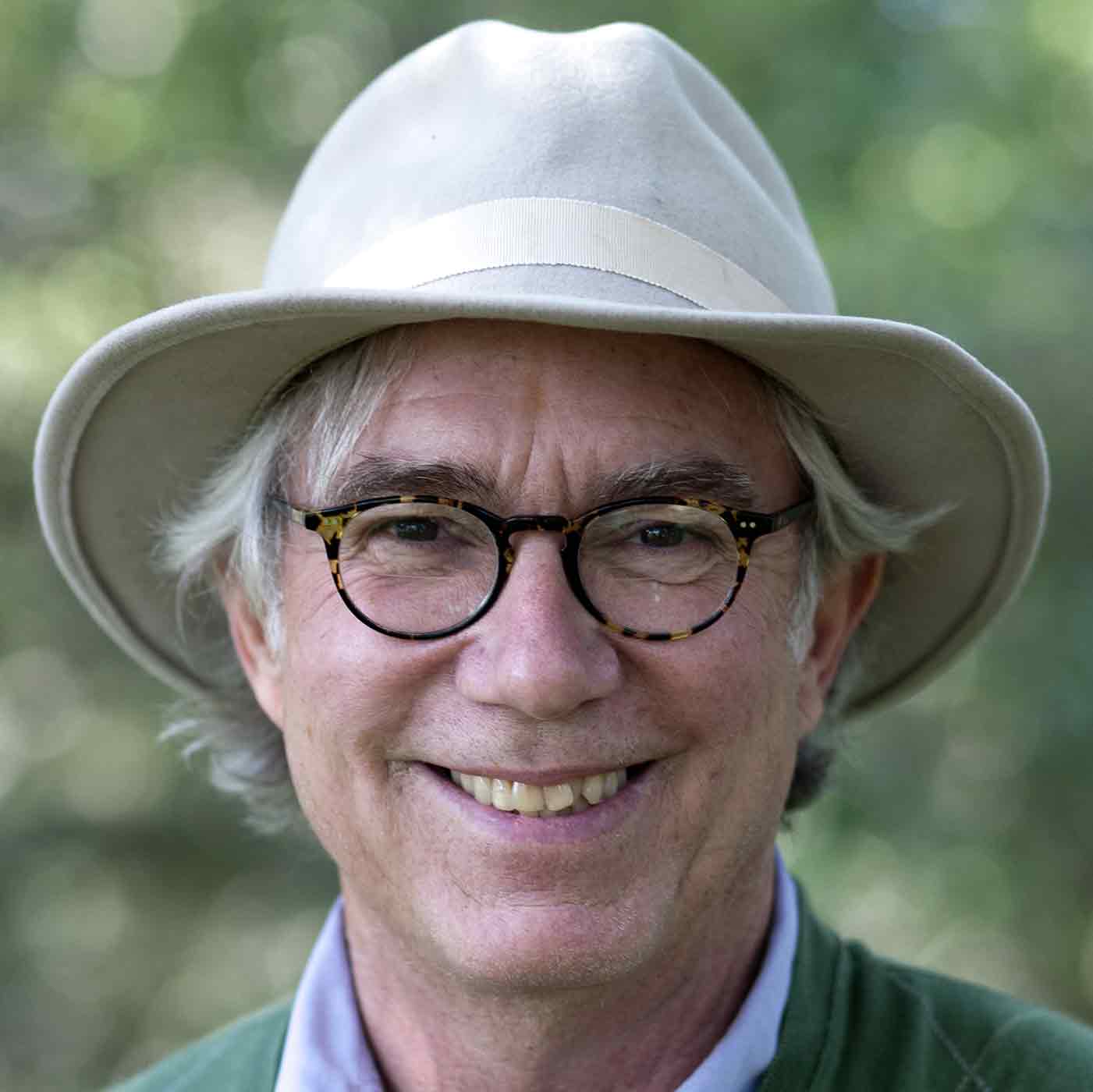
Tell us a little bit about your writing and some of the earlier books and how it's all evolved into being where you are now. I grew up reading science fiction and I liked it a lot and then I went to college and I ended up majoring in mathematics. I sort of wanted to major in English but my father told me I should major in something that would be harder to learn on my own and so I majored in mathematics and went to grad school and was writing some math papers but I... I was feeling a little frustrated that in writing math papers, you're writing for such a tiny audience. Generally, your paper is not going to be read by more than a few dozen people, unless you're one of the lucky ones who proves a super big result. And I didn't see that as happening for me. And so I wanted to somehow do something else, and I came back to science fiction, and I started trying to write science fiction. I started my first novel right after seeing the Rolling Stones play live at the Rich Stadium in Buffalo, New York in July 1976. It was very inspiring.
I mean, now Mick and Keith and Charlie have been going around for an awfully long time, but back then seeing them, it was like seeing Green Day would have been, you know, maybe five or ten years ago. It was just really uplifting to see these people on stage that you respected and looked up to and to see them live. And that somehow got my juices flowing, and I wrote this novel called Spacetime Donuts. And that is one of my books that's sort of hard to find. It's been out of print for a long time. Then I wrote another novel called White Light, and that is in print. There's this thing I do in science fiction, I call it transrealism, where I like to take my real life or things that I've really thought about or things that I've actually seen and then transmute them in some way and warp them and turn them into science fiction. And to me, that's a way of getting a sort of richer kind of science fiction. It's not just...
You know, like people wearing bad pajamas with grease in their hair, you know, calling each other captain. You know, it's a little funkier if you have actual real type people doing stuff. And so White Light is about a mathematician who can't get a job, and he travels out to infinity. And so that book was pretty well received. Then the book that's maybe the...
best known of my science fiction books, I think I might have written next, and that was called Software. And that came out in 1982. And that's sometimes thought of as the first cyberpunk book. William Gibson's Neuromancer came out, I think, the next year. And Software, it's about this old man. He's designed these really smart robots. They live on the moon. And then to do him a favor, they come down to Earth and cut his head open and eat his brain.
Why not? Why not? The reason they're doing that, it's because then they're going to be what we would call uploading now. They're going to save. They're going to get all the software out of his brain. When I wrote that book, software, it wasn't even a word that people used hardly. It was like a word I'd read in Scientific American. I'd never actually touched a computer at that point.
The book had hit a nerve, and people are still reading it. It's been published in a lot of languages. I wrote some sequels to it. I wrote wetware, freeware, and realware. Freeware is a good one. That's set in Santa Cruz. I always like writing about the Silicon Valley. A couple of my recent novels, like The Hacker and the Ants was set in Silicon Valley. There's one section I wanted to read to you, Anne, that is in The Hacker and the Ants because it involves KFJC.
Should I just go ahead and read that? Please. Okay. So this is chapter five of The Hacker and the Ants, which is still in print. I put out a new edition a couple of years ago. It's called version 2.0 of The Hacker and the Ants.
While I was driving 280 across town to East San Jose, I fished out the scrap of paper that Nya's cousin had given me, 5778 White Road. I flicked on the electronic map attached to my dash and told Nya's address. Intense green lines appeared, showing a diagram of San Jose with a highlighted path indicating the best route from my satellite-calculated current location to Nya Vos. The east side of San Jose was bounded by rounded yellow foothills that undulated hugely towards some mountain peaks that you could see on a smogless day. The hills weren't very good for hiking, because they were bone dry with tough, sharp grass that stabbed your ankles, but they were nice to look at from the freeway. As I drew close to Nyaz, the map rescaled itself, always maintaining a magnification that just held the bright wriggle of the remaining root.
Right before crucial turns, the map would speak to me in a quiet woman's voice. My wife Carol's voice, actually. Last year I'd fed the device a phonetic map of Carol's voice. I thought that was funny, since Carol was terrible at reading maps. Carol had thought it was stupid of me, not to mention being an invasion of her privacy. Whatever. The phonetic map was a good hack, and whether Carol liked it or not, I could still hear the sound of her voice, which was something I missed almost as much as the smell of her body. Two blocks from the Vos' house, the map showed me something I didn't want to see. A detailed, stippled picture of an ant. A cunning...
Dusting of dither pixels added informative shadings to the image. The scapes of this ant's antennae were tilted toward me, and her mandibles were wide open. Her body rocked back and forth in the sawing motions of stridulation. The map's tiny speaker began stringing fragments of Carol's voice into deep, demented chirps. The sound was scary, but also fun to listen to in a sick kind of way. It was as good as the thrash I might hear on, like, Ted Bed's Skunk Bunk on the Rhythm Wave of the West, Radio KFJC, 89.7 on your FM dial, broadcasting from Foothill College in Los Altos Hills, California.
a personal favorite. Ted Bed always sounded like he'd been up all night flying on Candy Flip in a cyber club.