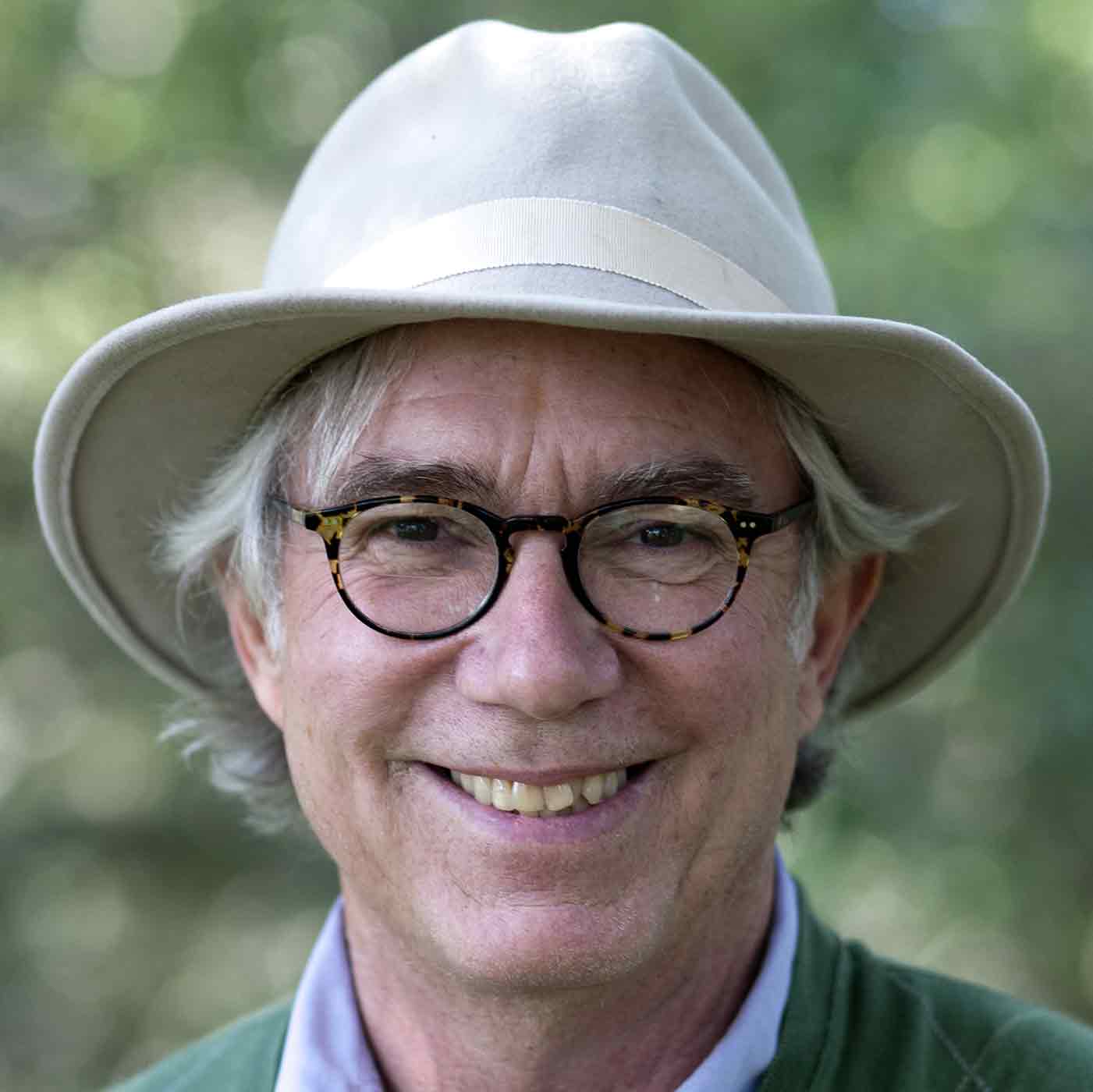
He's published over 30 books in his lifetime, from novels to non-fiction books on the fourth dimension and the higher levels of infinity. With his latest novel, The Big Aha, he actually kick-started it and proud-minded the whole thing and then published it under his own publisher called Transreal Books. So we're very into disrupting things here at Scribd, so I could not be more excited to present to you Rudy Robert. Thanks, Carrie. I don't think I need this microphone, do I? I've got three. Okay. Yeah, this is fun. This is a nice space.
I think it's interesting what Scribd is doing. At this point, we need lots of new channels for publishing. There aren't very many bookstores anymore, as you probably noticed. And we've got the traditional publishing. And recently, I got into this thing of making my own books. It's not too hard to do it. Well, it is and it isn't hard. I mean, in principle, it's simple. But my day job for many years was a professor of computer science at San Jose State. So I do know about computers. But it took me seven months to figure out how to.
how to put up a paperback. A Kindle is pretty easy, but making a paperback is hard because you have to use this Adobe software called InDesign, which is, maybe it's just me, but I found it harder to use than the Microsoft C++ debugger, which used to be my benchmark for hard software. But anyway, but it's cool, and I'm happy to be here. One thing, she mentioned art, and Maybe I'll just start. One guy cornered me, Karim, I think was your name, yeah, and he said he can't stay for the Q&A period, which is what I do at the end. So he pushed in his question, so maybe I'll answer it first, and then I'll do a little bit of reading, and then we'll have some extended Q&A. And he said, how do you do your world building? And he's sort of thinking maybe from a video game design perspective. And to me, with a novel, I have to have a sort of place where I want to go, a place that I want to see. And so I start with that. And in this novel, The Big Aha,
And by the way, if you don't have a copy of The Big Aha, this is something very cool that Scribd is doing. They paid for a bunch of copies, so if you want a copy, you can just go get one for free. And I will sign it for you later, probably. And anyway, with The Big Aha, I had this thing that I enjoyed the 60s. I was born in 1946. I graduated from college in 1967. And so things were sort of peaking then. And really, the 60s, they were going pretty strong in 70s, 71, and 72 as well. It wasn't just stopped in 1970.
It seemed to me, I mean, I enjoyed that time, and then obviously it didn't seem like it lasted long enough. And then, you know, all the other things happened. And I thought it would be interesting to write a book that sort of brings back that kind of zeitgeist. But then I thought, well, I don't want to do it in terms of just some future drug that people are taking, because people have these sort of fossilized attitudes for drugs. They hate them, they love them, whatever. So I want it to be something a little bit different than just another drug. So my idea for The Big Aha was to have it be...
Well, there's this thing, this phrase I sometimes use, I call it a bogosity generator. Like a science fiction novel, you want some weird things to happen. Now, if it's fantasy, you never have to offer an explanation at all. There's just a door appears on the wall, and that's what happened, okay? But if you're doing science fiction, then you want to come up with some sort of explanation. And that's where you need your bogosity generator, your thing that's going to produce it. Now...
What I decided to use in this was quantum mechanics. I mean, quantum mechanics, extremely bogus, does a lot of weird things. And then I thought, well, that's not enough. We need double bogosity. So then I said, we're going to have quantum wetware. So wetware, that's like your genes. And so then I had this idea, we could get some sort of quantum mechanical thing happening in your head. And actually, okay, so in a way this is world building. I'm talking about the things I was thinking about when I wrote this book. One of the other things I was thinking about was a sort of, maybe you could call it a philosophical thing that I've observed over the years, which is that
Most of us, pretty much anyone, you have two modes of consciousness. And what I mean by that is that you sort of merge into your surroundings, you relax, you know, all is one, you're together. But then you'll pull back and you'll say, okay, you know, how much time do I have left? Where do I have to go? How am I going to fill out my taxes by April 15th?
Does my partner like me? There's all these very specific things you worry about. Am I lost? And then you say, oh, well, the hell with it. And then you merge in again. You know, you're cool. And then, so we do this in and out. And to me, it's sort of like, it's a little like radar. The way you find yourself, you send out, you merge in, you pull back. You sort of gather what happened. And my feeling is that I do this about five times a second. Or maybe once every two or three seconds. This is continued pulse. What they called, the ancient philosophers called it the one and the many. There's the one.