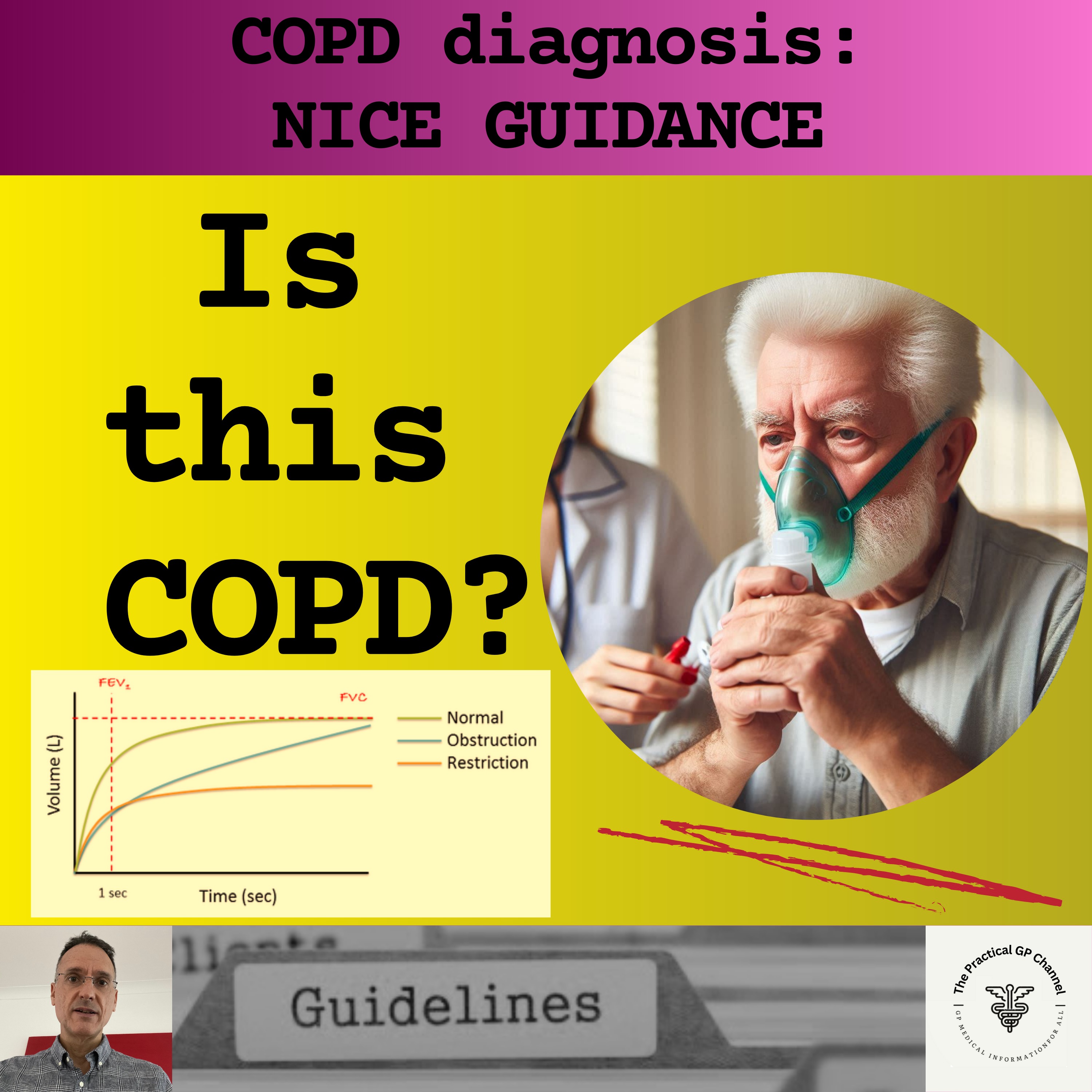
Podcast - Is this COPD? - NICE on COPD diagnosis
from Primary Care Guidelines Hosted by Juan Fernando Florido Santana
The video version of this podcast can be found here: https://youtu.be/o_q8TTra3Ys This video makes reference to guidelines produced by the "National Institute for Health and Care Excellence" in the UK, also referred to as "NICE". Please note that the content on this channel reflects my professional interpretation/summary of the guidance and that I am in no way affiliated with, employed by or funded/sponsored by NICE. My name is Fernando Florido and I am a General Practitioner in the United Kingdom. In this episode, I go through the section on diagnosis and initial assessment of the NICE guideline [NG115] on COPD in adults, always focusing on what is relevant in Primary Care only. I am not giving medical advice; this video is intended for health care professionals; it is only my summary and my interpretation of the guidelines and you must use your clinical judgement. There is a podcast version of this and other videos that you can access here: Primary Care guidelines podcast: · Apple podcast: https://podcasts.apple.com/gb/podcast/primary-care-guidelines/id1608821148 · Spotify: https://open.spotify.com/show/2kmGZkt1ssZ9Ei8n8mMaE0?si=9d30d1993449494e · Amazon Music: https://music.amazon.co.uk/podcasts/0edb5fd8-affb-4c5a-9a6d-6962c1b7f0a1/primary-care-guidelines?ref=dm_sh_NnjF2h4UuQxyX0X3Lb3WQtR5P · Google Podcast: https://www.google.com/podcasts?feed=aHR0cHM6Ly9mZWVkcy5yZWRjaXJjbGUuY29tLzI1ODdhZDc4LTc3MzAtNDhmNi04OTRlLWYxZjQxNzhlMzdjMw%3D%3D · Redcircle: https://redcircle.com/shows/2587ad78-7730-48f6-894e-f1f4178e37c3 There is a YouTube version of this and other videos that you can access here: ● The Practical GP YouTube Channel: https://youtube.com/@practicalgp?si=ecJGF5QCuMLQ6hrk The resources consulted can be found here: Chronic obstructive pulmonary disease in over 16s: diagnosis and management- NICE guideline [NG115]: ● https://www.nice.org.uk/guidance/NG115 The visual summary for the treatment of COPD can be found here: ● https://www.nice.org.uk/guidance/ng115/resources/visual-summary-treatment-algorithm-pdf-6604261741 The COPD Assessment Test score or CAT score can be found here: ● https://www.catestonline.org/hcp-homepage/clinical-practice.html The 6-minute walk test calculator can be found here: ● https://www.omnicalculator.com/health/6-minute-walk-test Intro / outro music: Track: Halfway Through — Broke In Summer [Audio Library Release] ● Music provided by Audio Library Plus ● Watch: https://youtu.be/aBGk6aJM3IU ● Free Download / Stream: https://alplus.io/halfway-through Transcript If you are listening to this podcast on YouTube, for a better experience, switch to the video version. The link is in the top right corner of the video and in the episode description. Hello and welcome, I’m Fernando, a GP in the UK. Today we are going to do an up-to-date review of the diagnosis and initial assessment of COPD in adults according to the NICE guideline [NG115], always focusing on what is relevant in Primary Care only. I will be creating further episodes on the management of stable COPD and COPD exacerbations so stay tuned. Right, so let’s jump into it. The diagnosis of COPD is suspected on the basis of symptoms and signs and is confirmed by spirometry. So, we should suspect COPD in people over 35 who have a risk factor (generally smoking or a history of smoking) and who present with 1 or more of the following symptoms: · exertional SOB · chronic cough · regular sputum · wheezing and · frequent so-called winter 'bronchitis' As part of our assessment, we will also check for signs such as: · weight loss · reduced exercise tolerance and fatigue · waking at night with breathlessness and · ankle swelling Chest pain and haemoptysis, are uncommon symptoms in COPD and they should raise the possibility of alternative diagnoses. The Medical Research Council or MRC dyspnoea scale should be used to grade the breathlessness, so let’s have a look at it: · Grade 1 is when the patient is not troubled by breathlessness except on strenuous exercise · Grade 2 is when the patient develops shortness of breath when hurrying or walking up a slight hill · Grade 3 is when the patient walks slower than contemporaries on level ground because of breathlessness, or has to stop for breath when walking at own pace · Grade 4 is when the patient stops for breath after walking about 100 metres or after a few minutes on level ground and · Grade 5 is when the patient is too breathless to leave the house, or breathless when dressing or undressing Once we have suspected COPD, we should confirm it with spirometry. So, spirometry should definitely be done: · At diagnosis; but it can also be performed · To reconsider the diagnosis, for those who show an exceptionally good response to treatment and · To monitor disease progression. Let’s take a moment here to learn about spirometry interpretation. The key measurements are: · Forced Expiratory Volume in 1 Second or FEV1 which is the volume exhaled in the first second after deep inspiration and forced expiration and it would be similar to the Peak flow rate. · Forced Vital Capacity or FVC, which is the total volume of air forcibly exhaled in one breath and the · FEV1/FVC Ratio which can be expressed as a figure or as a percentage. Both FEV1 and FVC values are compared to predicted values based on sex, age, and height. So, taking this into account, the normal reference ranges are: · FEV1: >80% predicted · FVC: >80% predicted · FEV1/FVC ratio: >0.7 or 70% A typical restrictive spirometry pattern would be · A Reduced FEV1of less than 80% of the predicted value. · A Reduced FVC of also less than 80% of the predicted value and · A normal FEV1/FVC Ratio, that is, a ratio greater than 0.7. This is because, although both FEV1 and FVC are reduced, the FVC value is reduced to a greater extent than the FEV1. On the other hand, a typical Obstructive Spirometry Pattern would be: · A Reduced FEV1of less than 80% of the predicted value. · A Reduced FVC compared to the predicted value, although there are occasions when the FVC can be normal. However, because FEV1 is reduced to a greater extent than FVC, this means that the · FEV1/FVC ratio will be reduced below 0.7 So, in principle, could we diagnose COPD just with typical symptoms and a typical obstructive pattern on spirometry? What about doing reversibility testing. And this is where NICE gives slightly ambiguous advice. On one hand, first it says that we must: “Measure post-bronchodilator spirometry to confirm COPD.” But later it says: “For most people, routine reversibility testing is not necessary because it may be unhelpful or misleading”. But, before we try to clarify this further, let’s look into reversibility testing itself a bit more. If we are doing Reversibility testing because of wanting to rule out or confirm asthma, we should stop any inhaled short-acting beta-2-agonists or anticholinergics like ipratropium at least 6 hours before testing. LABAs should be stopped at least 12 hours before testing and LAMAs at least 24 hours. Reversibility is considered positive if: · The FEV1 Increases by at least 12% and at least 200 mL compared to the pre-bronchodilator test. However, some argue for an increase of at least 15% instead of 12%: So, why does NICE say that reversibility testing may be unhelpful or misleading? This is because: · repeated FEV1 measurements can show small spontaneous fluctuations · the results of a reversibility test performed on different occasions can be inconsistent and not reproducible · over-reliance on a single reversibility test may be misleading unless the change in FEV1 is greater than 400 ml · the definition of a significant change is purely arbitrary and · response to long-term therapy is not predicted by acute reversibility testing. Consequently, if we want differentiate between COPD and asthma, we can frequently do so on the basis of history and examination rather than reversibility testing and, whenever possible, we will use clinical features to differentiate between them. Let’s have a look at these clinical features: · A positive smoking history is almost always present in COPD whereas it is only possible in asthma · Symptoms before the age of 35 is very rare in COPD whereas it is common in asthma · A chronic productive cough is common in COPD but uncommon in asthma · Breathlessness is persistent and progressive in COPD whereas it is variable in asthma · Night time waking due to breathlessness or wheeze is uncommon in COPD and common in asthma and finally · Significant diurnal or day-to-day variability of symptoms is uncommon in COPD but common in asthma. When diagnostic uncertainty remains, or both COPD and asthma are present, we will use the following findings to help identify asthma: · a large response (that is, over 400 ml) to bronchodilators · a large response (that is, over 400 ml) to 30 mg oral prednisolone daily for 2 weeks or · serial peak flow measurements showing 20% or greater diurnal or day-to-day variability. Also, we can’t talk about clinically significant COPD if the FEV1 and FEV1/FVC ratio return to normal with treatment and we should reconsider the diagnosis of COPD if there is a marked improvement with inhaled therapy. So, in summary, according to NICE, although we should do reversibility testing to confirm the diagnosis of COPD, asthma and COPD can usually be distinguished on the basis of history and examination. If diagnostic doubt remains, or where the patient is thought to have both COPD and asthma, reversibility testing or serial peak flow rate measurements can assist in the diagnosis. So, we have now made a diagnosis of COPD based on the clinical presentation and spirometry. Are there any other investigations that we should organise? Well, at the time of diagnosis, in addition to spirometry, all patients should have the following: · a chest X-ray to exclude other pathologies · a full blood count to identify anaemia or polycythaemia and · we should also calculate the BMI. Additionally, we will perform additional investigations depending on the circumstances. For example: ● Sputum culture if sputum is persistently present and purulent ● Serial home peak flow measurements to exclude asthma if diagnostic doubt remains ● ECG, serum natriuretic peptides and an echocardiogram if cardiac disease or pulmonary hypertension are suspected because of: o a history of cardiovascular disease, hypertension or hypoxia or o clinical signs such as tachycardia, oedema, cyanosis or features of cor pulmonale ● CT scan of the thorax to: o Investigate symptoms that seem disproportionate to the spirometric impairment o Exclude another lung diagnosis (such as fibrosis or bronchiectasis) and o Investigate abnormalities seen on a chest X-ray ● Serum alpha-1 antitrypsin to assess for deficiency if early onset, minimal smoking history or family history and ● Transfer factor for carbon monoxide (TLCO) to investigate symptoms that seem disproportionate to the spirometric impairment When discussing prognosis and treatment, we will look at the: ● investigations ● smoking status ● frailty and multimorbidity ● symptoms such as breathlessness using the MRC scale, symptom burden using assessment tests like the COPD Assessment Test score or CAT score, and exercise capacity using the 6-minute walk test. Links to these tests can be found in the episode description ● chronic hypoxia, cor pulmonale and whether the person meets the criteria for long-term oxygen therapy and/or home non-invasive ventilation ● low BMI and the ● severity and frequency of exacerbations and hospital admissions We will assess the severity of airflow obstruction according to the reduction in FEV1 post bronchodilator. There are 4 stages according to NICE: ● Stage 1 or Mild obstruction is when the FEV1 is > 80% or predicted. However, we can only make a diagnosis here if they have COPD symptoms ● Stage 2 or Moderate obstruction is when FEV1 is between 50-79% ● Stage 3 or Severe obstruction is when FEV1 is between 30-49% and ● Stage 4 or Very severe obstruction is when FEV1 is below 30% or below 50% with respiratory failure We will refer people for specialist advice if they have severe disease or confounding factors such as cor pulmonale, need for long term oxygen, steroids or nebuliser therapy, dysfunctional breathing and for the assessment of pulmonary rehabilitation. In addition, we may also refer at an early stage. for example: ● If there is diagnostic uncertainty ● If the patient requests a second opinion ● If there is a rapid decline in FEV1 ● If they are under 40 years or they have a family history of alpha-1 antitrypsin deficiency ● If the symptoms are disproportionate to lung function deficit ● If they have frequent infections in order to exclude bronchiectasis and ● If they have haemoptysis to exclude cancer We have come to the end of this episode. Remember that this is not medical advice and it is only my summary and my interpretation of the guidelines. You must always use your clinical judgement. Thank you for listening and goodbye.
Embed this episode
No transcript yet.