Podcast | The Crossroads
from Finding Manuland Hosted by Decoding Trolls
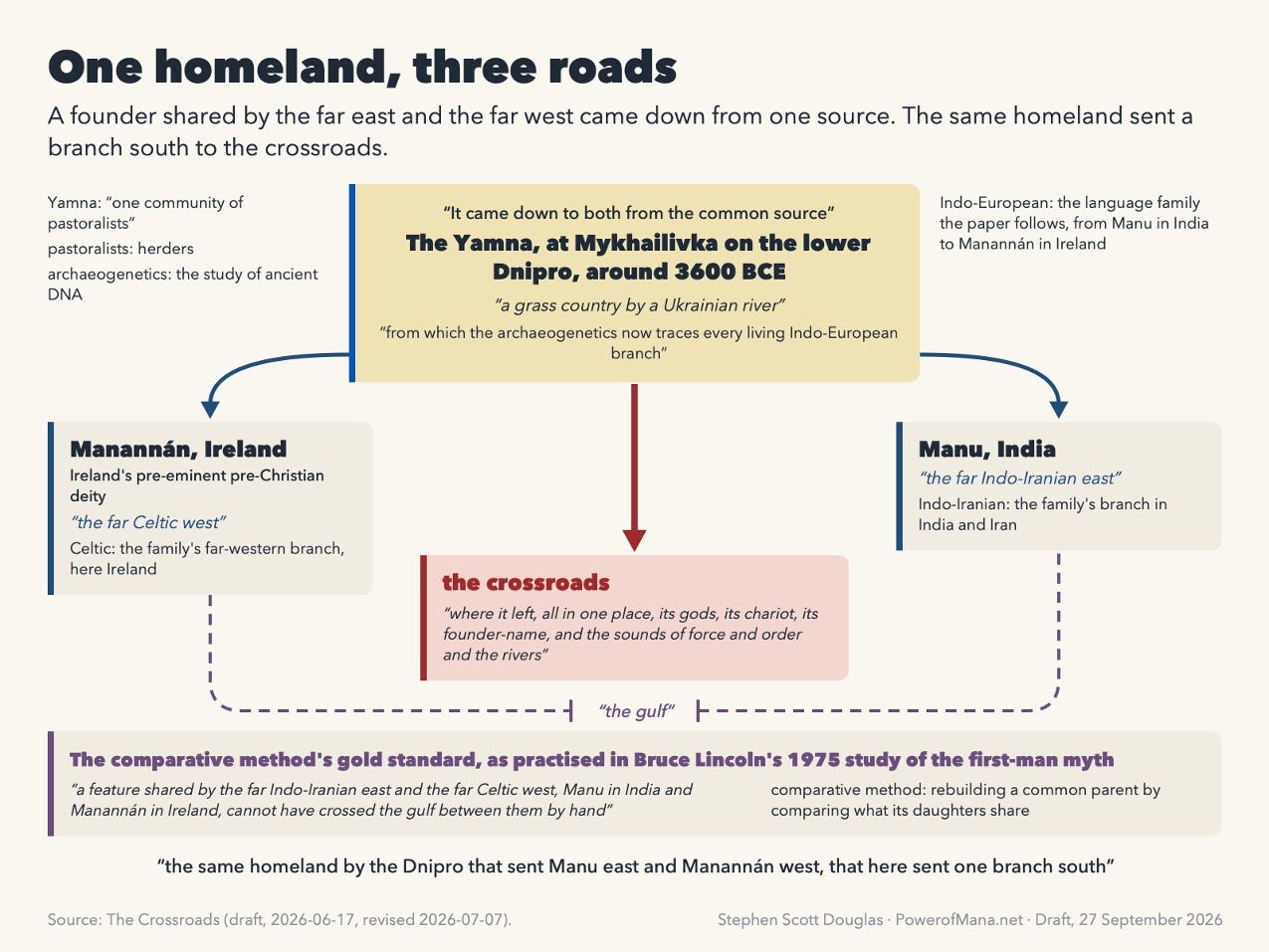
The first of the Atlas journeys I introduced you to the Atlas series of Finding Manuland in five podcasts, published over the last while. This is the very first of the Atlas journeys proper. I saved one of the best for it. Radiating out of this one is a series of pathways through the Anatolian side of Manuland. We will use them to show the method, the linguistics and the organising focus for the journeys still to come. Someone posted on Substack today that their mind was being blown by this series. That is a wonderful thing to hear. My own mind is, frankly, blown by it too. Today I also gained beta access to one of the first world models open to early adopters. I saw a month or two ago that it would come out in beta, and that people were invited to send in their use cases. I made mine about Finding Manuland and the Atlas papers. A world model is a neural network that builds spatial images and camera-controlled video, up to a minute long, from photographs, films or drawings. The very first proper vision network depended on ImageNet. The creator of ImageNet is the person behind this new world model, made by World Labs. I am very excited about it. Over the weekend I will play with it. The first thing I will try is a journey around Mykhailivka, the village on the Dnipro from which all living Indo-European languages set out. I have the archaeologists’ drawings of the excavations there, and I will test World Labs on them. There are conditions attached to the beta, so I will have to be careful about what I post. But we will see what I can do. So stay tuned. Where the crossroads is So, the crossroads. Bring your mind to the modern state of Türkiye. Many of you will have been there on holiday, probably on the westernmost coast, near Smyrna, or Kaş. I spent two wonderful weeks camping down in Cilicia, opposite Cyprus. That is not where we are going. We are going east. You may not have a mental model of this part of the world. I certainly did not, before I began all of this work a few years ago. So if you have a chance, now or later, open Google Maps or Apple Maps, or an atlas if you have one in your library. Look at Türkiye and go east. You will find Lake Van. It is always big on the map, on any depiction of Anatolia from ancient times onwards, because it is a huge saltwater lake. Just below it is the place I am calling the crossroads. Each episode of Finding Manuland has three parts. There is the M-N- sound. There is the linguistics. And there is the journey, the itinerary. Calling these episodes an Atlas does not mean giving up any of the three. The roads that cross The Ukrainian Yamna steppe inheritance did not only run east, to India or to Tajikistan. Picture a wheel with spokes radiating out of it. At the great crossroads of the ancient world, just south of Lake Van, the Indo-European family’s deepest sounds crossed too. This is where a treaty swore the Vedic gods centuries before the Rigveda. The Rigveda is the oldest surviving holy book in Indo-European culture. Modern scholars believe its poems, songs and prayers were settled into their form around 1200 BCE. Centuries before that, we have this treaty, sworn under the moon-god of Harran. I visited Harran last January. I had to hurry through it, unfortunately. It was late in the day, and I had been in the Tektek Mountains looking for another ancient shrine to the moon-god. We will return to Harran, on the podcast and on the ground. This is also where a monarch named Menua built his realm, at Ararat. Its own people called it Biainili. It was based at the modern city of Van. You may remember the video I filmed there last January, on an amazing blue-sky, snowy day. I was the first to go up to Van Castle that morning. In biblical times the Biainili people were known as Urartians. Menua, with the M-N- in his name, was the son of one of its founders and a founding figure himself. Just south of Van is Menua’s Canal, still called by his name today. That is where the crossroads begins, the roundabout this episode is about. And all of these things are caught together on one clay tablet, before the East had written any of them. By the East I mean Iran, and India. In earlier episodes I followed the road east to India and Iran. We will travel that road again. This road turns south-west, to the place where all the roads cross. It is the upland where Anatolia, Mesopotamia, the steppe and Iran all meet. It is the country of Van and Mardin, of Urfa, the modern city of Şanlıurfa, glorious Urfa, and of Harran. I have stood in all of those places. And that area holds something that ought to be on the first page of every history of the West, and somehow never is. Selling the inheritance down the river This week the US Secretary of State made a video, and an appalling speech, in front of the Acropolis. He was trying to tie his undergraduate course on Western civilisation to the beginning of Greece. Those of us who have listened to Finding Manuland know that what we now call Western civilisation began in ancient Ukraine. Marco Rubio and his administration are trying desperately to sell Ukraine down the river. In doing so they are selling the very inheritance they claim to promote. The Nazis did something similar. They went in search of the homeland of the Indo-Europeans, and assumed it was up in Norway, in the Nordic countries. All the while they occupied the very ground around the modern city of Dnipro, the Dnipro River and Zaporizhzhia, which the russians are relentlessly bombing now. Rubio and his MAGA adherents are promoting the surrender of Ukraine under this peace troll, which they have inherited from their communist and russian hypnotisers. They could have befriended Ukraine. They could have helped Ukraine drive the russians out of all of its territory, as will inevitably happen. Instead they are trying to troll Ukraine into defeat. They are not only losing their own country. They are losing the very germ of the civilisation they claim to promote. And in Finding Manuland we know that germ has a place on the map. Two roads to the crossroads The Yamna made a journey to Anatolia around 3600 BCE. It was matched by the journey of the Yamna’s brother and sister culture, which established the first Indo-European languages there. I have said this before, and I will say it again because it matters so much. The first attested Indo-European language is Anatolian, Hittite. You may remember my visits to Kültepe, near the modern city of Kayseri, where the earliest Indo-European writing was found. I have also brought you my discovery in the Museum of Anatolian Civilisations in Ankara. It is among the first Indo-European writing anywhere: a contract in which Tarmana bought a slave, set down in cuneiform on clay. It shows that the M-N- sound, Mana, the sound of energy and charge, is immanent even in the earliest Indo-European writing. So the M-N- sound was not only present among the Yamna in eastern Ukraine. Tarmana’s ancestors had come by another road, through the Areni-1 cave in Armenia, from the upper Volga and the Volga bend. These are parallel tracks. All living Indo-European languages come from the Yamna at Mykhailivka. The dead Indo-European languages, attested first, came by the other road. They include Anatolian, and we have the Hittite libraries of Boğazköy. I visited there in late September and October 2023, an amazing visit. So the journey to the crossroads has two starting points, as far as modern archaeogenetics can tell. One is by the Dnipro, where I spent four years as a diplomat, from 2018 to 2022, and where the Finding Manuland story began. The other road comes from the lower Volga bend. It crosses lands where everyone spoke Ukrainian until the Ruschists murdered, genocided and destroyed their culture, and occupied them. Ukraine is relentlessly striking those lands today. Today it hit the loading bay of the Novoshakhtinsk oil refinery, in Rostov. Everyone there spoke Ukrainian until very, very recently. From that area came the dead Indo-Europea… Get full access to Power of Mana at www.powerofmana.net/subscribe
Embed this episode
No transcript yet.