
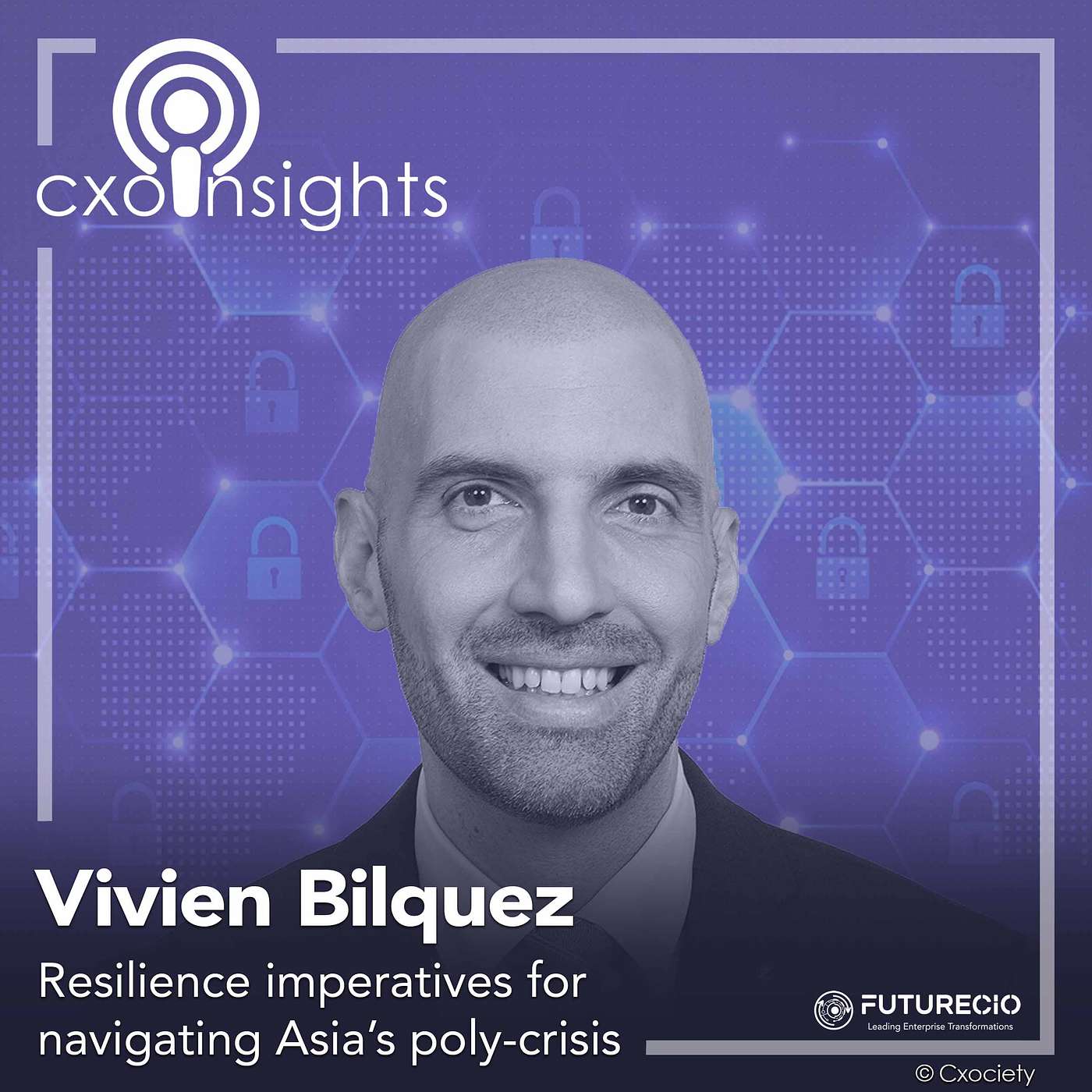
EPISODE · Jun 1, 2026 · 20 MIN
PodChats for FutureCISO: Resilience imperatives for navigating Asia’s poly-crisis
from CXOInsights by CXOCIETY · host CXOCIETY | FutureCIO FutureCFO FutureIoT
In 2026, the risk engineer in Asia faces a fractured reality. Geopolitical decoupling has splintered supply chains across Southeast Asia, while simmering South China Sea tensions directly threaten subsea cables—the region’s digital arteries. Concurrently, climate-driven heatwaves stress power grids, collapsing OT systems in manufacturing hubs. The core dilemma is no longer single-peril analysis but the "poly-crisis": ransomware demands spiking as a grid fails, or a sovereign cyber operation triggering an insurance exclusion. For Asian risk engineers, resilience means stress-testing for layered shocks—where a trade war, a flood, and a data exfiltration all arrive on the same Tuesday.Vivien Bilquez, global head of Cyber at Zurich Resilience Solutions, answers the following questions on resilience imperatives as the region faces its most challenging crises to date. 1. To set the context for our dialogue, please briefly provide a state of resilience for organisations in Asia today?2. With global trade splitting into US and China-centric blocs, which regulatory regime (export controls, data localization) costs/is costing/will cost businesses in Asia the most to operate under?3. Are existing power/electricity backups designed for simultaneous crises (e.g., heatwave blackout plus ransomware), and can we recover in milliseconds rather than minutes?4. How much do businesses rely on subsea cables through the South China Sea or Strait of Malacca, and what is the backup route if a cable is cut? 5. If a nation-state or hacktivist group shuts down existing OT systems (e.g., cooling or chemical delivery), what is the financial loss per hour of halted production?6. Do prevailing insurance policies exclude "sovereign cyber operations" (Stryker clauses), and have organisations moved from relying on insurance to building quantified self-resilience?7. When an AI-driven disinformation campaign targets an organisation’s brand or a climate event shuts plants/production facilities, do organisations have a playbook that unites engineering, the CISO, and the CFO within ten minutes? (If not, can you suggest such a playbook?)8. State the resilience posture of organisations in Asia9. What questions do I ask to put my organisation on the track to resilience?10. What do I need to do to put my organisation on the path towards resilience?
Embed this episode
What this episode covers
In 2026, the risk engineer in Asia faces a fractured reality. Geopolitical decoupling has splintered supply chains across Southeast Asia, while simmering South China Sea tensions directly threaten subsea cables—the region’s digital arteries. Concurrently, climate-driven heatwaves stress power grids, collapsing OT systems in manufacturing hubs. The core dilemma is no longer single-peril analysis but the "poly-crisis": ransomware demands spiking as a grid fails, or a sovereign cyber opera...
Ready to play
PodChats for FutureCISO: Resilience imperatives for navigating Asia’s poly-crisis
No transcript for this episode yet
Similar Episodes
No similar episodes found.
Similar Podcasts
No similar podcasts found.