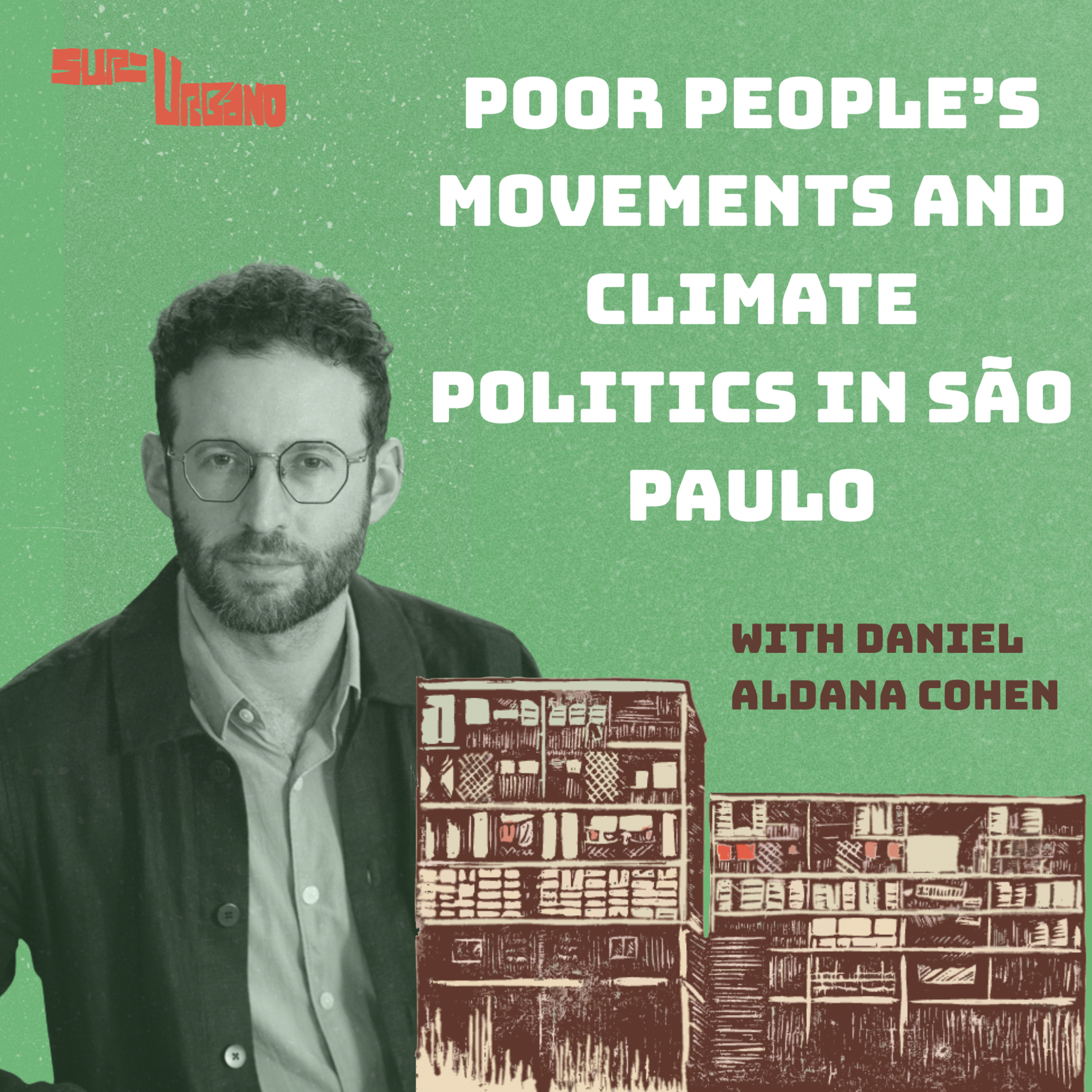
Poor People’s Movements and Climate Politics in São Paulo with Daniel Aldana Cohen episode artwork

EPISODE · Jun 11, 2026 · 53 MIN

Poor People’s Movements and Climate Politics in São Paulo with Daniel Aldana Cohen

from Sur-Urbano · host Latin American Cities Working Group

In the late 2000s, two movements emerged in Sao Paulo, each trying to make the city more humane and livable for its residents. On the one hand, green policy elites worked on a downtown revitalization plan that would model a moreintelligently dense, and hence lower-carbon, style of urbanism. On the other, the city’s housing movement occupied vacant buildings to pressure state actors to build up affordable housing and democratize urban planning. These groupscould have been allies, but first, they ended up on opposite sides of a battle over the future of the city. What were the conditions for the climate and housing agenda to pull in the same direction?There is a line of argumentation that says: “working class people don’t care about the environment or climate change; this is a privilege of the middle class or urban educated elites, that is incapable of accounting for the immediate necessities many families have”. And yet, this itself fails to recognize that many working class struggles already have a green agendaof sorts: they want good housing in central places; they want transit systems that work and access to urban amenities that the wealthy already have. In other words, what the environmentalist movement – and its critics - sometimes miss isthat some of the most important climate actors are not always the people who speak in the language of carbon emissions and bike lanes, but rather fight for the right to the city.Talking through this today is Daniel Aldana Cohen, who is not only Assistant Professor  of Sociology at UC Berkeley, but is also one of my models for public intellectual and leftist policynerds, particularly around working class politics and climate change. In this episode, we talk about Daniel’s upcoming book, titled Street Fight: Climate Change and Inequality in the 21st Century City. We look at the case of Nova Luz, a downtown redevelopment project sold as a green and dense revitalization urbanism, but that was actually experienced by housing movements as a kind of displacement from above. But the framing that there is an intrinsic conflict between climate and social justice is a strawman – instead, we need to understand the distinction between luxury and democratic ecologies and who reaps the benefits or pays the costs of these different political projects. There is a critique, but also hope in this! The environmental movement is doomed to alienate working class people if it shifts the costs of changes onto the people already bearing the worst brunt of climate change and inequality.But by integrating working class needs – including appropriate measures – such as protecting housing security to avoid green gentrification, or creating affordable housing in central locations – then the power of both movements can reinforce each other. This isn’t necessarily easy, and there are tensions tonavigate – but it’s the only long-term strategy that can create a deep leftist project of public affluence and climate justice. Daniel Aldana Cohen is Assistant Professor of Sociology at the University of California, Berkeley, where he is Director of the Socio-Spatial Climate Collaborative, or (SC)2, and serves as a member of the Graduate Group of the Designated Emphasis in Political Economy. He is also Founding Co-Director of the Climate and Community Institute (CCI), a progressive climate and economy think tank. He has been a CIFAR Azrieli Global Scholar (2021-24), and Member of the Institute for Advanced Study in Princeton, NJ (2018-19). He is the co-author of A Planet to Win: Why We Need a Green New Deal (Verso 2019).

In the late 2000s, two movements emerged in Sao Paulo, each trying to make the city more humane and livable for its residents. On the one hand, green policy elites worked on a downtown revitalization plan that would model a moreintelligently dense, and hence lower-carbon, style of urbanism. On the other, the city’s housing movement occupied vacant buildings to pressure state actors to build up affordable housing and democratize urban planning. These groupscould have been allies, but first, they ended up on opposite sides of a battle over the future of the city. What were the conditions for the climate and housing agenda to pull in the same direction?There is a line of argumentation that says: “working class people don’t care about the environment or climate change; this is a privilege of the middle class or urban educated elites, that is incapable of accounting for the immediate necessities many families have”. And yet, this itself fails to recognize that many working class struggles already have a green agendaof sorts: they want good housing in central places; they want transit systems that work and access to urban amenities that the wealthy already have. In other words, what the environmentalist movement – and its critics - sometimes miss isthat some of the most important climate actors are not always the people who speak in the language of carbon emissions and bike lanes, but rather fight for the right to the city.Talking through this today is Daniel Aldana Cohen, who is not only Assistant Professor  of Sociology at UC Berkeley, but is also one of my models for public intellectual and leftist policynerds, particularly around working class politics and climate change. In this episode, we talk about Daniel’s upcoming book, titled Street Fight: Climate Change and Inequality in the 21st Century City. We look at the case of Nova Luz, a downtown redevelopment project sold as a green and dense revitalization urbanism, but that was actually experienced by housing movements as a kind of displacement from above. But the framing that there is an intrinsic conflict between climate and social justice is a strawman – instead, we need to understand the distinction between luxury and democratic ecologies and who reaps the benefits or pays the costs of these different political projects. There is a critique, but also hope in this! The environmental movement is doomed to alienate working class people if it shifts the costs of changes onto the people already bearing the worst brunt of climate change and inequality.But by integrating working class needs – including appropriate measures – such as protecting housing security to avoid green gentrification, or creating affordable housing in central locations – then the power of both movements can reinforce each other. This isn’t necessarily easy, and there are tensions tonavigate – but it’s the only long-term strategy that can create a deep leftist project of public affluence and climate justice. Daniel Aldana Cohen is Assistant Professor of Sociology at the University of California, Berkeley, where he is Director of the Socio-Spatial Climate Collaborative, or (SC)2, and serves as a member of the Graduate Group of the Designated Emphasis in Political Economy. He is also Founding Co-Director of the Climate and Community Institute (CCI), a progressive climate and economy think tank. He has been a CIFAR Azrieli Global Scholar (2021-24), and Member of the Institute for Advanced Study in Princeton, NJ (2018-19). He is the co-author of A Planet to Win: Why We Need a Green New Deal (Verso 2019).

NOW PLAYING

Poor People’s Movements and Climate Politics in São Paulo with Daniel Aldana Cohen

0:00 53:26

No transcript for this episode yet

We transcribe on demand. Request one and we'll notify you when it's ready — usually under 10 minutes.

Ils nous gavent ces écolos Raje Chronique réalisée par Jenny Bernard.« Ils nous gavent ces écolos » est l’émission pour celles et ceux qui écrasent les araignées car elles sont moches ou qu’elles font peur, qui pensent que les moustiques ne sont sur terre que pour piquer ou qui aiment les animaux, surtout bien cuits ! Ces épisodes de quelques minutes ont pour objectif de faire changer leur regard sur la biodiversité avec humour et légèreté ! On va refaire le monde X "En mode coach" Lola Bon. J’ai décidé d’aborder des sujets dont on ne parle pas, par peur du jugement de l’autre, par pudeur, par insignifiance, ou par manque d’envie.Le sexe est pourtant partout. Il fait partie intégrante des relations humaines, qu’elles soient amoureuses, amicales, professionnelles, cordiales ou même fortuites. Et pourtant, on n’en parle pas, ou pas assez, ou juste pas de la bonne manière.Moi, je veux parler du sexe, du vrai, celui qui est là, devant nous, et qu’on ignore…Bienvenue sur : On va refaire le monde X En mode coach. Et Merdre ! Martin Poirot Et Merdre ! Votre émission vivante consacrée aux spectacles du même genre !Découverte des coulisses de toute les formes de créations artistiques du spectacle vivant : mise en scène, scénographie, jeu, écriture, expositions... Dans chaque émission retrouvez un artiste, un spectacle, un lieu, ou un festival. Aussi disponible en vidéo sur YouTubeUne émission animée par Martin PoirotRéalisée par Zachary GuerenneurIllustrée par Carole MarietHébergé par Ausha. Visitez ausha.co/fr/politique-de-confidentialite pour plus d'informations. Hasheur Hasheur Bienvenue sur ma chaîne ! Je me présente, Owen Simonin (alias Hasheur), je vulgarise sur Youtube différentes technologies, techniques et stratégies complexes du monde du Business. Principalement à travers la Blockchain et les Cryptomonnaies (bitcoin), je décortique même les méthodes de paris en ligne, le trading et les autres types d'investissements ou rendements passifs. Mon objectif est de simplifier les sujets et les investissements les plus complexes du milieu afin de permettre à tous de ne rater aucune opportunité.

Frequently Asked Questions

How long is this episode of Sur-Urbano?

This episode is 53 minutes long.

When was this Sur-Urbano episode published?

This episode was published on June 11, 2026.

What is this episode about?

In the late 2000s, two movements emerged in Sao Paulo, each trying to make the city more humane and livable for its residents. On the one hand, green policy elites worked on a downtown revitalization plan that would model a moreintelligently dense,...

Can I download this Sur-Urbano episode?

Yes, you can download this episode by clicking the download button on the episode player, or subscribe to the podcast in your preferred podcast app for automatic downloads.
URL copied to clipboard!