
Ave, and welcome to When in Rome, and now, cue the music. Here's Christine Rowlander. It was, however, a seat of an important imperial administrator, the Prokurator, Provincie Belgique et Utzgelskriegermannis, the imperial financial official, that sort of administered all of these, the two German provinces and the Italian Belgique. It's grown ever since then, so we know that some of the public buildings, some of the Roman buildings that are still standing today, we can date them more or less precisely.
The oldest one is the bridge across the Mosel River, which still stands. It's first mentioned in Tacitus in the context of insurrection against Roman rule at the end of the 60s AD, but archaeologically it has been dated to, I think it was 16, 17 BC. So that's the date when the wooden stakes that were rammed into the little bed as a sort of foundation for the work itself, that's when these were found. So we know that it's been there since around 1716 BC, and then the other buildings that survive to this day are a bit later.
Here was a wealthy city, it was always growing and prominent, so you can sort of trace that. You have the bridge, you have the first public bath on what is now the Fiemark, which was built around 80 AD. And of course, you have the amphitheater, which was built around 180 AD, so that's always a mark of a certain degree of wealth when a city gets big enough and prosperous enough to build an amphitheater, which is still standing. Then you have in the second century, that's where sort of the prosperity of Schlier really took off.
The Roman city walls were built around that time, and in that context also the Potanian was built. And then of course you have the late antique history, the 3rd century and particularly in the 4th century, where Tria gets to be one of the imperial residences, first of the patriarchs and then of the Constantinian and Valentinian dynasty. And that's sort of the high point of Tria and antiquity, the 4th century. Emperor spent a lot of time here, built a palace here, and chose it as their siege to when they had to govern the northwestern provinces.
In context of the gate then, you were saying that it's like the late 2nd century, where a wall is built around Tria. Why was it needing a wall, and is that when the first gate would have been built around then? It's actually a very good question, because it has proven surprisingly difficult to establish a specific day. It's not really mentioned in literary sources.
One clue is in the context of the civil war after the death of Commodus, so the year of the five emperors, Tria sided with Septimius Severus, and was besieged in 196-197 by British forces of Clovis O'Pinus, one of the pretenders to the throne. In order to have a siege, you need to have a city wall. So that's one clue in the literary sources. But there's always been discussion about when it was built, both the city walls and the Potanian.
And for a long time, the assumption was it had its origin in the 3rd century, so the so-called crisis of the 3rd century. On the face of it, that makes sense, because there was a lot of insecurity in the northern provinces. There were a lot of cross-border raids. Tria itself was actually plundered by Franks and Almen in 275.
So the assumption was always that building a city wall and fortification system needs to be connected to a sort of military threat. And actually, that doesn't appear to be the case. There's been a project undertaking to finally resolve the question, and there were a couple of archaeological field seasons right in vicinity, immediately close to the Potanian, and it's now dated to around the year 170 AD, so under the Antonines, under Marcus Aurelius. The small archaeological dig was made, a couple meters next to the Potanian, and they discovered parts of the city of the circuit walls that had not been discovered before in that section.
They also discovered the foundation of the fortification tower. There were around 50 towers in the circuit walls. They discovered wooden stakes that were hammered into the ground, because it was a very wet ground and had low stability, so they had to stabilise it in order to make the foundations and then build the city walls. And these wooden remains could be dated dendrochromologically, so it comes from the yearlings.
And so we now know to a certainty that the wooden elements of the city walls in the section, immediately next to the Potanian, the trees were felled in the winter of 169, 170. And so that means the city walls had to be built around that time, and the Potanian itself as well. There's always a possibility that the Potanian is older. Gates don't need walls particularly to function.
One function is the regular traffic, but another function is representation. So in some cases, gates were there probably before walls were there. Okay, but in this context, the gate was built with the wall. Towers, it sounds like it was a serious defensive fortification.
Yes and no, it was a serious work. Actually, I have to pull up the numbers. So the circuit wall in Trier, six meters high, so what is that, about 18, 19 feet high, and three meters, nine feet deep, quite significant. And it included either 48 or 50 fortification towers, city towers, watchtowers, and the entire circuit of the walls ran for more than six kilometers.
So that encloses almost but not quite three square kilometers. It may not sound like much, but it's a lot, particularly if you compare it to other almost contemporary buildings or city walls. Cologne, for instance, which was Colonia Claudiara Agripenensium, so an important Roman city on the Rhine, seat of the provincial governor of Germania interior, headquarter of the legions of Germania interior, headquarter of the Classis Germanica, so the Roman river streets that controlled and controlled the Rhine, a very important city with a larger population than Trier. It also had walls built a bit earlier, around the century earlier, so around 19, 100 AD, and that city fortification, it only encompassed less than one square kilometer.
So Trier had a city wall, a circuit wall, that was three times as large as that of Colonia. It probably enclosed a lot of empty space. The city population was not enough to really fill that area, so there's discussion about why they did it. The location of the city wall is not practically advantageous, it's more the opposite of that.
So why do we build it so big, perhaps to future prove it, to provide for future expansion of the city, possibly, and perhaps just to make a point, because as I said, 175, there was no need for a city wall in this region of the Roman Empire. The frontiers were secure. I mean, it was under Marcus Aurelius, so you had the whole Marko Manic wall, so that was on the Danube. The Rhine region was secure.
Trier is not located on the Rhine, it's a comfortable distance from the river. It was safe, it was prosperous, it just wanted to have a city wall, because that's what safe and prosperous and well-to-do cities did. That sounds like a surplus budget, which isn't a bad problem. No, it's a good problem to ask, and then you sort of have to make a statement how to show people that.
And so you build a huge city wall and a number of huge gates to show it off. Tell me about the gate, then. Is this a huge gate? What's the structure of it?
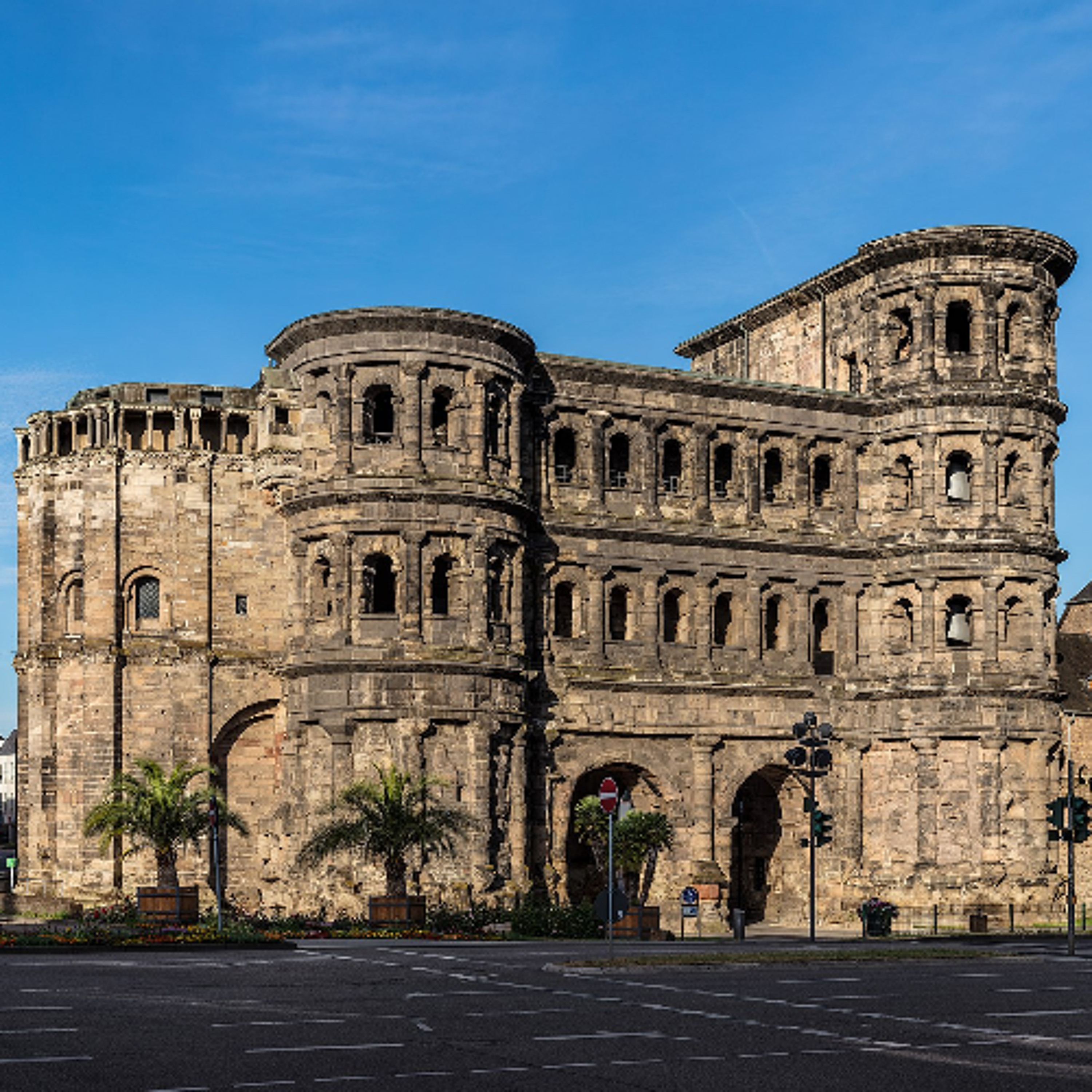
It's big, yeah. If you or your listeners ever come to Trier, first give me a call, and second, when you go to the Port Anil and you walk through it, the actual gate itself, so just the structure where you walk through, is around 9, 10 feet high. So that's a lot already. And the entire building, 36 meters in broad, around 20 meters deep, because it's a double set of gates.
You have two sets of double gates, one behind the other, on either side of a narrow courtyard. The walls and the gate was not a military fortification per se, it was more an aspirational thing, a symbol of status of the city, and it was also to check traffic and to check the economic flow of imports and exports. So it was where you had to pay your dues, for instance. So you had this narrow courtyard where you could stop cars and stop people and ask them what they were doing, what they were bringing into the city and what they were carving out of the city.
And it's around 30 meters high. So it's a significant size for a building. It consists of over 7,000 blocks of stones. The largest one is over 6 tons of weight.
It's not made of brick like the Basilica, but it's made of big, huge sandstone blocks that were quarried in the vicinity, so in the region of Cordel, which is a small village about 10 kilometers from here, and then probably transported over the Moselle River to the building side. The stone blocks were fit together with no mortar, but because of their own weight and spacing, they were put very closely together, and then to provide additional stability, they were connected with iron brackets. Big iron brackets as well, around 2 or 3 kilograms of iron per bracket. And we know that because these elements survive, but what does survive is a set of very obvious holes in the external and internal facet.
After Roman period, people just build holes into the structure to get out these iron brackets. There's lead there, there's iron there. These can be used for other things. They can be molten down and recast or something else.
And so we have quite a large number of holes all around the Port Aniga where this has happened. Yeah, well, if that's an indication of the walls as well and the other towers, this is a massive building project. It's a very big undertaking. Yeah, but still, there are indications in the way that the blocks are shaped and that the blocks are put together, and there are markings, what is called in John Steinmetz, so markings made by the artisans that constructed the whole thing for further use of the stone.
There is indication that the whole thing was probably built in around 4 to 5 years, so the wall, the turrets, and at that time, the 4 gates later, there was a 5 gate added, which is very quick, particularly when you compare to the time taken by public building projects in Germany right now, which measures more in decades than anything. The Roman treas, they put this whole thing up in 4 years. Interestingly, though, it was never finished. I would almost say intentionally never finished.
Just looking at it, particularly on its northern side, so the side that was facing away from the city. The Port Aniga faces north, and the road from there leads to Mainz and then to Cologne. So if you approach the city gate from the north, from Cologne, you can see today, and you would have seen it in Roman times as well, it's not finished. The blocks that were used, they were set, they were connected to each other.
The building, obviously, is standing and finished, but the facade was never polished. Artologists call it bossages, so there are still pieces of the original stone that are on the external facade that would have, or that were supposed to have been chiseled away, or chiseled into decorations, or decorative elements, or polished, or burnished. Never happened. So the external facade is still, it's very bumpy, it has a sort of an unfinished look to it, and we actually know that there can never have been an actual gate, a functioning gate in the Roman Port Aniga, because some of these bossages and some of these unfinished, uncut stones are such that they block the hinges of the door.
The building blocks would have prevented the door from ever closing all of them. It says something about the priorities, though, when they don't need an actual gate on the gate. Yeah. So I guess this takes us to, as Tria changes and becomes more of a, I guess, a Christian city, this gate takes on a different meaning to the city.
For a while, I guess it's a surviving reminder of the Roman time of the city, but it's also a useful place for heavy stones and material, like many other Roman buildings. So how does it survive in such a good state as it is now? What's the significance of it in this time that keeps it more or less intact? Actually, we know very little of the late antique and immediately post-Roman history of the gate.
Almost nothing. Parts of the Roman building survives, as always, and the Port Aniga is no different there, because it was repurposed into something else. The Port Aniga survives into the 10th and 11th century as a tower. So Port Aniga obviously means black gate, which sounds a bit ominous.
It sounds a bit like Sauron's black gate in Turkey and Slough of the Rings. It's not an ancient name. So in Roman parlance, it would never have been called the Port Aniga. It would have been called the city gate, the Porta or the Porta Dextra, because it was sort of from how the city was orientated.
The first mention of the gate as the Porta Aniga is actually in a geographical text from the 11th century. And that text, the Vita Simeone, is called the Porta Aniga a tower, a turist, that was of old called the Porta Aniga, anthea vocabatua. So we know that it was already called the Porta Aniga well before the 11th century. We also know from slightly later sources, from the 12th century, that the inhabitants of Sphere mostly called the Porta Marathis, so the Mars Gate.
Those seem to be the two names for which were in use in the Middle Ages. So that's all mentioned that it was called the Vita Simeone, so it's the hagiography of an Eastern Roman monk, St. Simeon, who was originally from Syracuse, but was probably one of the most well-traveled people of his age. He was born in Syracuse, he became a monk, he traveled throughout the Eastern Roman Empire, he settled down in St.
Catherine's Monastery in Sinai, in Egypt, and was then sent on a mission for his abbot to Normandy, north-eastern France, which is quite a distance from Sinai. And during his travels, he encountered the altruist of Trier, a man called Popo. They decided to undertake a pilgrimage to Jerusalem together, so he went from Egypt to France, the Gaul, and then from Gaul to Jerusalem, acting as a guide for Popo, and on their return, since they had become friends, and Popo must have told him how beautiful the Mozambique Valley was, Simeon decided to come back with him and to settle down in Trier. So he spent his last six years, from 1028 to 1034 or 1035, when he died, he spent in Trier, and he decided, because he was a monk, and he was a famous ascetic, and he decided to spend the rest of his life as a wreckage in the Porta Aniga.
There's not a lot of caves around here, so he took up residence in what was then an isolated structure that was uninhabited, and he just lived there. The medieval legend has it that he was walled in to live as a real recluse, and then he died there. Wow. I was reading about this guy, his name's Simeon, didn't you say?
And his entire story seemed to be attempts to become a recluse, and being unsuccessful at it, because people won't leave him alone. Yeah, he's a very holy man, and he was only trying to become more holy, but because he was so holy, people always pull him back out and task him with different things, and he just wanted to live a life of solitude and prayer. It struck me as a Monty Python skit in some forms. There's a scene in Life of Crime where that happens, right?
Yes, yes, that's right, yeah. The wilder static living in his hole in the ground, and people just come and adore him as the messiah. Yes, yes. But Simeon's life, it was a pretty wild affair, because there have been estimates in scholarship that he must have travelled around 25,000 kilometres altogether, and that's in the late 10th and early 11th centuries.
So it's quite a testament to the mobility that some groups of people could have in that period of history. Wow. So he becomes a recluse in the Porta Nigra, potentially sealed in there and, I guess, fed. Has that room been identified?
By tradition, yeah. He died in either 1934 or 1935, and the Alt-Bishop Popple, who was still alive, had him declared a saint, extremely fast, so he was declared a saint by the Pope a year after his death, I think. And to honour him, and possibly also to add another ecclesiastical to his attraction to it here, one shouldn't always discuss the economic aspects of this, Popple had to be declared a saint, and then he founded a clerical community of St. Simeon, a college of canons.
In German it's called the Schrift. They're not moms, they're clerics, who lived in a non-monastic community in a building. The Schrift has a church, the Schrift's Kirche, I think in English it's called Westminster, is an example of that, because it's an abbey, so an abbey is the church of a non-monastic college of canons. You can see on the western side of the Porta Nigra, there's a medieval building, these are the remains of the Simeon Schrift.
So that was the place where the non-monastic community lived, where the canons lived. Today it houses the city museum, St. Museum of Simeon Schrift, which is a very nice place, and one should go there when one visits. It was architecturally attached to the Porta Nigra, because the Porta Nigra was then turned into the church for the cabin.
And that's why we have a traditional identification of the place where St. Simeon lived, because there was a lot of construction going on, and its appearance changed radically, and one of the things they did was they added an abt on the eastern side. Simeon was buried in that abt, and it was supposed to have been the place where he had lived also. But, I mean, it's always unfair with these attributions.
And the interesting thing about the church is that it's no longer the Porta Nigra, it's not a church of St. Simeon in Porta Nigra. And the interesting thing about that, there's a medievalist at the University of Simeon, who has done a lot of work on the post-Roman history of the city, and the medieval history of the city, and he's very interested in what happened to the Romans. remains and how they were used and repurposed and utilized.
And so medievalists are always very, very, very depressed when I ask them about this church because of course it doesn't exist anymore today. We'll get to that later. But it must have been extremely fascinating because you can just imagine you have a huge Roman-built city gate of the second century. They buried what's the ground level for the Romans, where the actual gates are.
They buried that. They include on the southern side, so the city-facing side, there was a huge monument leading up to what was the new ground floor, which was the Roman first floor. And on the other side, facing away from the city, they added a terrace with butchering walls around it. So the whole ground floor of the Roman building was invisible for 800 years.
And on the western side, there was the Simeon Schrift, so the living community. So that was architecturally integrated into what used to be the Porta Nigga. And on the eastern side, they added a semicircular axe, which is one of the few medieval things still standing and still visible today in Porta Nigga. They tore down the eastern tower because the Porta Nigga had two towers.
The eastern tower was torn down because we didn't need it in a church and the western tower was transformed into a church tower. And that's the reason it still survives to this day. So in the medieval period, they added a church fire to the tower that was demolished again. But that's the reason why the Porta Nigga today is a bit unbalanced.
So you have on the western side, you still have the tower, and on the eastern side, you don't. Okay, that makes sense, because you can kind of visualize how there was a church system built over the top of it. So it almost had like a medieval Christian cocoon. Yeah, exactly.
And at the very center is this Roman structure that was turned into... Actually, I mean, it was not turned into one church, it was turned into two churches. On what was the new ground floor, the Roman first floor, there was a church, a parish church that was open to the public. They closed the inner courtyards, obviously, and they put in new floors.
And on the new first floor, what was the Roman second floor, you had another church, and that was the church of the canons. So that was not open to the public, but that was just for their private celebrations. So it's two churches. And you don't have to visualize it in your head.
There's really, there's very many depictions from the Middle Ages and early modern times, particularly. We know exactly what it looked like, because it survived until the early 19th century, and then it was torn down. And we have paintings, woodcuts, illuminations, and everything from all the previous centuries. And we have a very extensive documentation of the demolition process.
So we know exactly what that thing looked like. And if you go to the museum, you can have these 3D printed models that you can see. It looks completely different from anything you would imagine connected to a Roman city again. So why doesn't this structure exist anymore as a church?
What happened in, well, not too long ago, about 150 years ago, by the sounds of it, to change that status? Well, the question of what happened to XY and Thierre can always be answered with the same name. Napoleon happened. He did quite a number on Thierre, in many different ways.
During the French Revolutionary Wars, the coalition was Thierre and the surrounding region was conquered by the French Republic in 1794. And then it was incorporated in the French Republic by several peace treaties around that time. Thierre became the capital of what was then the département de la Sarte. So the French Department of the Republic was incorporated into the French there.
When the Republican government was replaced by Napoleon, Napoleon became emperor of the French, including Thierre. And the church itself and the Simeon Stift was dissolved in 1802. Several of the monasteries surrounding Thierre, which were also situated on top of Roman ruins, which incorporated Roman churches, latency churches like St. Maximian, they were all dissolved and the Simeon Stift and the church were also dissolved.
So they were profaned. Napoleon visited Thierre, the city, in 1804. He was here once. He saw the church.
He had people explain to him what the church was. He saw that there were some Roman things buried under there. And then he just gave the order of the church to destroy. It's been a bit understudied, actually, as all aspects of Thierre have been.
But I would say that there were a couple of factors involved. One is the sort of French Republican aversion to religion, specifically to the Catholic church as an organized state institution, so the Laie Cité of the French. And the other thing was, Napoleon was by then already emperor of the French and his proclivity for adopting Roman traditions and Roman symbolism in his own representation. So he may have just wanted to do this Roman thing.
We'll get that out and then the Thierre will like me because I restored his Roman citigate. And so in 1804, the demolition was started. It continued until 1809, when most of the medieval church was already gone. And then the second thing that's always the answer to the question of what happened to anything in Thierre is the Prussians, because Thierre became part of Prussia after the Congress of Vienna.
Together with Cologne and Mainz, it became part of the Reign province. And the Prussian state continued Napoleon's work. The last passages of the medieval church were destroyed in 1817. The only thing that survived is the eastern maps, demolishing it would have endangered the stability of the whole structure.
And that's more or less the state that you still see today. In some ways, I regret the loss of all of that church architecture, but it is good to see something in more of a Roman form. The example that comes to mind is if you go to Rome today and you go into the Pantheon, and that's just completely a church. There's very little, especially on the inside, very little Roman that's still there.
This structure reminds me of that, but it went the other way, turning it back into the Roman structure. No, what's your take of it? Are you happy that there's a Roman structure there now in Trier, or would you rather there be yet another church? Yeah, as an ancient historian, what can I say?
Of course I'm happy that the city gate is there. It's symptomatic of how politics of cultural heritage and archaeology as a discipline evolved in the 19th century. And you can see that from the correspondence between French administrators and Prussian administrators. The medieval aspect of it was always looked down upon.
I came across that there was a tourist guide written in the early 19th century, so before the demolition of Napoleon in 1801, I think. And they recommended visiting Trier as a tourist destination along the Moselle because of the natural beauty here. And then there were a couple of things mentioned. So the Potanita was mentioned, but it was mentioned in a sort of slightly sad way because it was explicitly said that this wonderful Roman building has been encroached upon by a dangerous superstition, but one should still look at it.
But I would just say, because I had this discussion with students the other day, this idea of getting something back to the way it was, that's always an illusion. That's the Prata Morgana. Because the structure that stands now is not the Roman structure. It's a chimera of Roman, medieval, and modern elements.
And the way that it stands now is not Roman. It stands as an isolated building. It has sort of this medieval edition. Parts of it were chopped off, or Roman cars.
And the western side, it's still attached to a medieval cannon building. It has never looked like that in its history prior to 1809. That's not Roman. That's what we imagined Roman to be.
But now it's a symbol of the city, you say. It's a symbol of Trier. It's got a pretty decent museum by the sounds of it. The Potanita itself is a museum, so you can enter it.
You can go up on the last floor, and you have a beautiful view of the medieval city hall there. The symbol of the city of Trier is a modern version of the Potanita. You have the local football club that has the Potanita in its power degree. And I've always wondered about this, because there is a city called New Trier, or a township called New Trier in Cook County, which is a county that also encompasses Chicago.
And when I looked it up, do you know what the logo of the school is? The Potanigra. The Potanigra, yeah. That's lovely.
That was Christian Rolinger, senior lecturer in ancient history at the University of Trier, and you have been listening to When in Rome. If you like this podcast, you can subscribe to Apple Podcasts, Spotify, or any readily available podcasting platform. Please leave a review. They are always very appreciated.
You can like us on the Emperors of Rome Facebook page. You can also follow us on Blue Sky. Christian is at Dr. C.
Rolinger. I am at Nightlight Guy, and the podcast is at Rome Podcast. When in Rome is a publicly funded podcast, and I'd like to give a sincere thanks to all of those who have supported it. The emperor for this episode is Lorenzo Morasco, and to our new trium beers, Tracy Morgan Harris, Dean Pavott, and Chris McDonald.
Ave to you. Also a shout out to Oli Julian, the composer of the music that you're listening to in this podcast. It is the theme music to the ITV show Plebs, from Rise Comedy. That's it today for When in Rome, so until the next episode, I'm Matt Smith, you've been fantastic, and thanks for listening.