The following podcast is part of the mindbodyspirit.fm podcast network. Put us in a box. Go ahead. That just gives us something to break out of. Because the next generation 2025 GMC terrain elevation is raising the standard of what comes standard. As far as expectations go, why meet them when you can shatter them? What we choose to challenge, we challenge completely. We are professional grade. Visit gmc.com to learn more.
Learning through play starts with Lego Duplo. With Lego Duplo, toddlers can develop real-life skills while having fun with colorful bricks made just for them. Large, easy to grip, and safe to explore. When children express themselves with Lego Duplo, they build patience, problem-solving, and empathy. See your child learn perseverance and self-expression with everything they imagine and create. Visit lego.com slash preschool to learn more. This episode was recorded when the world's attention was on the 2024 Summer Olympics in Paris. So I might have gotten a little carried away or confused about some of the stories I related, so...
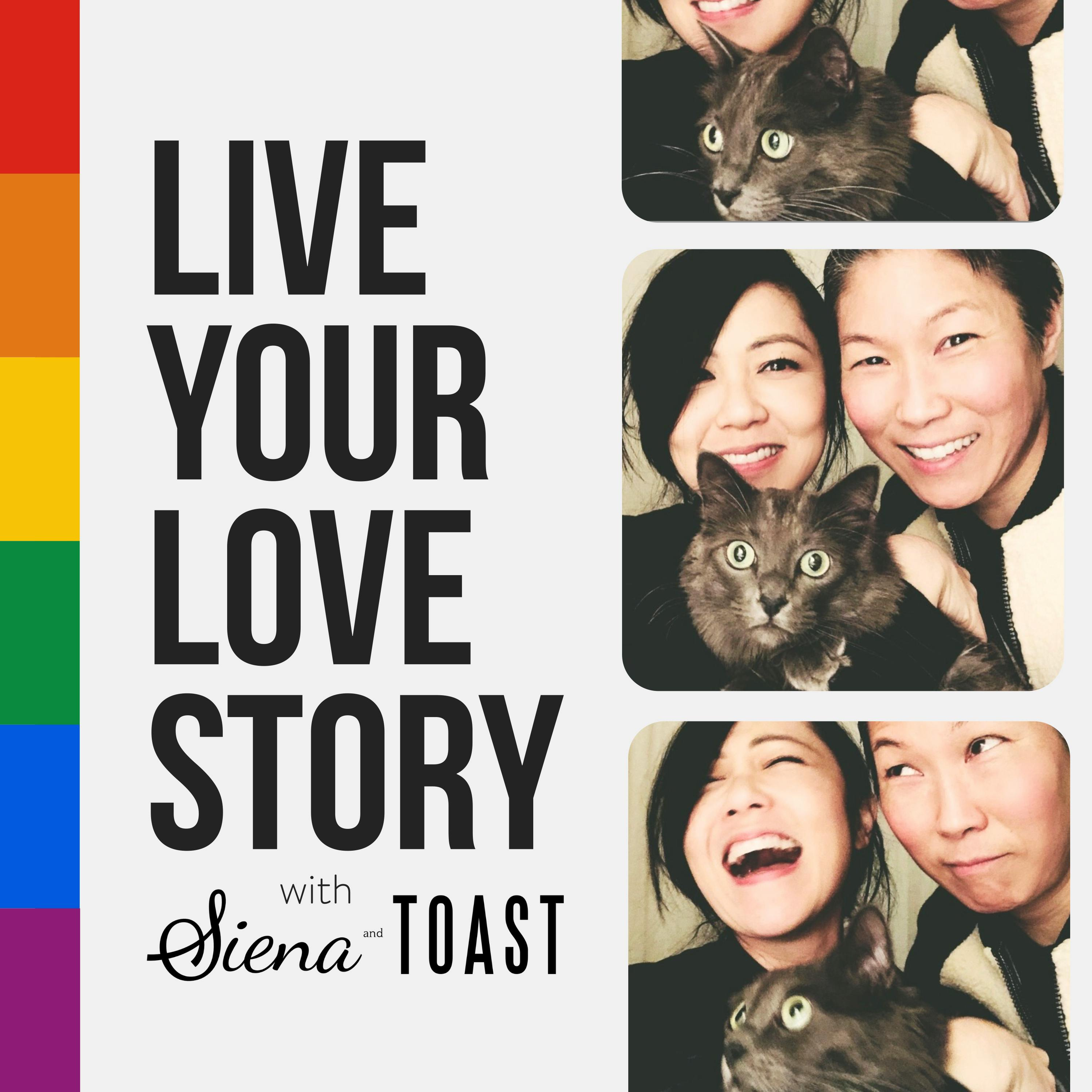
I just want to clarify, the stories of sportsmanship that we discussed did not happen at the 2024 Summer Games, but they did happen. And we've included links to more about them in the show notes on our podcast blog. Okay, with that being said, on with the show and what Barbara Fredrickson calls Love 2.0. Welcome to the podcast where it's all about living your love story and making your life a story where love wins. My name is Sienna. And my name is Toast. We're married and we've been partners in life, love, and music since 2001, over 20 years. On this show, we share our life as an Asian American lesbian couple. Some of our favorite topics are positive spirituality, holistic health, sometimes cats, lesbian alerts, and other things we hope are entertaining, uplifting, and helpful for living your love story. So here we go. Welcome to our home studio in the Pacific Northwest. Welcome. We have a cat here in the studio. Oh, there he is.
All right. So today we're talking about positivity resonance. Okay. What is positivity resonance? First of all, it's a shared positive experience, right? So it's like a social, it's a little capsule of a social moment where you're sharing a positive experience. And I think the cat in the studio is relevant because I think that is the function many times that pets serve for us humans is they create kind of like an excuse. They put the attention on themselves so that we humans can share a positive experience with each other.
And I think that's also the same as with sports. We were talking about the Olympics. Yeah. Yeah. I think the Olympics is definitely a, the whole thing is structured around creating this positivity resonance. People come together for this.
Shared positive experience. Olympians. Yeah. These amazing human beings. These athletes. Tell that story about the runner. Noah Lyles. Is that his name? Noah? Not that one. The other runner who, I think he was from Jamaica, who couldn't find where he had to go for his race. And a worker instead. Well, I'm already telling the story. So Tos shared the story with me about this runner. I apologize in advance because I do not know these people's names. It's okay. I think the story is so inspiring.
That the story in and of itself is just... So we saw this on TV the other night. There was an Olympian from Jamaica who was trying to get to the venue to run his race in the Olympics. And for some reason, he was having a hard time. Well, a volunteer worker at the Olympics...
Helped him out. Literally paid for a cab of some kind. Who knows? Maybe it was an Uber. Maybe it was a Lyft. I don't know. But paid for his ride to take him to the venue. He ended up winning that race. Gold. I think so. He won gold. I think so. And what was amazing is this runner, he was able to find that volunteer again and thank them.
I don't know the timeline of how or when or even if this has already happened, but that volunteer was offered an all expense paid trip for them and their family to Jamaica. I love that. There was another story that I saw about on social media. And once again, I do not know the athletes' names. I'm sorry. And in this one, I don't even know their countries. Tell us what you do know. Tell us what you do know. Okay. Don't focus on what I don't know. Let's just ignore that part. Okay. So the important thing was that, again, this was a track or a running kind of event. I think it was like a really long one, like a marathon-ish. Anyway, they were getting near the finish line. And the person, the athlete who was in the lead, they were going to win. Oh, I love this story. They were going to win, appeared to get confused because...
they didn't understand the signs of where the finish line was and all that kind of stuff. So they kind of stopped short. Like they were not sure where the end was, where the finish line was. Well, the runner behind them from Spain. Oh, were they from Spain? I think it was from Spain. Okay. Saw what was happening and realized what was happening and pushed, you know, kept pushing the runner in front of them across the finish line. Like first to make sure like they crossed, you know, and they got the, the.
athletes as they should yes and it was so um cool because apparently a journalist you know a reporter um investigated or interviewed the athletes and asked um the second place guy he's like why did you do that you know like you could have won you could have just ran ahead And the athlete, thank God, showing some character and honor and giving all of the rest of humanity hope, basically said, what would be the merit in that? No, it's not like I let him win. He was going to win. And what would my mother think? If I had basically stolen it from him, so I'm like, yes, those are the types of stories that I think so many of us love those kinds of stories from the Olympics. That's what makes the Olympics so great. And I think that's what makes sports so great is that human...
side of the story, the side that focuses on this benevolence and the honor and the graciousness of sportsmanship. Change is always happening. But no matter what changes in five years, there's one thing that will stay the same. The price of your internet. With the Xfinity five-year price guarantee, you get five years of the most reliable Wi-Fi with our best equipment included for a price that stays exactly the same. Restrictions apply. New residential customers only. Taxes and fees extra and subject to change. Most reliable Wi-Fi based on OpenSignal Awards USA. Fixed broadband experience report, August 2024.
See Lowe's.com slash rebates for details. All right, so on to positivity resonance. Let's talk more about positivity resonance. All right, so this term was coined by Barbara Fredrickson, who is the author of a book called Love 2.0. And her efforts are in trying to redefine what love is. Because we tend to think, oh, love is like, it's like this.
It's so deep and big. And it's like, oh, if you love someone, it has to be like, oh, it's a relative. I love my parents. Oh, this is my best friend from kindergarten. I love that. Oh, I'm in love with my spouse or whatever. And I've known all these people for so long. I've developed these relationships. But she is saying that love can be any shared positive experience between two people. Wow. And she talks about positivity resonance being the most elemental building block of love.
So because, right, don't you think like you would never tell a stranger I love you? That would be a little too much. Too much, right? And yet there is so much love. This is what she's saying. There's so much love that can happen between two strangers. Okay. You know, from a moment for me. And basically she's actually an emotion scientist. So. Yeah. I like how.
I like that effort. I like that idea of love 2.0 and it being a more widespread, ubiquitous thing. And it's not like this has to be such a profound, heavy, meaningful thing. I mean, you've always talked about how in other languages there are more words for different types of love. Yeah, I think it's Greek, right? Like phileo and eros and agape, all those different kinds of love. But I don't even know if one of those would talk about this kind of love specifically to this. Maybe the closest would be phileo, brotherly.
It makes me think of a phileo fish sandwich. But I think it's called phileo, right? City of brotherly land in Philadelphia. You're going to have to look it up. But anyway, so if we talk a little bit more about positivity resonance, there sounds back here because of the cat in the studio. There are two prerequisites. To having an experience of positivity resonance? Correct. Okay, here's the science part. Okay. So number one is each person needs to feel a sense of perceived safety. Okay. I like it. Number two.
It needs to be in real-time sensory connection, ideally face-to-face. Okay. So not through a screen. Right. Okay. Or texting. It needs to be like proximate. Yes. Yes. So those are two things that really create this positivity. Lays the foundation for positivity. Okay. Lays the foundation. Because I was about to say, and I don't mean this in a negative way, but that's a really low bar. You know, like to have a perception of reasonable safety and to be in proximity to each other.
But that's why the opportunities are everywhere. Exactly. Right. So that's a wonderful thing. And especially now with technology and everyone just getting their social connective needs from social media. Hi. Right. It's like your relationship is with this glass screen. Right. Yeah. Right. It's really it's kind of frightening if you if you think about it too long. But anyways, let's get back to positivity resonance. OK. So she also talks about, which I thought was really interesting, is how as a culture, we're so.
like driven to accomplish things and to get from point A to point B. We just want to achieve a certain thing. And she talks about and really encourages prioritizing positivity versus kind of like believing that accomplishing something is actually more important. Okay. So it sounds like she's contrasting the idea of productivity and a product, having an end product, contrasting that with a focus on the process and the positivity experienced throughout the process, almost regardless of what the product ends up being. Right, because...
it's easy to think that accomplishing something is the most important thing in your day. Like, oh, you wake up and you're like, oh, I got to do this. Oh, and I'm totally guilty of like really gauging how good the day was by how much you've got done. Versus prioritizing connecting and prioritizing the emotions you might feel because you connected with someone or several people. So putting yourself in positions based on how you might feel versus what you might accomplish.
I'm kind of tripping on my words because versus what we might accomplish, kind of, I feel this internal protest because I think, well, if I accomplish something, then I'm going to feel good. Right? That's the assumption. It's like, well, I am prioritizing how I feel because, and that's why I'm trying to accomplish because then I'll feel good. And I think that's real. Like that, yeah. And especially for certain types of people, I think that the feeling good about yourself because what you've done, I think is real, but I think it's shallow.
Versus like because we're so meant to connect with other people, there is a feel goodness about that that is deeper and longer lasting and more healthy. Like it's going to last you versus you accomplish the thing. And then the next day you're like, OK, I got to accomplish something else. Right. Yeah. Yeah. To get that feeling. I think there is valid merit in it. But I think, yeah, our society and our culture puts so it's so heavily weighted on that side of things. We don't have to balance enough. Yeah. Yeah. So valuing positive emotions.
is really what we want to be after and how we use our time so it's like you know are we chasing the thing or are we valuing like using our time to connect with others helping to be a part of this positivity resonance and truly how because here's the thing like sometimes people will Or well, I'll speak for myself. So if I am trying to accomplish something and I'm like, oh, my God, I have to get this done and I have this and I've got to go do all this stuff. And say if an opportunity comes up where it's like, oh, a friend of ours says, hey, you want to just run out for a quick ice cream?
I'll even bring it. I'll just bring it by. We can eat ice cream in your driveway. Like, let's just have, you know, I'm on my way to something, something. So it's just a quick visit. I would tend to think like, oh my God, but how long is that going to be? Like, I'm thinking about time and how that's going to infringe upon my existing plan of accomplishing the thing. And even if it is 30 minutes, right? 30 minutes, I tend to feel like, oh my God. And then I'm going to feel tired and then I'm not going to be able to do the thing. It's like, it's just such these crazy things we imagine where.
This positivity resonance actually helps create more energy for you to continue doing what you were doing. It's a positive. It's part of a positive feedback loop. Yes, it is. It is. So, yeah, you know, I mean, it's so much of this stuff in our heads, how we think. And it's just it's a lot. Well, you know, it's a lot. We're up against our brains. Well, not just our brains. See, I'm having right now I'm having to just stop myself from.
from wanting to like go into this entire sermon about interest bearing debt and our financial system and how it brings out the worst attributes in humanity and how it really is. Okay. So I won't, I'll skip over that and just go to the part where, you know, it really is quite something and a very, and a huge testament to the noble qualities of the human spirit that even in the face of this anxiety producing financial system, we are still striving to be kind to one another. We recognize the value of that, you know, like, yeah. So I take a lot of restraint. I take heart in that. Also, I just have to say, oh my gosh, how funny, like you and I, we are just old enough to remember the days when these interactions in person, positive.
we're just part of everyday life we didn't have we didn't have to have a name for it right it was just called oh here look we have these extra um you know star fruit give it to the hiratas you know oh the madera says look they had some you know extra whatever popcorn or fish or whatever and they wanted to share so okay yeah you know it was just part of life right but now yeah but now we have a name for it because because it's gotten rare people don't answer their doors anymore we're guilty of that they're just looking through their ring right right and it's like oh it's just the ups guy we don't need to answer it He's going to leave the box there, you know, because I find myself since learning this like once in a while, I will go, oh, a micro connection. Let me try and get to the door in time to stretch myself because I don't like to make small talk. And so it's like, oh, hi, thank you. And there's my micro connection for the day, right? It's like baby steps. And you can feel accomplished about that. Right. Yeah. So, okay. So let me, this is kind of like one last point about positivity resonance. So positivity resonance requires cultivating an optimistic bias.
About human beings? About life in general. Oh, about existence itself. Learning how to lean towards optimism versus pessimism and how really cultivating that helps one to move forward. So I do like this aspect of optimistic bias in fortifying this positivity resonance focus. And so they did, Barbara Fredrickson talks about the ratio. She gives a ratio for positive versus negative emotions.
Okay. So if you're at two to one, you have two positive emotions to one negative emotion. You're just getting by. Okay. When I heard that, I was like, oh, really? You're just getting by? I was like, oh, because ideally what you want to.
strive for which you want to accomplish is a three to one ratio a four to one ratio and five to one ratio okay you want to be in those upper kind of levels right to make your optimism a bias like a true bias i see i see yeah you want to tip that a bit well you know i'm no scientist but i am really curious if how you measure that yeah i think it's more the sensation right because i know when i when i learned this okay i went i think i'm two i think i'm two to one okay and At best. And then I went, woo. It's just a sense, you know, it's just a sense, right? Like we're not in the lab trying to, we're not coming back every Tuesday to take the test, right? For her to track us. Well, that's the thing is that I think our society has been so hooked on the idea of being able to quantify and count things and emotion and an experience of positivity versus negativity. And it's two to one and three to one or whatever. It's like.
Can you really quantify it? I know. I don't think so. But it's something to strive for. It's a way of thinking about it. Okay, that's the general. I'm like, whatever. All right. It's a fortune cookie little thing. So if you're going to strive for optimistic bias, how do you up your ratio? So here's some tips. So mindfulness meditation, because the more aware you are, the more you can write. Prioritizing connecting with others. Hi, that's what this whole thing is about. And even micro connections too. And to really adopt this phrase.
This is worth my time. Because again, so there's an example. Okay, so I learned about this positivity resonance because of an interview that Dan Harris, the creator of 10% Happier, had with Barbara Fredrickson. And he was relaying how he's an achiever kind of guy. And he works from home. And he and his wife were having, they were having all these remodeling projects.
happening, but he's the one that works from home. And so he's like, he had to, you know, let the workers in, you know, tell them what they had to do. And he said in the beginning, he was just like, okay, that's enough. I don't have time. I got to go and do my work. But after speaking with Barbara Fredrickson, he was like, okay, let me, let me just try this. So then he started to chit chat a little with the workers and then they started to.
really connect like some of the workers would take out a photo of their kids and then dan and the worker would bond over them having a son around the same age and then dan found himself like oh let me get them some water and you know so it just started to expand but dan was really like okay so this is worth it right like like it's like it's nice and all oh my gosh so funny it's nice it's nice but in the back in the back of his mind he's like OK, I could have been doing this other thing, you know, so really changing our perspective. It is how we're using that time and making sure we believe like get to the get to believing that this is worth it. It's such a it's it's a fundamentally different value system. It's a shift in the culture itself that would.
not only say, of course it's worth it, but I think would go on to say that that's not even a question that you ask. Because worth is tied to what in our culture, it's tied to money, value. How do you quantify how much this is worth? It's like, you don't do that to your grandmother. You don't do that to another human being, you know? So I love it. I love that this whole, this vocabulary of things like positivity, resonance is becoming more mainstream. I feel like the culture that I hope and believe is becoming obsolete, that is trying to prove value based on quantification is
finally coming to such an extreme that we're realizing oh um that this is not it you know like the good life quote unquote the good life does not lie in this kind of quantifiable self and being able to quantify and scientifically mechanically manipulate our way to happiness it's like no the happiness the pursuit of happiness so-called arises as a byproduct of being in deep surrendered almost relationship with other people with other and light relationships light relationships with animals with plants with everything anyway okay all right see see i almost went off on a sermon again i was feeling it i was getting ready to say that i know i know i saw the yawn coming up in your face i was like okay time to wrap it up i hope you enjoyed this episode and as always live your love story