Pragmatic Causal Inference with AI-Learned Representations
from Best AI papers explained Hosted by Enoch H. Kang
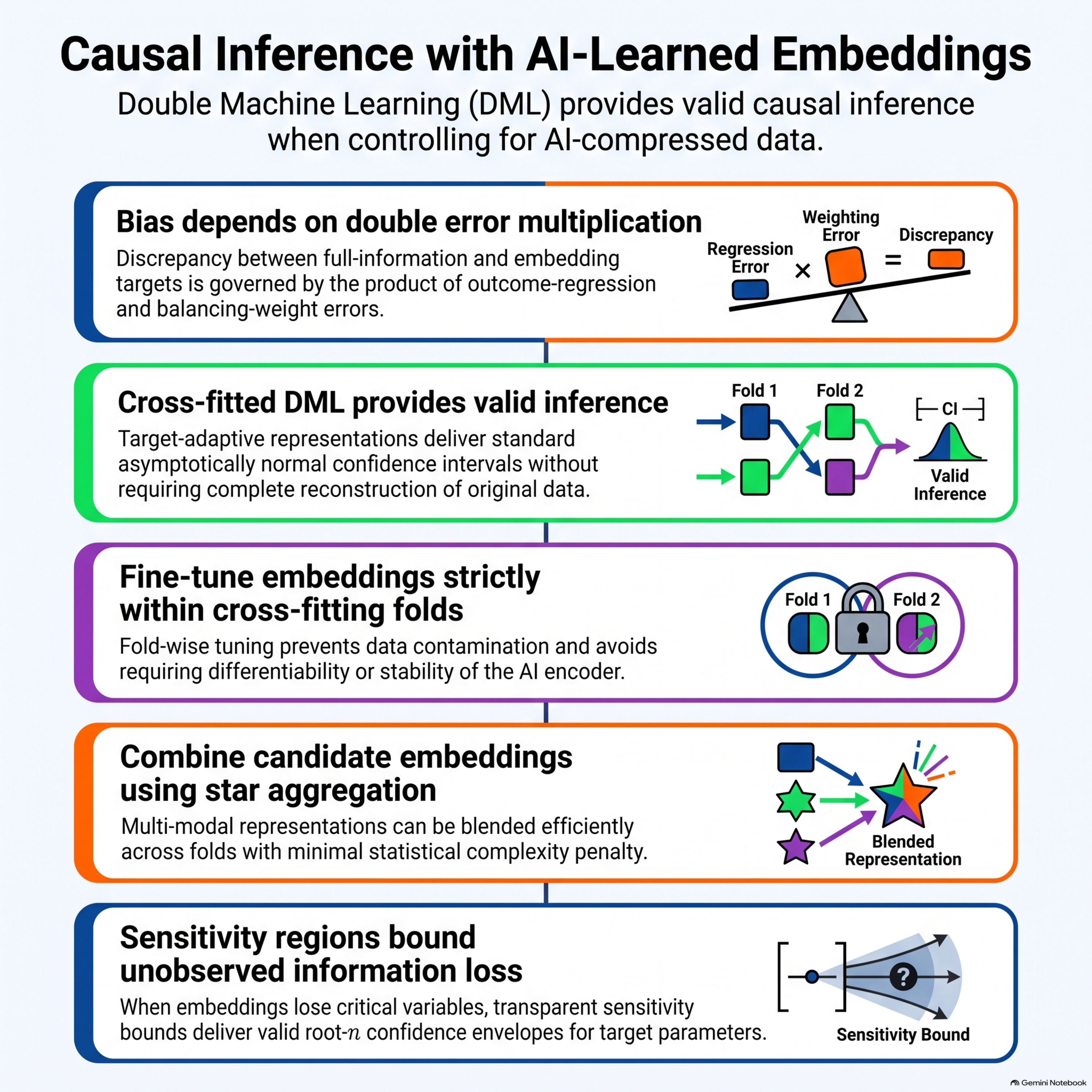
This paper presents a rigorous framework for performing valid causal inference when complex covariates are compressed into AI-learned representations or embeddings. The authors demonstrate that information loss from compression distorts causal parameters through a product of regression and balancing weight errors. By leveraging cross-fitted double machine learning (DML), researchers can conduct valid Wald inference either for the specific representation-based target or, under target adaptivity, for the full-information target. The methodology accommodates fold-wise fine-tuning without requiring differentiability of the embedding step and introduces star and convex aggregation techniques to combine multiple modality representations. Finally, the framework provides sensitivity bounds to evaluate robustness against unobserved information loss, which is demonstrated through a multimodal demand analysis of Amazon product data.
Embed this episode
No transcript yet.