
EPISODE · Aug 4, 2026 · 45 MIN
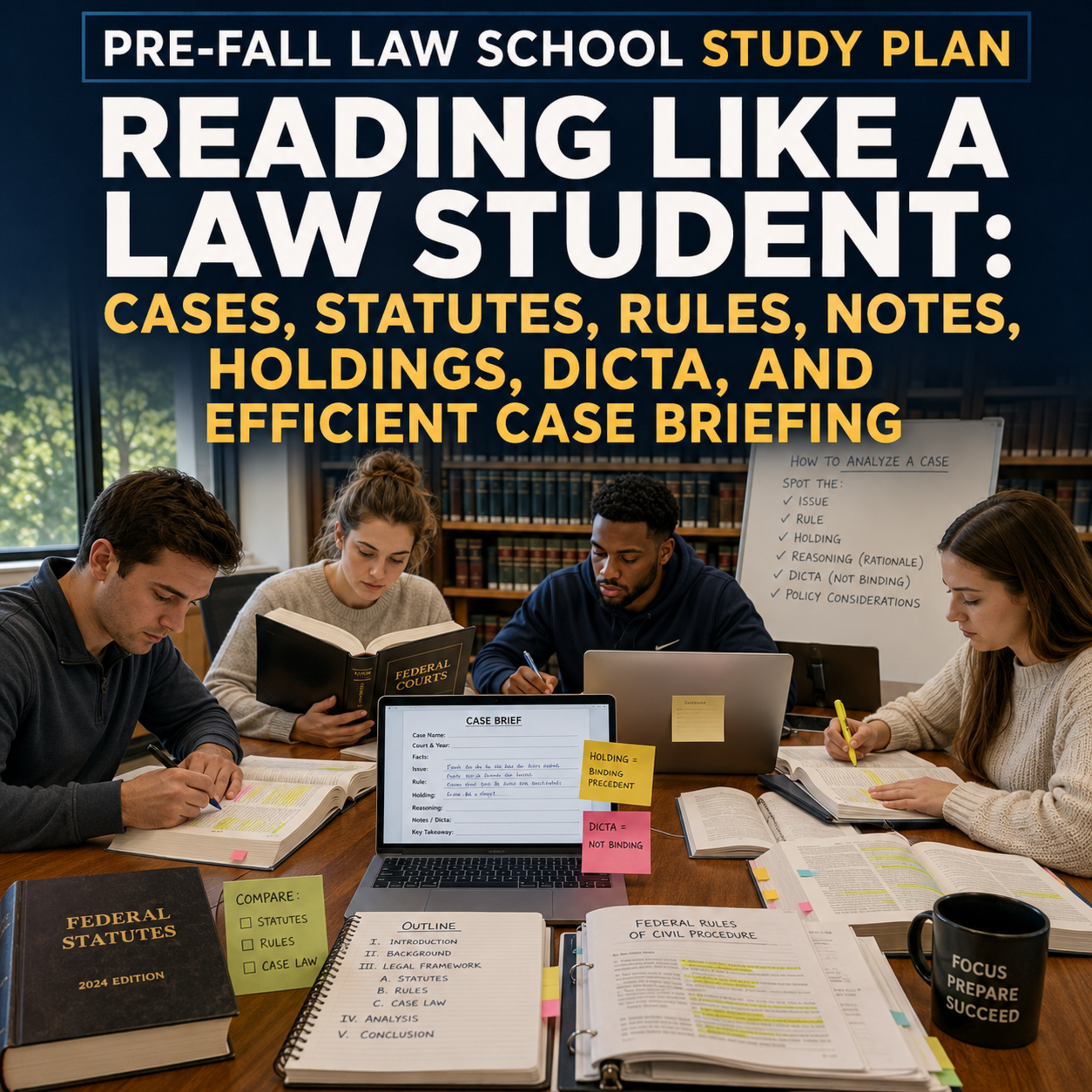
Pre-Fall Law School Study Plan: Reading Like a Law Student: Cases, Statutes, Rules, Notes, Holdings, Dicta, and Efficient Case Briefing
from Law School · host The Law School of America
» 📘VIEW THE COMPANION STUDY GUIDE📘[💡FREE💡] «▬▬▬▬▬▬▬▬▬▬EPISODE SUMMARYLegal reading is selective, structured, and purpose-driven. Students read cases to extract legal tools, including rules, elements, standards, exceptions, burdens, reasoning methods, policy, procedural posture, analogies, distinctions, and doctrinal development.Before reading closely, the student should identify the course topic, chapter, introductory notes, relevant statute or rule, and relationship to prior assignments.Procedural posture determines what the court is reviewing and how it treats facts. Dismissal, summary judgment, trial, and appeal involve different records and standards.Material facts are facts that affect application of the governing rule. Students should focus on facts repeated by the court, used in application, employed to distinguish precedent, or capable of changing the result.A useful issue statement combines law and decisive facts. Rule extraction requires identifying the general rule, elements, definitions, exceptions, burdens, standards, remedies, and policy. The governing rule must be distinguished from party arguments, historical quotations, dicta, and dissenting approaches.The holding is the court’s resolution of the issue necessary to decide the case. It should connect the rule to the decisive facts. Reasoning explains how the court moved from rule to result through precedent, analogy, distinction, text, history, structure, policy, fairness, economics, or practical concerns.Dicta consists of statements unnecessary to the result. It may be persuasive and educational but should not be confused with the holding. Concurrences and dissents reveal alternative reasoning, policy disputes, and possible future developments.A full case brief may include the case name, court, posture, facts, issue, rule, holding, reasoning, disposition, separate opinions, and exam relevance. As skill develops, students may use condensed or book briefing. The goal is efficiency, not maximum note length.Statutes and rules should be divided into regulated persons, commands, triggers, definitions, exceptions, deadlines, cross-references, waiver provisions, and remedies. Notes and problems should not be ignored because they often contain qualifications and examination-worthy variations.Reading should operate within reasonable time limits. Students should preview, read for structure, extract legal tools, prepare for class, and return after class for synthesis.The central lesson is that a law student does not read to preserve every word. A law student reads to identify what the law requires, which facts matter, why the court reached its result, and how the doctrine can be used in a new problem.About & LegalApplication Information, Privacy Policy, and Terms of Use. App PurposeThis 1L Study Aide is a supplementary educational tool designed for law students and Bar Exam candidates. It provides strategic advice, rule compression techniques, and interactive quizzes to assist in academic preparation and exam performance. Disclaimer (Not Legal Advice)The content provided in this application is for educational and informational purposes only. It does not constitute legal advice, nor does it establish an attorney-client relationship.This application does not guarantee a passing score on the Bar Exam or success in any law school course. Privacy PolicyYour privacy is our priority. This application operates entirely as a local, client-side tool.No Data Collection: We do not collect, store, transmit, or share any personal data, usage data, or analytics.No Account Required: You do not need to create an account or log in to use this app.Offline Functionality: All quiz scores and flashcard progress remain solely on your device's local memory and are cleared when the app is restarted.
Embed this episode
NOW PLAYING
Pre-Fall Law School Study Plan: Reading Like a Law Student: Cases, Statutes, Rules, Notes, Holdings, Dicta, and Efficient Case Briefing
No transcript for this episode yet
Similar Episodes
No similar episodes found.
Similar Podcasts
No similar podcasts found.