
EPISODE · Aug 16, 2026 · 1H 23M
Privacy Not Included
from Disturbing History · host Disturbing History-True Stories
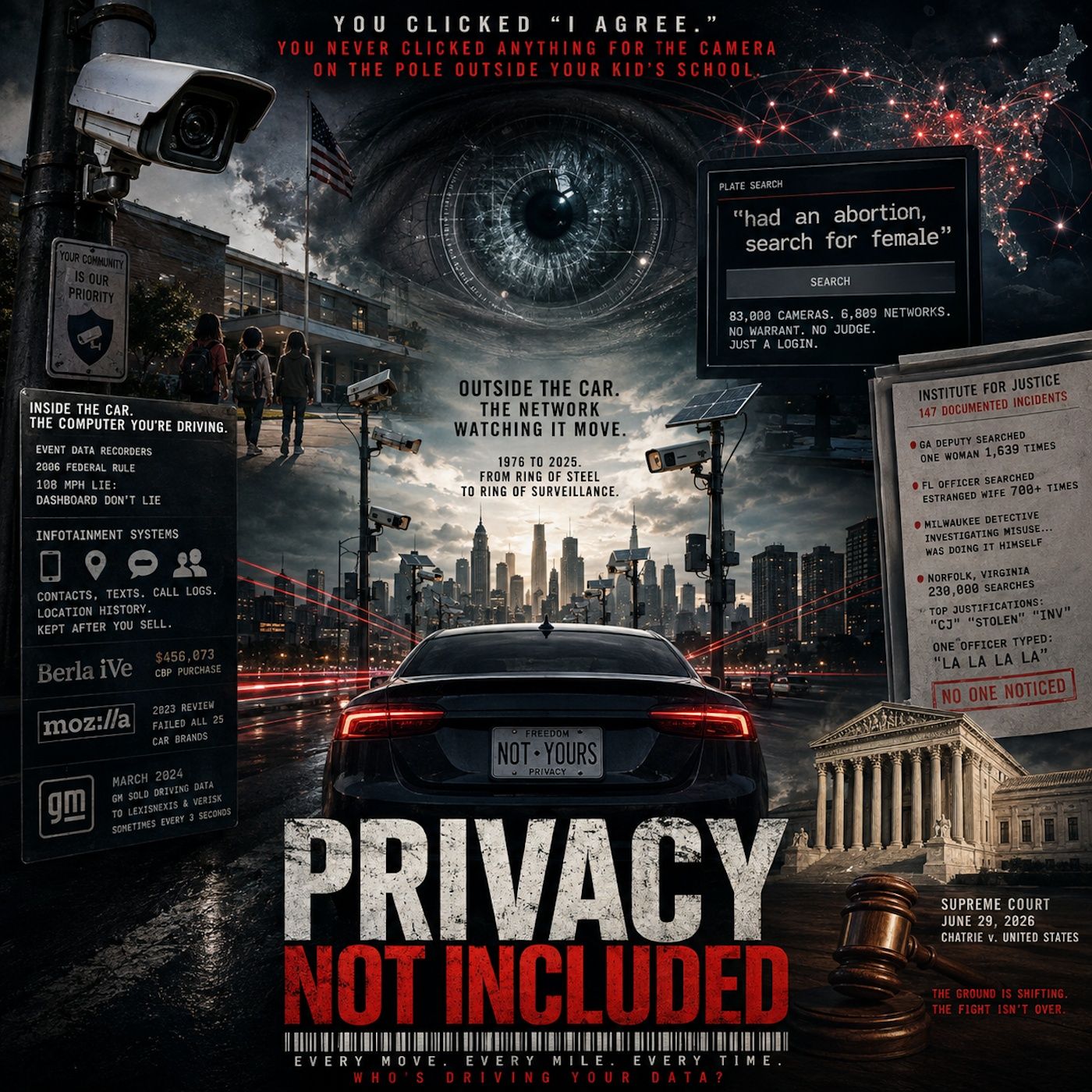
You clicked “I Agree.” You never clicked anything for the camera on the pole outside your kid’s school. On May 9, 2025, a deputy with the Johnson County Sheriff’s Office in Texas typed “had an abortion, search for female” into a license plate reader network. That single search swept across 83,000 cameras connected to 6,809 law enforcement networks, including cameras in states where the conduct being investigated was legal. No warrant. No judge.Just a login and a sentence in a search box.In this episode, I dig into two surveillance systems most Americans barely realize they’re part of: the computer you’re driving and the network watching it move.We start inside the car, tracing vehicle data collection from the earliest event data recorders to the 2006 federal rule that standardized them. We revisit the Massachusetts lieutenant governor whose dashboard data contradicted his account of a 108-mph crash, then move into modern infotainment systems capable of copying contacts, text messages, call logs, and location history—and sometimes keeping that information long after the car changes hands.We also examine the Berla iVe forensic systems purchased by U.S. Customs and Border Protection for $456,073, Mozilla’s 2023 privacy review that failed all 25 car brands it examined, and the March 2024 revelation that General Motors had been sharing driving data with LexisNexis and Verisk, in some cases recording behavior at intervals of just a few seconds.Then we move outside the vehicle.Automatic license plate recognition began in 1976 with the British Home Office, became part of London’s Ring of Steel in 1993, and decades later evolved into a solar-powered camera network marketed to police departments, neighborhoods, businesses, and homeowners associations. That company is now valued at $8.4 billion, with more than 120,000 cameras operating across more than 5,000 communities.And the technology can work remarkably well. Plate-reader networks helped locate the Brown University shooting suspect and, in Galt, California, helped police find a kidnapping victim within five minutes.But the same system has also documented a very different kind of use. According to the Institute for Justice’s database of 147 incidents, a Georgia deputy searched one woman’s plate 1,639 times. A Florida officer searched for his estranged wife’s vehicle more than 700 times. In Milwaukee, a detective assigned to investigate another officer’s misuse of the system was later discovered to be misusing it himself. Accuracy creates another problem. Roseville, California police found that 71 percent of their plate-reader alerts came from misreads. In Morristown, Tennessee, grandparents were held at gunpoint after a camera mistook the letter O for the number zero.And then there’s Norfolk, Virginia.Discovery in a federal lawsuit revealed that among roughly 230,000 searches, the three most common justifications officers entered were simply “cj,” “stolen,” and “inv.”One officer repeatedly typed “la la la la” as the stated reason for searches—and apparently nobody noticed.Sixteen years in law enforcement taught me what a plate hit can be worth on a bad night. It also taught me what can happen when a powerful investigative tool operates with little oversight. Now the legal ground underneath these systems may be shifting. The Supreme Court’s June 29, 2026 decision in Chatrie v. United States undercut the reasoning Norfolk relied on to prevail earlier in its case, and that fight is now before the Fourth Circuit.Email BrianJoin Our FREE NewsletterGet Brian's Books Leave Us A VoicemailVisit Our WebsiteHave a forgotten historical mystery, disturbing event, unsolved crime, or hidden conspiracy you think deserves investigation?Send your suggestions to [email protected] History is a dark history podcast exploring unsolved mysteries, secret societies, historical conspiracies, lost civilizations, and the shadowy stories buried beneath the surface of the past.Follow the show and enable automatic downloads so you never miss a deep dive into history’s most unsettling secrets.Because sometimes the truth is darker than fiction.
Embed this episode
Ready to play
Privacy Not Included
No transcript for this episode yet
Similar Episodes
No similar episodes found.