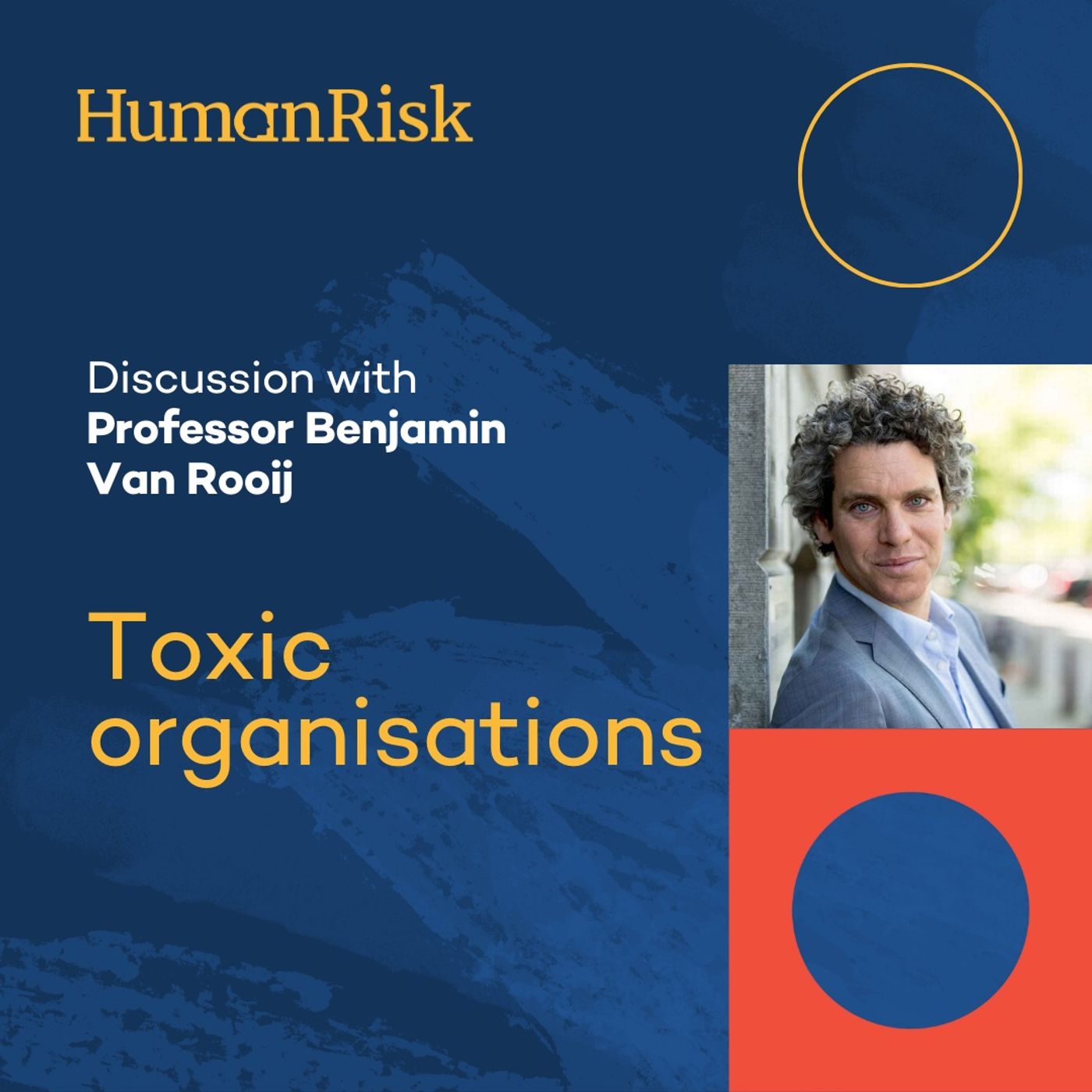
Welcome to Human Risk, a podcast dedicated to the understanding of human behaviour as a risk. Here's your host, Christian Hunt. Hello and welcome back to the show. On this episode, I'm exploring a topic that we'll all be familiar with, toxic organisations.
Whether you know it or not, you will have been impacted by one. You might have had or be having the misfortune of working for one, or maybe as a taxpayer you've had to contribute to pay for damage caused by one. Toxic organisations harm us all. If you're wondering what I'm talking about, well it's the sorts of things we see covered by Netflix documentaries, think Volkswagen, Boeing, Enron, Wirecard, the financial crisis, social media and so on and so forth.
But what makes organisations toxic? Well, to help me explore that, I'm joined by someone who's been on the show several times before. He's one of my favourite academics because he loves tackling thorny topics. When he writes and speaks about them, he does so with authority, and really in a way that we can all understand.
Professor Benjamin Van Roy is officially a Professor in Law and Society and the Director of Research at the School of Law at the University of Amsterdam, and the Global Professor of Law at the University of California, Irvine. You can catch up with previous episodes of the show he's been on by links in the show notes. And writing Benjamin back onto the show because he's currently working on a new book co-authored with Professor Nicholas Lord, which has the working title of toxic organisations gone back. And rather than looking at individual scandals in isolation, this book zooms out to spot the patterns behind the stories.
What are the organisational processes, or just bad people or broken systems, but the day-to-day dynamics that repeatedly lead to harm? In our discussion, Benjamin explores things like unrealistic targets, silencing, groupthink, over ambition, organisational secrecy and the complex interplay between organisational goals and moral comes. He explains why the word toxic is both useful and problematic in this context and why this isn't just a corporate issue. Governments, religions, political parties and even regulatory bodies are included too.
You'll hear why he doesn't believe in civil solutions, why the usual compliance fixes and mediations often miss the mark, and how asking better questions in cheeky ones might be one of the most powerful tools we had. This is an incredibly timely conversation and has ever with Benjamin incredibly insightful. It's my discussion with Professor Benjamin Van Roy on toxic organisations. Benjamin, welcome back to the Human Risk Podcast.
Thanks for having me. I'm so excited to have you here. I can't remember how many times you've been in the show, but every single time I learn a load of things, I get absolutely energised by your enthusiasm. And you're here today to talk about a new book, which is all about toxic organisations.
Tell us about it. Yes, I'm happy to do that. I'm working on a new book together with Nicholas Lord, who is a criminologist at the University Manchester. And the book's core idea is that some of the worst harm that we face as humans originates from organisations.
And the book traces the organisational processes behind harmful behaviour. And the core idea is that organisations are multipliers and the multipliers are good. They do many organisations allow us to pull resources, to get the same values, to incentivise people, but they can also do that in a way that comes to harm either actively, where it sort of is known to the organisation, and there's maybe some idea towards the harm. But oftentimes also passively, and the organisation that fails to curb the harm that is ending up causing and it's at some point knows it's causing.
And that's a different sort of thing that the behavioural code, the prior book, which had a chapter on organisations, but largely was on individuals. And the biggest difference, I think this book is really what I would say inducted. I tried to find patterns and connect the dots between all these cases. I've been reading sort of organisational biographies or organisational studies about particular scandals or organisational problems for years.
And gradually I came to see these patterns and I developed a short academic article on them, wrote a chapter on behavioural code on them, but now it's a full book discussion that goes really deep into what are these patterns. And I just learned tons of going deeper into them. The word toxic, you've talked about it doing harms. We tend to think about toxic in terms of physical substances.
You're obviously taking a much broader definition, which is, I guess, loosely defined things that are bad for us. Yes, I would say largely defined. So we use the word toxic organisation and the book, we're working towards toxic organisations gone bad. We use the word toxic organisation as shorthand for organisations either public or private that structurally come to cause harm.
And that's it. And then toxic processes are the processes in your organisations that causing harm. So that's a very broad definition. To be honest, I don't like the word toxic.
I think it's become a bit toxic. But still, it's a good shorthand. Otherwise, it would be maybe harmful organisations, which just doesn't work as well. And it's used also often that something's gone toxic, or does it toxic culture or it's a toxic environment people are in.
And I think toxic, it does seem to be about physical, but in the end, it's about sort of something is poisonous, that something is harmful to us. If we breathe in or we eat something that's toxic. And I think toxic also has a little bit of that things can spread from one place to the other. And so I think that's another aspect that does make it shit as a word.
As I've heard you talk about this before, but as I was reading it, I was thinking all of the names that you mentioned, it's the Boeing's, the VW's, the banking, the banks, of course, all this. I mean, this is basically the kinds of things that we are attracted to as Netflix documentaries. Big scandals that we see, things that are horribly wrong, that we are fascinated by humans. So I guess we like watching the Netflix thing a little bit to find out what's going on, but also because the drama, you're kind of behind that and saying, how the hell does this happen repeatedly?
What are the traits that we see on display? Yes. So what I see. So we do know about the scandals.
So when we know about a scandal, what we automatically do is the first thing that happens when a cuz scandal unfolds is how bad is it? How bad is the harm? So news focus on how many barrels are leaking, how many people got killed or injured, and how bad is the stock exchange crash? Then the next thing we do as humans is we look at the highest responsible person.
So we start to look for the individual, and then we look at who's failed in regulating oversight, et cetera. So we look at those things. We look at the harm itself to a certain extent, and maybe victims. We look at individuals and we want to hold individuals accountable.
And then we look at the sort of larger system. Also, when we discuss it, it sort of ends up a discussion of bad apples. So these individual actors either lower in organization, like the Larry Nesters or the USA Gymnastics, or higher leaders, such as Richard Sackler at Brigofarma, or we look at the system. And then also it ends up being something about capitalism, neo-liberalism, some of these isms.
Or in case we're looking at public organizations, it can be the deep states or I mean what have not. And what I see, it's very difficult to get rid of bad individuals or even good individuals who cause harm, because I don't really believe that all from a clear distinction. So you still will have humans in organizations. And if they are in organization, the organizations have a certain skill and they have to reach over things that may cause harm, I'm pretty sure we can't get rid of the individuals there.
The systems, sure, and we have a chapter at the end, which is about the broader system, which we call the orchards. So if you have the bad apple, you have the orchards where the apple is grown, the broader orchards surely is very, very influential. But it's a very difficult thing to change. If you think about we trace, for instance, the history of certain things about a market capitalism, chances the way we trait shares in companies and the way corporations change and the way and legal liability changed over time, or the way in society certain values that may be harmful such as the racist values or for instance, misogynist values, those things are very hard to change.
We can say they shouldn't be there, but if they're not there in a large system, if you live in revolutions that have tried to upend capitalism, they end up developing other systems that are maybe equally hurtful. So there's something in between where I think we can understand and respond, which is the organizational process. And that's what the book is really about. It's about the barrel, such to speak.
It's about the barrel in which these apples are that's maybe part of a bigger orchards. And I think often in the documentaries, we see snippets of those organizational processes, but we don't get them outlined. And the other thing is we don't connect the dots between these cases. And that's what this book does.
I love that. Once you start to see these threads, and I think there are threads that we can identify, so I'll use the word toxic CEO and the leader, you can sort of see those types of threads, but that's driven very much around that we need the narrative around. It's an easy to write narrative around evil people. But some of the other things that you talked about, one example would be people being silenced and not being asked to speak up.
These threads, I think it's really interesting because these threads are obvious to us. Once you point them out, they're obvious. Were they easy for you to find when you started to look for them? Let me first say something about this, both the silencing and the leadership.
So I would say many people say obviously it's silencing, obviously that's an organization process. I don't think that's a surprising one. I do think we too easily say, oh sure, there was a cultural fear or cultural silence. What is it exactly about silencing?
How does that happen? What we show in the chapter on silencing, first of all we show, it is logical that organizations have secrets. That's a very important thing. We can't just say, oh, everything has to be transparent.
And this isn't just because a trade secrets or privacy concerns or other things. It's also the basic idea of hierarchy. Somebody who's hiring an organization has certain information that somebody lower doesn't. That's one part of it.
The other part of it is somebody hiring an organization doesn't know what happens every day, lower the organization. So both people lower an organization at their secrets and higher the secrets. That's how organizations work. That's a very important principle we had in most chapters where we say, okay, sure, we can identify a broad glance, a process.
Let's first try and find out why it exists for good. So silencing or secrecy has a good function. Second, when we then open it up, it isn't just an organization threatening people not to talk. Now we actually see that, and this is the same with many of these posts, it doesn't much more passive form.
For instance, we write about 3M where employees lower the organization also people living close to the factory to simply get to know how PCBs were harmful. So PCBs were these were the were chemical substance that they made since 1932. The company already knew in 1937 that it was toxic, that chemical was literally toxic, that literally it could cause cancer. And it kept that information from people.
So keeping information is part of the silencing process, same as you should see at Chernobyl. So the people that were there at Chaitel Knight, they made certain mistakes that we can also look at the organizational process behind them, and they were highly trained. They didn't understand the information if they'd been given it to them, but there were many design flaws in the reactor, but then they intersected it, wiped by pressing the button that they did that they're trying to stop the reaction, actually that's an explosion, if they happen to be fully informed. So keeping information from somebody is already a silencing process.
And we look at different aspects of the instrument. Another subtle form is the groupthink that we analyze with Enron. So Enron is the big currency sort of scandal that happened in this big energy, sort of energy trade company. And again, you see so many besides the silencing that isn't just the, oh, if you say something, there will be retaliation.
And that's sort of how in newspapers or in scandals, we normally talk about silencing. And so we showed that shut patterns of this larger thing, same for leadership. So leadership sure, there's some really, really bad leaders, we start with the leader of Uber and sort of the things sort of the model he said, sure, everybody there. But you see, there's a lot of leadership patterns where it's just failure to care enough, failure to actually take a certain signal seriously, failure to take responsibility.
And that's a different sort of thing where a leader then it may not be even that we can say the leader was necessarily a bad person, very probably not. Maybe we cannot even blame the leader, but it is the leader that was there. I think that's an important thing there. Then coming back to your question about recognizing the pattern.
So first of all, these are the patterns that we recognized, probably a different reading of the scandals right come up with other patterns. I think we recognize the patterns through two processes. One is you see certain things being repeated. And these are very clear.
So silencing is very clear. A normalization of deviancy where it becomes normal to break rules, becomes clear. With others, we were influenced by academic literature. We knew.
So for instance, the chapter where we show, well, there's a larger opportunity farm and the organization can expand the opportunity farm because it can grow scale or it can give access to potential victims. That's something we knew very clearly from criminology and we built that out the same for visualization. Any company or corporation or organization can defend itself and shift the way blame that's normal. Again, we look at why it exists.
But in doing so, it can also make it harder to address the problems at stake and address the harm and to actually learn from the from the scandal and to prevent it in the future. That's something we knew the sort of mechanisms that we knew from terminology as well. So actually we drew quite a lot from a terminology and organizational science to recognize the patterns. Usually a challenge for these sorts of books is obviously stories.
How did you pick the ones to tell in the book? But also I guess the ones you researched because if you really wanted to dive deep into any one of these areas, you're not sure what material? No. So several selection criteria.
One is we needed cases where we had what seemed to be a regular organization. And I would say made off and there are no sort of exceptions, but we didn't include them because they're so telling for the extreme form where organizations really used in a defrauding manner. But that's more willful. That's more on the extreme side of things.
I wouldn't even put them in my normal destination of a toxic organization. For the other sort of that to be organizations that have a legitimate business purpose or a legitimate purpose if it's more more general. So not organized crime, not a Nazi party. But we just recently included the Chinese Communist Party in the 1950s, which in the core case we do there has about how they try to rapidly industrialize and expand true production to the legitimate goals that ended up in the worst famine that we've ever seen in human history.
Second thing, we needed cases where there was a large body of material that had already been studied. If we had had to go through all the primary material, then well, it cost the book to write one case, at least. So for instance, Chernobyl, there's three really good books, including a well known book, Chernobyl, midnight, but also two historical books. The Catholic Church, again, it was a really, really good academic book that's both in depth on Ireland and broader than others.
There's a lot of good national report score cases. That's the same for all the cases we had. In the end, we are not claiming that our sample of cases represented. There is many other cases we could have done.
These were just the case that we thought had enough depth where we know there's enough material, there's enough variation, both public, private, different sectors, and also where we could really understand these mechanisms. So there's enough there to sort of develop patterns. And obviously, we also pick the cases sometimes to show a different side to a pattern. So which examples do we show?
Well, we really show the examples that helped every year to better understand sort of different aspects of the toxic patterns that we talked about. And you've used the word organization. This isn't just about companies. This is also looking at broader pieces, religion being one example.
A primitive analysis would say you sort of expect those things to be different. But what's interesting is that actually these threads run across them. And even where you're not using an example from business examples come up to mind, but even when you're using a non-business, it wasn't that I thought, okay, this is the chapter that's relevant to the Church. There's a lot more commonality.
I guess that comes from the fact that we're talking about people here. And ultimately, we might think about the form as being different, but I guess the substance is the same. Well, we're talking about organizations, and organizations in their core part as people coming together in a way, and they're all successful organizations. But they've come together in a successful way.
And the book starts with a contrast of two really different organizations, the 1950s Communist Party, and how it caused the famine where 36 million people died, and produced pharma, and the opioid epidemic that killed a couple of hundred thousand people. Of course, it didn't cause the complete opioid epidemic, but it contributed to it. I was so surprised, these are completely different organizations. One is a revolutionary Communist Party that sought to develop an egalitarian society in a totalitarian system, in a non-democratic, totalitarian system.
Then you have Purdue Pharma, a family owned for a profit, a pharmaceutical company that sought, if we take it as a value, to make money by offering a pain relief medicine amongst others in a high capitalist situation, yet we see very, very similar patterns. And that is why we start with that, because then the reader immediately says, ah, so there is something hidden here that we haven't been looking at. And for me, the one that really, if you ask me, what's the most surprising pattern, or the most important one, I would say it's the targets, it's the unrealistic targets. And this also where the book becomes difficult for practice immediately.
So I talk a lot about the book when I talk with people in practice, it's sort of the elephant in the room, I think. So you may have seen in other events I've done that people talk about incentives and I then put it back to the targets. And we don't, if we're doing compliance management or even regulation, even prosecution, we're not looking at targets unless they're illegal. But there's nothing illegal, and that goes for a lot of things that the book talks about.
Many of the processes in the book are not illegal, and those are not necessarily bad, but they can be. So organizations such as well as Fargo is a good example when you set the target at eight products for clients, at the industry average is 1.6, it may not be possible. The same for Facebook, which you're not telling the book, but will be, if you say we want to connect the world and you want to build not just one billion users, but you want to build many billion users. Also, you don't just want them there, want it to be there as much as possible and be as engaged as possible.
But you can't do that in a way where you can do the proper content moderation and things will slip. So the Myanmar sort of, I mean, the genocide of the Rohingya was in part incited through communication on Facebook, where Facebook has one of the memories, a language moderated. That's one for country. I think it's, I forgot how many million, 40 million or more in the whole country.
And there's many other examples where you have a mismatch of your goals and your means. And that goes throughout these different cases in very different ways, though, very, very different ways. But I do see, yes, those are the patterns behind it. And we tend to, when we look at this immediately for corporate cases, oh, yes, no, behind is capitalism.
And for public cases, we have other ways of looking at that because the pattern is similar. I don't think it can just be seen as capitalism or communism or some other reason. And it was interesting, I understand entirely why you use modern examples right? Because they're the most salient, you've got the most data on them.
But I was just reflecting thinking, you could probably go back a little bit, I mean, you talked about politics there, you could probably go back a few hundred years. And if we think about some of the other dynamics, it seems to me this, sure, we've got 20th and 21st century dynamics that are exacerbating it, scalability being won. But the fundamental underlying seems to me was, you know, and this goes back to your orgid barrels and apples. This is to do with humans.
And therefore, we're just seeing a 21st century manifestation. But I would say, probably, I'm guessing all of these things on some level will have played a part in the past. I'm pretty sure. So I'm not on this story that we do talk a little bit for instance about the Dutch East Indies Company.
And that's where the modern corporation, I mean, share the publicly traded share organization starts, where we, we discussed that the ownership of the corporation becomes much more distinguished from where the harm can potentially be. And then if you have a more more shareholder value orientation, which of course is more recent, but still, the value of those more distance from where the end harm is, if that's a longer distance, then it's easy to get these sort of goals and targets that may clearly induce harm that are just not cared for, because well, it's the owner that matters, but the owner is very distant from it also through the sort of limited liability structure. So yes, you can see these things. I do think fundamentally, what has changed in history is that a, we had organizations that were much more embedded in the society.
So if you, if you would say, I would say go pre 1500s, you have guilds for sure, if you live at large religious organizations, yes, we can probably find patterns there. I mean, I've read it. Look on the history of folks going from Peter all the way to now. It's pretty shocking how, and I'm not anti-Catholic.
I'm just saying that there's a lot of documentation of arms there, but a lot of it was more embedded within a local context. And if somebody did something wrong, it wouldn't scale up. So the example we talk about in the chapter about opportunity, if you make a design flaw in an airplane that's your building, that's how you were the right brothers, you have an extreme example, you would kill yourself, right? Boeing has 42% of commercial air jets.
So even tagging mistakes, I can have massive consequences. Same with, let's say, a different example, but similar also about non-technology is if you're running a nuclear reactor. I mean, that sort of harmful material, we didn't have a couple of centuries back, the same with the sort of scale of social media. So I do think the technology also the same with chemicals, same also in financial industry.
So banks, the sort of medieval banks were local, a singular bank now, like, can have a really big upsetting effect. So if you look at the LIBOR schedule, I mean, this is the work of several bankers, how they affected the interbank interest rate, that then abstracts again mortgages. Of course, it didn't lead to a massive meltdown, but the sort of risks that were there were massive. So I think the scale made possible through to modern organization, which is much larger, made possible through modern technology, is just a very different beast of animal.
And one of the things I love about your research and your approach is that you're not just interested in analyzing things and understanding them. You're also looking at real sense from you that you want to change things, right? You want to point things out so that we can do better. As I look at this, this is possibly, I would argue, one of your larger challenges that you've taken on, because it seems so, so endemic.
If I look at the work you've done before on legislation and rules and things like that, we can start to change those constructs. At least we can do that in a micro way. What you're talking here is a massive thorny issue. This is a really big challenge.
So this is also the problem with, I mean, look, I never like the solution parts of books. So you read a really good analysis of a problem. For instance, I did reading these books about terms of social media. And then the end, you had a final chapter that says, as well as we do, A, B, and C, it'll solve it.
Well, A, M, B, R, impossible will never happen, and C, I'm not sure it works. I mean, there's a book called The Quick Fix, which is about social scientists offering these really quick fixes to problems. And I really don't believe in that. If I could write a book that solves organizational harm, it will be the next Bible, right?
So yes, I mean, having said that, the final chapter, which I haven't read, which I haven't read yet, we'll discuss sort of what do we learn from this? What do they takeaways? And the first takeaway would be we're all an organization. I hope most of the readers are non-organizations like the ones are in the book.
They also don't want to be organizations like that. So I think we can use the patented book to diagnose sort of the red slags. I mean, I mean, things turning orange. We can sort of see maybe it's 1130, rather than 1210.
So we can be there ahead of time. Once we do that, a key thing here is to see how many of these negative processes do you have? So when I talk to companies, I talk about, for instance, unrealistic targets. Every company or organization has to be ambitious.
That's a natural thing that has to do. But they have to realize if they become overly overly overly ambitious, let's say, well, as far ago, a Protestant, fine. I'm not saying you shouldn't, but you have to realize that if you do that, there's an inherent risk. And if you do that, for instance, you want to balance it out with some of the other processes being in the green.
So if you want to be very ambitious in your targets, you have to make sure people can speak out when things go wrong. If you have ambitious targets and people can't speak out, then it's very likely you have a problem. If I put it the other way around, if you know in your organization, it's hard to speak out, let's say you're in a very hierarchical and, let's say, military-like organization. And everything is about order and following order.
And that's just a core part of who you are. Maybe you should be extra careful then in being more ambitious. So it's about balancing these different aspects in your organization. And I think the book helps in that.
It helps, A, leaders. And this goes beyond compliance, because I think compliance is just not at the chair where you have conversations about targets. And also, you can't read my book and prove for 100% sure that if your organization is overly ambitious, there will be harm. What you can do is show examples of that happening and show, at least make arguments that we should look at that.
But in the end, it's going to be in the leadership of the organization. And they have to balance this. And these are not cheap things. Asking Wells Fargo to lower their targets would affect their share price by a lot.
Asking Boeing to really care about the long-term safety more than the short-term cost reductions would have cost them, also in the share in the stock markets. But you have to make those arguments, and it's not even possible to make those arguments based on, oh, all these companies did horribly in the long run. I mean, the final chapter will talk about this. How do these organizations end up?
Some were killed by their own toxicity. Let's say, produce our mass, for instance. I mean, it's what they did them in. But there's many others who, at least in the aftermath of this kind of work, were quite okay.
But Wells Fargo was okay. I think it did become the biggest bank. Folks run for a while, before others was okay. Boeing is not doing perfectly fine, but it's still okay, ish.
The Catholic Church is still surviving. And probably will. We will do fine. But what I see is it's sort of like an instruction.
It's like a virus. It's going back to Corona. It'll kill off some. So some of it has a very high rate of being lethal.
With others, it becomes endemic, but it lingers on in the organization for long run and pops up every now and then. And with others, maybe it can be cured. And what I want to make sure is that people in other organizations where they haven't gone fully talked to yet, they may be able to prevent a real intersection. So that's part of it.
The other part, I would say, is in case where things have gone completely wrong, I do think we can diagnose better how we address sort of the residues of harm that are there by really pinpointing to these underlying causes, to really say left, you have to look at these ambitions and you have to look at speaking out and you have to look at deviancy and the other methods that we talk about. But that in the end is easier said than done. So I don't claim that we know surely how to do this. The orchard chapter talks about problems for instance, also in the regulatory oversight.
And there's so many things that are happening there. Most of them are well known, but we can show better how they're related to the organizational process. And I think that may help people that want to strengthen reforms in regulatory oversight. As you're talking, I love this idea of, I guess it's almost like homeostasis where, and this is why the analysis, I think of there was a good side to this.
It's not all evil things going on. So keeping secrets, I think the obvious one to understand, is that I love the fact that you went there, because it'd be really easy to sort of go, well, we need full transparency job done. And actually, that balancing, this is the inherent challenge here. It's not all about you just eating unhealthy food, the equivalent of a bad diet.
It's actually going, some of that stuff, I don't want to carry the analogy too far, but some of that stuff we need. And so we are trying to add more things, get a balance of these facts. So that makes it, I guess that makes it, it's hard to grapple with, because it would be much easier to write an analysis. Let's get rid of all these toxic elements, yes, without acknowledging the positive side of it.
No, exactly. And that's where the balancing has to be. So you can't say, I mean, to me, the clearest example is ambition. So organizations need to be ambitions.
So the chapter is called wound shop. Why? Because we've breathed that amazing things just by getting together as humans in a group and saying, this is our thing we can't achieve, but let's try it. So you can't get rid of that.
You should get rid of that, but you have to understand the risk of having it and to encapsulate the risk in a way that can mitigate it to a certain extent, without killing the ambition itself. And that is not something I can, I can, I mean, just in one chapter, say how all of that should be done. Yes, I do think for a reader, every chapter ends with questions they can ask about their own organization. So I think that that in itself is the big value, I think, because we're all part of our organization, we all want to, and we all have some roles and organizations that contribute to our organization functions, whether you're lower or higher, recognizing, oh, it seems we have groupthink.
For instance, groupthink is a very positive thing to have. It feels great. We all agree. But that may be a part of why we're not listening to critique.
It may be why people who had a thought in their head that they're like, is this right? It's not that they're afraid to speak out. They don't see they should be speaking out because it's so good to be in the group. I mean, recognizing those things are very subtle things that may actually contribute to big risk and harm.
So it's that why I think where the book's biggest value lies in recognizing the sort of things that may harm to say one other thing about is we often see these scandals in terms of the law. And we often say, well, this is illegal and it should be dealt with by the law. And that's great. That should be done.
But what I see is a lot of these patterns are not illegal. They're not even maybe things that are wrong. But they are things that contribute together, maybe without a way that we can say that they're bad enough themselves, but they contribute to a risk towards true harm. I think it's that sort of recognition, because that also brings it out of the forceful conversation.
It is also very hard to say, okay, let's get rid of and let's say, silencing. Well, you couldn't find a legal basis for that because a lot of it is normal and even necessary. And it's really interesting when you talk about those dynamics and whether it's legal or illegal, as we know, it's not a great judge of whether we should, just because you can, doesn't mean you should. But it's fascinating when you talk about this, because it's almost points towards and if I use a dietary analogy, we don't necessarily know what's good or bad for us.
So we have models as a society, and this is, I guess, the orgy court. Well, the society, well, we kind of assume that certain things must be okay. So certain things are good things are bad. So if I come back to the targets, of course, you don't want to go somewhere where, well, the company has no ambition whatsoever.
We don't necessarily think about those negatives. We haven't, in some respects, we haven't been taught. And I'm thinking, as we get taught lessons of these things, the Netflix drama has been the most obvious way of us learning or news more with the media. We don't necessarily talk to some of these lessons.
So a question for you is, do we sometimes not know what's bad for us? Yeah. I mean, just the thing about organizational harm. It is a culmination of a larger group of people coming together over a larger amount of time where things come together, at some points, in this case, is in a negative way, where sometimes single attributes of that or single actions by individuals may seem to be perfectly sound, moral, and okay, or even wanted, or where the whole of it.
And that's the thing we are looking at this with 2020 hindsight, or, okay, let's be honest, maybe 1920 outside. But this is not always foreseeable for the people seeing it. And that's also why we're seeing this in purely accountability and clear case where it's clearly not a case. And yes, there is willful and bad behavior in these cases.
But only portraying them that way overshoots and makes us not see the other parts of them that are maybe equally, if not, worse. I'm just sort of musing on the solutions to this. And maybe there isn't one, maybe it's just you've said that. And I love the questions.
I thought were really good, because I love that idea. And the younger version of me would have loved it for this reason, is I was always one of those people that wanted to are slightly cheeky, but important questions. Yes. And so I sort of thought, actually, this is quite powerful as a sort of guide to stuff.
You know, when you have like a town hall or something within an organization, here's your opportunity to ask a question. What you've got in there is some really good ones, right? And so I think it's a really helpful, it's a good way to talk about regulators. But it's your point.
It's almost like I'm reminded of the emperors and you close. The kid that asks the question, no one else dares ask. And so there's a little bit I think in what you're doing here that's permission to ask might seem silly or basic questions that actually have a fundamental, you know, there's a rationale for asking it. 100%.
So everybody's part of an organization. So everybody reading this book can A, ask the questions for themselves. B, ask them out loud if they're worried about it. C, explain why they ask these questions.
So it would have been a really short book, just to have the question. But they can back up the questions with examples and theories about why these questions important, they can say, well, on groups, think, well, that sort of what killed anyone. You don't know the case of Enmon? Let me explain.
Right. And the same with targets. I mean, they can ask these questions, for instance, about are we looking enough at the, at the long run, not just at the short run, or fundamental question in any organization. But I have to be honest, the same way they had in the behavioral code.
I don't because the things are so interlinked with a larger context for instance. Okay, shoot organizations look at the longer run. I believe they all shoot. I 100% believe that.
But then I look at, okay, how do for profit organizations that are public and traded work, they are in an environment where that is nearly impossible. And then you're talking about the way we trade stocks, the way we have derivatives, the way we have shareholder value and essential. Sure, I can say all those things should be reformed. But I'm not a specialist on what model you should have to reform them into it.
And also knowing that it doesn't cause more harm. So that's sort of where I'm careful where I'm not sure. I can say, Oh, you can easily get rid of these short term thinking, which I believe we should. It's more being aware of doing that and making that part of the system.
So, for instance, I could imagine that somebody who's a shareholder activist might ask questions about more longer term, a charitable ethics, because in the long term, the share price might suffer because of short term thinking where it doesn't know the short term, but that's outside of the organization. Inside the organization, you're more a pinball machine when it comes to that, other than a maybe leadership resisting this urge a little bit to be too much focused on shareholder value. And that's a difficult thing. And I think what we always seem to get to do is you're in effect, you're calling stuff out, right?
And you're pointing out things uncomfortable truths, I guess, in many ways, which is that we sort of rely on a system and a process. And I think sometimes when these things go wrong, when these companies have blow up, the big public ones, it's almost like an accepted part of it. You know, a few in some respects, a bit like firms, some firms, you regulatory fights, cost of the business, right? That will happen from time to time.
We will have failures, but that's just part of the ebb and flow of commercial. And that's the good ones we'll survive in the polls. And I think you're killing that and going, we can't necessarily rely on that, calling that stuff out. Yeah, I mean, there's different sides to me in this.
So I think, first of all, having finished sort of the core part of the book, I did come out with, wow, that's really, really, if you look at all these examples together, there's really some really horrible stuff happening, right? It keeps on happening. And yes, what happened, right? Nothing changes by default.
Yes. And there are individuals that are involved that could be more accountable. So I do come out of that. I'm not sure it's the full solution.
You know, my other work on punishment. I don't see it in itself will change everything. I also see that the portrayal in media is not always helpful. So for instance, the book also talks about culture.
And I think what we've seen over the last years is increasing attention for culture. Every time a scandal breaks, there's something about culture. So I think I found nine different cultural aspects that were discussed about Wells Fargo, cultural fear, cultural greed, cultural life. It was all culture of and then adds your own favorite noun.
And when I look at that more deeply, I see that by using the term culture, where we can't really establish what that culture is. And to my understanding with cultures, which the book describes, it's quite complex. It is the sort of transmitted and shared values, practices and structures that people have in organizations. It's very hard to really piece that together well.
And by using the word culture, you sort of say, A, it's not really the individual. So you shift the way the blame to a certain extent. B, it also shows you, well, it's culture, so you can't change it. So it becomes a sort of defeatist.
And third, and that's maybe most important, it drowns out actual process. Because it's just one big catch, it's a higher culture. So you don't really look at the goals anymore or the science and process or the normalization deviance. So that's sort of what I see in the public portrayal.
We get a simplistic portrayal, the same on silencing. You then get something like, well, there was a cultural fear, or, or armerta or just silencing, but they don't really dig in. What was behind the silencing? What sort of silencing do we have here?
How do we address that? So I think that's what the book also calls for is a more nuanced understanding of what the root causes are. And that's, so if you ask me what's the real solution, it's going into these scandals with the root cause analysis. To the root cause analysis, we really find, okay, what we're the deeper lying internal into the organization, root cause, and which ones were outside.
And once we understand that we can try and fix that. And the book does show you examples of these root causes in these bigger scandals. But of course, if you are working on a particular organization, you can go way deeper into the root cause analysis. The problem we see, well, in academia, but also in media and in practice, we also don't have a root cause analysis.
We have a set of set interventions that we are ready to roll out whenever there's a problem. And we never think about, do they actually fix the root causes? And that's my bigger call out that I think is in line with what we said in the actual code. Except this book does it much deeper and with the focus of organizations, where it's much more difficult to do a root cause analysis.
I love this, not the underlying fact that what you described, because if I think about the industry that came from banking, like, you're going to broker trader, and it's always like, we'll just talk about that the other ones, as if they were all up to the same thing, and they're all individuals in individual circumstances. Yes, breaking rules and breaking the law. But the fact patterns are different. The drivers are different.
And there's this, there's this sort of very lazy, here's another one that's just come off the bandwagon. And you're right. And then you get to your point, you get the same solutions, which is, it's almost like consultants. And you might say, well, this is interesting, right?
They roll, let's bring out the playbook again. It's one of them. So we'll bring out the same playbook. And so you end up with these, and I'm not sure the solutions ever worked with that one.
But just assuming that because you managed to, so much like you need to taxonomy of things going wrong, and then you just anything that previously sitting in the same time, you put as much as you can in there. Yes. It's just a written repeat thing. And I totally see what you're saying.
And that's just one example. I'm willing to battle for another one. Not always the same. Yes.
Well, and then I can bring it back for the corporate world a little bit to the Department of Justice, the way the federal sentencing guidelines have guided this. So you need to have an effective or a robust compliance and ethics program. One is that sort of we have historically developed the idea of what that consists of. And that's sort of the playbook, by so to speak.
But we've never really wondered how that matches to the root causes. So I don't think there's anything in there about unrealistic targets. It's also not there, therefore, within the job of anybody, compliance, or audit, or whatever, to look at targets. It may be about incentives, but largely it's about values training.
It's about bystander training, because we believe somehow that may have something to do with science, even though I also not see much evidence of that. We get some rules that we write in the code, we get a dedicated compliance function officer, etc. There's a number of things we do. We all end up doing, we all check, were you doing this or you weren't?
Or, well, maybe you improve this. But doing a full root cause and others of the organizational processes, it may get to a different field. I mean, and it may be that sometimes it fits and sometimes it doesn't. But I would say, let's switch it around, especially in the worst cases.
That's really look at what is needed for this case. And sure, then with the case, you start to generalize from single individual actors to a larger body, where you're still going to lose some detail. But for me, as long as you look at the root causes of the particular problem, that's the most important thing. You make a really good point there, because often it's sorting the symptoms out.
Yes, right. As opposed to the code, so it's the kind of remediation equivalent of paracetyl, right? Let's just make the pain go away without wondering where it's come from. I would even say worse, very often in day-to-day practice.
I'm not even sure we're dealing with the symptoms. We're just dealing with what is visibly seen as the best way to deal with the symptoms. I mean, we sort of get a package of paracetyl, I'm not even sure that we're taking an actual pill. Because the pill we know at least helps with the symptom.
We don't even know if, let's say, a value straining does anything or a bystander training. I mean, there's some evidence, but there's not that much evidence. And there's also mixed evidence. And so that's what we described in the behavioral culture, to a certain extent.
And it's a similar thing when it comes, for instance, to culture. So I have a paper where we look at how we measure culture in surveys. If we look at this, most of the existing measurements of culture are not operationalized based on the idea of what culture actually is. So we have these sort of tools that we developed that we're all used to using, which is great because, well, we need to do something, I guess.
But I'm not sure they actually should have the problem. Maybe not even the symptom. I mean, this sounds perilously close to what I might lose the term theater, right? We just go, in many cases, we're just going through the motions, tending that we want certain things, because it's hard, right?
Yes. Yes. And I think part of the problem comes because people claim to have a fix, at some point, I mean, these things come from somewhere. I haven't traced it.
Let's say, a bystander training or a value training, we probably believed or saw at some point that it's something, or at least we needed to do something. And then it sort of becomes the norm and becomes normal. And I'm not saying it doesn't work at all. I'm just not sure it's just in the worst case is what I've seen as the problem.
I didn't do an analysis because it would require a different analysis. But I'd be curious to see, I'm pretty sure most of the recent corporate cases have a lot of the systems in place that we all had, yet still had the big scandals. I mean, it's hard to be a bank nowadays without most of these systems in place. And sure, you see at HSBC and the money laundering scandal in Mexico that they were understaffed and the know your customer systems work working in.
I think there, you do have a lot of, I think parts of the system that do make a lot of sense from a behavioral point of view. But these systems don't work if the broader organization, if for instance, the targets, the way HSBC wanted to expand, the way they wanted to build this business broader. Well, then all these sort of secondary systems that we have in place, you come under mind. And that's what I mean about the root cause analysis, that if your conclusion is, oh, we should just stop or know your customer, folks in a bank, great, it's probably necessary.
But why weren't they there? What was behind it that was part was that they were just expanding too quickly. And when people spoke out about these risks also understaffing the response. But I mean, that's the classic example I can talk to this because I know the sector, but banking staffs up and staffs down according to economic conditions.
Yeah. And so it's kind of you end up with these, yes, and of course, technology is part will help with those things. But ultimately, you end up with it becoming this variable cost that matches the revenues, which is utterly in fact your point around substance, which is utterly insane because the risks don't suddenly go away just because the economy is quite in fact, in many cases, there's also risk you're talking about. There's more likely to have people trying it on in bad times than in good times.
So it's amazing if you can have a staffing model, maybe you should be the opposite. But that's the interesting thing though, if you look at HSBC, the problem started in good times. I mean, they were starting up, but they were expanding way quicker into markets like Mexico. And you see the semi-Facebook, for instance, they went into markets such as Myanmar, Indonesia, Brazil, etc.
which were high risk, very, very difficult. These were great times. They were really on the up and they were expanding staffing, just not in relation to the risk they were entering and not realizing enough that with this sort of new opportunities for income, also came for a larger opportunities for harm. And that goes back again to understanding your ambition levels and keeping done in check.
As I mentioned to you, I think we get to a thing where we almost, if I was like a big picture, we don't necessarily know what we're doing. We're relying on structures and processes, and I think about that at the micro level, the way meetings are run or processes are run is often toxic, actually, to be honest. And then we go to a larger thing, the way organizations are run. But it comes down to, we've kind of overstretched ourselves a little bit as a species.
We're involved in things, we think we understand stuff that we don't. And what we're seeing here, I would contend, basically, is exactly the worst of that. I mean, some of it we get away with because we're lucky. And maybe, is this because we assume certainty around social sciences and those topics that we have in physical sciences, natural sciences, that we make presumptions about things, but we don't really know what we do.
So I think the overstretched part is definitely part of this. So it's partly a skill problem, and that's what the opportunity chapter also talks about, that if you operate in a skill that large, it becomes also, if then there is a slow harm, personal risk of harm, if that materializes, it has a really big effect. And also has to do with the means that you still have to control the harm. So again, going back to Facebook, I read a book the other day, which I was still in corporate called Social Warming, which is sort of about the inherent risks of social media.
And it is a balanced book, it's not just dishing or saying, well, these companies are bad. But it is at some point, in the end, talking about sewage, it was talking about, can you actually successfully run a sort of public platform that also has algorithms that sort of creates filter bubbles and that also annotates certain speech over others, that also based on a model that where there's more engagement, it's better, but more engagement also means more divisiveness. Can you actually run that at a scale of two billion people? Could you ever understand the sort of cultural ramifications of speech and the aspects that can have in different contexts?
And of course, the answer has been in the section as well, with AI we can. And still the issue is, well, but the humans that are doing the speech that evolve quite rapidly in the interactions after each other. So they've called, for instance, content moderation, the biggest game of Wacomol, where every time you find a risk, the new one pops up somewhere else. So I do think, yes, overstretched, definitely, for some of the things that we see in cases is something, it's not for all.
But for some of these, yes. And so we talked about the book, you're still looking at the copy, I've seen it's still working progressive, you're talking about social media that's coming into play, and you obviously want to draw some conclusions on those, where do you go from that? So I still want to include, if I do conclude that there is sufficient harm, but I think I'm there, I do want to include at least some of the social media companies. And sort of the sort of harm is on different sides.
I think the large, because for me, the harm has to be really big before it's included in the book. I think part of it is really direct human harm safety, which is the rowinga case in Myanmar is a good example. Another example is, for instance, the sort of induced harm on adolescents. So one case I read about was one social media company targeted teenagers, and especially girls at moments that were insecure.
How do they know they were insecure when they delete the selfie? And then they would get an ad for let's say a skin product or something like that. Yes. And this was a little bit of a scandal at first, but then also the company couldn't truly deny it.
Because well, it is also how they were selling themselves to ad agencies targeted. I mean, it's the most targeted form of advertisement. I mean, if you think about it, you delete the selfie. Indeed, that is a moment of weakness of insecurity.
And you can really target at that precise moment your message. And then the third part of social media harm is, I would say, the distrust in institutions, distrust in information and spread of misinformation. So in a way, if I add all those things up, and also what they've meant politically, but also with vaccines, they're potentially one of the largest harms that we have. And they also, they're a direct example of A, they have a massive opportunity towards harm.
B, they have massive targets and goals, and they have to keep them. If you're sliding in your user numbers or user engagements, they can always be the next network. They can kill you and tap in several times. I mean, Facebook beat MySpace and MySpace beat Friendster.
TikTok seemed also to be beating both of them. And by the way, I mean, nobody's on Facebook itself anymore. So these things rise and fall, but in order to keep the engagement and the numbers, you need to expand continually. So you end up expanding into countries where maybe you shouldn't, or also where you are in line with all three term regimes.
B, you need to keep people engaged, and you only need to keep them engaged with what we know are algorithms that bit people against each of it. And it also scaled up very quickly. So the retweet button, for instance, there's a lot of writing about the retweet button and effects that has had on polarization, those on the spread of source information, because you retweet without looking at something deeper and reading it and thinking about it, you're end up retweeting things that maybe completely false. You're not still doing it.
So also some of the inventions behind the retweet button now feel bad about that. So that's how it will bring it probably into the book. So that's still within this book. We're also going to obviously do a lot of language editing, look at sort of fine-tuning the cases we have, how long, et cetera.
And I'm about to submit the book proposal, so I'm about to find why it's there. So those are the first steps. Wow. And in your broader research, any topics you want to talk about that you're looking at?
Sure. So one thing that came out of this book was the political side. So we did include the Republican Party, the GOP, as a case in the book. And the harm we're looking at is the distrust in the electoral process by false claims of election fraud, which the GOP has been doing before Trump.
This has a longer history, but of course became stronger first after the first election of Trump, because he did win the popular vote and expanded also in the wake of the 2020 election, which culminated in January 6, which as he has a big harm in terms of trust in the electoral process. But I haven't gone through the last months, which we've all seen. I came to see that the American executive power such a large organization, the presidency, but also the other executive bodies that the presidency controls. So it's a whole article two under the US Constitution.
That whole body of power, that whole organization, I've come to see a has a massive potential to do harm and has done that in the past. Also a massive responsibility to reduce harm and a massive responsibility to keep people from harm, for instance, by providing services. So any of those things, A, it can cause harm, B, it can fail to do its regulatory duties and C, it can fail to provide people with income or other things or subsidies. And I saw that it had the whole marks, what has been happening in the last months of really turning into a toxic organization while we're watching it.
So this is more than just losing detection balances. So it's about the normalization of deviancy, for instance, which is not a normal part of how we talk about checks and balances. It's about all science and practices. There's so many different kinds of chilling things we were talking about before we went into the interview.
It's also with this sort of different neutralization processes that deflect blame and guilt away. So for instance, the accusing the accusers, which is a criminological term that criminals will deflect blame by saying, well, I'm excused by somebody with themselves as a criminal. Obviously, this is happening in real time and it's harming all the institutions. So that is going to be my next project.
A book length discussion of how the American executive is becoming a toxic organization. Wow. Benjamin, as ever, when I'm talking to you, time races away, my mind is racing. Thank you.
Every time I speak to you, I say this, but genuinely, what you do is phenomenally important, it's fascinating. But you have that rare gift in academia of an ability to translate highly complex stuff into simple language and simple things that we can all understand and actually use in our, in my case, in my work. But I think what you just talked about is all of us in our day-to-day existence, whether you're a small child asking provocative questions or it is not at all responsible with things. So I want to say thank you for all of those things, but as ever, thank you for being an amazing guest on the show.
Well, thank you for having me as ever and I really love your show. So that's it for this episode of the Human Risk Podcast. My enormous thanks to Benjamin for appearing and to you for listening. To find out more about Benjamin, his research, his books, including the brilliant behavioral code, and to hear his previous appearances on the show, have a look in the show notes.
There are links to all of those there. If this is your first time listening to the Human Risk Podcast, wherever you've been, but thank you so much for joining me, you can subscribe or if you get your quality audio content. It's available on all of the major podcasting platforms. If you like the show and have yet to leave a review for it, please do wherever you listen to it.
It really, really does help. To discover episodes of the show that you might have missed, and there are over 300 of them now, visit the show's website, which is humanriskpodcast.com. I'll be back very soon with another episode of the show, but in the meantime, stay safe, take and look out for toxic organisations in your world. There are probably scarily more than you might think, and thank you so, so much for listening.