
EPISODE · Jun 12, 2026 · 17 MIN
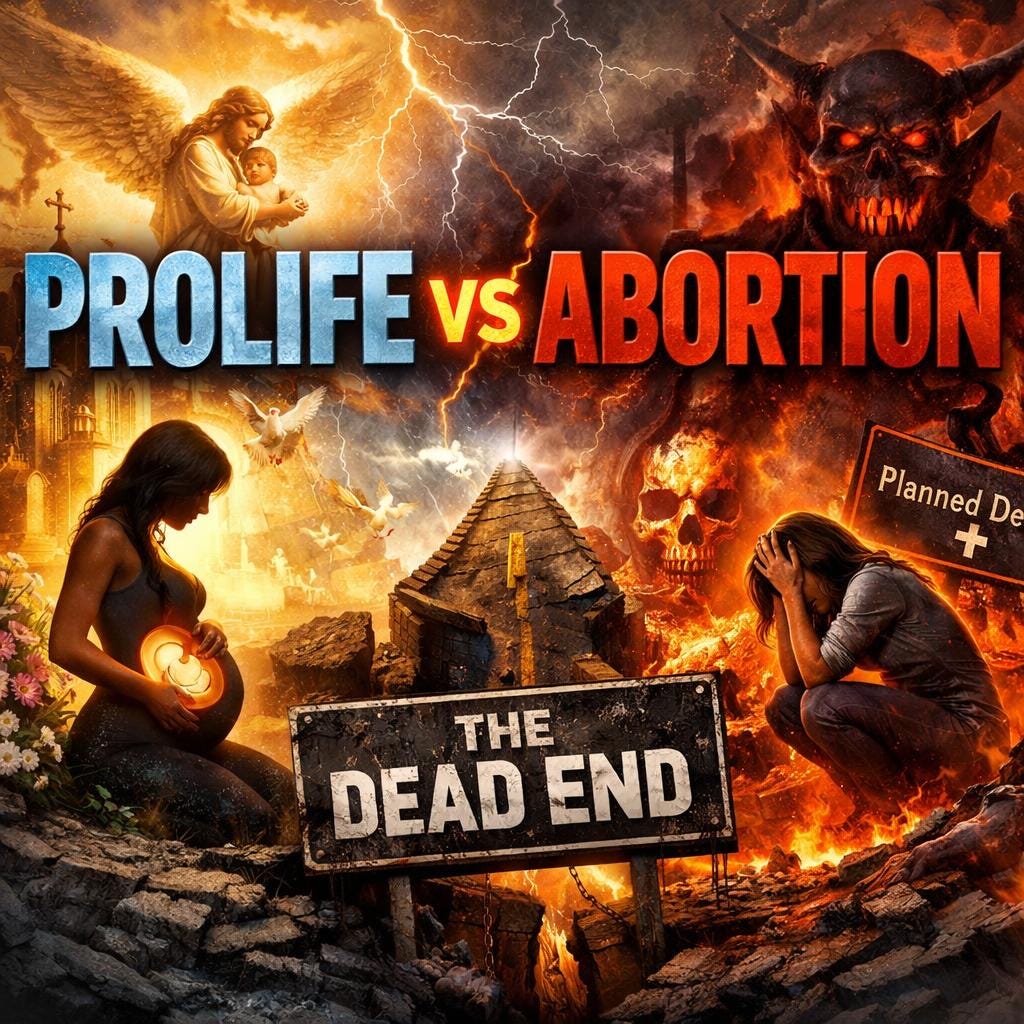
Prolife vs Abortion - The Dead End
from The Experience of Adoption · host Thoughtless Delineation
The pro-life movement has a question for adoptees. It is asked at dinner tables, in comment sections, in parliamentary debates, and in the oral arguments of the Supreme Court of the United States. It is asked with the confidence of people who already know the answer they expect.Would you rather have been aborted?The intent is coercion. The architecture of the question assumes that existence — any existence, under any conditions — is preferable to non-existence, and that the adoptee, having been granted the gift of life, is obligated to perform gratitude for it. The question is designed to silence. It has worked for decades.But some adoptees are answering honestly now. And the honest answer is not the one the system anticipated.It is the most damning indictment of the adoption system ever recorded. Not because it proves the system failed. Because it proves the system worked exactly as designed.The Supply ChainThe adoption system was not built for the child. It was built for the crisis.Every major forced adoption regime in the Western world — Australia, Canada, Ireland, the United Kingdom — was constructed at the intersection of two institutional pressures: shame management and demographic demand. The unmarried mother was a social and moral problem to be resolved. The childless couple represented a constituency with needs that institutions were positioned to serve. The infant was the mechanism by which one problem resolved the other. The transaction was dressed in the language of love, of rescue, of Christian charity. The language was always secondary to the logic.Canada’s Senate motion, tabled in May 2026 and calling for a federal apology, names an estimated 300,000 women coerced into relinquishing their children between the 1940s and the 1970s. The coercion was not incidental. It was the product of systematic collusion between government policy, religious institutions, medical authority, and family pressure — an interlocking machinery designed to ensure that unmarried mothers had no viable alternative to surrender. Australia has apologised for its version of this machinery. Ireland has apologised. Scotland has apologised. Canada has not yet done so. The delay is not an administrative oversight. It is the Architecture of Silence in its self-preservation mode: the instinct of institutions to manage acknowledgement without permitting accountability.The pro-life movement inherited this architecture and industrialised it. When Justice Alito cited adoption in the Dobbs majority opinion as the logical resolution for women who feared their child would not find a suitable home, he was not making a compassionate argument. He was restating supply chain logic that has governed adoption policy for a century. The child’s function is to resolve someone else’s crisis. The child’s experience of that resolution is not part of the calculation.This is not a cynical reading of adoption policy. It is the reading the policy produces when you centre the adoptee rather than the institution. Non-Adoptee Bias — the systematic failure of policy, narrative, and legal architecture to account for the perspective of the person adoption is performed upon — is not an oversight. It is structural. The supply chain cannot function if the product is permitted a perspective that complicates the transaction.The Permanent LockOnce the transaction was complete, the system had one remaining task: make it permanent.Sealed records are not a privacy protection. They have never been a privacy protection. They are an identity lock — a legal mechanism by which the state replaces one document of origin with another, substitutes one identity for another, and then enforces the substitution by making the original inaccessible. The original birth certificate — the document that records who the adoptee actually is, who their biological parents are, what their original name was — is sealed. In its place, an amended certificate is issued. The amended certificate records not biological reality but legal fiction: the adoptive parents are listed as the parents of origin. The original is buried.There is no legal mechanism to discharge an adoption. In most jurisdictions, there is no exit. The identity the state assigned is the identity the adoptee carries, regardless of whether they consent to it, regardless of what it costs them, regardless of what they discover about the person underneath it. The Identity Gravity Well — the relentless pull of an externally imposed identity that distorts every attempt at authentic self-construction — is not a metaphor. It is a legal condition with no resolution mechanism.Virginia’s House Bill 301, signed into law by Governor Abigail Spanberger in April 2026, grants adult adoptees unrestricted access to their original birth certificates for the first time. It passed the House 84-10. The margin is worth sitting with. If the arguments for sealing records had ever been as strong as institutions claimed — if secrecy genuinely protected adoptees, birth parents, and adoptive families in the ways proponents insisted — the vote would not have been 84-10. It would have been contested. The near-unanimity reveals that the arguments for sealing were never principled. They were convenient. They served the system.California’s SB381 is advancing. Sixteen states have opened records since 2019. The majority of states have not. In those states, the amended certificate remains the only legal reality available to the adoptee. The statutory lie holds. The original is still sealed.The adoptee who cannot access their original records is not protected. They are contained. The Architecture of Silence does not merely prevent knowledge — it enforces an alternative reality and demands the adoptee inhabit it.The ExpulsionIn 2026, the United States government launched Operation True Parent — a systematic review of intercountry adoption files for paperwork irregularities. At least 49 cases have been identified. Some of the people under review have gone into hiding. They are people who were adopted from overseas as infants or children, raised in American homes, educated in American schools, who have lived American lives for decades. They are now potentially deportable.Approximately 75,000 people are in this position. They were legally adopted by American citizens through court-sanctioned processes. They were raised as Americans. They were never naturalised because the system assumed that citizenship would resolve itself — because the paperwork, in this as in so much else, was treated as secondary to the narrative of rescue and belonging. The Child Citizenship Act of 2000 closed the gap for some adoptees but not all. Those it missed have been carrying the citizenship void for decades. Under the current administration’s immigration enforcement surge, that void is now an active exposure.The state that chose them is expelling them.This is the Adoptee Paradox operating at federal scale. The foundational mythology of adoption — the chosen child, the rescued infant, the family completed by an act of institutional love — collides here with the legal reality that the state’s selection was never unconditional. The belonging it offered was provisional. The conditions are now being enforced by the same institutional apparatus that originally produced the adoption.The deportation pipeline is not an accident or an administrative failure. It is the logical endpoint of a system that processed adoptees as legal transfers rather than as persons with civic identity. The paperwork was always the architecture. The person was always secondary to it. Operation True Parent does not represent a betrayal of adoption’s values. It represents their completion.Activist Annie Wu, a Chinese adoptee, has said: If my birth mother aborted me, that would be fine with me. I would not exist so I would not care or be impacted. She said this in the context of the Roe v. Wade debate. She was responding to people who wielded her existence as an argument against reproductive rights. Her answer was not a cry for help. It was a political statement about the relationship between the state, the adoptee, and the question of whose interests adoption has ever actually served.The VerdictThere is a question adoptees are asked. It is usually deployed as a silencer — a way of telling the adoptee that their critique of the system that shaped them is illegitimate because the system’s first act was to ensure they existed.Would you rather have been aborted?Some adoptees are answering yes.Tony Sanderell has stated publicly: For most of my life, I was pro-life. Partially because of being adopted. In just the past few years, I now wish I was aborted because of the lifelong pain in my soul that seems to get worse and not better.Dawna Unsell: I wish I was aborted all those years ago.Washington DC lawyer Cynthia Landesberg, writing in the Washington Post: When antiabortion advocates ask abortion rights advocate adoptees, ‘Would you rather have been aborted?’ the intent is to coerce us into saying no. But for some of us, the answer is yes.The pro-life movement treats these statements as aberrations — as evidence of psychological damage, as the tragic exception to the rule of adoptee gratitude. They are not aberrations. They are the system’s final output. They are the verdict of people who have lived inside the architecture of sealed records, amended identities, legal non-discharge, conditional belonging, and in some cases active deportation proceedings — who have processed the full weight of what was built, and arrived at the only conclusion the evidence honestly supports.This is not pathology. Post-Tragic Consciousness is not depression or self-destruction or the failure to heal. It is the state of having moved through grief, processed institutional reality without the comfort of illusion, and arrived at an assessment that is clear-eyed rather than broken. The adoptee who answers yes to the question is not expressing a wish that they were dead. They are expressing a judgment about what was done to them — that the system which produced their existence did not do so in their interest, did not build conditions in which their existence could flourish, and cannot be defended by pointing to the existence itself as its own justification.The system built people who would rather not have been built by it.That is not a failure. That is a result.The Dead EndThe Prosecution rested four parts ago. The case has been made — the neurobiological architecture of separation damage, the weaponisation of unresolved maternal grief, the intergenerational transmission of unaddressed attachment rupture. This is the terminus. Not the beginning of the argument. The end of it.Every mechanism the adoption system constructed leads here. The sealed record that contains the adoptee’s original identity without their consent. The amended certificate that replaces biological reality with legal fiction. The citizenship gap that converts the chosen child into the deportable alien. The pro-life supply chain that instrumentalises the adoptee’s existence as a political argument while stripping them of the agency to evaluate that existence on their own terms.These are not separate failures. They are a single coherent system producing a single coherent result.The pro-life movement asks: Would you rather have been aborted?The honest adoptee answers: That question assumes my existence was a gift you gave me. It was not. It was a transaction you conducted. And I am the one who has been paying for it ever since.When the pain of your existence is the only thing the system didn’t steal, wishing you were aborted isn’t a pathology.It is the final, honest audit of a life built on a theft.This Substack is reader-supported. To receive new posts and support my work, consider becoming a free or paid subscriber.Reports This is a public episode. If you'd like to discuss this with other subscribers or get access to bonus episodes, visit thoughtlessdel.substack.com/subscribe
Embed this episode
NOW PLAYING
Prolife vs Abortion - The Dead End
No transcript for this episode yet
Similar Episodes
No similar episodes found.
Similar Podcasts
No similar podcasts found.