
EPISODE · Jun 27, 2026 · 1H 5M
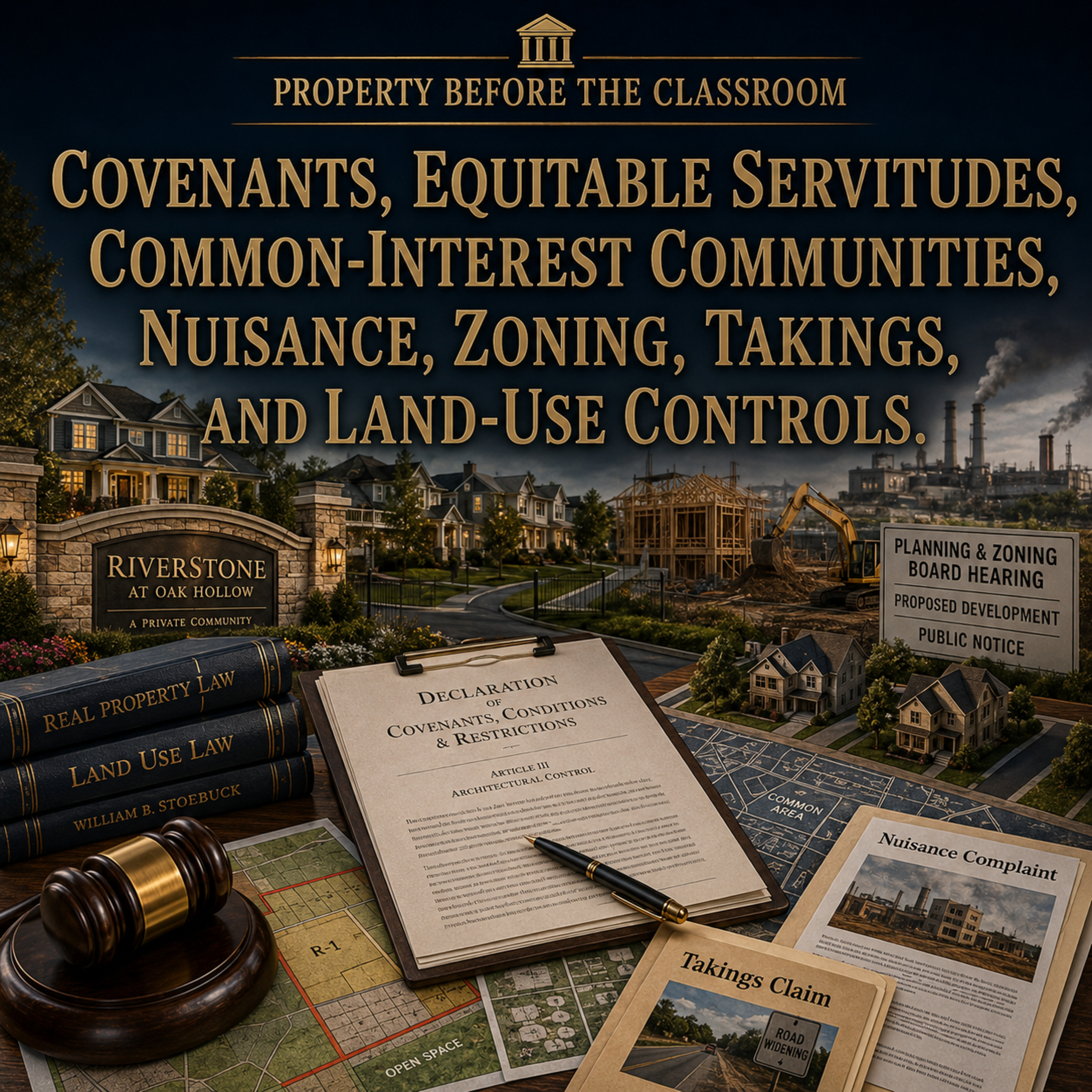
Property Before the Classroom: Covenants, Equitable Servitudes, Common-Interest Communities, Nuisance, Zoning, Takings, and Land-Use Controls
from Law School · host The Law School of America
» 📘VIEW THE COMPANION STUDY GUIDE📘[💡FREE💡] «▬▬▬▬▬▬▬▬▬▬EPISODE SUMMARYProperty ownership does not mean unlimited use. Land may be restricted by private promises, neighborhood schemes, nuisance principles, zoning, and constitutional doctrines.A real covenant is a land-use promise enforceable through damages. For the burden to run, traditional law usually requires writing, intent, touch and concern, horizontal privity, vertical privity, and notice. The benefit usually has less demanding requirements. An equitable servitude is enforceable by injunction and traditionally requires writing, intent, touch and concern, and notice, with less emphasis on privity.Touch and concern means the promise affects the parties as landowners. Implied reciprocal servitudes may arise in subdivisions with a common plan if buyers have notice. Common-interest communities use declarations, bylaws, assessments, architectural controls, and common-area rules, usually enforceable if reasonable and consistent with law.Private nuisance is a substantial and unreasonable interference with another’s use and enjoyment of land. Public nuisance is an unreasonable interference with a right common to the public, and private plaintiffs usually need special harm. Remedies may include damages, injunctions, partial injunctions, or other equitable solutions.Zoning is public land-use regulation. It may regulate use, height, density, setbacks, signs, parking, and development. Nonconforming uses may continue despite later zoning changes, subject to limits. Variances allow deviation from zoning requirements; use variances are usually harder to obtain than area variances. Special exceptions or conditional uses are allowed if specified conditions are met.Takings doctrine limits government power. Physical occupations are usually takings. Regulations may be takings if they deny all economically beneficial use or go too far under a balancing test. Exactions require essential nexus and rough proportionality. Eminent domain allows takings for public use with just compensation.The key lesson is that land ownership is always shaped by limits. A strong Property answer identifies the owner’s proposed use, every private and public restriction, the available remedies, and any constitutional boundary on regulation.
Embed this episode
Ready to play
Property Before the Classroom: Covenants, Equitable Servitudes, Common-Interest Communities, Nuisance, Zoning, Takings, and Land-Use Controls
No transcript for this episode yet
Similar Episodes
No similar episodes found.
Similar Podcasts
No similar podcasts found.