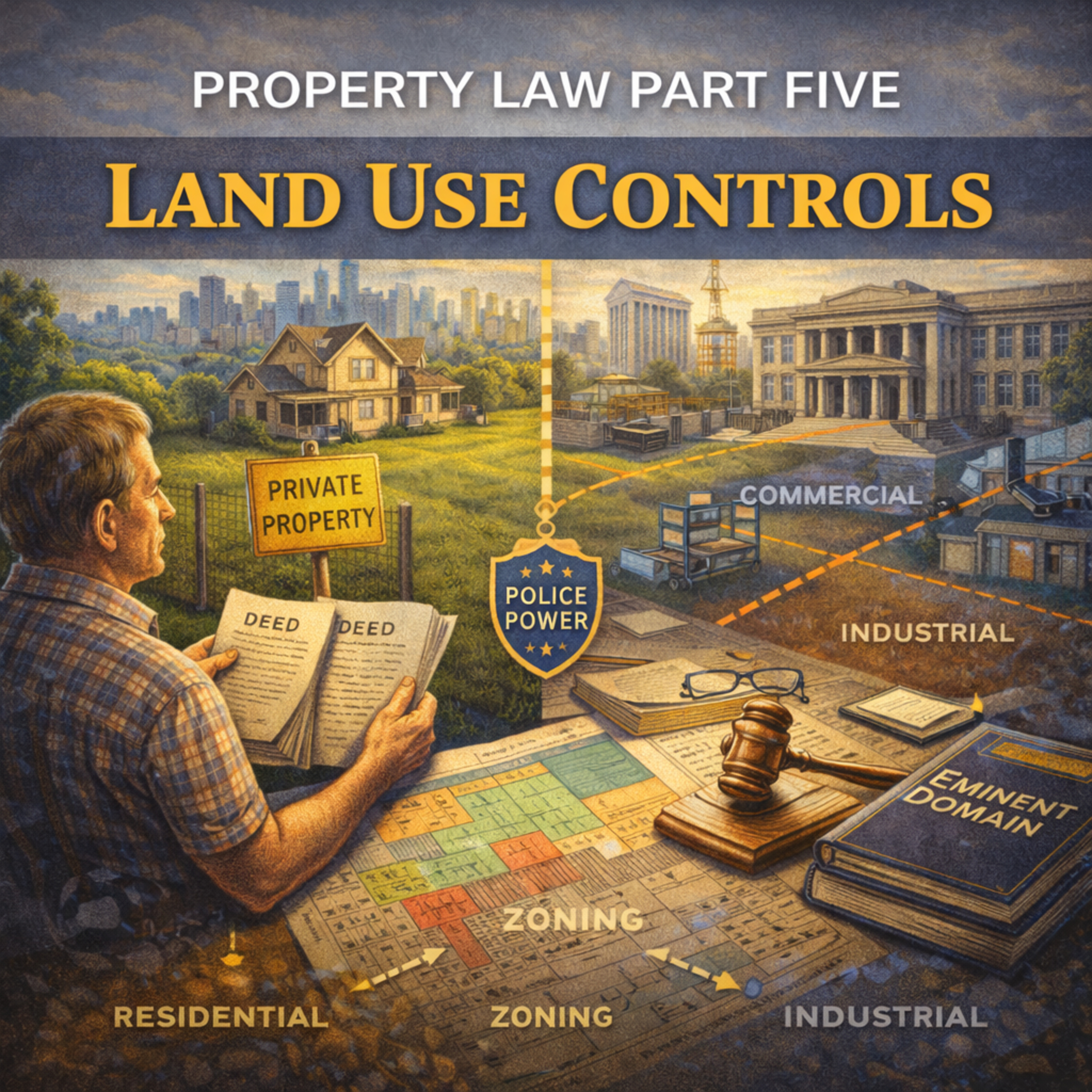
Property Law Part Five: Land Use Controls episode artwork

EPISODE · Feb 20, 2026 · 50 MIN

Property Law Part Five: Land Use Controls

from Law School · host The Law School of America

This conversation delves into the complexities of land use controls, focusing on the interplay between individual property rights and government regulations. It explores the concept of police power, zoning laws, eminent domain, and regulatory takings, providing a comprehensive overview of how these elements shape property law. The discussion highlights key cases, modern trends, and the implications of government actions on private property rights, ultimately emphasizing the ongoing negotiation between public interest and private ownership.Most property owners don't realize how easily their land can be redefined or taken by the government — and the rules that determine when you get paid are more complex than you think. If you're facing land use restrictions, rezoning, or government seizures, understanding the subtle distinctions could be the difference between compensation and being left empty-handed.In this eye-opening episode, we cut through the legal jargon to reveal how land use law balances individual property rights against the state's police power. You'll discover how the concept of police power grants governments broad authority to regulate land for public health, safety, and welfare — but that power is checked by constitutional limits that can turn a regulation into a costly takings claim.We break down the core frameworks that govern land disputes:Zoning: How local governments draw legal lines that enforce land use categories like residential, commercial, or industrial. You'll learn why courts give zoning laws the rational basis test, often leading to deference but with key exceptions for nonconforming uses, variances, and spot rezoning. Plus, the history behind Euclidean zoning and its modern reforms—mixed use, PUDs, and inclusionary zoning—are explained with practical insights for real-world or exam scenarios.Eminent Domain: Dive into the power that allows governments to seize land for public use, with the landmark Kelo v. New London case illustrating the broad interpretation of public purpose, including economic development. We'll explore what it means to be paid just compensation — mainly fair market value — and the pitfalls involving sentimental value and partial takings.Regulatory Takings: This gray zone is where law fights to define “too far.” Justice Holmes' famous Mahon line sets the stage: regulations that deny all economic value (Lucas) or involve permanent physical invasions (Loretto) trigger per se compensation. You'll learn how courts analyze cases where regulations restrict land use but stop short of total deprivation, using tests like Penn Central balancing factors, and the importance of parcel as a whole (Murr) in valuing property.Advanced Concepts: We discuss the denominator problem—how property boundaries influence claims—and how exactions (like impact fees or land dedication) are scrutinized via Nolan and Dolan tests for nexus and proportionality. Discover the innovative use of transferable development rights that turn regulation into market transactions, offering strategic ways to mitigate takings claims.Recent Developments: The episode closes with compelling cases like Cedar Point Nursery, affirming that even partial physical invasions are takings, and Tyler v. Hennepin, emphasizing that government overreach in foreclosures can cross the line into “home equity theft.”This episode is essential for anyone navigating property disputes, land use planning, or preparing for law exams. Master the step-by-step checklist: from applying the rational basis test in zoning, to spotting per se takings, and balancing analysis in complex regulatory cases. Property law is a battlefield of rights and limits. By understanding where the line is drawn—and when it’s crossed—you'll be better equipped to protect your interests or challenge overreach. land use, zoning, eminent domain, regulatory takings, property law, police power, property rights, Euclid v. Ambler, nonconforming use, exactions

This conversation delves into the complexities of land use controls, focusing on the interplay between individual property rights and government regulations. It explores the concept of police power, zoning laws, eminent domain, and regulatory takings, providing a comprehensive overview of how these elements shape property law. The discussion highlights key cases, modern trends, and the implications of government actions on private property rights, ultimately emphasizing the ongoing negotiation between public interest and private ownership.Most property owners don't realize how easily their land can be redefined or taken by the government — and the rules that determine when you get paid are more complex than you think. If you're facing land use restrictions, rezoning, or government seizures, understanding the subtle distinctions could be the difference between compensation and being left empty-handed.In this eye-opening episode, we cut through the legal jargon to reveal how land use law balances individual property rights against the state's police power. You'll discover how the concept of police power grants governments broad authority to regulate land for public health, safety, and welfare — but that power is checked by constitutional limits that can turn a regulation into a costly takings claim.We break down the core frameworks that govern land disputes:Zoning: How local governments draw legal lines that enforce land use categories like residential, commercial, or industrial. You'll learn why courts give zoning laws the rational basis test, often leading to deference but with key exceptions for nonconforming uses, variances, and spot rezoning. Plus, the history behind Euclidean zoning and its modern reforms—mixed use, PUDs, and inclusionary zoning—are explained with practical insights for real-world or exam scenarios.Eminent Domain: Dive into the power that allows governments to seize land for public use, with the landmark Kelo v. New London case illustrating the broad interpretation of public purpose, including economic development. We'll explore what it means to be paid just compensation — mainly fair market value — and the pitfalls involving sentimental value and partial takings.Regulatory Takings: This gray zone is where law fights to define “too far.” Justice Holmes' famous Mahon line sets the stage: regulations that deny all economic value (Lucas) or involve permanent physical invasions (Loretto) trigger per se compensation. You'll learn how courts analyze cases where regulations restrict land use but stop short of total deprivation, using tests like Penn Central balancing factors, and the importance of parcel as a whole (Murr) in valuing property.Advanced Concepts: We discuss the denominator problem—how property boundaries influence claims—and how exactions (like impact fees or land dedication) are scrutinized via Nolan and Dolan tests for nexus and proportionality. Discover the innovative use of transferable development rights that turn regulation into market transactions, offering strategic ways to mitigate takings claims.Recent Developments: The episode closes with compelling cases like Cedar Point Nursery, affirming that even partial physical invasions are takings, and Tyler v. Hennepin, emphasizing that government overreach in foreclosures can cross the line into “home equity theft.”This episode is essential for anyone navigating property disputes, land use planning, or preparing for law exams. Master the step-by-step checklist: from applying the rational basis test in zoning, to spotting per se takings, and balancing analysis in complex regulatory cases. Property law is a battlefield of rights and limits. By understanding where the line is drawn—and when it’s crossed—you'll be better equipped to protect your interests or challenge overreach. land use, zoning, eminent domain, regulatory takings, property law, police power, property rights, Euclid v. Ambler, nonconforming use, exactions

NOW PLAYING

Property Law Part Five: Land Use Controls

0:00 50:06

No transcript for this episode yet

We transcribe on demand. Request one and we'll notify you when it's ready — usually under 10 minutes.

The Small Business Startup School – Business Notes | Financial Literacy | Retail Psychology – For Professionals & Entrepreneurs The Small Business Startup School Inc. Starting or buying a small business? While personal circumstances may vary, business patterns remain timeless. On The Small Business Startup School, we explore strategies, insights, and practical solutions to help entrepreneurs confidently navigate their journey.Hosted by Ola Williams—a retail entrepreneur, fintech founder, and financial coach with over two decades of experience—this podcast marries financial awareness and retail psychology with optimism to deliver actionable takeaways.Join us to learn, grow, and connect as we uncover the keys to business success.Let’s continue to learn together and be encouraged to keep on connecting! The 48 Laws of Power by Robert Greene (Full Audiobook) Robert Greene Amoral, cunning, ruthless, and instructive, this multi-million-copy New York Times bestseller is the definitive manual for anyone interested in gaining, observing, or defending against ultimate control – from the author of The Laws of Human Nature.In the book that People magazine proclaimed “beguiling” and “fascinating,” Robert Greene and Joost Elffers have distilled three thousand years of the history of power into 48 essential laws by drawing from the philosophies of Machiavelli, Sun Tzu, and Carl Von Clausewitz and also from the lives of figures ranging from Henry Kissinger to P.T. Barnum.Some laws teach the need for prudence (“Law 1: Never Outshine the Master”), others teach the value of confidence (“Law 28: Enter Action with Boldness”), and many recommend absolute self-preservation (“Law 15: Crush Your Enemy Totally”). Every law, though, has one thing in common: an interest in t Guardians Of Innocence Guardians Of Innocence Guardians of Innocence is a powerful and informative podcast designed to equip parents, teachers, and communities with the knowledge and tools needed to protect children from the growing threat of trafficking. Each episode dives deep into the tactics traffickers use to target vulnerable children—both online and in real life—and provides actionable advice on how to recognize the warning signs.Through expert interviews with cyber safety professionals, law enforcement, and survivors, we uncover the latest grooming methods, share real-world stories, and empower listeners to become vigilant guardians of innocence in their own families and communities.Guardians of Innocence is more than just a podcast; it’s a call to action to safeguard our children, raise awareness, and foster a united front against trafficking.Listen. Learn. Protect. The Laura Ingraham Show Laura Ingraham The most-watched woman in the history of cable news brings her no-holds-barred political and cultural commentary to podcasting with The Laura Ingraham Show. A bestselling author, breast cancer survivor, and mother of three internationally adopted children, Laura was the most listened-to woman in talk radio before launching her own podcast. A trailblazer across media platforms, she brings a unique perspective to this twice-weekly show, drawing on her experience as a white-collar criminal defense litigator and a Supreme Court law clerk.New episodes drop twice a week—delivering the clarity, courage, and common sense America needs.

Frequently Asked Questions

How long is this episode of Law School?

This episode is 50 minutes long.

When was this Law School episode published?

This episode was published on February 20, 2026.

What is this episode about?

This conversation delves into the complexities of land use controls, focusing on the interplay between individual property rights and government regulations. It explores the concept of police power, zoning laws, eminent domain, and regulatory...

Can I download this Law School episode?

Yes, you can download this episode by clicking the download button on the episode player, or subscribe to the podcast in your preferred podcast app for automatic downloads.
URL copied to clipboard!