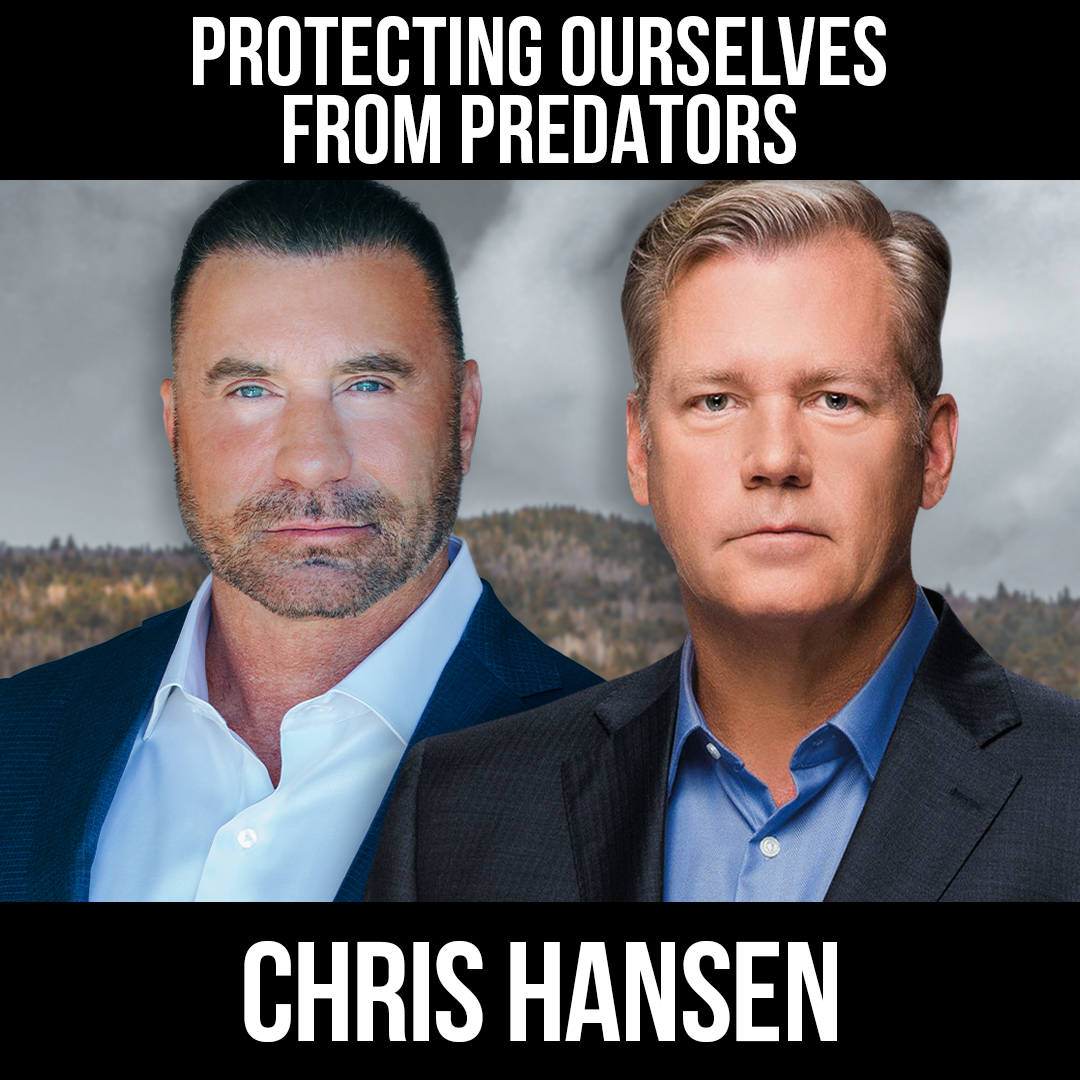
This is the end mileage show. All right, welcome back to the show everybody. My guest today is an eight time Emmy award winner. And you probably best know him from Dateline or catch a predator, but he's the first guest I've ever had on him on my show where I'm glad to be introducing him to all of you and not having him introducing himself to me.
Because the last thing you want to hear if you're in someone's living room or kitchen is hi, I'm Chris Hanson, grab a seat. So I'm super glad that I'm the one introducing him and he's gonna podcast out right now called Predators I Caught. I'm super fascinated by this man. It's kind of a giveaway as we do it is.
So Chris Hanson, welcome to the show. And thank you very much. I suppose you're gonna tell me to have a seat for this show. That's exactly what we're doing.
And I'm fascinated by you, Chris. The work you've done your life, you've really got a unique seat, so to speak, and a viewpoint in the world that's really unique only to you. I'm curious to begin with because now everybody, they recognize that voice and if they're watching this, they recognize the face. And I'm curious, when you started to do catch a predator in the Dateline work, what preparation did you have?
Were you qualified? Did you feel qualified to sit behind the scenes and then walk into someone's living room and have that conversation with somebody? Did you have preparation to do that? Well, nothing from a therapist standpoint or any experience in law enforcement except that you have done investigating reporting for several years running up to that, both at NBC and in local news beforehand, but nothing can prepare you for that very first to catch a predator episode.
When I pitched it to Dateline, it was never meant to be a continuing series. It was meant to be a one-off story for Dateline, exploring men who go online to sexually assault children. And we had become aware of the first justice online watch show, which at that time, would put decoys into chat rooms and if they got hit on and there was a solicitation by an adult, they would really post that person's identity on their website and occasionally cooperate with law enforcement to help in a prosecution. I thought once I became aware of River Justice that it could be very compelling if we could combine and collaborate with their ability to be decoys online with our ability to wire a house or hidden cameras and microphones.
I thought it would be eye opening. And I did doubt though, whether or not we'd see people show up. I was driving out to the first location and I thought, man, what if I just wasted tens of thousands of dollars in the network's money? And with that my producer called and said, hey, where the hell are you?
We've got two guys to get to the show up in 45 minutes. And in that first investigation, in Bethpage, Long Island, we had 17 guys surface over 2 and 1 half days, including a New York City firefighter. So was that a one time only event? I didn't know at the time, but your heart's in your throat because you really don't know what you're dealing with.
We had security, but we weren't working with law enforcement in that particular investigation. Law enforcement came in later and made a prosecution or two in that case. But we were testing this out and kind of learning as we went along, but no, there was no preparation for it. Other than that, I had done obviously a number of spontaneous interviews in the past.
I had the transcripts. I prepared asbestos. I could, but it's live. You are going inside the commission of her Sony and showing people that crime as it is actually committed.
And it was eye opening, even for me, but then at that point around the world doing this. Yeah, the reason I ask is that people listen to the show, they're stepping to different spaces in their life. And I think it was like you have to be completely prepared. There's really no such thing.
And you step into this space. There's really no one that stepped into before you sort of created a space the way that you did it. And it was really, I mean, there's not a person who listens to my show or is watching this because not familiar with you. And it's became that big of a deal.
And I used to watch it and think, I don't know if I ever could be like, well, that guy could be walking by me in the grocery store. You never know. And that's what I wanted to have you want everybody. What today's show is really going to be about is obviously some insights into that show.
And also lots of other things about predatory behavior. I want to talk about protecting our children, protecting yourselves if you're single and you're dating the social media piece. But then even offside all of that, how do you know if someone's got ill willed towards you? Is there a profile, someone's predatory with you financially just antagonistic towards you?
So we're going to go all down that road if you're wondering why Chris is sitting in that seat today because I think he's the most qualified person on the planet to do it. I'm curious first, Chris, when you meet these guys, you walk in there, did anything strike you about their humanity? In other words, were they otherwise on the surface normal people or is you would sit there for 20, 30, 40 minutes, eventually? Were there things about them other than the, obviously, the underlying, perverted predatory behavior that would give you a clue into who they were?
It was different. You know, they come from different categories. Ed. So you may have a guy who walks in who's a doctor or a teacher or somebody even in law enforcement in a recent investigation just a matter of months ago in Michigan, we had a prison guy, a Michigan State Corrections Officer walk in to try to have sex with a 14 overall.
You know, we're doing these investigations again now, 17 years later, and guys are still showing up. So they come from different categories. You see the legit guy, you could be standing next to you at the right time, there's not a Saturday morning or standing next to you in public transportation here in New York, somebody. And then there are, obviously, guys who could have the word predator's hand to do cost the forehead.
They look janky. You know, they look like a guy who's looking for trouble. So it's a combination of things. But I think if you're looking for, you know, that common denominator, it's really, really hard to tell on the surface.
If you go beneath the surface, you know, and you see things, there are definitely warning signs. But, you know, when you and I were kids, our parents said, don't talk to strangers. And that was good advice then and good advice today. But the problem with online grooming and the internet has changed all of this in so many ways, is that the person who's a stranger on a Wednesday is so adept at gaining the confidence of a child or anyone really by the end of the week that you think you know this person over the weekend.
Yeah, you use the word grooming. And it's fascinating that you did a few weeks ago, I had Sarah Klein on. Sarah was the one the original, you know, she was one of the original young ladies who came forward that was a victim of Larry Nassar for USA Gymnastics. And she used that word grooming.
Now he could groom them because he was in there doing physicals with them. But how does that work? I've got a child. Let's give some advice to parents now.
You got a child there on Instagram? Let's say, how does the grooming work and what should we be looking out for? Should parents be monitoring the direct messages of their children? Do you advise that?
What's your life? You have a child? I think it's not a bad idea depending on what you see and how old the child is. You need to start with an age appropriate discussion.
And I think sometimes it's as simple as look, I'm going to trust you to have communication on the internet. They have an Instagram or Facebook or a TikTok or, you know, Snapchat. But you need to know that there are adults out there who would like to trick you for a lot of different reasons. And kids don't like to be tricked.
So I think it starts there. And if you can get that point across to a child, then you can start to prepare them. There is no real effect of demand reduction for this crime. Right?
It's not a very sexy part of therapy or psychiatry or medicine. Well, enforcement does the best it can to Boston and incarcerated punished monitor these people. But at the end of the day, it's so prolific this crime that your best defense is education and awareness. And that starts with an age appropriate discussion with your kids.
How prolific is it? I just want to. That's a great question. Yeah.
I mean, we used to say, you know, 15, 16 years ago when I started talking about this, there was a number that we used to quote and it was at any given time, 50,000 predators are online. Well, you know, it's a hard number to come up with. And we were challenged on that and we ourselves went back to where was where this coming from? It came from a speech from the Attorney General and got it from the Attorney General United States that got it from one of our stories where we interviewed somebody who was a former FBI agent and I asked the question, would it surprise you?
That would truly say no, it could be even higher. So there's no way of really knowing is the honest answer, right? Common sense would tell you that there are a lot of predators online because we've fought a lot of predators online, not just sexual predators looking to assault children, but financial predators, all kinds of confidence teams and things that go on every day. So it's ubiquitous and we really don't know is the honest answer.
Yeah, that's the thing. We're going to go there in a minute, but I just think they're always wanted to ask you and this is the scene. I might even take some black rascals to this question. But the first thing is that because the way movies are made, you know, usually the bad guy in a movie is just a bad guy in every area, right?
Like, but the truth is many of these people have otherwise other redemptive qualities. Absolutely. And I think that's part of it. Like, well, he's a great soccer coach or an amazing, she's an amazing business woman or what?
She's so good with his own children. And so then we automatically categorize that person as there's no way they could be one of those because they have other redemptive qualities. These aren't just all bad people. This is some behavior they have that's perverted or a character flaw.
They may have other redemptive qualities and that should cause us not to discount the possibility they could be doing harm, correct? Because that's absolutely right. And we see this in the predator investigations. We see people who function as an oncologist, for example, at a major biotech firm on the cutting edge of curing cancer.
Yet there's a guy who is, you know, going online by tall dreamy Doc lying about his age, trying to meet up with a 13-year-old girl in Petaluma, California for sex, after a sexually charged conversation. Here's a guy who was at the orders. It was Mary who has a big job, an incredible education, doing some good for society, but yet in this dark corner of his life was out trolling for kids. And I think, you know, people ask what's the profile?
Well, there's in terms of my experience and I'm not a therapist and I'm not qualified to make this judgment. But in my experience, these predators break down into three different categories. There's the heavy hitter, pedophile predator, child luster who would be doing this with or without the internet, right? The bad little coach, the bad scout master, the guy who's hanging out, playing around with a food court at the ball.
They're going to do this. They're hardwired, whether it's because of something in their mind or because of a child experience, they're going to go after children. Then there's a younger group, right? 1920, 21, 22, socially inept, insecure, thinking that, well, this might be an opportunity to finally have romantic experience and maybe the best way to do this is to choose somebody who's emotionally at the same level of IM who happens to be 13 or 14.
And if it works out in a couple of years, it's not that big of an age difference. You know, they'll be 16 soon. They look at it as a Romeo and Juliet situation. That's a guy who can be put on probation, punished, warned and probably never offend.
Then we have this much more difficult situation in the middle. I think there's a whole category of guys who may have an attraction to the other boys or girls in their teens. In their teens. In their teens.
Yeah. These guys are, you know, any adult age, but they have an attraction to the other boys and the other kids, boys and girls. And they wouldn't act upon this without the internet, without the access to the chat rooms, to pictures. It's addictive.
It's 24 seven and it's anonymous and they find themselves seeing things online to somebody who they think is a vulnerable 13 14 15 15 or a girl that they wouldn't say in person. And then at some point they blur this line between fantasy reality and they may know better. They may suspect it's a Christian system operation or an FBI sing operation or any local police sheriff's about it, but they do it anyway because they get so caught up in this fulfilling this fantasy that they blur the line and the next thing you know, they come knocking at it or and that's the most difficult part, the most difficult profile to identify to treat to punish and to set your society. I think well, now that is fascinating because that sort of helps me really processing the way you described that because that behavior manifests itself online now.
It has created a space online where this transcends sexual predators. Right. For example, in my case, people will regularly make fake accounts of that in my let make them look really good and then solicit people to buy some cryptocurrency or if I do $50 and these are otherwise people that I almost think because I've actually encountered a few of these people in my last six years online that I think they do blur this line where they forget what they're doing is illegal and hurting another human being that almost get caught up in the process of it. And this is so prevalent online.
So anything do you agree with that number one and second is there anything someone listening to this can do to protect themselves from any type of predatory behavior online? Well, number one, yes, you are right. I think that's an accurate profile of what happens online and it is this constant blur of fantasy in reality. And because it is such a vast space of potential money making that it creates opportunity for those who are trying to scan folks and we've seen it, especially in a difficult economy.
I mean, the penetrator always goes for the most vulnerable, right? And not always do they start out to take advantage. But once they get a sense of success or how easy it is and it becomes financially lucrative or emotionally lucrative, they keep going until they get caught. And I suppose it's just that the ubiquitous nature of the internet in some respects.
But also if you provide an opportunity for bad people to execute this sort of thing, they will do it. I mean, we've seen it in our various investigations of online predators, not the traditional kind in the hands and verses quite a bit or a catch-up record, but the Onision and real life series that we have now on the Discovery Plus. Here's a guy who's a YouTube sensation. He had a big following, was making millions of dollars and ultimately crossed the line and started abusing and praying upon his young female followers.
And it started a whole investigation, both civil and criminal. And, you know, we did a series of stories in that. And the women, the young women who were the targets here were vulnerable for a lot of different reasons, some because of their emotions, some because of their talents, their creativity, they felt a secret spirit with this fellow who was also somewhat creative, talented, but also because they came from a home that there was freedom enough for them to be approached and to be emotionally taken advantage of by a guy like this. And you see it among the most wealthy people, Peter Nygaard, investigating the thing.
You know, there you have a guy who was not only a predator, but was a money predator. And he could buy this sensitive impunity that he had for 45, 50 years. He got away with thousands of sexual assaults. And finally, because of dedicated investigators as civil lawsuit, you know, that went on between Nygaard and a neighbor who did the right thing, reporting by us in your times and Canadian broadcasting network, he finally got exposed.
You know, but who knows without this? I mean, absolutely, without the Miami Herald staying on top of the story day after day after day, as he probably gets away with it. And the US attorney in New York at the time essentially said that. I mean, it's these guys have money, they have connections, they have power, and they can get away with it.
And so this is down as an attitude on the internet. Aren't they protected some of them by the bigger apparatus as well? I think I was reading that you wanted to do something on Epstein or had an inclination about him or something came up and then it didn't happen. Is that right?
Well, it was, you know, that's the lesson of good dog good reporting and that's what Julie K Brown did at the Miami Herald. We had an opportunity. I had an opportunity to look into some of the stuff. And quite honestly, I tried to fashion the sting operation in New York.
Wow. The levels of security were so guarded that we weren't able to you know, it penetrated. And so I got busy with other stories other topics with things and it was the Miami Herald, he came digging away day after day after day after day. And finally got the confidence of these survivors, some of them to identify themselves and come forward and become very effective witnesses to cross out this case.
You know, so do I regret not pursuing it more aggressively? Yeah, of course. But I'm also glad that Julie came around with Miami Herald did and you know, we've done stories around it. I continue to work on that case of it here and there and I think we'll come up with some fiction.
But you know, it's it's just a lesson of reporting. You have to sometimes it's old fashioned legwork and just staying on it and not going for the grand slam hidden camera investigation that wins the day. That's what wanted for the Miami Herald reporting aside as a human being. What has this work done to you?
What does it mean? How does it mean you look at human beings differently overall if it has? I mean, you've seen a side of humanity up close in your face multiple times really a seat that aside from maybe a few people in law enforcement have ever seen. Has it changed the way you look at someone in the grocery store to change the way you look at the goodness of humans in general?
I'm curious as what it's done to you as a man. Well, it's a great question and I think there was a time in between that it gave me kind of a dark look at society in general and you can let yourself get caught up in that if you're not careful. And I think with time passing and perspective, you know, I've developed a much broader, more balanced view of the world. I think that comes with, you know, doing something for 40 years and reaching a certain age in life.
And the kids were now adults to learn this business. You get a perspective that you didn't have it 40 that you now have it 62. And so it allows you not to be too hung up but to have, you know, a worldview of things and to understand how my work is fit into that world view and improve the situation and contribute to the education people and, you know, to get into the minds of a predator or criminal and to understand a little bit how that works and to cure the voice of the victim, you can create a hopefully an environment where fewer people become victims. And that's kind of what all my work and my reporting is about, you know, is creating that awareness because at the end of the day the cops can't arrest them all, you know, we can't catch them all.
So if you create this body of work that makes people pay attention just a little closer, you can prevent people from becoming victims, you know, it's like in these interviews with these guys, you know, whether you call it anybody can jump out of the back move or from behind the bushes in a great 10 seconds of traumatic video. My job is to get inside their heads, you know, to get them to talk to me. I'm not out there beat them up. Of course, if you're being, you know, agitated and angry that somebody would do this to a child, but my job is to understand it and to get them to spill their guts on camera so people can see it.
You know, that's been one of the interesting things about going back into the podcast now, which is I immersed myself in each one of these cases. And at the time, you know, I've got the transcripts and, you know, I've got some background and I'm able to think I might see it and do what these interviews. And unquestionably, even in this dark subject matter, there are, you know, borderline curious things that happen. And so you have to live in those moments too, because people see it going where it is.
But you've got to, you know, get the truth out of these guys. And that's the job involved. And I think, you know, especially looking back as I was saying with the podcast, I mean, you now see the bigger picture, right? Because it may have been a time when two guys were coming in with 10 minutes of each other.
Now I can sit back and watch the videos again, look at all the transcripts, see what's happened to the guy since I know more about his background than I did when he first walked in and we usually had a pretty good background on the other guys. And it gives this forward picture. And I think in these times when kids are spending more of their days on the internet, especially during the pandemic, and when you think of how many more social media platforms are out there now, it's more important than ever to have this conversation. Remember, when we did the first encounter, 17 years ago, we merely had the equation in chat with Al Wanyak.
That was it. That's all we used. Take a look at the landscape around you today. Look at what you and I use as men of a certain age in the media to promote our work, to have discussions with followers and viewers and fans.
It's exploded. I mean, every day there's a new social media platform that I don't know about. We're potentially predators and approach children. I was just thinking about TikTok specifically, a younger profile, we got some data that says Instagram's got about a billion three users.
I mean, imagine that number of billion three, but the TikTok is now at a billion and will likely surpass them in the next six months. So if there are billions of people on these two platforms, and again, they're overlapping users, but that means there are millions of some form of predators online, whether that's a financial predator, a sexual predator, somebody that it's not 50,000 anymore. Somebody that even if you're a woman on your own dating app, just a guy who's got no intention but to be physical with you, hide you about his intentions to be that's a bit of a predator. It's absolutely a predator.
And let me take it one step further. We did a story a week or so ago on the YouTube channel, Have a Supercraze Hanson on parents who are exploiting their children online. And you look at these family loggers, these people who are doing stories about the families and adopting kids and rehoming the kids because they've got behavioral issues. We did a story on the case of Daniel Cohen.
He was 15 years old. The mother of her is Jen, our share is essentially pimping this girl out online, making millions and millions of dollars. And the young girl who's been doing this since 11, 12, 13, all her relationships, her pregnancy, abortion, borderline child born. And all of this makes money for the mother on their YouTube channel.
Yet when we do a story on it, even though we blur any questionable video, we're not monetized because of sensitive social content. Just fine. I don't do YouTube to make money. I know exactly what you mean by incubate stories for photographers.
But so they're out there doing the exploitation and making them up. That's crazy. So you make sense of that. That is nonsensical.
I relate very deeply to what you're saying there. I'm curious about people are dating. The main place people meet now is online. So it used to be at a bar or a nightclub or church or a church.
It's like I've had great dating experts on my show. And so, man or woman. So I'm meeting the guy who's in my DMs, right? He's in my DMs on Instagram.
Or I'm meeting a guy who's, I don't know the names of them anymore. I'm on Tinder. I don't know. It tells you a little bit about the American.
But you're on these apps. And so you're going to want to meet people that way. There's got to be some advice you give to somebody. Like, hey, meet in a public place.
Look for a movie. Yeah, all of that. You have to just be wary. I mean, obviously if you're an adult and you're on one of the dating apps, a lot of people meet and have healthy relationships because of that.
You know, Tinder and Grindr are set up for different, you know, sort of hookups. But you know, the traditional dating apps result in healthy, wonderful, long-term relationships. But you just have to know that there are people who will try to exploit that and exploit your good nature. And so, yeah, all the common sense things apply, which is take your time, meet for coffee in a public space.
Don't put yourself in a situation where somebody can drop a roofie in your drink. Make sure you bet your own way there and own way home. And it's not a bad idea to make sure you tell a friend what you're up to. It's no different than selling a television on Craigslist or on Facebook, meet in a public place, you know, in the public place.
Don't set yourself up to become a victim. And it's a little, you know, trickier with adults who meet each other online. And I know people who met their spouses on traditional dating apps. It's not unusual.
So... I think it's funny that I named the hookup app. I don't know if it's the same thing. I don't know if it's the same thing.
I don't know if it's the same thing. I don't know if it's the same thing. There are profiles on there from time to time. Someone will screenshot and say, is this you?
Yes, that's definitely my picture. But my name is not Joe Mendoza. I don't live in Sarasota, Florida. So even there's that sort of thing.
You know, all the fraud online blows my mind. It just blows my mind. Well, and we saw, you know, years ago we did a piece on, you know, some of the financials can't online. And, you know, there's an intersection between the financials can't and this we heart swindled.
You've got these people who think they've met somebody online who's cute and, you know, has a lovely picture in front of some flowers. And it's actually somebody in West Africa who's joined us ham. And suddenly they're accepting packages. They're reshipping these things.
And, you know, this is a single woman in Georgia who's got five kids alone and is vulnerable, you know, and likes the companions of online. And we'll do this thinking that she's getting involved in a business venture with somebody who might also be a romantic. What you're describing there, everybody, Chris is describing. I know because I'm in the financial space.
And so like, that is much more prevalent than you would think what you just described. People that are a little bit more advanced in age, having what they think is a romantic encounter with somebody who does not exist. It is in some other country who then that person slowly grooms them to use Chris's term earlier to the point where they just begin to believe them financially and people have lost their entire life savings this way slowly but surely. And you think there's just no way it's nonsensical.
This grooming, this connection, this blurring that you described the predator uses also happens to the prey. The blurring starts to happen to the person being preyed upon. Right. And then they don't want to believe that it's really a scam because to accept that means they're not going to see this $250,000 that they invested with this person back.
So this Stockholm syndrome clicks in because they don't want to believe they've been the victim of a confident scheme. And so then they become very difficult victims for law enforcement. They don't want to come forward. There's a sense of embarrassment.
And they're tricky cases of processing. We once at NBC, we convinced our bosses to give us a year and more producers than usually are given to a project to out the Nigerian scammers. And it was a hell of an effort. I mean, I had three or four producers.
Usually when you do a story, you have eight producers and associate producers. I had three or four producers rotating in and out constantly trying to get these guys to come out of the back rooms and out of wherever to put together a snap. So I can confront them. And we did it.
But it was, I'm telling you, we were at this for a good nine months to a year before we could really smoke these guys out. We had a field day with them. I mean, it was a great story. But it was expensive.
It was aggressive. It was, you know, saw what dangerous I suppose. But we traveled, you know, throughout Europe and went to West Africa. And you don't get a chance to do that very often.
And because, you know, it was a great story. It became iconic, but it's one story that costs hundreds of thousands of dollars in, you know, many months and a lot of manpower to do it. But that's how difficult it is. Now, imagine, you know, a mid-sized police department.
That's not going to happen. Back up. And that's why these guys get away with it. I mean, I'm convinced that there's a poster of me in virtually every internet, uh, cafe in Lagos, Nigeria in Benin, West Africa, uh, with, you know, saying don't talk to anybody who looks and sounds like this, but, uh, because we did not even think your work, Chris, just as long as long as lines, how do you think your work has changed the way at all the way to the predator operates?
Has your work caused this sort of culture of predatory behavior to alter the way they operate, literally because of you and the, sort of dynamic that was set up by the way you did the show? And I think, uh, I would like to think that it's a deterrence, right? I mean, I honestly thought we'd do three, maybe four predator investigations and I honestly thought that we would not see guys show up, that we, you know, I'd be taking an ambulance and taking a counter like a maytag repairman. Nothing to do.
And that's not the case. I mean, again, 17 years later in Michigan, guys are showing up. Now we've changed what we do. We had a COVID protocol.
We did a lot of things differently, but, uh, there's still out there. And guys still walking and say, oh, you're Chris Hins. And guys still walking and don't know who I am. And I don't know whether to be, you know, offended by that or, or flattered, but, uh, it's, it's not a problem that's going on anytime soon.
And it's always asked why that is, you know, and I think, I think it's just the nature of the issue. And I think for some people to deal with this, for some people, it's a weakness or some people, it's just a, it's a predator mindset. But it also is not a practice of medicine. If you look at it as a psychiatric illness, for instance, and some of it is, if you go to medical school and you graduate and you have the choice of becoming a plastic surgeon in Beverly Hills, California, Bloomfield, Hills, Michigan, or, or Park Avenue, New York and Big Glens, Valor, or what about this?
I can study sexual predators and work for the U.S. Marshals and spend my days in federal penetrates interviewing, um, hard and core predators. What choice? Now, thank God.
There are people who do that, you know, and I've interviewed them and they're wonderful, smart, dedicated human beings who devoted their life to this particular practice of medicine, but you can understand why somebody wouldn't want to do that. Yeah. Well, I also think part of it is the rush. I feel like sometimes people's lives are so monotonous and unexciting and they're not chasing a dream.
I don't time for human beings can be a really dangerous thing. I just wonder sometimes it's just, I'm sure, I can't empirically prove this, but I'm positive that there are cases where, so let me just take a look at this channel. Let me just see what's there. There's a, you know, young guy or young gal.
What happens if I did have a chat? What happens if I did propose this idea? I'm talking face to face. So they, they, they get on the slippery slope where they start saying stuff they wouldn't say face to face.
And the internet has changed our whole culture and the way humans communicate. I mean, you know, I tell the story to my kids, I tell me in cell phones, they don't even have peedries when I was in college. We just have to leave notes on doors in dormitories and then people had to write things down and little pink pieces of paper, yellow pieces of paper, and you have to read them and then you'd have to go to do these bars and work there. They must be at the alley eye and stuff.
You had to find somebody, you know, and we always found the other people. We always did. We always found who we were looking for. But nobody just, you know, took each other and said, you know, we're going to do this.
We're going to do that or here's where we're going to be or, you know, I can't use Tinder today just to figure out where the other kids are going to be either or avoid them. I mean, it's a whole different world now. I have a big theory that attention is something that drives humans. And in an odd way, I think the predator and the prey share this need.
In other words, the prey, this child or this person is just seeking some form of attention. They're not getting somewhere else. Maybe they don't have a father or a mother. And I'm not trying to steal that.
No, no, but I think, again, it all goes back to a vulnerability. And I think a lot of predators have a deep sense of, of where that vulnerability is and I mean, if you look at all the victims, there's a vulnerability that doesn't mean that it's okay to make them a victim. It just means that a predator can often sense that and win. I mean, it's the old story.
Why do you round the bank? So it's when money's at, you know, criminals figure that out. Yeah. Did you ever find yourself, this is the hard question that one of always asked you, I'm making a little flag for it.
I was going to ask you earlier, just coming up now. So did you ever find yourself when you're in that kitchen or that living room and this guy's jabbering on and on and he seems remorseful and he's teary-eyed. And I'm a father. I can't believe I did this and I'm an idiot.
And did you ever find yourself feeling? This is a tough question. Did you ever feel any empathy for the predator? Yeah.
Yeah. A couple of times, a specific guy. I remember one and I had conversations about this with some other colleagues. There was a fellow who came into Georgia, a house, a sing operation, he got set up there and he was in a rocky bed.
And he came in and I walked out and I don't know that he had figured out it was me or what was going on. He probably thought I was a cop. But he immediately got down on his knees and put his hands behind his back in the prisoner of the war position as if he had been caught by, you know, a rocky forces. And he was compliant to the answer all the questions, he was apologetic.
He had, you know, reasoning for all this. He had PTSD. None of that, however, forgives the fact that he was very likely going to settle his father child and alter that child's life forever. Now, did I feel bad for the guy because he served our country because he was having issues perhaps due to that?
Yes. Does that make him okay? Does that excuse what he was about to do? No.
But it was a moment of emotional torture for me to, you know, figure out, okay, had this guy decided to ask him online today or had he decided to go, you know, get his tires rotated because he was supposed to show up here, you know, he wouldn't be facing this. And maybe he would have never acted on the symbols. I don't know. But you can ask yourself those questions and you can have these emotional and intellectual wrestling matches with yourself.
And that's healthy because it makes you think or makes you better at what you do. But you can't torture yourself forever over it. Ultimately, you have to realize that this was what I chose to do. We did it with integrity and intelligence and some balance to it.
And this was the product. And I was like, generally speaking, I mean, look, we'll always take heed in certain corners in the journalistic community for being sensational or working too close with the police or whatever. But you know, look, I, you know, I long ago got over that because of my long ago realized that by following the path of doing this kind of reporting, I was going to eliminate some more traditional opportunities, right? And I have this conversation, my second son is a reporter on television.
And I said, look, did this make perhaps 16 minutes off the platter? Maybe. But this is what I chose to do, uncomfortable with the legacy that I'm creating. And I think as a whole, you know, I was more cutting edge than worried about being more traditional.
And it's not used analyzing. It's a death because I already did it. You know, I don't get people all the time. You know, my tool just gives us a private school in Connecticut and having a father on television wasn't a big deal because they had to work kids with dads with captains of industry and sports and all kinds of things.
And it wasn't until South Park to the Chris Hanson, catch a credit or parody that something out was the coolest. Yeah. I was on South Park. So it is what it is.
I don't, you know, my son's all the time. I said, look, you know, I'm not saying that you have to go do what I did or do it the way I did it. But, you know, realize that you're, you know, as you charge your path, there are consequences to it. And you have to be comfortable with those decisions, even though, you know, sometimes there needs the will you.
Yeah, but you know, because they're the truth. We all make mistakes. I like you. Maybe we'll make mistakes in your personal life.
Everybody has those mistakes happen. But the truth is it's very rare in your industry and your work, but the actual work. I mean, it's sincerely probably saved lives. I'd like to think so.
I mean, when they say one and we know it's more than that. And it's worth it. You know, and to me, again, it's, it's a dialogue and awareness that didn't exist before. That's right.
And a part of that is due to a cartoon show. Well, so be it. You know, it's an intelligent, biting, cutting-edge, well-written cartoon show. You, you, by the way, had the temperament to do this.
And then there's a lot of other guys that are investigative reporters or journalists on television that their temperament could have changed the tone of the environment when that walkout happened. There's something to your presence. And by the way, this is just something everybody learned in communication too. There was something to the way that your presence, your energy was brought into the room that created an environment that was dynamic between you and this predator.
That, and everyone should be conscious of their energy and how they walk into a space. You don't walk into every room the same way. You walk into that room that way. I'm curious.
Take us into it for a minute. What are you feeling when you're coming around that corner? And what are you feeling typically from the person who you walk eyes with? That's got it.
That is a moment that 99.9999% of all of you beings will never experience in their life, which you've experienced multiple times. Is it the same every time for you and the other person? No, it's different every time because, you know, each individual, obviously there are some similarities. Some guys are going to have the same excuse.
You're prepared for it and you've thought about it since the last guy gave you that excuse. So you have a really good comeback to that, right? Too bad for that guy because I'm really ready for him and I'll have his lunch. But generally, it's the rule that I have for every interview, which is to be a good listener and to not be afraid of dead air.
You know, Mike Wallace was a great teacher of that in spontaneous controversial interview. And that is, you know, sometimes you got to go forward and get it while you have the opportunity. But at the same time, if you've got that person in a controlled environment, there's nothing wrong with asking a simple question like explain it and letting them hang there on the vlog until they say something. And I can't tell you how many times I've been in a situation, especially in the country cases, where I thought it was over.
I thought the guy was never going to give it up and I kept at it, kept at it, kept at it, and finally said, you know, just explain to me what was going on in your mind. And finally, you see the switch go and the guys as well, you know, it started to year, I was at this age and I kept getting older and the kids kept at the same age were getting younger. And they give you some sense of what happened. I might be all posted at the end of the day.
And I'll be confused. But at least you have some sense of what this guy is about and how they got there. You know. Do you think that a couple more things I'm fascinated by?
I mean, it's like, for me, that's a conversation many years into making of wanting to ask these questions. I know it is for my audience too. Do you think that forecasts a little bit? You're in the space a while.
Is there a future that you see coming where predatory type people change their behavior? Is there another venue or forum other than just online? Anything you see that we should be looking out for that's sort of the next level, right? As you said, we didn't have text and phone back in the day.
Now we've got Instagram and TikTok and dating apps. Is there anything on the mind? I think one of the next thing is people will try to exploit it. You know, whether it's another level of communication, you know, another level of internet connectivity.
You know, we see it with the interactive video games. You know, that's another thing. People think we could say playing a video game. Well, they don't know who's on the other hand.
If you say they're, you know, Sam's not going from wherever they don't know who that really is. You know, so I think it's really, it's the same predatory behavior taken to the next level and exploiting whatever technology is available. I mean, the old days, you know, you can sell the same track of sometimes in the bus data, you know, to the same guy looking to buy a factor. You can get away with it about, you know, seven times before the share of it, you know, what you're up to.
And today, you know, it's just, you know, you use a picture of the factor and, you know, people sell it multiple times, you know, all the time online. So you're going to be careful. I was going to just add to what you're saying that, you know, I'm a target for certain people just because of, you know, net worth or whatever or reach. And I just want to share with the audience that when someone, someone doesn't usually come right directly at me with their thing they'd like to get from me.
It trickles over time and it can seem like a very normal relationship in the beginning, even for an extended period of time. But what I did know was in the back of their mind, they were waiting for that moment where I was the most comfortable. I was the most vulnerable. I was the most trusty.
We are being groomed by people for different things other than just what Chris is experiencing or experienced. So that's true. It's a grooming that someone's trying to get something from you. I've seen it in my life.
I mean, you know, I've said to people, I said, do you really think that I'm the guy you want to try and con? How do you think that's going to possibly go? And mostly people make up a sort of a, a couple of times where somebody's constantly trying to take advantage of an online scam or, you know, the typical phone calls you get, but you know, it's somebody trying to get money from you for some nefarious reason. And, you know, you can tell because they'll say, Christoph or, you know, he has the name that doesn't fit on their, on their, you know, put an ER on that.
I think it all off that. Does that name sound at all familiar to you? I'm sorry about that. They think the worst dude.
Yeah. Could you pick a worst human being? I have my last question. I'm curious about redemption, but I just, I think I've always in my mind thought when I came to sexual predators, physical predators, physical abusers.
I've just sort of always, that's been a category that I went, no, they're not. They're not redeemed. They're, they don't come back. They don't get a second chance.
I'm just being candid. About everything. Liars, cheap. Yeah.
No. Flanners, bad people, gossippers, they can all be redeemed. That cat, those two categories for me have always been, no, they're not redemptive. No way, no, how, everyone I trust them again.
Well, I think, I think there's a category of predators who can never be before. I think there definitely is, you know, a group and no matter what you do or how you punish or anything else, they're going to figure out a way to play their hard wire to do it. And that's probably, at least in my experience of 30 of these guys, you know, to change. And they're going to be, and we've seen them.
We've seen them get out. We've seen them re-offend. We've seen guys who successfully wanted to have productive lives. And, you know, I think there are categories that, with monitoring and probation and some sort of treatment, I think they'll be fine.
But we've also had guys in prominent positions who, you know, the therapist and had their pro-obvisit, they're not supposed to have a device that has access to the internet and the phone rings while they're in the therapist and the probation officer and they're cooperating with the phone. I mean, you know, it's like, come on, geez, we just tried. You know, but they can't be reformed in some cases. Thank you for today.
Thank you. No, what a treat. And thanks for having me on. And I appreciate the thoughtful conversation and good luck to you and all your endeavors.
And let's do it again. I think you're wonderful. Guys, I think predators, I've got to something. I cannot wait to hear it.
I mean, I really didn't, I'm accused of being addicted to your program and addicted to you in terms of the work that you've done. And it's really true. If I've missed one, I've missed one because I think I've seen all the other ones. Oh, we have more.
We have more comments. So, and we'll have a, I think we'll have a little announcement on that. So I'll keep you posted. Yeah, follow Chris on Instagram, you guys.
Today was a little bit of a different take because I want you, your family protected. I want you thinking about people that are grooming you for all kinds of different things. And I think grooming is that word, that word of it. Someone's sort of working on you towards some you'll gotten means some you'll gotten intent in your life.
And we have literally the world's expert on the show today too. Plus you're just fascinating. I know everybody wanted to hear it from you today. So thank you, Chris Hanson.
Thank you, man. I actually appreciate it. It was great to be here. I enjoyed it.
All right, guys. Hey, share today's show. Make sure you subscribe to YouTube. If you listen to the audio, listen to audio, go over there and get on YouTube because there's different content there as well.
God bless you all. Max out. This is the end mileage show.