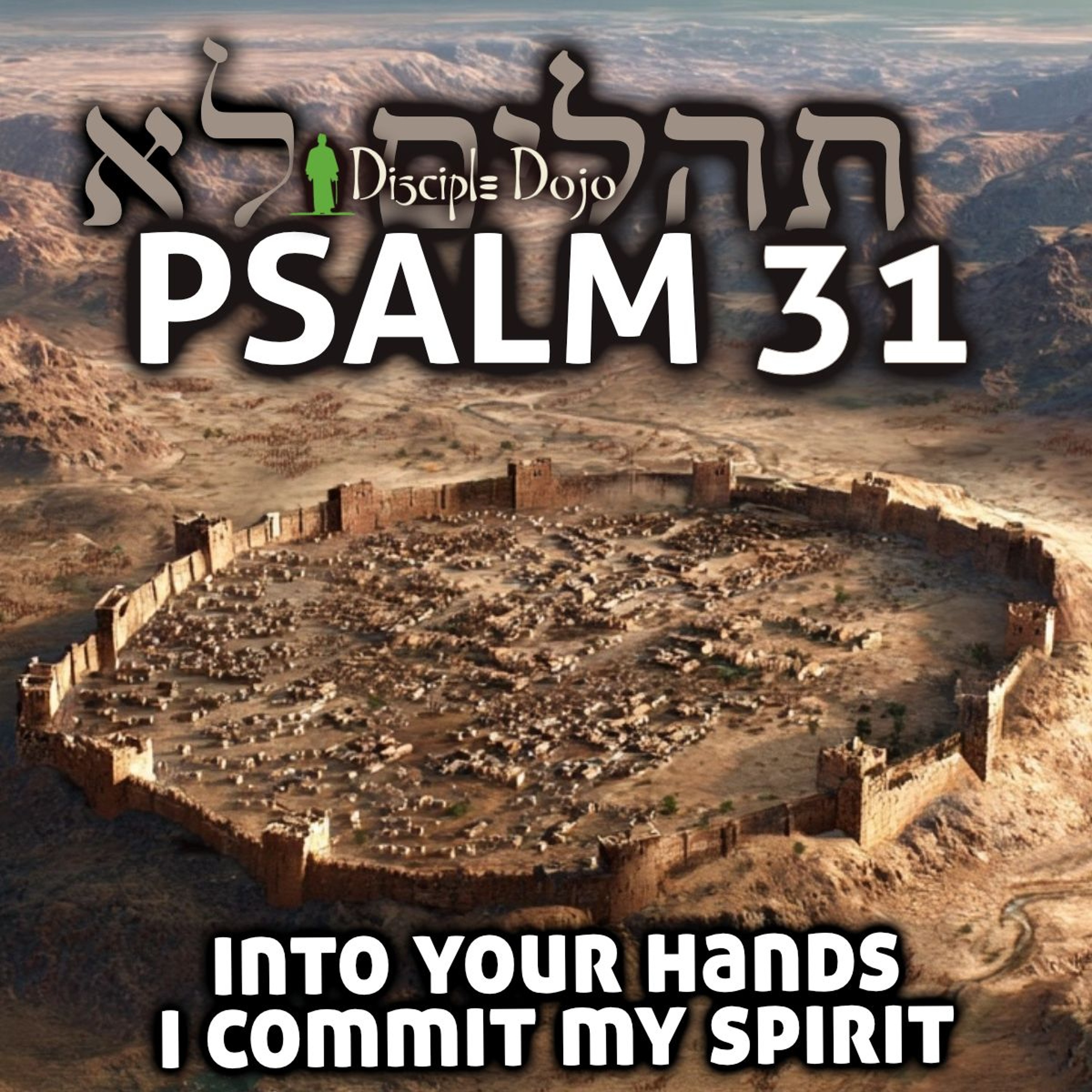
Welcome back to our ongoing journey through the lyrics of the Psalms. If this is the first video you're seeing, check the playlist here on the channel. We have gone through the first 30 Psalms at this point, and so in this episode we're going to be taking a look at, unsurprisingly, Psalm 31. If you appreciate this type of in-depth teaching, these videos don't get nearly the number of views that our study Bible reviews or book reviews or things like that get, but they... are the heart of what we do here on the channel, biblical teaching that's unapologetically long form, focused on the original languages, and helping people to dig deeper into the words of scripture. So if you appreciate that, we would love for you, if you haven't already done so, hit that subscribe button. Our goal this year is to make it to 100,000. We're right at 77,000 right now, as of the recording of this video, and hopefully by the end of this calendar year, we can make the big 100K. But that'll only be if people like you subscribe, like, share, comment, and let other people know about Disciple Dojo as well. All right, with that out of the way, let's jump into Psalm.
31. So Psalm 31, I'm going to read from the old NIV translation, 1984, and then we're going to jump back and look at the text a little closely and compare different translations as we go through. For the director of music, a Psalm of David. Into your hands I commit my spirit. Redeem me, O Lord, the God of truth. I hate those who cling to worthless idols. I trust in the Lord.
I will be glad and rejoice in your love, for you saw my affliction and knew the anguish of my soul. You have not handed me over to the enemy, but have set my feet in a spacious place. Be merciful to me, O Lord, for I am in distress. My eyes grow weak with sorrow, my soul and my body with grief. My life is consumed by anguish and my years by groaning. My strength fails because of my affliction and my bones grow weak. Because of all my enemies, I am the utter contempt of my neighbors. I am a dread to my friends. Those who see me on the streets flee from me. I'm forgotten by them as though I were dead. I've become like broken pottery, for I hear the slander of many. There's terror on every side. They conspire against me and plot to take my life.
But I trust in you, O Lord. I say, you are my God. My times are in your hands. Deliver me from my enemies and from those who pursue me. Let your face shine on your servants. Save me in your unfailing love. Let me not be put to shame, O Lord, for I have cried out to you. But let the wicked be put to shame and lie silent in the grave. Let their lying lips be silenced, for with pride and contempt they speak arrogantly against the righteous. How great is your goodness which you have stored up for those who fear you, which you bestow in the sight of men on those who take refuge in you. In the shelter of your presence you hide them from the intrigues of men. In your dwelling keep them safe from accusing tongues.
Praise be to the Lord, for he showed his wonderful love to me when I was in a besieged city. In my alarm, I said, I'm cut off from your sight, yet you have heard my cry for mercy when I called to you for help. Love the Lord, all his saints. The Lord preserves the faithful, but the proud he pays back in full. Be strong and take heart, all you who hope in the Lord. So as always, now we're going to take a more microscopic look, a fine tooth comb over the text. And there's some differences right up front.
Verse 1, typical, this is a standard introduction for the Naseach, and this is the director, or Septuagint translates it, for the end, our friend Dr. Andy Witt has written a good article on this issue. If you're interested in what's going on and why would the Septuagint translators translate it as for the end, then check out his article. I think it was in the Journal of Biblical Research from IBR. Dr. Andy Witt, he's been here on the channel. We've talked about the Psalms before. It's in this playlist. But then the Septuagint, after Mismore David, a praise song four by two of David, it adds extasios. Extasios is of dismay or of disorientation. So in the Septuagint, it's a praise song of David of dismay. And then it begins with a request, a plea. In you, Yahweh, I seek refuge. Do not let me be put to shame, le olam, for a long time, forever, but rather in your...
In your righteousness, rescue me. In verse two, verse three in Hebrew, bend to me your ear is literally what it says. Bend to me your ear means like, you know, make sure you listen. Quickly deliver me. Be for me. And these are two words that have to do with like rock fortress or a cliff or a stronghold. I think sewer is one of the words for rock. And then is like a stronghold. So I just translate as be for me a rocky stronghold. A house of fortresses is a plural ending. And so this would be like a qualitative, like when you.
In Hebrew, when you pluralize something, sometimes that's to show like the type of thing. So a house of fortress would be a very literal way of rendering this house of fortresses, meaning a fortress house. To save me. And there's this common word we've seen throughout the Psalms, which is where Yeshua comes from. So be for me a rocky stronghold, a house of fortress to save me. And this is the word just brought right down from the previous line. And my fortress are you. And for the sake of your name.
You guide and you lead me. You nachan and you nachal. You bring me out or cause me to come out of. And this would be the meaning is you free me. from a net which they hid for me. For you, my stronghold. And then it continues, verse five, six in Hebrew. Into your hand, I entrust my ruach, my spirit, my breath, my life. And this is a well-known line. This we know was on Jesus's mind, on the cross. This is one of the last things he said before he died.
And of course, this is a Psalm of despair, a Psalm of lament, a Psalm of rescue. So it's natural that those are the Psalms that were clustering in Jesus's mind, the greater David, when he was experiencing the agony and the torment that the lesser David had experienced a thousand years before on a much more temporal level. David's Psalm continues, you redeemed me, Yahweh, God of truth. So into your hand, I entrust my spirit, you redeemed me. And then verse six, seven in Hebrew, there is a textual discrepancy right at the beginning. The Masoretic text says, I hate the ones guarding.
Havle Shav, Hebels of emptiness. That's the most literal. So Hebel, and this is the word from Ecclesiastes. It's also the name of Cain's brother, translated usually as Abel, but it's Hebel. And it means breath, emptiness, wind, vapor. So false vapor. And this is a reference to idols. So that's why some English translations, they translate the meaning rather than the literal words. But the one to shamar means to look after or to observe, you know, Havle Shav.
worthless idols. So the psalmist is declaring, I hate those. In other words, that's the opposite of what I am, but I myself, I will trust. So it's comparing the psalmist piety with the idolatry of those who chase after idols. The Septuagint though, instead of translating it as I hate the ones who do that, it has emisesas, you hate. So this is a declaration of what God thinks about those who go after idols, not what the psalmist thinks. Either translation works.
It just gives a slightly different take on what this first line is about. But the second line makes clear, Lord, if you hate that, know that I trust in you, not in idols. Or it's a declaration of, I hate that, I trust in you instead. Either way, it works. And then the song moves to praise in verse 7, verse 8 in Hebrew. Let us be glad and let us rejoice in your chasid. Because you saw, you saw, you looked at, looked upon, my affliction. You knew in distress.
of my soul, nafshi, my soul, my life. So you knew, not just you saw, but you knew, and this is the word yada, to know. It's an important word in Hebrew. It doesn't just mean, oh, I know something like mentally. It means I know, like I am, you know, in this case, God is, it's more than just, I'm aware. It is, I know your saroth, your distress, your troubles. And you did not shut me up, bayad o yev, in the hand of my enemies. He's already said, into your hand, I entrust my spirit. And because of that, he did not close me up.
in the hand of my enemy. Rather, you caused me, you made me stand. We would say you stood upon broad places, my feet. You set my feet upon broad places. So the image is I'm not hemmed in. I'm not trapped. I'm freed from the net, from these people trying to ensnare or encircle or attack me. Later in the summer, it's going to use city under siege imagery, but I'm not that. Instead, you have set me, my feet on broad places. You have opened me up. You have brought me out into safety. Merchav, this is from Rahav, which is to be broad or to be wide or to be expansive. And it's also the name of Rahab.
the prostitute. And there's a wordplay because she was, in English it works too, she's abroad. Now, this would be a fitting conclusion to the psalm. It could end at verse 8, verse 9 in Hebrew, and be a perfectly normal psalm. But now, in verse 9, the psalm kind of starts over again. In fact, in Conrad Schaeffer's commentary in the Barit Alam series, he notes that it's all parallel. That verses 1-8 is the first movement, and verses 9-22 is the second movement. And they line up, verses 1-3, a plea to the Lord for help. Verse 9, a plea to the Lord for help.
Verse four gives us the psalmist's plight. Verses 10 through 13 give us the psalmist's even more serious plight. Verses five and six, it's a vowel of confidence. And verses 14 through the first half of 15, it's an expression of confidence about things being in God's hand and trusting. And then verses seven and eight talk about God's chesed and that God hasn't delivered the psalmist into the hand of the enemy and there's confidence that God will help. And then the last half of verse 15 through 22 talks about deliver me from the hand of my enemies. And it's a final prayer for rescue and grateful recognition of God's chesed.
So that's why I've color coded these sections here. So you can see how it lays out. Let me zoom out here real quick just to get a bird's eye view. So the Psalm, here's one section and that corresponds to this section in verse nine. Then verse four here corresponds to this longer section, 10 through 13. Then verses five and six, that's in gold. That corresponds to 14 in the first half of 15. And then the part in red here corresponds to the final movement of the Psalm. And then in the end, there's an encouragement versus 23 through 24. So the Psalm, it's basically, it repeats itself now.
in terms of its content. It starts over, be gracious to me, Yahweh, for I have distress, or literally ki tzar li, for trouble to me. So we'd say I have trouble or I have distress. And then she wastes away in ka'as, in vexation. There's another word common in Ecclesiastes. She wastes away in vexation my eye, whether it's bloodshot or his eyes are just sunken in or something. It's just, you can see grief on the psalmist's face. And not just his eye is wasting away, but also nafshi, my soul, or we would say my life.
Upitni, and my belly, my innards, my gut. So I'm wasting away my eyes, my breath, or my throat, Nafesh literally is throat, and my gut. For they ended or they completed in sorrow my lives. And this is plural, lives, but again, probably talking about my life, my livelihood, or my lifetime, something like that. And my years in sighing. And it stumbled, or he stumbled, in my iniquity, my strength. So my strength, this is all being personified, my strength stumbled.
Because of my iniquity. In other words, I lost strength because of my sin. I'm wasting away. And my bones dissolved. From all my adversaries, I was a reproach. And to my neighbors, exceedingly. Oh, very much. And a dread to the ones knowing me. One seeing me outside, flee from me. I have been forgotten. Like the dead from heart. In other words, people's heart, it means your heart or your mind. So like the dead, like people who die and are no more, and they're forgotten, they're out of people's minds.
I have been forgotten. I'm like that, but I'm still alive. I was like a broken or a lost vessel. So a vessel that is obeyed. Abad can either mean to be destroyed or to be lost. So either way, a thrown out vessel. And in this case, it would be pottery, like cracked pottery shards. For I heard Dibbath Rabin, for I heard a report of many or a great report. Rabin can be many or much. Terror from all around. They're plotting together against me. All around, I'm hearing people plotting together against me.
To take my soul or life, zamamu. They murmured, they plotted, they schemed. Now there's a really interesting parallel in Babylonian prayers. There's a prayer called the poem of the righteous sufferer. And it's very similar concept. This is written in Akkadian. And the person praying it says, I who walked proudly learned slinking. I so grand became servile. He's somebody who's now suffering. He was once proud and now he's been brought low. To my vast family, I became a loner. As I went through the streets, I was pointed at. I would enter the palace. Eyes would squint at me. My city was glowering at me like an enemy.
Belligerent and hostile would seem my land. My brother became my foe. My friend became a malignant demon. My comrade would denounce me savagely. My colleague kept the taint to his weapons for bloodshed. My best friend made my life an aspersion. My slave cursed me openly in the assembly of the gentlefolk. My slave girl defamed me before the rabble. An acquaintance would see me and make himself scarce. My family disowned me. A pit awaited anyone speaking well of me, while he who was uttering defamation of me forged ahead. One who relayed base things about me had a God for his help. For the one who said, what a pity about him, death came early.
The one of no help, his life became charmed. I had no one to go at my side, nor saw I a champion. So this is, I mean, this is a very common prayer motif in the ancient world. And this is the biblical version of it. This is the psalmist expressing that same thing of there's no one, no one's in my corner, basically. You know, even my neighbors, even the ones who are supposed to be on my side, they don't stand with me. But unlike the Babylonian sufferer, the psalmist has a God who he can turn to. Verse 14, but I myself upon you, I trust Yahweh.
I said, my God, are you, literally, my God, you, in your hand, my times. So the psalmist affirms, even if everybody else has turned their back on him, he has not forgotten his God. And he has put his hope and his trust in the God who he knows is faithful, even when he can't see it. And so he still cries out. I mean, declaring trust doesn't mean you don't still cry out and lament. So he then moves in to cry out again, deliver me from the hand of my enemies and my pursuers, the ones pursuing me, the ones chasing me. Shine your face upon your servant.
save me in or by or through your chesed. This is what he's banking on. Yahweh's chesed. Yahweh's loving kindness, steadfast faithfulness, mercy, however you translate chesed, he knows that that's who Yahweh is because that's who Yahweh revealed himself to Moses as when he revealed his divine name. The Lord, the Lord, gracious and compassionate, showing chesed. This is what Jonah complained about when he wanted God to destroy Nineveh and he knew God wouldn't. And he says at the end of the book, it's because I knew you were a God of chesed. So the psalmist is...
banking on that. And he says, so Yahweh, do not let me be shamed for I call to you. Evildoers will be shamed. They will wail for Sheol. Or this could also be, they will perish or they will be silent. It's what Yidmu, does this come from Damah? Does it come from Damam? Does it come from Doom? Depending on which verb this word comes from, it's either they will wail, they will be silent, or they will perish for, in, or at Sheol. And I think all of those meanings work. I'm not sure which one it is. That's the fate of the evildoers. And so...
He continues verse 18, let them be struck dumb or mute. Why? Because they are uttering lies. They are speaking lies against him. So let them be silenced. Lips of a lie, speaking against a righteous one, unrestrained in arrogance and contempt. God hates lying. He hates arrogance. He hates contempt. You know, these are things that characterize many people today that people look up to, that people vote for. And the psalmist is like, let them be silenced. Let them be struck dumb. And he's asking God to do it. This is an imprecation. The psalmist isn't saying, I'm going to go silence them.
The psalmist is giving it into God's hand and saying, Lord, you are the one who's true and just. You silence them. Verse 19, how great is your goodness that you hid for those fearing you. So how great is your goodness that you kept in store, we would say, to hide or to collect, to preserve. Like you've preserved, you've held in your goodness for those who, for the ones fearing you, and that you have done for those seeking refuge in you.
all of humanity, literally the sons of Adam, the sons of humanity. So before all people, the psalmist knows that God has kept hidden good things for those who seek him. It's hidden because he can't see it right now. He's in despair, but he knows that that's not the end of the story. And so those who seek him, just like he's hidden good things for them that they will get eventually, verse 20, you conceal them in the shelter of your face. And panecha literally means your face, but face is the term for presence.
So like, and you've sheltered them in the shelter of your presence, in your midst, we might say, from the plots of man or the schemes of man. You will hide them, basukah, in a sukkah. This is where the feast of booths, Sukkot, when you build a little shelter and stay in it, like that's what this is, sukkah. You will hide them in a sukkah from merive lashonoth, from lawsuits of tongues. So this would be like, rive is like a complaint or bringing a charge against someone and you do that with your tongue.
So this, you might say like contentious or litigious tongues or, you know, litigious speech, something like that, protecting someone from charges being brought against them bogusly. Verse 21, Baruch Adonai, blessed is Yahweh, for he made chesed wonderful to me in a besieged city. So in a city besieged. Is this talking about literal salvation from David or another king who's literally in a city under siege? Or is the image of a besieged city?
the poetic image, because that's what it feels like when you're surrounded by enemies, you're surrounded by slander, you're surrounded by people that hate you, that mock you. You have no escape. You can't go anywhere. You want to be brought out into wide open places and have your feet set there, but you can't because you're hemmed in, you're surrounded. And so I think this is poetic. I mean, this would obviously apply if you are praying from a besieged city, but I think that's an imagery that's being used. But commentators have different takes on it. So check the commentaries. Verse 22. And I myself said in my haste, I am cut off from before your eyes. So the psalmist is confessing. I said in my haste, I'm cut off.
There's no hope. I'm done. I came surely or however, you heard the sound or the voice of my plea in my cry to you. I thought you were ignoring me. I thought I was done. I hastily gave into despair for a moment, but then I realized, no, God has heard my cry. And so then the song concludes with a call to worshipers. Love. This is a command and it's in the plural second person. So y'all love Yahweh. It's a command to love the Lord. All his chassid.
his righteous ones, faithful ones, keeping watch Yahweh. Now, is this keeping watch on behalf of Yahweh, keeping watch over, like the command in Torah is guard the commandments of God, guard Torah. So is that what this referring to, the ones who are guarding? And so it would be keeping watch, parentheses, over the things of Yahweh, or is it faithful ones, Yahweh is keeping watch. In other words, Yahweh is watching over faithful ones and compensating, literally, to pay back.
to make whole or make restitution, to pay back upon the rest, the remainder, the ones who are the ones doing arrogance. So it ends with another plural command. Y'all be strong and let y'all, this is plural again, y'all's hearts, let them be strengthened. All the ones waiting patiently for Yahweh. So an encouragement for those who are waiting patiently, feeling affliction, feeling distress, in your distress, in your affliction, know.
that God is going to pay back those who are causing that affliction. So let your heart be strengthened as you're keeping watch, or that God is keeping watch, and love God, all you righteous ones. In the language of love, ahav, it could mean love. Don't think of sappy, sentimental love, but think of devotion, be devoted to. And by extension, when love is used of kings in ancient covenant language, it usually has the connotation of be loyal to. Loyalty is love in the ancient Near East.
And that's what the psalmist is calling upon God's faithful to do. And so you can see why this psalm was one of the ones on Jesus's mind during the crucifixion. He was surrounded by enemies. He was hemmed in. People were mocking him. People had slandered him. They had brought false accusations, a leave of tongues, a cut lawsuit of tongues against him in the high priest's court. And Craigie in his word biblical commentary.
Craigie says, Jesus dying on the cross quoted Psalm 31.6 in his dying words, Father, into your hands I commit my spirit, Luke 23.46. He anticipated not deliverance from death, but trusted God even in dying and death, a trust that was later fulfilled in resurrection. So he says, it is in the light of the use of the Psalm in the words of Jesus that this transformation for contemporary faith becomes clear. The Psalmist prayed for life, for deliverance from death, and that is the Psalm's fundamental and legitimate sense. That's what the Psalmist was asking for. But in the context of resurrection faith, like on this side of the cross, the Psalm may also be used as a prayer in death.
expressing trust and commitment to the life lying beyond the grave. It was a perspective denied to the psalmist, but follows naturally from the use of his words in the mouth of Jesus. And so he says the psalmist's lament with respect to his physical grief and the enmity directed against him in verses 10 through 12, though not identified specifically as messianic in the New Testament, nevertheless assumes messianic overtones when read in conjunction with Jesus's quotation of verse six. In this sense, Psalm 31 has close parallels with Psalm 22 and its messianic interpretation. And I think Craigie's right. I think, you know, we look at Psalm 22 here on the channel and how Jesus was living that out to a fuller degree. I think that's what's happening in Psalm 31 as well. And that's why it was on Jesus's lips. And then talking about the repetition, like the Psalm, he literally, this is Golden Gay in Golden Gay's commentary on the Psalms. He calls Psalm 31 when a prayer needs to be prayed twice. And he says at the conclusion, it's an example of a prayer that needs to be prayed twice. That might be because he has received no answer. It might be because the actual situation stays the same and thus gets worse. Or it might be because this is required by the complexity of the tale that needs telling.
or the depth of the feelings that need expressing, or the greatness of the God who needs to be acknowledged. So one statement is insufficient. And Beth Tanner, in her look at this psalm in the NICOT series, she says, noting how it kind of doesn't unfold easily beginning, middle, and end, but rather it goes in cycles. She says, as much as we want to believe otherwise, our lives do not unfold in logical order. Things happen that we do not expect, and faith and doubt are part of that cycle. We can believe one moment and know that our lives, both physical and spiritual, belong in God's faithful hands, and the next second feel alone and full of doubt and hurt. This psalm tells us about this reality in our lives.
Our lives are cycles of the highest highs and the lowest lows. And even in our prayers, we can be confident of God. We can live as if he is the ultimate source of all reality. We can commit ourselves to him in loyalty. We can love the Lord as the Psalm commands. And yet we can still experience genuine doubt, genuine despair, genuine lament. That's why the Psalms of lament are so prevalent throughout the book. And Tanner concludes by saying, poetry is meant to engage our memories and our imagination.
And in that, transform our relationship with God. So the meaning of this psalm is to examine the thin line between faith and doubt that we all share as we strive to better understand and embrace our relationship with God. I love that. That's fantastic. I love that so much. You know, a lot of times people, we feel this pressure, especially in Christian worship circles where everything's happy and clappy, that we have to be on fire and full of confidence and not doubting. And sometimes that's just not the case. A lot of times that's just not the case. And the psalms never shrink back from that. Israel's worship looks very different from most modern church worship.
Because Israel's worship was poetry that allowed the worshiper to express their anger, their doubt, their frustration, their fear, along with their longing and their confidence and their joy. Oh, that we could reclaim that as Christians. So that is Psalm 31. If you appreciate this type of in-depth biblical teaching, check out our playlists here on the channel. We've done this through numerous books of the Bible. We've done it through all the books of the Torah. We've taught in-depth through Joshua, Judges, Ruth.
More recently, the book of Habakkuk, the Olivet Discourse. We have a whole playlist that goes through the book of Revelation. So we do a lot more here on the channel than review study Bibles, even though the analytics would lead you to believe otherwise. So if you appreciate these type of long form teaching videos, we would love for you to subscribe to the channel if you haven't done so already. And we don't monetize our teaching videos. So if you've seen any commercials here on YouTube during this video, that's not on this end. That's totally on YouTube. We do not.
enable mid-roll ads on our teaching videos so that they can be shown in small group settings, Sunday school setting, you know, wherever without having to skip through ads. But as a result, that does take a hit in terms of what we are able to make revenue wise from this channel. So if you appreciate the long form teaching without the ads and everything that we make freely available, we would love for you to consider supporting this channel, supporting us as a monthly. dojo donor. We have patches for those who support us and it doesn't matter what amount you give per month, that's between you and the Lord. But if you are a monthly dojo donor, all you have to do is send me a message through our website, the contact form on our website and just say, Hey, I'm a dojo donor. And I would love either a dark patch or a light patch. And I will get these to you in the mail, just as a thank you for helping us do this type of teaching and making it freely available to everyone. That'll do for now. Thanks for watching. Stay tuned for more here at Disciple Dojo. And in the meantime, as always keep training.