
EPISODE · May 15, 2026 · 1H 8M
PSYCH 002: Functional Neuroanatomy
from Clinical Deep Dives · host Dr Manaan Kar Ray
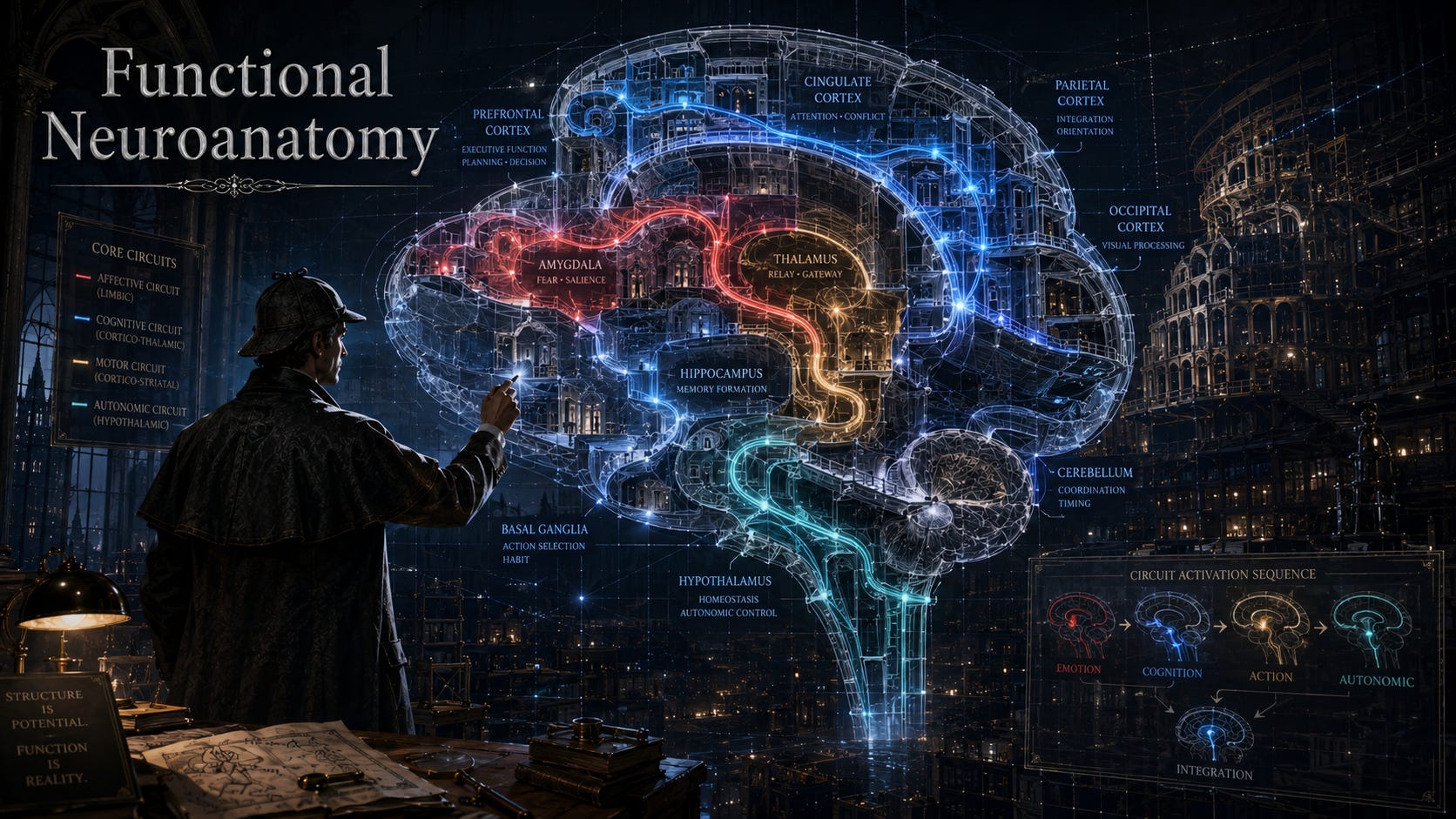
If neuroscience asks how the brain works, functional neuroanatomy asks where those processes unfold. This chapter moves us from abstraction into structure — not as static geography, but as a living map of function.In this episode, we explore how different brain regions contribute to distinct domains of mental life: perception, emotion, memory, decision-making, and behaviour. The cortex, limbic system, basal ganglia, thalamus, and brainstem are not isolated entities, but nodes within interconnected networks that continuously exchange information.A central idea here is that localisation is only part of the story. While certain functions cluster in particular regions, psychiatric phenomena arise from circuits, not single sites. For example, emotion is not “in” the amygdala alone, but emerges from its interaction with prefrontal, hippocampal, and brainstem systems.We also examine how disruptions in these circuits manifest clinically — how alterations in fronto-limbic balance may underlie mood disorders, or how dysconnectivity in associative networks may contribute to psychosis.Functional neuroanatomy therefore becomes more than a map — it is a framework for clinical reasoning. It allows the psychiatrist to link symptoms to systems, and systems to underlying mechanisms.This chapter invites a shift in perspective: to see the brain not as a collection of parts, but as an organised conversation — where meaning emerges from connection.Key Takeaways* Brain function is organised across interconnected circuits rather than isolated regions.* Functional neuroanatomy links structure to domains such as emotion, cognition, and behaviour.* The cortex, limbic system, basal ganglia, and brainstem operate as integrated systems.* Psychiatric disorders often reflect dysregulation within circuits (e.g. fronto-limbic imbalance).* Localisation provides clues, but connectivity explains complexity.* Clinical reasoning in psychiatry often involves mapping symptoms to neural systems.* Understanding networks is more useful than memorising isolated structures. This is a public episode. If you'd like to discuss this with other subscribers or get access to bonus episodes, visit drmanaankarray.substack.com/subscribe
Embed this episode
Ready to play
PSYCH 002: Functional Neuroanatomy
No transcript for this episode yet
Similar Episodes
No similar episodes found.
Similar Podcasts
No similar podcasts found.