
EPISODE · May 23, 2026 · 53 MIN
PSYCH 008: Neuropeptides: Biology, Regulation and Role in Neuropsychiatric Disorders
from Clinical Deep Dives · host Dr Manaan Kar Ray
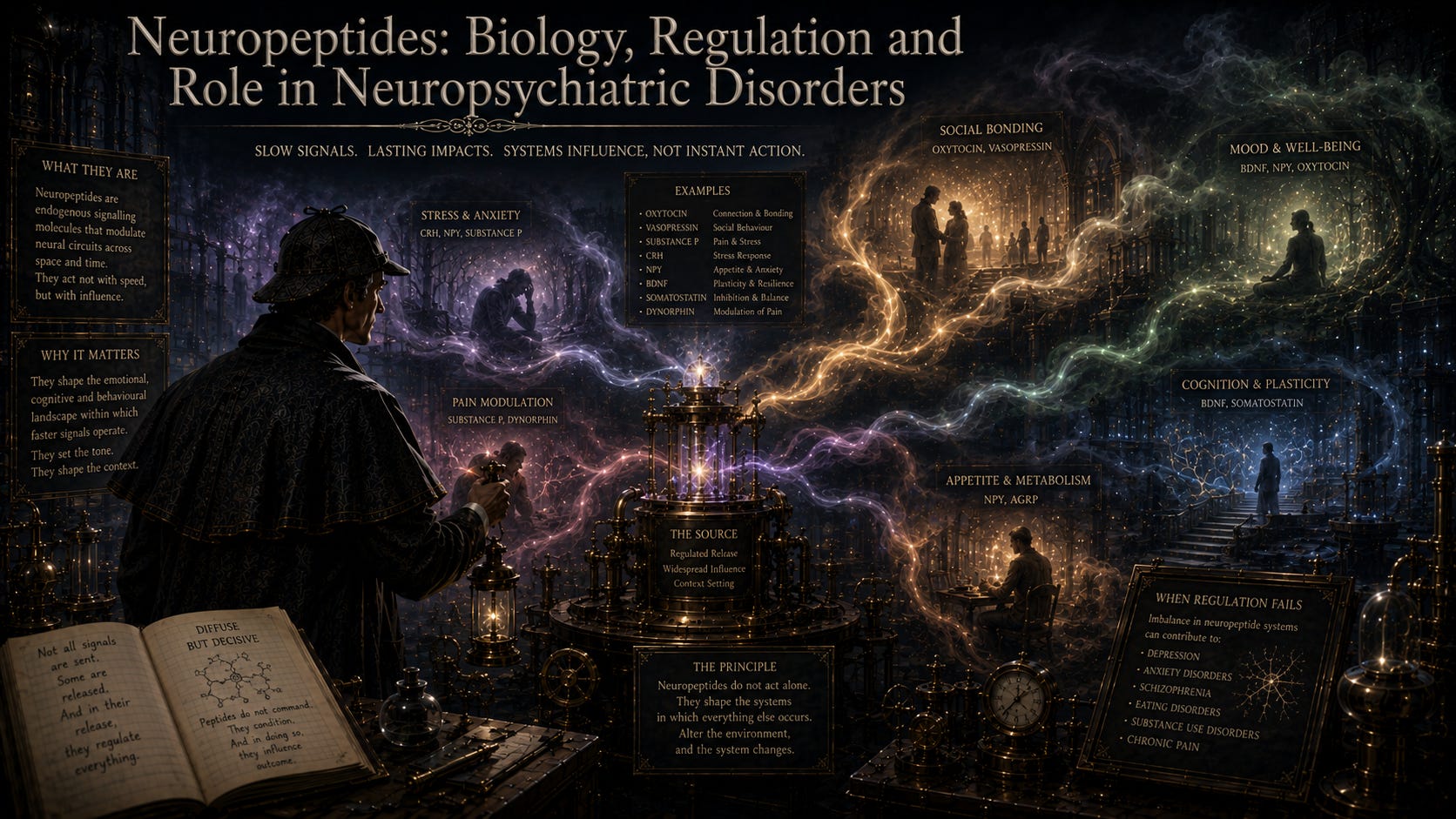
Beyond fast neurotransmission lies a quieter, more sustained form of communication. Neuropeptides do not simply transmit signals - they shape the context in which those signals are interpreted. This chapter explores a class of molecules that operate over longer timescales, influencing emotion, stress, bonding, and behavioural states.In this episode, we examine how neuropeptides such as CRH, oxytocin, vasopressin, and endogenous opioids act as modulators of internal experience. Unlike classical neurotransmitters, their effects are slower, more diffuse, and often longer-lasting - altering the tone of entire systems rather than moment-to-moment signalling.We explore their central role in stress regulation, particularly through the hypothalamic–pituitary–adrenal (HPA) axis, and how dysregulation can contribute to anxiety, depression, and trauma-related conditions. Neuropeptides also shape social behaviour - influencing attachment, trust, and interpersonal sensitivity.Crucially, these systems blur the boundary between biology and meaning. They encode not just signals, but significance - linking physiological states to emotional and relational experience.This chapter invites a different lens: to see psychiatric disorders not only as disturbances of fast signalling, but as alterations in the deeper, slower currents that shape how the world feels over time.Key Takeaways* Neuropeptides act as slow, modulatory signalling molecules in the brain.* Their effects are longer-lasting and more diffuse than classical neurotransmitters.* They play key roles in stress regulation, particularly via the HPA axis.* Neuropeptides influence social behaviours such as attachment, bonding, and trust.* Systems involving CRH, oxytocin, vasopressin, and endogenous opioids are central to emotional regulation.* Dysregulation contributes to anxiety, depression, trauma-related disorders, and social dysfunction.* Neuropeptides link physiological states to subjective emotional experience. This is a public episode. If you'd like to discuss this with other subscribers or get access to bonus episodes, visit drmanaankarray.substack.com/subscribe
Embed this episode
Ready to play
PSYCH 008: Neuropeptides: Biology, Regulation and Role in Neuropsychiatric Disorders
No transcript for this episode yet
Similar Episodes
No similar episodes found.
Similar Podcasts
No similar podcasts found.