
EPISODE · Jul 7, 2026 · 38 MIN
PSYCH 053: Neurocentrism: Addiction and the Courtroom
from Clinical Deep Dives · host Dr Manaan Kar Ray
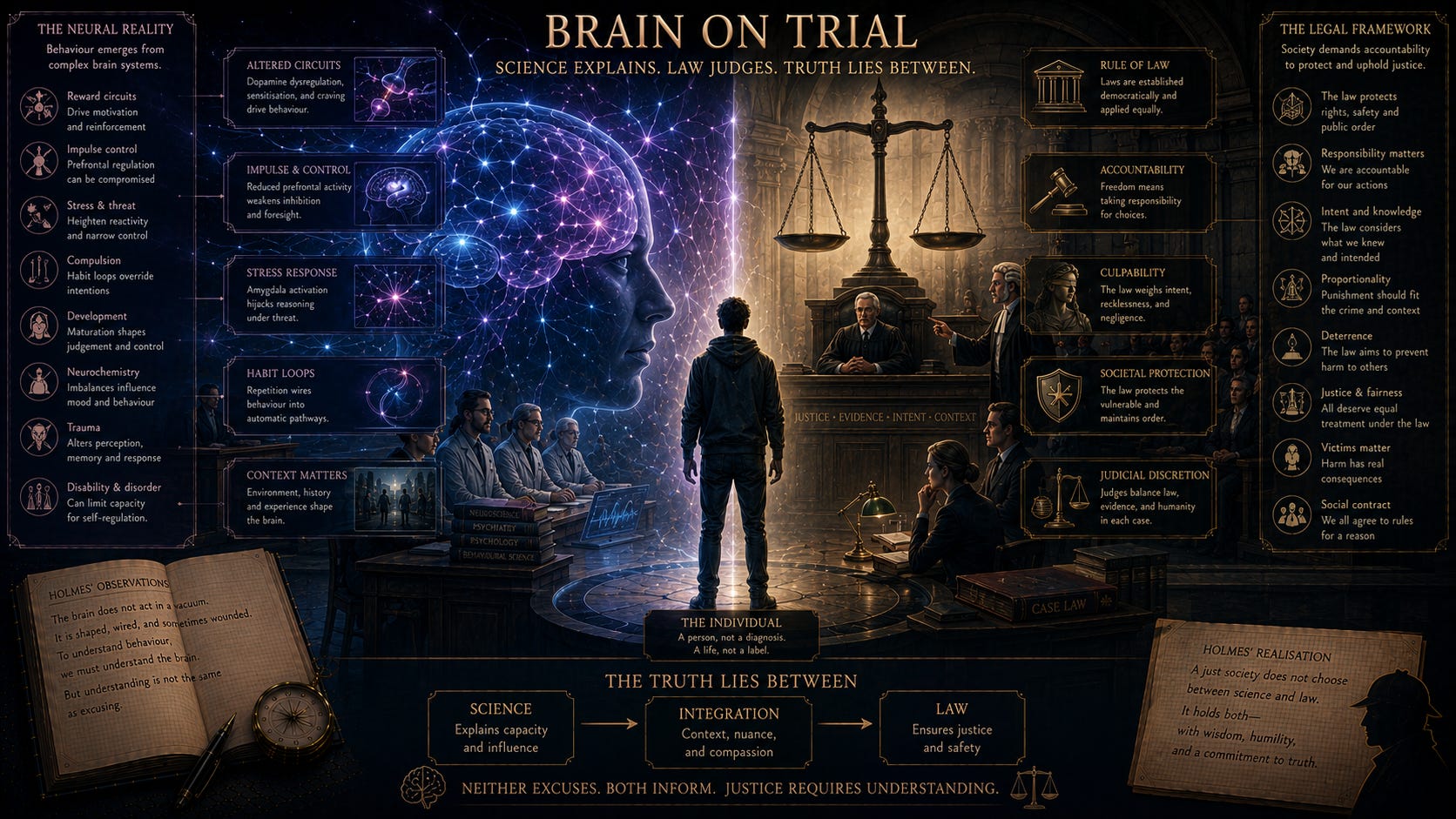
This chapter examines the growing influence of neuroscience in legal and societal understandings of behaviour - particularly in the context of addiction. Neurocentrism refers to the tendency to explain complex human actions primarily, or exclusively, in terms of brain function.In addiction, advances in neuroscience have highlighted changes in reward pathways, impulse control, and decision-making systems. These findings have reshaped addiction as a disorder of brain circuitry rather than simply a failure of will. While this has reduced stigma and improved treatment approaches, it also raises profound ethical and legal questions.A central tension emerges in the courtroom: if behaviour is driven by altered brain function, to what extent is the individual responsible? Neuroscientific evidence is increasingly introduced in legal settings to argue for diminished responsibility, mitigation, or alternative sentencing. Yet the law fundamentally depends on notions of agency, intent, and accountability.The chapter explores the risks of over-reliance on neurobiological explanations. Human behaviour cannot be fully reduced to brain mechanisms alone - it is shaped by context, choice, social environment, and meaning. Neurocentrism, if uncritically applied, may oversimplify this complexity.Clinically and ethically, the challenge is integration. Neuroscience provides powerful insights, but it must be balanced with psychological and social perspectives. The goal is not to replace one model with another, but to hold multiple levels of explanation simultaneously.Key Takeaways* Neurocentrism emphasises brain-based explanations of behaviour.* Addiction involves changes in neural systems related to reward and control.* Neuroscience has influenced legal arguments about responsibility and culpability.* There is tension between biological determinism and legal notions of free will.* Over-reliance on neuroscience risks oversimplifying human behaviour.* Behaviour must be understood within biological, psychological, and social contexts.* Ethical and legal frameworks must integrate, not reduce, these perspectives. This is a public episode. If you'd like to discuss this with other subscribers or get access to bonus episodes, visit drmanaankarray.substack.com/subscribe
Embed this episode
NOW PLAYING
PSYCH 053: Neurocentrism: Addiction and the Courtroom
No transcript for this episode yet
Similar Episodes
No similar episodes found.
Similar Podcasts
No similar podcasts found.