
EPISODE · Jul 9, 2026 · 1H 9M
PSYCH 055: Evolutionary Foundations of Psychiatry
from Clinical Deep Dives · host Dr Manaan Kar Ray
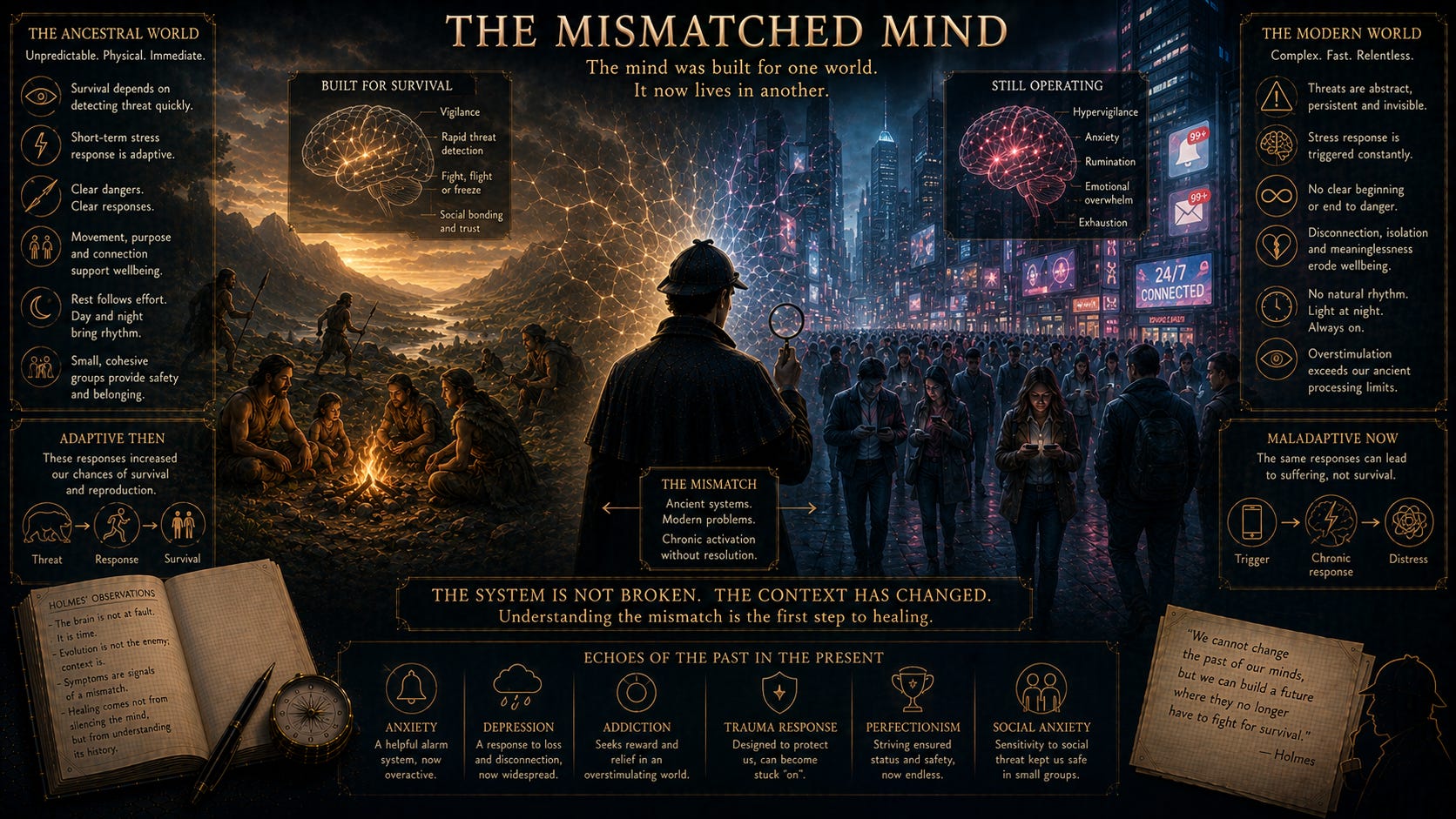
This chapter explores psychiatric phenomena through an evolutionary lens - asking not only how mental disorders occur, but why the human mind is vulnerable to them in the first place.Evolutionary psychiatry proposes that many features of the mind are shaped by natural selection to solve problems of survival and reproduction. Emotions such as fear, anxiety, attachment, and even low mood may have evolved as adaptive responses to specific environmental challenges.A central concept is mismatch. The modern environment differs profoundly from the one in which the human brain evolved. Systems designed for acute threats now respond to chronic stress; reward systems calibrated for scarcity are overwhelmed by abundance. What was once adaptive may now manifest as pathology.The chapter also introduces the idea of trade-offs. Traits that confer advantages in one context may carry costs in another. For example, heightened vigilance may improve survival in dangerous environments but predispose to anxiety disorders. Similarly, traits associated with creativity or risk-taking may overlap with vulnerability to mood or substance use disorders.Importantly, not all distress is disorder. Evolutionary perspectives distinguish between adaptive responses (e.g. grief, fear) and dysregulated or excessive responses that impair functioning.Clinically, this framework encourages a more nuanced view of symptoms - not simply as defects, but as signals or exaggerations of underlying adaptive systems. It invites the clinician to ask: what was this system designed to do, and why is it now misfiring?Key Takeaways* Evolutionary psychiatry asks why the mind is vulnerable to disorder.* Many emotional systems evolved as adaptive responses to environmental challenges.* Modern environments can create mismatch with evolved systems.* Traits often involve trade-offs between benefits and vulnerabilities.* Not all distress is pathological; some responses are adaptive.* Psychiatric symptoms may reflect dysregulation of adaptive systems.* Understanding evolutionary function can inform clinical interpretation. This is a public episode. If you'd like to discuss this with other subscribers or get access to bonus episodes, visit drmanaankarray.substack.com/subscribe
Embed this episode
Ready to play
PSYCH 055: Evolutionary Foundations of Psychiatry
No transcript for this episode yet
Similar Episodes
No similar episodes found.
Similar Podcasts
No similar podcasts found.