
EPISODE · Jul 23, 2026 · 46 MIN
PSYCH 069: Psychiatric Rating Scales
from Clinical Deep Dives · host Dr Manaan Kar Ray
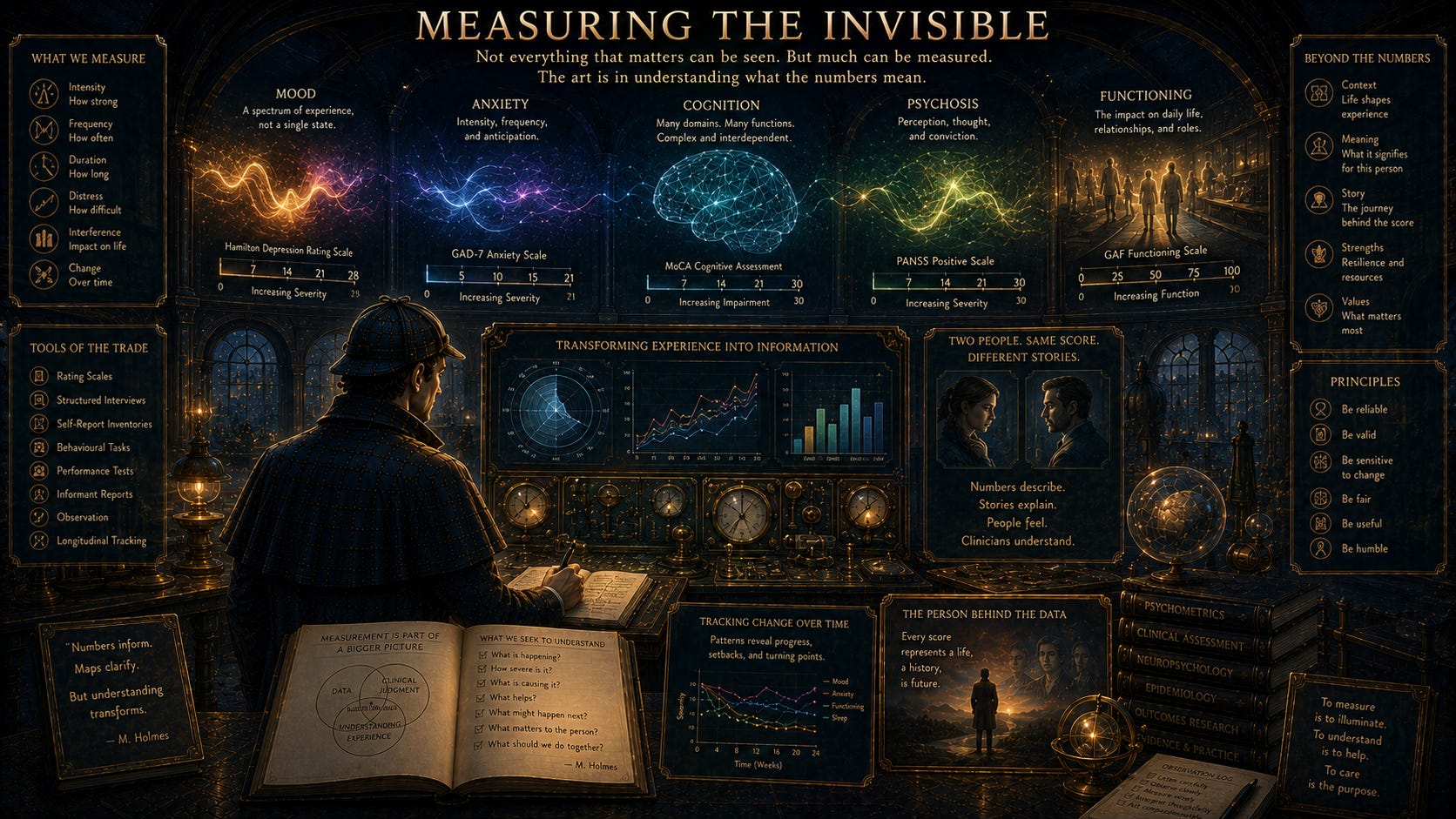
This chapter explores psychiatric rating scales, the structured tools used to quantify symptoms, monitor change, and support clinical decision-making. Psychiatry deals with many phenomena that are inherently subjective—mood, anxiety, psychosis, cognition, functioning, and quality of life. Rating scales provide a common language through which these experiences can be systematically assessed.At their core, rating scales transform clinical observations and patient experiences into measurable data. They allow clinicians to assess symptom severity, establish baselines, monitor treatment response, and compare outcomes across individuals, services, and research studies.The chapter reviews the principles underlying scale development, including reliability, validity, sensitivity, and specificity. A useful scale must consistently measure what it claims to measure while remaining sensitive enough to detect meaningful clinical change over time.A central theme is the relationship between measurement and meaning. Numbers can provide clarity, but they can also create false certainty. A score may indicate symptom severity, yet it cannot fully capture an individual’s story, context, strengths, or lived experience. Rating scales are therefore aids to understanding, not replacements for clinical judgement.The chapter also examines widely used instruments across psychiatry, including scales for depression, anxiety, psychosis, mania, cognitive impairment, suicidality, and overall functioning. These tools help standardise assessment while improving communication between clinicians and researchers.Importantly, psychiatric rating scales have become essential for evidence-based practice. They allow clinicians to move beyond impressions alone, providing objective markers that can guide treatment planning and evaluate outcomes.Ultimately, this chapter reminds us that measurement serves understanding. The goal is not to reduce people to numbers, but to use numbers to better understand people.Key Takeaways* Psychiatric rating scales provide structured measurement of symptoms and functioning.* Scales support assessment, monitoring, and treatment evaluation.* Reliability and validity are essential characteristics of useful instruments.* Quantitative measures complement, but do not replace, clinical judgement.* Different scales assess different symptom domains and clinical outcomes.* Rating scales improve communication across clinical and research settings.* Measurement allows objective monitoring of change over time.* Numbers are valuable only when interpreted within the broader clinical context. This is a public episode. If you'd like to discuss this with other subscribers or get access to bonus episodes, visit drmanaankarray.substack.com/subscribe
Embed this episode
Ready to play
PSYCH 069: Psychiatric Rating Scales
No transcript for this episode yet
Similar Episodes
No similar episodes found.
Similar Podcasts
No similar podcasts found.