
EPISODE · Aug 24, 2026 · 51 MIN
PSYCH 101: Neurocognition in Schizophrenia
from Clinical Deep Dives · host Dr Manaan Kar Ray
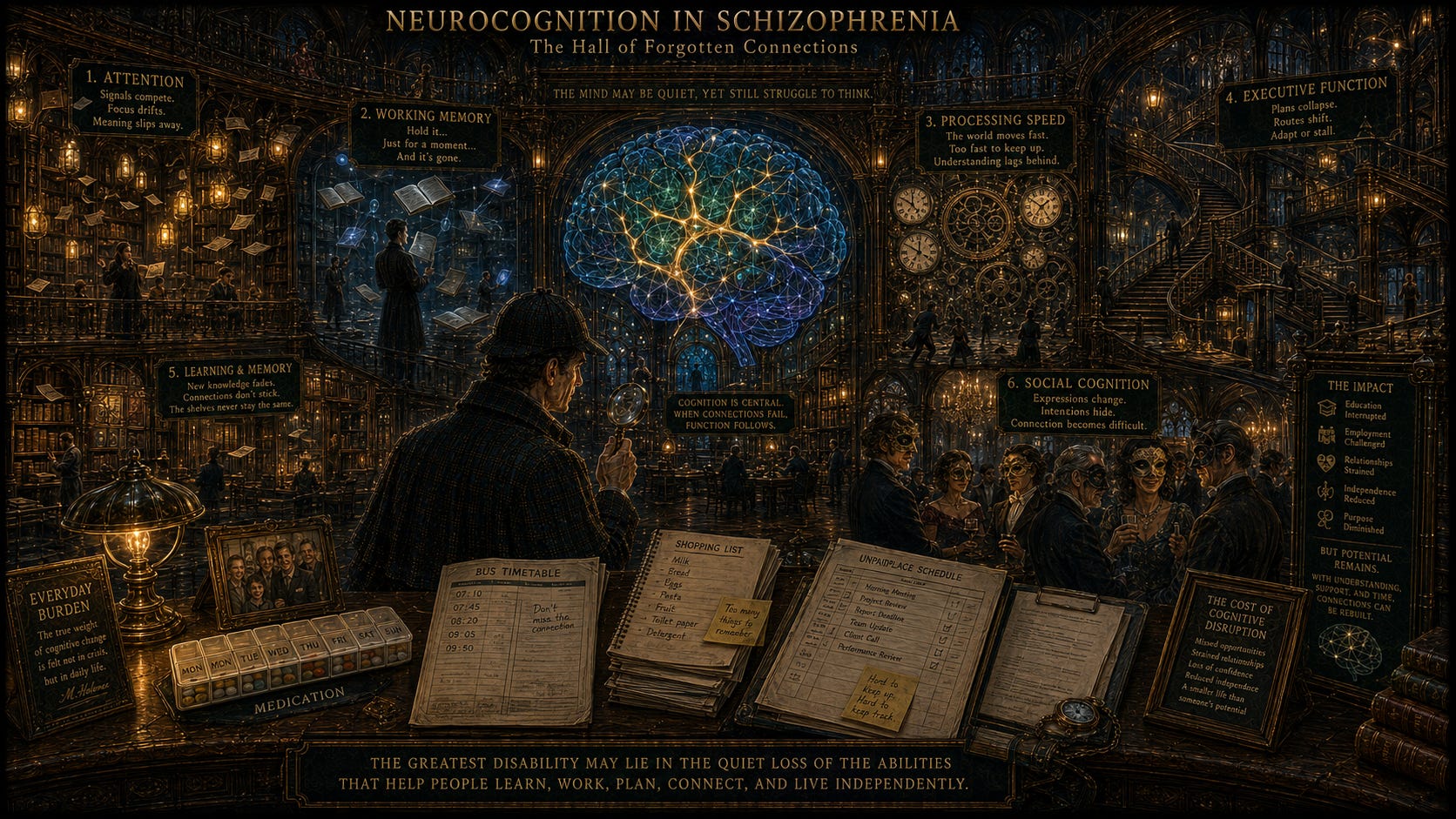
Medlock Holmes arrives at what appears to be the simplest of all investigations.A patient is sitting quietly in an elegant Victorian library.No voices.No delusions.No obvious distress.To every casual observer, the illness seems well controlled.Yet something is wrong.The patient repeatedly loses track of conversations.Simple instructions must be repeated.Bills remain unpaid.Appointments are forgotten.Books are read without being remembered.Employment slips away despite the disappearance of hallucinations.Holmes realises that the greatest mystery of schizophrenia is not always what can be seen.Sometimes it is what can no longer be thought.The library transforms into the Hall of Forgotten Connections, where every shelf represents a different cognitive ability essential for daily life. Unlike hallucinations, these shelves do not collapse dramatically. Instead, their books slowly become harder to reach, their pages blur, and the pathways between them grow increasingly tangled.Holmes begins his investigation with attention.Without attention, the brain cannot decide which information deserves priority. Conversations become fragmented. Reading a page requires repeated attempts. Watching a film becomes exhausting because the thread of the story constantly slips away.Nearby stands the Chamber of Working Memory.Here, information must be held briefly while the mind manipulates it. A telephone number disappears before it can be dialled. Multi-step instructions evaporate halfway through completion. Everyday planning becomes an intricate puzzle.Beyond lies the Gallery of Learning.Patients with schizophrenia often struggle far more with learning new information than with retaining what they have already successfully learned. Holmes watches students repeatedly study the same material, making progress much more slowly than expected despite genuine effort. Their brains are not forgetting rapidly-they are finding it difficult to build the memory in the first place.The next room contains the Laboratory of Processing Speed.Everything moves just a fraction too quickly.The outside world races ahead while the mind struggles to keep pace.Instructions arrive before earlier ones have been processed.Decisions that once took seconds now require minutes.The problem is not intelligence.It is speed.Holmes notices that this slowing quietly affects nearly every other cognitive ability, making processing speed one of the strongest overall markers of cognitive impairment in schizophrenia.The investigation continues into the Hall of Executive Function.Here people must solve problems, adapt to changing rules, organise tasks, and make flexible decisions.Some visitors persist with strategies that no longer work.Others cannot plan several steps ahead.Life itself becomes difficult to organise because the brain’s internal manager struggles to coordinate its workforce.Further ahead lies perhaps the most fascinating chamber of all.The Room of Social Understanding.Faces display fear, happiness, anger and sadness.Most visitors immediately recognise each emotion.Some patients hesitate.Others misinterpret expressions altogether.Holmes realises that the difficulty extends beyond recognising faces. It involves understanding another person’s intentions, beliefs and emotions-a capacity known as theory of mind.Without this ability, ordinary conversations become detective mysteries with missing clues.Social withdrawal begins not because people dislike others, but because understanding them has become extraordinarily demanding.As Holmes examines the evidence, a surprising pattern emerges.These cognitive difficulties are not simply side effects of hallucinations or delusions.Many are already present before psychosis begins.Children who later develop schizophrenia often demonstrate subtle cognitive differences years before their first episode. During the prodromal phase these impairments frequently become more apparent, and by the time psychosis develops, most cognitive deficits are already established.The shelves of the library reveal another clue.Unlike hallucinations, cognition changes very little when psychosis improves.Antipsychotic medications often reduce positive symptoms dramatically, yet memory, attention and executive functioning frequently remain impaired. These cognitive deficits therefore represent a relatively independent dimension of schizophrenia rather than simply reflecting active psychosis.Holmes finally discovers the room labelled The Measure of Recovery.It contains no MRI scanner.No blood tests.No symptom checklist.Instead, it contains ordinary life.A shopping list.A bus timetable.A medication organiser.A workplace roster.A family dinner.These simple tasks reveal the true importance of cognition.The strongest predictor of whether someone with schizophrenia can live independently, maintain employment, benefit from rehabilitation, adhere to treatment, and enjoy a meaningful quality of life is often not the severity of hallucinations.It is the health of their cognitive abilities.Holmes closes the final volume.The mystery is solved.Psychosis may announce schizophrenia to the world.But cognition determines how a person lives within it.The quietest symptoms often shape the loudest consequences.Key Takeaways* Neurocognitive impairment is a core feature of schizophrenia.* Patients typically perform one to two standard deviations below healthy controls across multiple cognitive domains.* Major affected domains include attention, working memory, verbal learning, visual memory, executive functioning, processing speed and social cognition.* Processing speed is among the strongest overall indicators of cognitive impairment.* Cognitive deficits often precede the onset of psychosis and are present during the prodromal phase.* Neurocognitive impairment remains relatively stable throughout much of the illness.* Cognitive deficits are largely independent of positive symptoms such as hallucinations and delusions.* Antipsychotic medications improve psychosis far more than cognition.* Social cognition-including theory of mind and emotion recognition-is markedly impaired.* Executive dysfunction affects planning, organisation and flexible problem-solving.* Working memory deficits impair the ability to hold and manipulate information.* Learning new information is often more impaired than retaining previously learned information.* Cognitive impairment predicts employment, independent living and rehabilitation outcomes better than positive symptoms.* Poor cognition contributes to medication non-adherence and relapse risk.* Cognitive remediation programmes show modest benefits, particularly when combined with psychosocial rehabilitation.* Neurocognition has become a major target for future schizophrenia treatments. This is a public episode. If you'd like to discuss this with other subscribers or get access to bonus episodes, visit drmanaankarray.substack.com/subscribe
Embed this episode
Ready to play
PSYCH 101: Neurocognition in Schizophrenia
No transcript for this episode yet
Similar Episodes
No similar episodes found.
Similar Podcasts
No similar podcasts found.