
EPISODE · Aug 25, 2026 · 22 MIN
PSYCH 102: Phenotypes of Psychosis
from Clinical Deep Dives · host Dr Manaan Kar Ray
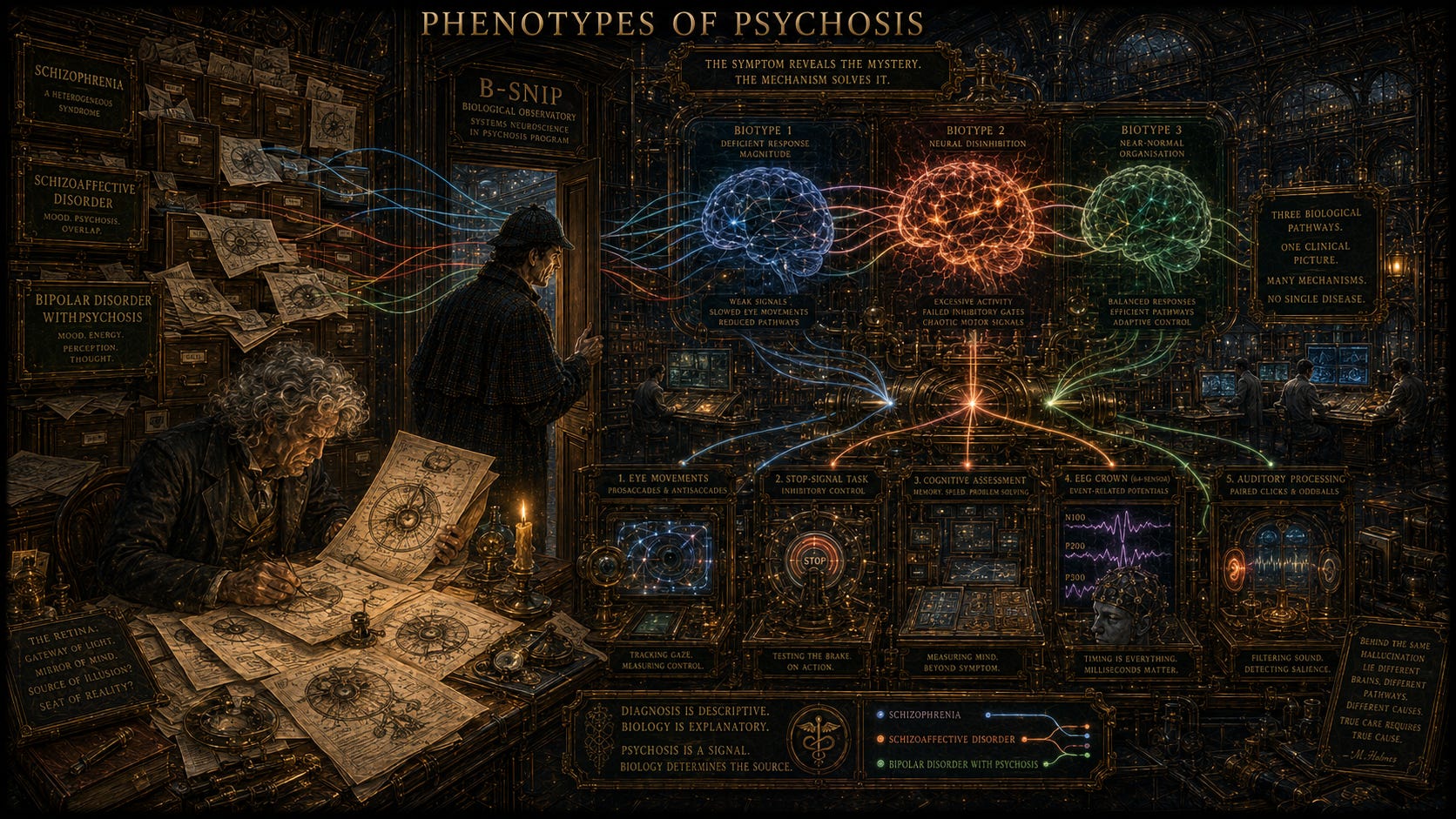
Medlock Holmes is summoned to a locked psychiatric ward to meet an extraordinary patient.The man was once a distinguished professor of anatomy: intellectually formidable, artistically gifted, and professionally successful. Long after the age at which schizophrenia usually appears, he developed relentless visual hallucinations and an elaborate belief that the source of psychosis lay within the human retina.Across a worn wooden table lie hundreds of precise anatomical drawings.Each depicts an eye containing elaborate prisms designed to bend and transform visual information. The professor studies every diagram, attempting to discover how his own eyes could create the hallucinatory world that torments him.The clinical label appears obvious.Schizophrenia.Yet Holmes hesitates.The professor has chronic hallucinations, delusional explanations, profound functional decline and minimal recovery. But he retains exceptional intellectual capacity. He has no prominent formal thought disorder. His illness began unusually late, after decades of achievement.The diagnosis describes what happened.It does not explain why.Holmes enters the Archive of Psychiatric Classification, where towering cabinets divide psychosis into schizophrenia, schizoaffective disorder and bipolar disorder with psychosis.The labels are reliable enough for clinicians to use, but the biological boundaries between them are blurred.Cognitive deficits, negative symptoms, affective disturbance, genetic vulnerability, brain abnormalities and treatment response overlap extensively. Families do not consistently transmit one diagnosis in isolation. Antipsychotic medications target psychosis across diagnostic categories rather than treating a unique biological mechanism within each one.The cabinets classify experiences.They may not classify diseases.Holmes turns to a different kind of investigation: the Bipolar–Schizophrenia Network for Intermediate Phenotypes, known as B-SNIP.Instead of beginning with diagnostic labels, B-SNIP studies large groups of people across the psychosis spectrum and measures features closer to brain function. These include cognition, eye movements, response inhibition, auditory processing and electrical brain activity.The first instrument is the Brief Assessment of Cognition in Schizophrenia. It examines memory, processing speed, working memory, reasoning and problem-solving.Next come the eye-movement chambers.In a prosaccade task, the eyes must rapidly look towards a peripheral target. In an antisaccade task, they must resist that automatic response and instead look in the opposite direction. Delayed or incorrect movements reveal impaired inhibitory control.A stop-signal task examines whether an initiated action can be rapidly cancelled.Electroencephalographic experiments measure how the brain responds to repeated sounds, unexpected auditory targets and irrelevant stimuli. Components such as the N100, P200 and P300 reveal whether the brain detects salience, updates working memory and suppresses redundant information effectively.Holmes notices that none of these biomarkers works well enough alone.Psychosis is too complex to be captured by one measurement.The investigators therefore combine multiple signals into integrated biological factors.When the traditional diagnoses are compared using these measures, they largely arrange themselves along a single severity continuum. Schizophrenia tends to show greater impairment, bipolar psychosis less, with schizoaffective disorder often between them. But the groups overlap extensively.The biology differs mainly in degree.Not in kind.Holmes then watches the investigators remove the diagnostic labels and cluster patients according to their biomarker patterns alone.Three psychosis Biotypes emerge.Biotype 1 shows profound cognitive and physiological impairment. Neural responses are weak. N100 and P300 activity is reduced. Ongoing electrical activity is diminished. Responses to repeated sounds are blunted, and eye movements are slow. This group resembles the classic picture of severe, persistent psychosis with broad cognitive and neural dysfunction.Biotype 2 displays a different disturbance. Cognitive control is poor, but neural activity is excessive rather than reduced. Antisaccade and stop-signal errors are prominent. Background electrical activity is heightened, and P200 responses are exaggerated. The problem appears to be disinhibition: too much poorly regulated neural activity rather than too little response.Biotype 3 looks comparatively intact. Cognition is only modestly impaired, physiological measures approach the healthy range, symptoms are milder and social functioning is better.Every traditional diagnosis appears within every Biotype.Some people diagnosed with schizophrenia belong to Biotype 3.Some with bipolar psychosis belong to Biotype 1 or 2.The biological map has reshuffled the clinical categories.Holmes understands the implication.Two patients may both hallucinate, yet one may have deficient neural responsivity while another has neural overactivity and impaired inhibition. Giving them the same treatment simply because both meet the same symptom criteria may be like treating every fever with the same medicine regardless of its cause.Psychosis may be an important signal of disease.It may not be the disease itself.The new Biotypes remain experimental. Their stability over time, molecular foundations and treatment implications require further study. There may be more than three biological forms of psychosis, and classifications will depend on the biomarkers chosen.Yet the investigation establishes a powerful proof of concept.When psychiatry looks beneath symptoms, distinct biological patterns begin to emerge.Holmes returns to the professor’s table.The drawings of retinal prisms remain beautiful, precise and wrong.But the professor’s search was not meaningless.He understood something essential.A label describing the hallucination was never enough.The real mystery was the mechanism creating it.Key Takeaways* Current psychosis diagnoses are based primarily on clinical symptoms and experiences.* Schizophrenia, schizoaffective disorder and bipolar disorder with psychosis overlap substantially in genetics, cognition, neurobiology and treatment response.* Diagnostic reliability does not necessarily establish biological validity.* Traditional psychosis diagnoses may represent syndromes rather than distinct disease entities.* Psychosis can be understood as a transdiagnostic phenomenon occurring across several disorders.* B-SNIP investigates psychosis using biological and cognitive measurements rather than relying only on diagnostic categories.* Relevant measures include cognition, prosaccades, antisaccades, response inhibition and auditory event-related potentials.* N100, P200 and P300 responses provide information about sensory registration, salience and working-memory updating.* Individual biomarkers are unlikely to capture the biological complexity of psychosis.* Integrated biomarker composites may provide stronger and more reproducible classifications.* Traditional DSM psychosis diagnoses mainly separate along continua of symptom and biological severity.* B-SNIP identified three reproducible psychosis Biotypes using biomarker clustering.* Biotype 1 is characterised by severe cognitive impairment and reduced neural response magnitude.* Biotype 2 is characterised by neural overactivity, disinhibition and impaired response control.* Biotype 3 shows relatively preserved cognition and neurophysiology with better functioning.* All major clinical psychosis diagnoses are represented within all three Biotypes.* Hallucinations and delusions do not strongly distinguish the biologically derived subgroups.* Psychotic symptoms may resemble fever: clinically important but insufficient to identify the underlying disease.* Biologically informed classification may eventually improve treatment selection and outcome prediction.* Biotypes remain investigational and require validation through longitudinal, molecular and treatment studies.* A more biological psychiatry need not become less humane; accurate classification may improve compassionate care. This is a public episode. If you'd like to discuss this with other subscribers or get access to bonus episodes, visit drmanaankarray.substack.com/subscribe
Embed this episode
Ready to play
PSYCH 102: Phenotypes of Psychosis
No transcript for this episode yet
Similar Episodes
No similar episodes found.
Similar Podcasts
No similar podcasts found.