
EPISODE · Aug 26, 2026 · 1H 4M
PSYCH 103: Pharmacologic Treatment of Schizophrenia
from Clinical Deep Dives · host Dr Manaan Kar Ray
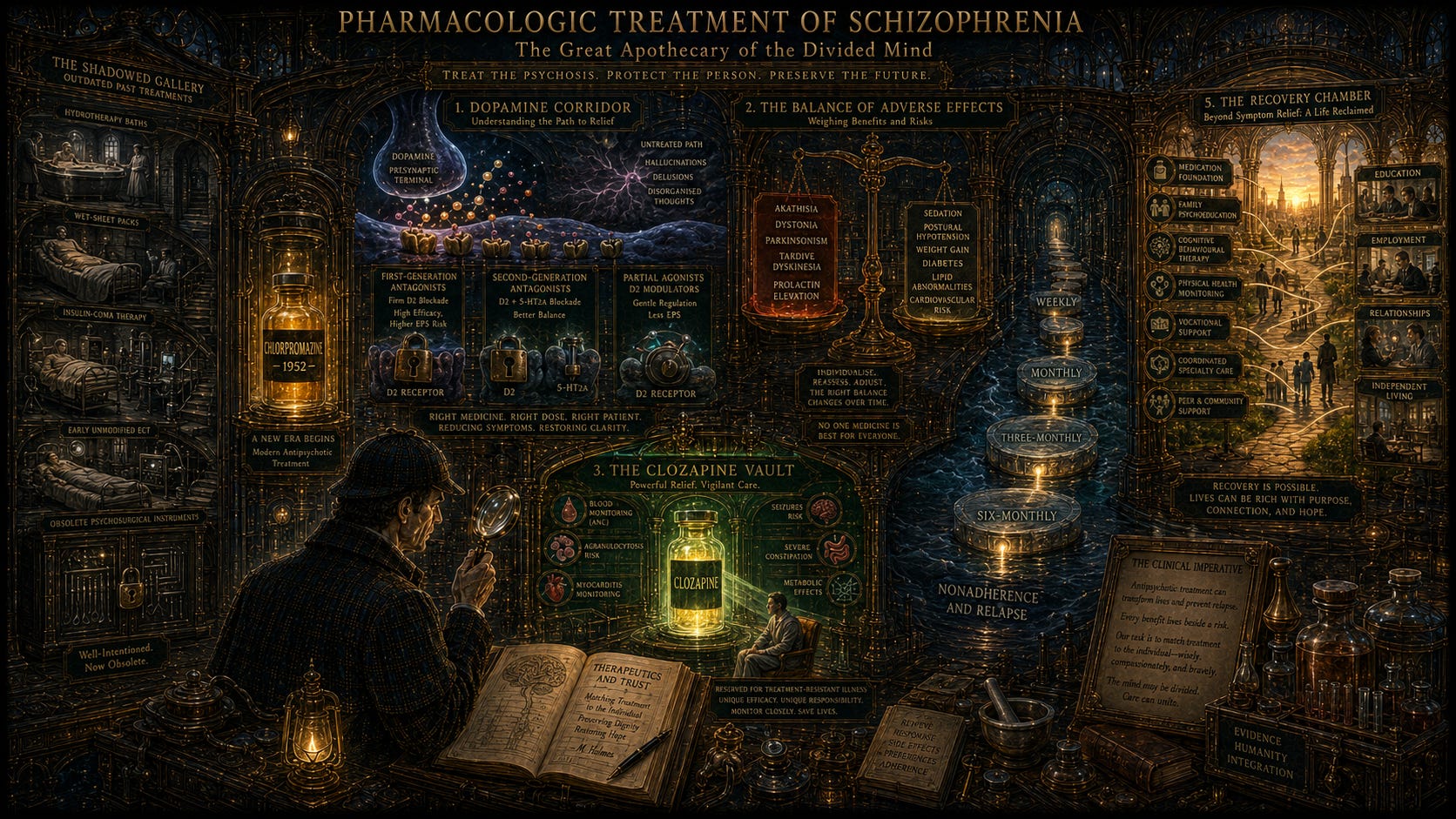
Medlock Holmes enters the Great Apothecary of the Divided Mind.The chamber is vast.Along one wall stand the abandoned instruments of psychiatric history: wet-sheet packs, insulin syringes, barbiturate sleep chambers, convulsive machines, and the cold steel apparatus of prefrontal lobotomy.Each represents an era in which clinicians tried to calm psychosis without understanding how to treat it.Then Holmes finds a small amber bottle labelled Chlorpromazine, 1952.Its arrival changed psychiatry.For the first time, hallucinations, delusions, disorganised thought, agitation, and aggression could be reduced with a medicine that did not require coma, surgery, or prolonged restraint. Hospitals began to empty. Patients once considered destined for lifelong institutional care gained the possibility of returning to families and communities.Yet Holmes quickly discovers that the bottle did not contain a cure.Every currently established antipsychotic reduces postsynaptic dopamine-receptor activity, whether through D₂ antagonism or partial agonism. These medicines are often highly effective against positive symptoms, but they remain much less successful against negative symptoms and cognitive impairment-the very difficulties that frequently determine whether someone can work, study, maintain relationships, or live independently.The Apothecary is divided into three treatment halls.The first is the Acute Chamber.Here, the priority is safety and rapid relief. The clinician must confirm the diagnosis, consider substance use and medical causes, perform physical and neurological examinations, and obtain baseline blood tests, metabolic measurements, and an electrocardiogram when indicated.Medication choice is not simply a contest of efficacy.Most antipsychotics have broadly similar effectiveness for ordinary acute psychosis. The major differences lie in their adverse-effect profiles.High-potency first-generation drugs carry a greater risk of extrapyramidal symptoms: dystonia, akathisia, rigidity, tremor, and bradykinesia.Lower-potency drugs more often produce sedation, postural hypotension, anticholinergic effects, and weight gain.Second-generation medications generally reduce-but do not eliminate-the risk of movement disorders. Some instead bring substantial metabolic burdens.Holmes sees that the correct medicine is therefore the one whose risks best match the patient’s vulnerabilities, previous response, physical health, preferences, and likelihood of continuing treatment.The second hall is the Stabilisation Chamber.The first weeks matter greatly. Most symptom improvement occurs within two to four weeks, and little or no improvement after the first two weeks-despite adherence and an adequate dose-predicts a poorer eventual response.Yet the solution is rarely to push the dose indefinitely.Above-standard doses usually add toxicity without adding meaningful benefit. When response is poor, Holmes checks the hidden variables first:Was the diagnosis correct?Was the medication actually taken?Was the trial long enough?Was the dose therapeutic?Was the drug absorbed properly?Could rapid metabolism or substance use explain the apparent resistance?Only after these possibilities are examined should the treatment be declared ineffective.The third hall is the Maintenance Gallery.Here the danger is no longer acute psychosis but recurrence.Without continued medication, relapse is common. With treatment, it is substantially reduced. Yet nonadherence remains one of the greatest preventable causes of relapse, hospitalisation, disrupted education, lost employment, homelessness, suicidality, and family distress.Long-acting injectable antipsychotics become an important clue. They provide stable drug delivery, reduce day-to-day variation, reveal missed treatment immediately, and can be offered early rather than reserved as punishment after repeated nonadherence.Holmes notices that the way they are offered matters.Shared decision-making transforms an injection from something imposed into a practical tool for protecting recovery.At the centre of the Apothecary stands the most powerful-and most feared-medicine in the room.Clozapine.It is the treatment of choice when adequate trials of other antipsychotics have failed. It can reduce persistent psychosis, lower suicidal behaviour, and help some patients whom other medications have not reached.But clozapine demands respect.Agranulocytosis requires blood monitoring. Myocarditis, seizures, sedation, hypersalivation, constipation, orthostatic hypotension, and substantial metabolic effects must be anticipated and actively managed.Too often, Holmes discovers, clinicians delay clozapine for years while ineffective combinations accumulate. The danger lies not only in using clozapine-but also in failing to use it when it is clearly indicated.The side-effect galleries reveal other trade-offs.Akathisia may be mistaken for worsening agitation.Drug-induced parkinsonism may resemble negative symptoms.Anticholinergic treatment may worsen cognition.Prolactin elevation may impair sexual function, fertility, and bone health.Tardive dyskinesia may emerge after prolonged dopamine blockade.Weight gain, diabetes, dyslipidaemia, hypertension, and cardiovascular illness may shorten life.Effective prescribing therefore requires continuous monitoring, not simply issuing a prescription.By the end of the investigation, Holmes reaches the final chamber.There is no medicine cabinet here.Instead, there is a multidisciplinary team: psychiatrist, nurse, psychologist, family worker, occupational therapist, peer worker, and vocational specialist.Medication reduces psychosis.But psychoeducation, cognitive behavioural therapy, family work, coordinated specialty care, physical-health intervention, rehabilitation, and practical support turn symptom control into recovery.Holmes closes the case.The purpose of pharmacology is not merely to silence voices.It is to create enough stability for a person’s own voice, choices, ambitions, and future to be heard again.Key Takeaways* Antipsychotic medication is the mainstay of treatment for schizophrenia.* All established antipsychotics reduce postsynaptic dopamine-receptor activity.* These medicines are most effective for positive symptoms, agitation, and aggression.* Negative symptoms and cognitive impairment remain inadequately treated.* Treatment is usually divided into acute, stabilisation, and maintenance phases.* First-episode patients often respond to lower doses and are more sensitive to adverse effects.* Most antipsychotics have broadly similar efficacy, except clozapine in treatment-resistant illness.* Medication selection should be guided by previous response, adverse-effect risk, physical health, patient preference, and adherence considerations.* High-potency first-generation agents are more likely to cause extrapyramidal symptoms.* Lower-potency agents more often cause sedation, hypotension, weight gain, and anticholinergic effects.* Clozapine and olanzapine carry particularly high metabolic risk.* Aripiprazole, brexpiprazole, cariprazine, lurasidone, lumateperone, and ziprasidone generally have lower metabolic liability.* Akathisia may present as anxiety, irritability, pacing, or apparent psychotic agitation.* Acute dystonia can be frightening and laryngeal dystonia is a medical emergency.* Drug-induced parkinsonism may mimic or worsen negative symptoms.* Tardive dyskinesia requires regular monitoring and may respond to VMAT2 inhibitors.* Baseline and ongoing monitoring should include weight, blood pressure, glucose, lipids, and other investigations guided by clinical risk.* Long-acting injectable formulations can reduce nonadherence and relapse.* Early nonresponse after approximately two weeks predicts a lower chance of later response.* Routine use of doses above approved therapeutic ranges is rarely beneficial.* Apparent treatment resistance should prompt assessment of diagnosis, adherence, absorption, metabolism, substance use, and adequacy of treatment.* Clozapine should be offered after adequate failure of other antipsychotic trials.* Clozapine can also reduce persistent suicidal behaviour.* Antipsychotic polypharmacy has limited supporting evidence and should not replace an indicated clozapine trial.* Maintenance medication substantially reduces relapse compared with discontinuation.* Medication treatment is most effective when integrated with family work, rehabilitation, psychoeducation, psychological therapy, and coordinated care. This is a public episode. If you'd like to discuss this with other subscribers or get access to bonus episodes, visit drmanaankarray.substack.com/subscribe
Embed this episode
Ready to play
PSYCH 103: Pharmacologic Treatment of Schizophrenia
No transcript for this episode yet
Similar Episodes
No similar episodes found.
Similar Podcasts
No similar podcasts found.