
EPISODE · Aug 27, 2026 · 51 MIN
PSYCH 104: Psychiatric Rehabilitation in Schizophrenia
from Clinical Deep Dives · host Dr Manaan Kar Ray
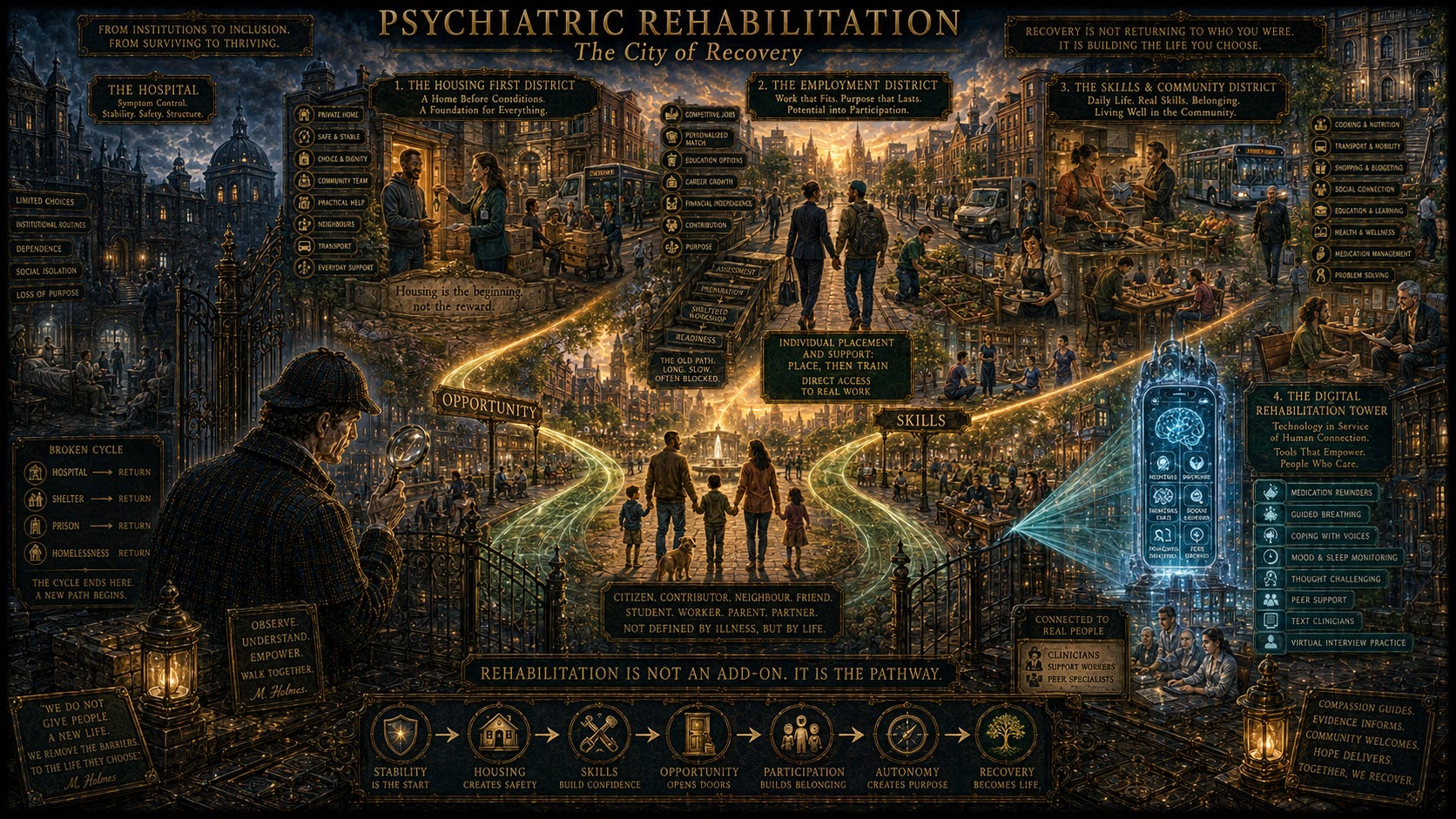
Medlock Holmes enters a psychiatric hospital expecting to find the next mystery inside the consulting room.Instead, the patient is waiting at the front gate.His hallucinations have improved.His delusions are less intense.His medication is stable.Yet he has nowhere secure to live, no employment, few relationships, and no meaningful reason to wake each morning.The treatment has reduced the illness.It has not restored the life.Holmes follows the man beyond the hospital walls and discovers the City of Interrupted Lives.Its streets contain empty apartments, locked workplaces, abandoned classrooms, silent social clubs, and train platforms leading nowhere. Each represents an ordinary adult role that severe mental illness can disrupt: tenant, student, employee, friend, partner, parent, neighbour, and citizen.At the centre of the city stands the Office of Psychiatric Rehabilitation.Its purpose is not simply to make patients less symptomatic.It is to help people live successfully in the environments they choose.Psychiatric rehabilitation therefore focuses on three essential elements:Opportunity. Support. Skills.The first district Holmes enters is the Quarter of Opportunity.Here he finds barriers that medication cannot remove.Landlords refuse applications.Employers assume incompetence.Educational systems offer no flexibility.Services segregate people into psychiatric spaces rather than helping them enter ordinary community life.Stigma has built walls around the city.Rehabilitation begins by opening doors: access to housing, education, competitive employment, relationships, recreation, and full community participation.The second district is the Bridge of Support.People recovering from schizophrenia may need practical assistance to succeed in ordinary roles, especially at the beginning.A clinician may help someone negotiate with a landlord.A case manager may teach them to use public transport.An employment specialist may accompany them to an interview.A family worker may help relatives support rather than discourage a return to study or work.Support is not intended to create dependence.Its purpose is to make independence possible.The third district is the Workshop of Skills.Here people practise managing symptoms, organising medication, shopping, cooking, communicating, resolving conflict, maintaining routines, and coping with stress.Yet Holmes notices an important change from older rehabilitation models.The skills are no longer taught only inside clinics.They are learned where they will actually be used.A person learns to shop in the supermarket.To travel on the bus.To prepare meals in their own kitchen.To manage anxiety in the workplace.The community itself becomes the classroom.Holmes first investigates housing.For decades, services assumed that people with schizophrenia had to become stable, abstinent, compliant, and treatment-ready before they could earn the right to an independent home.The Housing First model reverses this sequence.Housing is not the reward at the end of treatment.It is the foundation upon which treatment and recovery can begin.People are offered safe, affordable accommodation without requiring sobriety or compulsory treatment as a precondition. Flexible community support is then offered according to their needs and choices.Holmes meets a man who has moved repeatedly between hospitals, shelters, prisons, and the streets. His psychosis remains persistent and substance use has complicated his life. Previous programmes required him to prove readiness.Housing First gives him an apartment.The team helps with furniture, neighbours, shopping, conflict, and boundaries. They listen respectfully to his beliefs while solving practical problems.The hallucinations do not vanish.But homelessness does.The man remains housed, avoids prison, and begins making choices that protect the home he now values.The next investigation concerns employment.Traditional vocational rehabilitation followed a train-and-place model. Patients attended readiness assessments, sheltered workshops, counselling sessions, and prolonged preparation programmes before being considered suitable for competitive work.Many never reached the workplace.The process designed to prepare them became the barrier that stopped them.Individual Placement and Support, or IPS, takes the opposite approach:Place first. Train and support within the real job.Anyone who wants to work is eligible.There is no exclusion because of symptoms, substance use, poor work history, or cognitive difficulty.The job search begins rapidly and focuses on competitive employment matched to the person’s preferences. Support continues for as long as needed and is integrated with mental health care.Holmes meets a father who believes schizophrenia means he cannot work. He also needs to be home when his children return from school.An employment specialist learns that he loves driving and is dependable when others rely upon him. A part-time meal-delivery job provides the perfect match.The hours suit his family.The work feels meaningful.He earns a wage.His children see him leaving for work like other parents.Employment becomes more than income.It restores identity.Holmes reviews the evidence and finds that IPS consistently outperforms traditional vocational programmes. Across numerous trials, participants are substantially more likely to obtain competitive employment, earn more, work longer, and remain satisfied with their jobs. Importantly, employment does not destabilise them. It often improves confidence, self-esteem, quality of life, and community participation.The final district is unlike any rehabilitation centre Holmes has previously seen.It exists inside a smartphone.Digital tools now extend rehabilitation beyond scheduled appointments.Web programmes can teach coping strategies for voices.Online communities can connect people with peers and families.Text messaging can provide support between visits.Virtual reality can help practise social situations and job interviews.Mobile applications can prompt medication, monitor symptoms, guide breathing exercises, challenge distressing thoughts, and deliver support at the precise moment it is needed.Holmes examines FOCUS, a smartphone intervention designed specifically for people with schizophrenia. It asks users about symptoms, mood, medication, sleep, and social functioning, then provides brief personalised strategies. Every tool remains available on demand.For someone frightened to use public transport or enter a crowded clinic, the intervention travels with them.Technology does not replace human care.It carries care into the places where life actually happens.At the end of the investigation, Holmes returns to the hospital gate.The same patient is waiting.But now, beyond the gate, three roads are open:A home.A workplace.A community.Holmes understands the central principle of psychiatric rehabilitation.A person does not need to become symptom-free before beginning to live.Recovery is not the final stage after treatment has succeeded.Living itself can become part of the treatment.Key Takeaways* Psychiatric rehabilitation aims to improve functioning, quality of life, community integration, and personal recovery.* Its goals include independent living, education, competitive employment, relationships, leisure, and participation in ordinary adult roles.* Antipsychotic medication often improves positive symptoms but has limited effects on cognition, negative symptoms, and psychosocial functioning.* Symptom reduction alone does not guarantee functional recovery.* Psychiatric rehabilitation combines three central approaches: creating opportunities, providing support, and developing skills.* Rehabilitation is strengths-based, person-centred, and directed by individual goals and preferences.* Community integration requires challenging stigma, segregation, discrimination, and structural barriers.* Supports should promote independence rather than long-term dependence on professionals.* Skills are often learned most effectively in the natural environments where they will be used.* Assertive Community Treatment provides intensive multidisciplinary support in community settings.* Supported housing separates access to housing from compulsory participation in treatment.* Housing First offers safe, affordable housing rapidly and without requiring treatment adherence or abstinence as a precondition.* Stable housing can reduce homelessness, emergency-service use, and hospitalisation.* Housing improvement does not automatically produce equivalent improvements in symptoms or substance use, so ongoing support remains important.* Traditional train-and-place vocational programmes have generally produced poor competitive employment outcomes.* Individual Placement and Support uses a place-and-train approach.* IPS principles include zero exclusion, rapid job search, competitive employment, client choice, integrated services, ongoing support, targeted job development, and benefits counselling.* IPS substantially improves competitive employment, earnings, hours worked, and job tenure.* Competitive employment does not increase relapse or clinical instability.* A good job match should reflect the person’s interests, strengths, family responsibilities, coping style, and preferences.* People with schizophrenia commonly use smartphones, the internet, social media, and digital communication.* Digital rehabilitation can provide psychoeducation, peer support, self-management tools, symptom monitoring, and real-time interventions.* FOCUS delivers smartphone-based support for medication, mood, sleep, social functioning, and psychotic symptoms.* Text messaging, web-based interventions, virtual reality, and telehealth can extend rehabilitation beyond clinics.* Technology should supplement rather than replace therapeutic relationships and community services.* Personal recovery includes hope, meaning, self-efficacy, choice, and creating a life that is not dominated by illness. This is a public episode. If you'd like to discuss this with other subscribers or get access to bonus episodes, visit drmanaankarray.substack.com/subscribe
Embed this episode
Ready to play
PSYCH 104: Psychiatric Rehabilitation in Schizophrenia
No transcript for this episode yet
Similar Episodes
No similar episodes found.
Similar Podcasts
No similar podcasts found.