
EPISODE · Aug 28, 2026 · 47 MIN
PSYCH 105: Medical Health in Schizophrenia
from Clinical Deep Dives · host Dr Manaan Kar Ray
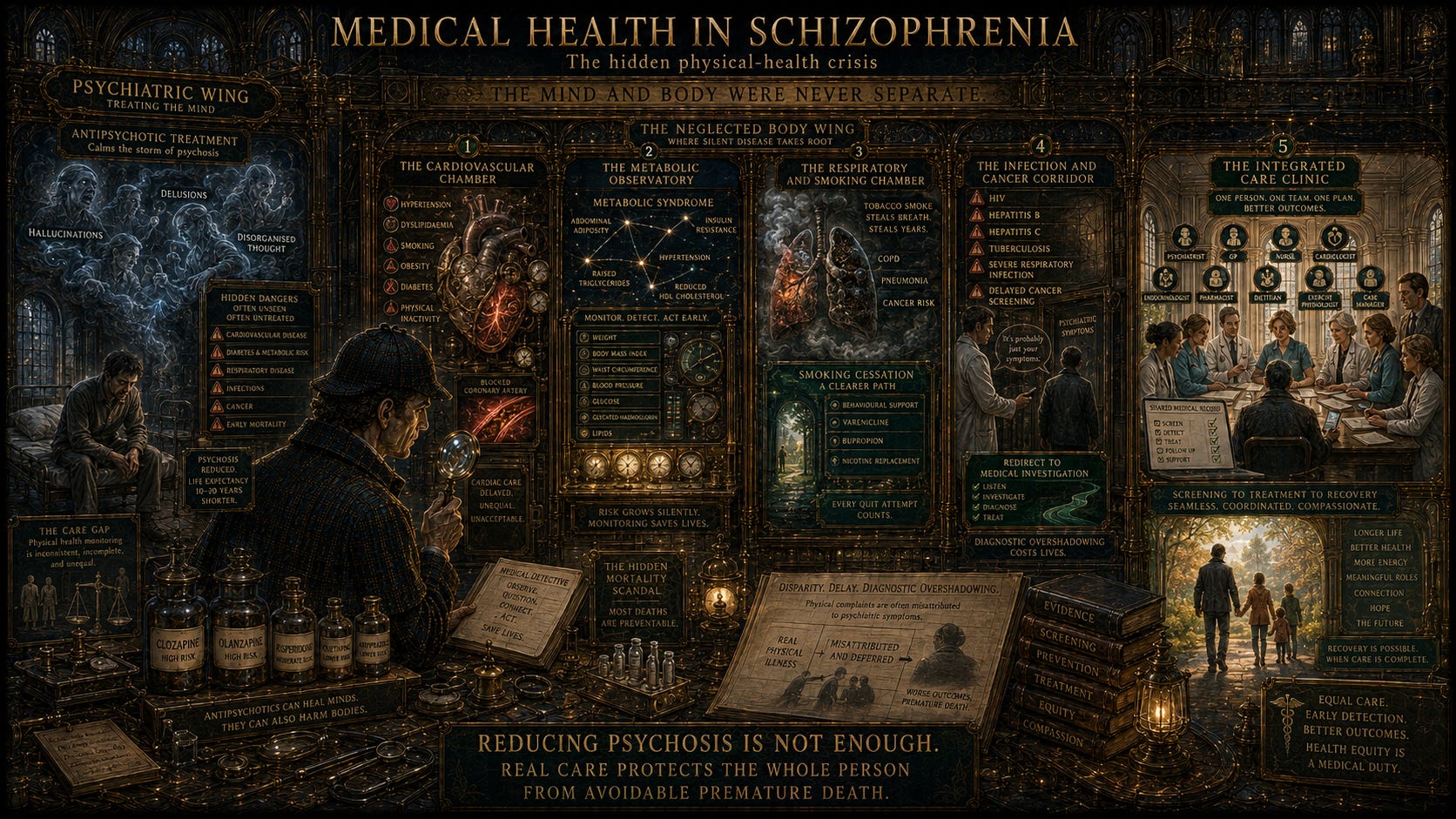
Medlock Holmes is called to investigate a disturbing pattern.The records appear unrelated.A man with schizophrenia dies from a myocardial infarction in his fifties.A woman develops diabetes that remains undetected for years.Another patient is repeatedly treated for anxiety while an underlying respiratory illness worsens.Someone else survives psychosis but dies from a preventable infection.Holmes spreads the files across a long forensic table.The pattern is unmistakable.People with schizophrenia die approximately a decade or more earlier than the general population. Their mortality is two to four times higher, and most of the excess deaths arise not from suicide, violence, or accidents, but from ordinary physical diseases that should often be detectable and treatable.The investigation begins in the Hall of Premature Death.Above the entrance are four warnings:* Earlier mortality* Greater medical comorbidity* Reduced access to appropriate treatment* Poorer medical outcomesHolmes first enters the cardiovascular chamber.Heart disease is the leading cause of death in schizophrenia. Obesity, smoking, hypertension, dyslipidaemia, diabetes, physical inactivity, poverty, stress, and medication effects converge like tributaries feeding the same river.Yet risk alone does not explain the whole mystery.When people with schizophrenia experience acute coronary syndromes, they may be less likely to receive proven treatments, invasive investigations, angioplasty, or bypass surgery. Their symptoms may be dismissed, overlooked, or attributed to mental illness.This is diagnostic overshadowing.The psychiatric label becomes so large that everything else disappears behind it.The next chamber contains glucose monitors, waist measurements, and lipid profiles.Type 2 diabetes is substantially more common in schizophrenia than in the general population. Insulin resistance, obesity, inactivity, poor diet, smoking, socioeconomic disadvantage, and antipsychotic treatment all contribute.Some antipsychotics carry greater metabolic risk than others. Clozapine and olanzapine are strongly associated with weight gain and abnormalities in glucose and lipid metabolism. Other agents generally carry lower risk, though no medication is entirely free from concern.Holmes discovers that the danger often begins quietly.Weight increases.Waist circumference expands.Triglycerides rise.High-density lipoprotein falls.Blood pressure creeps upwards.Fasting glucose becomes abnormal.Together these changes form the constellation known as metabolic syndrome-a powerful predictor of cardiovascular disease and type 2 diabetes.Yet the true failure often occurs before treatment is needed.Screening is simply not done.The recommended measurements are straightforward:Weight.Body mass index.Waist circumference.Blood pressure.Glucose or glycated haemoglobin.Lipids.Personal and family history.Still, many patients are never monitored adequately.Holmes moves into the respiratory wing.Smoking rates are extraordinarily high among people with schizophrenia. Many smoke heavily, increasing their risk of chronic obstructive pulmonary disease, pneumonia, cardiovascular illness, lung cancer, and premature death.For years, clinicians assumed smoking was too difficult to treat in schizophrenia or that stopping might destabilise mental health.The evidence does not support such therapeutic pessimism.People with schizophrenia can quit smoking. Medications such as varenicline and bupropion, alongside behavioural support, can help. Smoking cessation may improve not only physical health but also mood and quality of life.The infectious disease chamber reveals another layer.Rates of HIV, hepatitis B, hepatitis C, tuberculosis, pneumonia, and severe respiratory infections are elevated. During the COVID-19 pandemic, people with schizophrenia experienced greater infection risk and higher mortality.The reasons are multiple: poverty, crowded housing, reduced healthcare access, lower vaccination rates, smoking, chronic illness, and delayed treatment.The cancer chamber is more complicated.Cancer incidence may not always be dramatically higher, but cancer mortality often is. Screening may occur late. Symptoms may be poorly communicated or dismissed. Treatment may be less aggressive. Smoking adds further risk, particularly for lung cancer.Once again, the problem is not only biology.It is access.It is prejudice.It is fragmentation.It is a healthcare system divided into mental and physical worlds, as though the same person cannot inhabit both.Holmes then enters the room labelled Modifiable Risk.Here, unlike the earlier chambers, the atmosphere changes.The clues are actionable.Smoking can be treated.Weight can be monitored.Exercise can be supported.Dietary interventions can be offered.Hypertension can be managed.Dyslipidaemia can be treated.Diabetes can be detected earlier.High-risk antipsychotics can be reconsidered when appropriate.Metformin may help with antipsychotic-associated weight gain and metabolic dysfunction. Newer glucagon-like peptide-1 receptor agonists offer emerging promise. Structured physical activity can improve cardiovascular fitness, symptoms, and quality of life.The problem is not that medicine lacks interventions.The problem is that patients with schizophrenia often do not receive them.At the centre of the investigation stands the psychiatrist.Some may believe physical health belongs entirely to general practice.Holmes rejects this division.The psychiatrist is often the clinician with the strongest and most enduring therapeutic relationship. That relationship can be used to encourage screening, coordinate referrals, challenge therapeutic nihilism, support adherence, and ensure that medical problems receive the same standards of care offered to everyone else.The final chamber is the Integrated Health Clinic.Psychiatry, primary care, nursing, endocrinology, cardiology, pharmacy, dietetics, exercise physiology, and case management work in the same system.Medical records communicate.Screening is scheduled.Results are followed up.Abnormalities trigger treatment.No symptom is dismissed merely because the patient has schizophrenia.Holmes closes the mortality ledger.The mystery was never simply why people with schizophrenia become physically unwell.It was why predictable illness remained unseen, untreated, and accepted as inevitable.The solution is not another psychiatric intervention alone.It is equal medicine.To treat schizophrenia properly, clinicians must protect not only the mind from psychosis, but the heart, lungs, metabolism, teeth, and body from neglect.A life saved from hallucinations should not then be lost to hypertension.Key Takeaways* People with schizophrenia die approximately 10 to 15 years earlier than the general population.* All-cause mortality is roughly two to four times higher.* Most excess deaths arise from physical illness rather than suicide or other unnatural causes.* Cardiovascular disease is the leading cause of premature mortality.* Many patients have multiple coexisting physical illnesses.* Medical comorbidities are frequently underdiagnosed and undertreated.* Diagnostic overshadowing occurs when physical symptoms are incorrectly attributed to mental illness.* People with schizophrenia are less likely to receive appropriate cardiovascular screening and treatment.* Type 2 diabetes is approximately two to four times more common than in the general population.* Cardiometabolic risk factors include obesity, hypertension, dyslipidaemia, hyperglycaemia, insulin resistance, smoking, and physical inactivity.* Metabolic syndrome is highly prevalent and substantially increases cardiovascular and diabetes risk.* Clozapine and olanzapine are associated with particularly high metabolic risk.* Antipsychotic choice should consider both psychiatric benefit and physical-health burden.* Weight, body mass index, waist circumference, blood pressure, glucose, glycated haemoglobin, and lipids should be monitored routinely.* Smoking affects a large proportion of people with schizophrenia and remains a major preventable cause of illness and death.* Smoking cessation treatments can be effective and do not generally worsen psychosis.* Substance-use disorders are common and worsen adherence, physical health, and functional outcomes.* Respiratory illnesses, including chronic obstructive pulmonary disease, asthma, and pneumonia, are more common.* Rates of HIV, hepatitis, tuberculosis, and severe respiratory infection are elevated.* Cancer mortality may be increased through delayed diagnosis, inadequate screening, smoking, and treatment inequality.* Oral health is frequently poor and should form part of routine care.* Lifestyle interventions combining diet and exercise can improve weight and metabolic outcomes.* Switching from a high-risk to a lower-risk antipsychotic may reduce metabolic burden when clinically appropriate.* Metformin can be useful for antipsychotic-associated weight and metabolic problems.* Glucagon-like peptide-1 receptor agonists are emerging as promising options for cardiometabolic management.* Physical exercise may improve cardiovascular health, psychiatric symptoms, and quality of life.* Psychiatrists should remain actively involved in physical-health monitoring and care coordination.* Integrated mental and physical healthcare offers the best opportunity to reduce preventable mortality.* Patients with schizophrenia should receive the same evidence-based medical treatment as the general population. This is a public episode. If you'd like to discuss this with other subscribers or get access to bonus episodes, visit drmanaankarray.substack.com/subscribe
Embed this episode
Ready to play
PSYCH 105: Medical Health in Schizophrenia
No transcript for this episode yet
Similar Episodes
No similar episodes found.
Similar Podcasts
No similar podcasts found.