
EPISODE · Aug 30, 2026 · 52 MIN
PSYCH 107: Psychosis as a Defining Dimension in Schizophrenia
from Clinical Deep Dives · host Dr Manaan Kar Ray
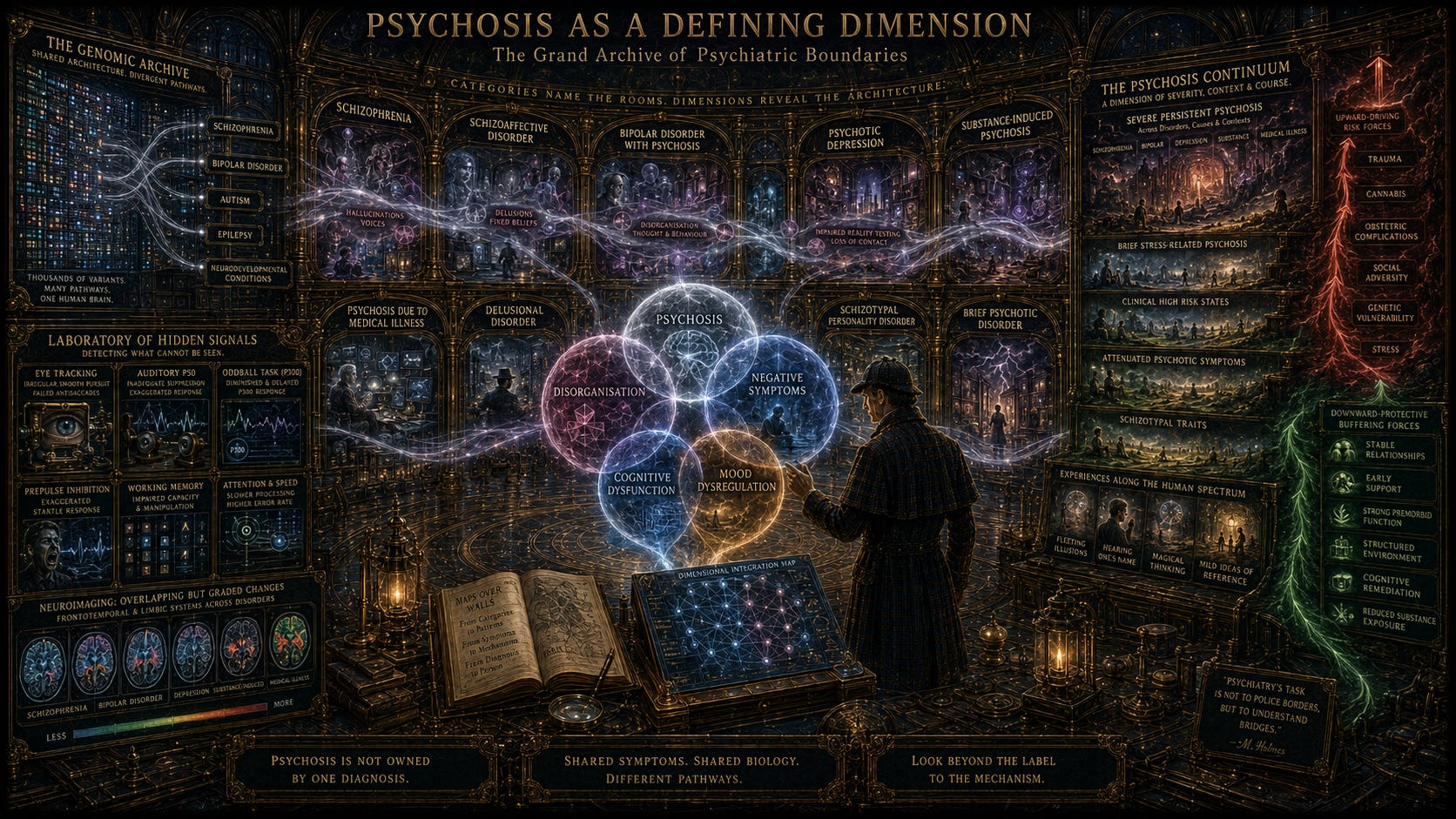
Medlock Holmes enters the Grand Archive of Psychiatric Boundaries.The building is divided into rigid rooms.One is labelled Schizophrenia.Another Bipolar Disorder.Another Psychotic Depression.Beyond them lie chambers for substance-induced psychosis, psychosis caused by medical illness, delusional disorder, schizotypal personality disorder, and brief psychotic states.Each room appears separate.Yet from beneath every door, Holmes sees the same strange light.Psychosis is moving between them.He follows it into the central hall and discovers that hallucinations, delusions, disorganised thought, and grossly disorganised or catatonic behaviour are not unique possessions of schizophrenia. They occur across numerous psychiatric, neurological, medical, and substance-related conditions.Even within schizophrenia, no single psychotic symptom is essential.A person may meet diagnostic criteria without hallucinations or delusions if severe thought disorder, disorganisation, catatonia, and negative symptoms form the clinical picture.The diagnosis is therefore not defined by one pathognomonic sign.It is built from combinations of symptoms.This makes schizophrenia clinically recognisable-but biologically heterogeneous.Holmes turns towards an enormous map of the disorder.Instead of one uniform syndrome, it contains overlapping domains:* Psychosis* Disorganisation* Negative symptoms* Cognitive dysfunction* Mood and affective dysregulationPsychosis includes distortions of perception and inferential thinking.Disorganisation involves disrupted thought, speech, and behaviour.Negative symptoms involve diminished emotional expression, speech, motivation, and goal-directed activity.Cognitive dysfunction affects attention, memory, processing speed, and executive function.Mood symptoms range from depression to mania.These dimensions overlap, but they are not identical.A patient may have severe psychosis with relatively preserved cognition.Another may have fewer hallucinations but profound negative and cognitive symptoms.A third may combine psychosis with mania.Holmes realises that the categorical label hides these differences.Dimensional assessment reveals them.The investigation expands beyond schizophrenia.In psychotic depression, mood disturbance dominates while psychosis appears at its most severe points.In bipolar disorder, mania may become psychotic.In substance-induced states, hallucinations and delusions arise in temporal relationship to exposure.In medical and neurological disorders, psychosis may accompany altered brain function.The clinical form overlaps even when the underlying causes differ.This raises a provocative question:Is psychosis itself a disease?Or is it a shared clinical dimension produced by many diseases?Holmes examines family records.Schizophrenia and bipolar disorder do not segregate neatly across generations. Families may contain schizophrenia, schizoaffective disorder, bipolar disorder, depression with psychotic features, and substance-related psychoses.The inherited liability appears broader than the diagnostic categories.Twin studies reinforce the same conclusion. Identical twins show substantially greater concordance than non-identical twins, confirming a strong genetic contribution. Yet when one twin has schizophrenia, the other may develop an affective psychosis rather than the same diagnosis.The vulnerability may be to psychosis and related dimensions-not to one perfectly bounded disorder.Holmes then enters the genomic vault.There is no single psychosis gene.Instead, thousands of small genetic effects interact with neurodevelopment, epigenetic regulation, environment, trauma, obstetric events, substance exposure, and social adversity.Candidate genes and genomic regions once considered specific to schizophrenia also appear in bipolar disorder, autism, epilepsy, mood disorders, and other neurodevelopmental phenotypes.The genetic architecture ignores the walls constructed by diagnostic manuals.But genes are still too distant from symptoms to explain an individual case.Holmes therefore turns to intermediate phenotypes-measurable biological features lying between inherited vulnerability and clinical illness.He enters the Laboratory of Hidden Signals.The first station examines eye movement.Healthy eyes follow a moving target smoothly and can suppress reflexive movements when instructed.Across psychotic disorders, pursuit may become irregular and inhibitory control impaired. Similar abnormalities appear in schizophrenia, psychotic bipolar disorder, schizotypal traits, and unaffected relatives.The next station tests sensory gating.Two clicks are presented in rapid succession.A healthy brain reduces its response to the second click because the information is no longer novel.In psychosis, this suppression may fail.The brain continues responding as though every stimulus is equally important.The world becomes difficult to filter.An oddball task produces a related clue. Rare stimuli usually generate a P300 response as the brain recognises significance and updates attention. In psychotic disorders, the response may be delayed or reduced.A prepulse-inhibition chamber tests whether a weak warning signal can dampen a later startle response.When this gating mechanism fails, irrelevant stimulation intrudes and the startle response remains excessive.These findings suggest that psychosis may involve not only false perceptions and beliefs but a deeper difficulty deciding which internal and external signals deserve attention.Cognition provides another biomarker.Working memory, verbal learning, attention, processing speed, problem-solving, and executive function are impaired across psychotic disorders, though generally more severely in schizophrenia.Patients with bipolar disorder who have experienced psychosis often resemble schizophrenia more closely than those who have never been psychotic.Once again, the psychosis dimension reorganises the clinical map.Brain imaging adds further evidence.Schizophrenia is often associated with widespread grey-matter reductions and ventricular enlargement.Psychotic bipolar disorder may show overlapping but usually less extensive changes, particularly in anterior limbic and frontotemporal regions.Relatives with mild psychosis-spectrum features may show subtler versions of the same abnormalities.The burden of psychosis seems to leave graded traces in the brain.Yet no biomarker is currently specific enough for routine diagnosis.Single measures cannot capture the complexity of psychosis.The future may require multimodal batteries combining cognition, EEG, eye tracking, imaging, genetics, and clinical dimensions-analysed computationally at the level of the individual patient.Holmes then reaches the final chamber.It contains no diagnostic cabinets.Instead, it is built like a rising landscape.At the lowest level are fleeting experiences common in the general population:A name heard when no one called.A momentary illusion.Magical thinking.A brief idea of reference.Most do not become illness.Higher on the slope lie persistent but subthreshold symptoms, schizotypal traits, brief psychotic experiences, and clinically high-risk states.At the summit stand frank psychotic disorders.The transition is governed not by a single boundary but by severity, persistence, breadth, distress, functional impairment, and loss of insight.Risk factors push the person upwards:* Genetic vulnerability* Obstetric complications* Childhood trauma* Social adversity* Cannabis and other substances* Stress* Neurodevelopmental disturbanceProtective factors push in the opposite direction:* Strong premorbid functioning* Stable relationships* Structured environments* Early support* Cognitive and psychosocial intervention* Reduced substance exposureHolmes understands that subthreshold psychotic experiences signify proneness-not destiny.Some high-risk individuals progress to schizophrenia.Some develop bipolar or depressive psychosis.Some remain stable.Some recover completely.The early symptoms predict a spectrum of possible outcomes, not one inevitable diagnosis.The case ends where it began: at the Archive of Psychiatric Boundaries.Holmes removes the rigid walls between the rooms and replaces them with transparent partitions.The categories remain useful.But they are no longer mistaken for nature itself.Psychosis is not a single destination.It is a dimension that can emerge through many pathways, at many levels, within many disorders.The detective’s task is therefore not merely to ask whether psychosis is present.It is to ask:What form does it take?How severe is it?What other dimensions accompany it?What mechanism may be producing it?And what keeps this particular person moving towards illness-or back towards health?Key Takeaways* Psychosis includes delusions, hallucinations, disorganised thought, and grossly disorganised or catatonic behaviour.* Psychosis occurs across schizophrenia, mood disorders, substance-related states, medical conditions, personality disorders, and neurodevelopmental conditions.* No single psychotic symptom is unique to schizophrenia.* Hallucinations and delusions are common but not obligatory for a schizophrenia diagnosis.* Auditory hallucinations are most typical in schizophrenia.* Tactile, olfactory, and gustatory hallucinations should raise suspicion of medical, neurological, or substance-related causes.* Schizophrenia is clinically heterogeneous and is better understood through overlapping symptom dimensions.* Major dimensions include psychosis, disorganisation, negative symptoms, cognitive dysfunction, and mood dysregulation.* Disorganisation is a distinct domain and is associated with poorer prognosis.* Cognitive dysfunction frequently precedes the first psychotic episode and strongly predicts functional outcome.* Dimensional profiles may predict course and treatment needs better than diagnosis alone.* Psychosis cuts across traditional schizophrenia–bipolar boundaries.* Mania is often a better discriminator between schizophrenia and mood disorders than psychosis itself.* Family studies show shared liability across schizophrenia, schizoaffective disorder, bipolar disorder, and psychotic depression.* Twin studies confirm strong heritability but also demonstrate cross-diagnostic expression.* Psychosis is polygenic and reflects many small genetic effects interacting with development and environment.* Candidate genes and genomic regions overlap across psychiatric and neurodevelopmental disorders.* Intermediate phenotypes may lie closer to disease mechanisms than broad diagnostic categories.* Candidate biomarkers include abnormal eye movements, impaired sensory gating, reduced P300 responses, deficient prepulse inhibition, cognitive impairment, and structural brain changes.* P50 suppression deficits reflect impaired filtering of repeated sensory information.* Reduced or delayed P300 responses indicate abnormalities in attention and salience processing.* Prepulse-inhibition deficits suggest impaired sensorimotor gating.* Cognitive abnormalities overlap across schizophrenia and psychotic bipolar disorder but are usually more severe in schizophrenia.* Structural brain abnormalities overlap across psychotic diagnoses but vary in distribution and severity.* No single biomarker currently has sufficient specificity for clinical diagnosis.* Future classification may require multimodal biomarker batteries and computational biotyping.* Psychosis exists on a continuum from fleeting experiences to severe persistent illness.* Mild psychotic-like experiences are relatively common in the general population.* Severity, persistence, breadth, distress, functional impact, and insight distinguish subclinical experiences from disorder.* Prodromal symptoms predict risk for a range of psychotic disorders, not schizophrenia alone.* Approximately one-third of clinically high-risk individuals may progress, one-third remain persistently subthreshold, and one-third improve.* Schizotypal personality disorder represents an important subthreshold psychosis-spectrum phenotype.* Psychotic symptoms in borderline personality disorder are typically transient and stress-related.* Subthreshold psychotic experiences indicate vulnerability, not inevitability.* The emergence of psychosis reflects the balance between pro-psychotic risks and protective resilience factors. This is a public episode. If you'd like to discuss this with other subscribers or get access to bonus episodes, visit drmanaankarray.substack.com/subscribe
Embed this episode
Ready to play
PSYCH 107: Psychosis as a Defining Dimension in Schizophrenia
No transcript for this episode yet
Similar Episodes
No similar episodes found.
Similar Podcasts
No similar podcasts found.