
EPISODE · Aug 31, 2026 · 41 MIN
PSYCH 108: Other Psychotic Disorders
from Clinical Deep Dives · host Dr Manaan Kar Ray
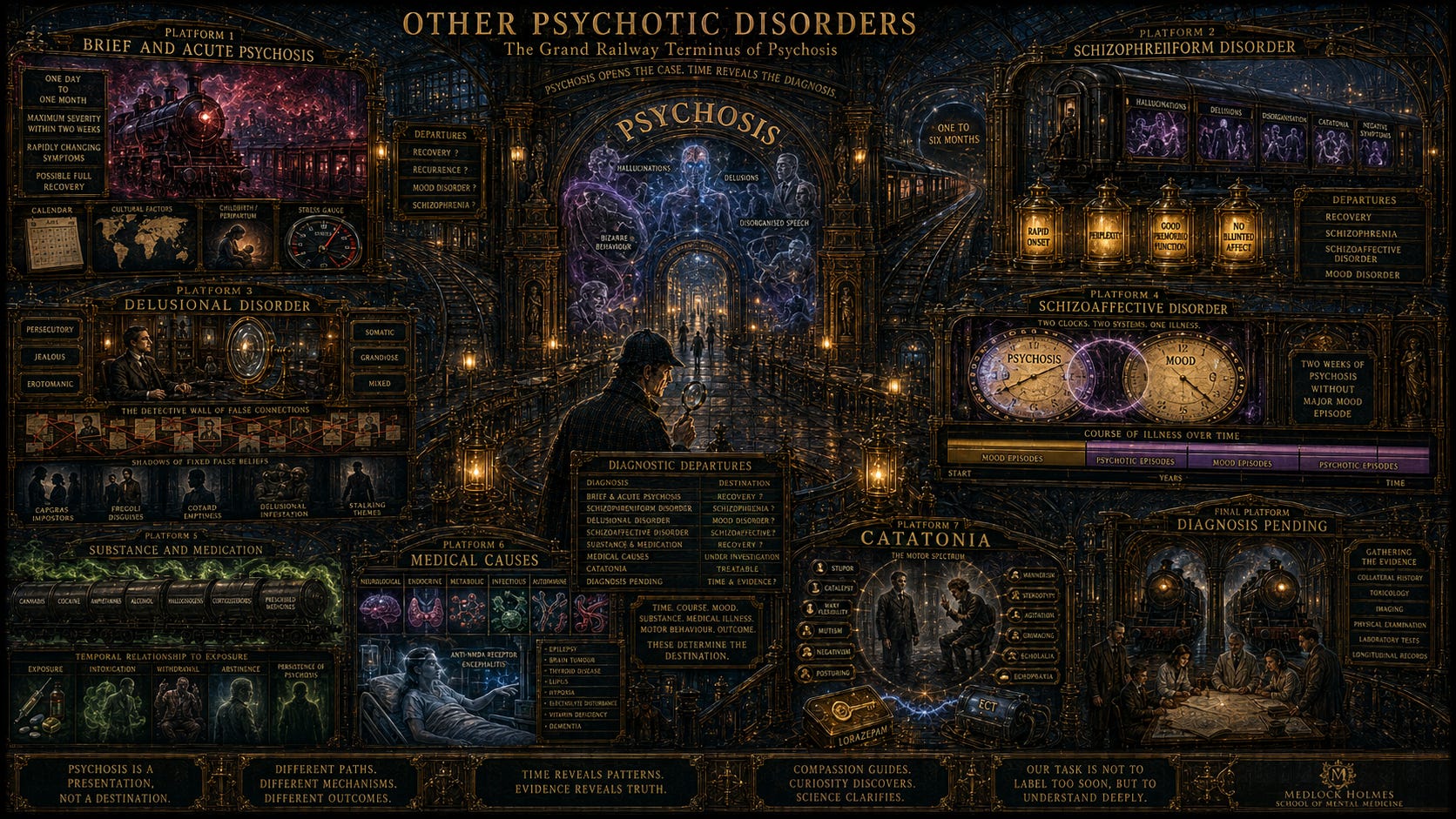
Medlock Holmes enters the Grand Railway Terminus of Psychosis.Every platform begins in the same central hall.A patient may arrive with hallucinations.Another with delusions.Another with disorganised speech, bizarre behaviour, perplexity, agitation, or catatonic stillness.At first glance, all appear to be travelling towards the same destination.But the departures board tells a different story.Some journeys last days.Others months.Some are driven by mood.Some by drugs, prescribed medicines, neurological disease, endocrine disturbance, or autoimmune inflammation.Some leave thinking and personality largely intact except for one immovable belief.Holmes realises that the diagnosis cannot be solved from the psychotic symptom alone.He must investigate time, context, consciousness, mood, medical causation, substances, function, and longitudinal course.The first train arrives without warning.A woman who had been functioning normally becomes perplexed, frightened, and intensely psychotic over several days. Her hallucinations and delusions shift rapidly. At one moment she is terrified; hours later she appears ecstatic. Her behaviour changes just as quickly.This is the territory of acute and transient psychotic disorder and brief psychotic disorder.Descriptions of such episodes have appeared throughout psychiatric history under names including cycloid psychosis, bouffée délirante, reactive psychosis, amentia, and oneirophrenia. Across languages and traditions, the shared pattern is striking:Acute onset.Rapidly changing symptoms.Short duration.The possibility of full recovery.Under DSM terminology, brief psychotic disorder lasts at least one day but less than one month, followed by complete return to the premorbid level of functioning. A marked stressor may be present, but it is no longer required. Episodes may also arise during pregnancy or shortly after childbirth.Under ICD terminology, acute and transient psychotic disorder reaches maximum severity within two weeks, often includes confusion, mood disturbance, or rapidly changing polymorphic symptoms, and may last up to three months.The prognosis is often favourable-but Holmes remains cautious.The diagnosis can only be confirmed retrospectively.During the first days of psychosis, no one knows whether it will remit next week, persist for four months, or become the first episode of schizophrenia or bipolar disorder.The apparent destination changes as the journey continues.The next platform is marked One to Six Months.Here Holmes meets a man with hallucinations, delusions, disorganised speech, and social withdrawal. His presentation is indistinguishable from schizophrenia, but the illness has not lasted long enough.This is schizophreniform disorder.It meets the core symptom requirements of schizophrenia but lasts at least one month and less than six months. Functional decline is not mandatory. When the diagnosis is made before recovery, it remains provisional.Certain signs suggest a more favourable course:Rapid onset of prominent symptoms.Confusion or perplexity.Good premorbid functioning.Absence of blunted affect.Yet the diagnosis is unstable. Many patients initially diagnosed with schizophreniform disorder later meet criteria for schizophrenia or schizoaffective disorder. A smaller proportion develop a mood disorder, while others recover and never experience another episode.Again, time is not merely a measurement.It is part of the diagnostic instrument.Holmes then enters a quiet chamber occupied by a successful accountant.The man works, pays bills, dresses carefully, and speaks coherently.Yet he is absolutely convinced that his neighbours have installed hidden devices to monitor him.Every event fits the theory.A passing car is surveillance.A delayed parcel is interference.A colleague’s glance is evidence.Outside the delusion, much of his life remains organised.This is delusional disorder.Unlike schizophrenia, it is dominated by one or more persistent delusions lasting at least a month, without the broader syndrome of prominent hallucinations, disorganisation, negative symptoms, or marked global deterioration.The belief may be plausible or bizarre.Its power lies not necessarily in its content, but in its unshakeable certainty and its consequences.Holmes walks through the galleries of delusional themes.In the Persecutory Gallery, individuals believe they are being conspired against, poisoned, monitored, cheated, obstructed, or harassed. The beliefs are often coherent and systematised, leading to anger, litigation, confrontation, or violence.In the Jealous Gallery, a partner’s ordinary behaviour becomes proof of infidelity. Receipts, clothing, phone records, and facial expressions are examined like forensic evidence. The danger is considerable because the delusion may arm anger with moral certainty.In the Erotomanic Gallery, an individual becomes convinced that another person-often of higher status-is secretly in love with them. Rejection is reinterpreted as coded affection, and stalking may follow.In the Somatic Gallery, the body becomes the centre of the delusion. The person may believe they are infested, emit a foul odour, possess a deformity, or suffer from an undetected bodily abnormality. They often seek dermatologists, dentists, surgeons, or other specialists rather than psychiatrists.In the Grandiose Gallery, the person believes they possess extraordinary talent, insight, status, power, or a world-changing discovery.Other chambers contain misidentification syndromes.In Capgras syndrome, a familiar person is believed to have been replaced by an identical impostor.In Fregoli syndrome, different strangers are believed to be one persecutor appearing in disguise.In Cotard syndrome, the individual may believe they have lost their organs, possessions, identity, or even existence itself.Holmes knows that unusual beliefs cannot simply be declared delusional because they sound improbable.Some extraordinary claims are true.Cultural and spiritual frameworks differ.Overvalued ideas and obsessions may be held with great conviction.The investigator must establish whether the belief reflects psychopathology through collateral history, behavioural consequences, degree of flexibility, cultural context, and the broader clinical picture.Before diagnosing delusional disorder, Holmes searches for medical explanations.Basal ganglia disease, epilepsy, dementia, stroke, metabolic disturbance, endocrine illness, vitamin deficiency, and focal brain lesions can all produce delusions or misidentification phenomena.Stimulants, medications, and toxins can do the same.The psychiatric diagnosis comes only after these possibilities have been considered.The next platform contains two clocks running simultaneously.One measures psychosis.The other measures mood.A woman experiences severe depression alongside hallucinations and delusions. Yet Holmes discovers that psychosis also persisted for several weeks when the depressive syndrome was absent. Over the total course of illness, major mood episodes occupied most of the active and residual period.This pattern suggests schizoaffective disorder.It occupies one of psychiatry’s most difficult borders.To meet DSM criteria, a major depressive or manic episode must occur alongside the schizophrenia syndrome. There must also be at least two weeks of hallucinations or delusions without a major mood episode. At the same time, mood episodes must occupy the majority of the illness duration.The bipolar type includes mania.The depressive type includes only major depressive episodes.The diagnosis sounds precise, but in practice it is difficult to establish. Patients may struggle to remember exactly when mood and psychotic symptoms began or ended. Negative symptoms may resemble depression. Irritable psychosis may be mistaken for mania. Clinicians may use schizoaffective disorder as a compromise when uncertain between schizophrenia and bipolar disorder.Holmes therefore reconstructs the entire longitudinal timeline rather than relying on one admission.The central question is not simply whether mood and psychosis both occurred.It is how they related across the whole illness.The next train arrives from the Chemical District.A young man develops persecutory delusions, anxiety, and depersonalisation after high-dose cannabis use.Another feels insects crawling beneath the skin during cocaine intoxication.A third hears threatening voices after prolonged heavy alcohol use.An older adult becomes psychotic after starting corticosteroids.These presentations may represent substance- or medication-induced psychotic disorder.The core requirement is prominent hallucinations or delusions developing during, or soon after, intoxication, withdrawal, or exposure to a substance or medication capable of producing psychosis.The investigation is often difficult because substance use and primary psychotic disorders frequently coexist.A positive toxicology screen does not prove causation.The substance may have precipitated psychosis.It may have worsened a primary disorder.It may have been used in an attempt to cope with emerging symptoms.Holmes studies the chronology.Did psychosis begin before the substance exposure?Has it occurred repeatedly during abstinence?Does it continue for a substantial period after intoxication or withdrawal has resolved?Is there a family history of psychosis?Did the person retain insight into the perceptual disturbance?When the person recognises a drug-related visual distortion as unreal, the appropriate diagnosis may be intoxication with perceptual disturbance rather than a psychotic disorder.When reality testing is lost and the person believes the experience is true, the diagnosis changes.The prognosis is often favourable once the offending agent is removed, but not always. Stimulant-, cocaine-, PCP-, and cannabis-related psychoses may persist, recur, or reveal an underlying primary psychotic disorder.The next platform leads away from psychiatry and into the Hospital of Hidden Causes.A middle-aged woman develops hallucinations, agitation, memory change, and catatonic behaviour. Her presentation initially resembles schizophrenia.But the age of onset is unusual.The symptoms fluctuate.Visual experiences predominate.Neurological signs begin to appear.Holmes finds the true cause: autoimmune encephalitis.This is psychotic disorder due to another medical condition.The diagnosis requires evidence that hallucinations or delusions are directly caused by a medical illness and are not better explained by a primary psychiatric disorder or delirium.The list of possible causes is vast:Epilepsy.Brain tumour.Head trauma.Stroke.Hypoxia.Huntington disease.Multiple sclerosis.Central nervous system infection.Thyroid and parathyroid disease.Adrenal dysfunction.Electrolyte disturbance.Kidney or liver failure.Vitamin deficiencies.Systemic lupus erythematosus.Anti-NMDA receptor encephalitis.Holmes learns to treat certain clues as alarms:First psychosis at an atypical age.Visual, olfactory, or multimodal hallucinations.Seizures.Focal neurological signs.Autonomic instability.Cognitive fluctuation.Rapid progression.Abnormal movements.Olfactory hallucinations may suggest temporal lobe epilepsy. Visual hallucinations are more frequent in medical psychosis than in schizophrenia. But no single symptom proves the cause.The diagnosis depends on history, examination, laboratory testing, imaging, and the temporal relationship between medical illness and psychosis.Treatment begins with the underlying condition.When the disease improves, the psychosis often recedes.Holmes then enters the most silent chamber in the terminus.A patient sits motionless.They do not speak.One arm remains suspended after the examiner moves it.Their body resists repositioning with wax-like flexibility.Elsewhere, another patient is intensely agitated, repetitive, grimacing, echoing words, and imitating movements.These are different faces of catatonia.Once treated as a subtype of schizophrenia, catatonia is now recognised as a psychomotor syndrome occurring across mood disorders, psychotic disorders, autism, neurological disease, metabolic illness, autoimmune encephalitis, and other medical conditions.The syndrome may include:Stupor.Catalepsy.Waxy flexibility.Mutism.Negativism.Posturing.Mannerisms.Stereotypy.Agitation.Grimacing.Echolalia.Echopraxia.At least three characteristic signs are required for diagnosis.Catatonia can shift rapidly between immobility and excitement. It can be mistaken for severe depression, psychosis, medication-induced rigidity, behavioural refusal, delirium, or neuroleptic malignant syndrome.This mistake can be dangerous.Untreated immobility may lead to dehydration, malnutrition, aspiration, pressure injury, contractures, thrombosis, infection, and death.Benzodiazepines and electroconvulsive therapy can produce dramatic improvement.High-potency antipsychotics may worsen the condition, particularly when neuroleptic malignant syndrome is a concern.Holmes therefore treats catatonia not as a descriptive curiosity, but as a medical and psychiatric emergency.The final platforms carry incomplete labels.Other Specified Psychotic Disorder.Unspecified Psychotic Disorder.These are not careless diagnoses.They acknowledge the limits of available information.Other specified psychotic disorder is used when the clinician knows why the presentation does not meet criteria for a more specific disorder-for example, persistent auditory hallucinations without the broader schizophrenia syndrome, attenuated psychotic symptoms, or shared delusional beliefs.Unspecified psychotic disorder is used when psychosis is clearly present but there is not yet enough information to determine its cause or category.This is common in emergency care.A patient may arrive agitated, intoxicated, frightened, and unable to provide a history. Family may be unavailable. Medical testing may be incomplete.The correct response is not premature certainty.It is a provisional diagnosis, immediate safety, careful assessment, and revision as evidence emerges.Holmes encounters two final mysteries.The first is attenuated psychosis syndrome.The person experiences suspiciousness, mild hallucination-like phenomena, or unusual beliefs, but symptoms are less intense, more transient, and accompanied by greater insight than in frank psychosis.The distress and functional impairment are real.The future is uncertain.Most will not develop a full psychotic disorder in the near term, so routine antipsychotic treatment may expose many people to harm without benefit. Careful monitoring, treatment of anxiety, depression, sleep disturbance, substance use, and functional decline may be more appropriate.The second is shared delusional belief, historically called folie à deux.Two people in a close and often isolated relationship come to share the same delusional system. Usually one person develops the original belief and the other gradually adopts it within a relationship marked by dependence, submission, social isolation, or limited alternative perspectives.Sometimes the delusion spreads through an entire household.The content is often persecutory, but religious, grandiose, and somatic themes may occur.The relationship itself becomes part of the pathogenesis.As the investigation concludes, Holmes returns to the departure board.The destinations have changed several times during the night.Brief psychosis became bipolar disorder.Schizophreniform disorder became schizophrenia.Substance-induced psychosis persisted after abstinence.An apparent primary psychosis became autoimmune encephalitis.A mute patient thought to be refusing care responded to lorazepam.Holmes understands the central lesson.In psychosis, the first diagnosis is often a hypothesis.The symptom tells us that reality has fractured.The course tells us why.Key Takeaways* Psychosis occurs in several disorders beyond schizophrenia.* Accurate diagnosis depends on duration, mood relationship, substances, medical causes, consciousness, function, and longitudinal course.* Early diagnoses in first-episode psychosis are often provisional.* Brief psychotic disorder lasts at least one day but less than one month and is followed by full return to premorbid functioning.* A marked stressor may precipitate brief psychosis but is not required.* Brief psychotic disorder may have peripartum onset or catatonic features.* Acute and transient psychotic disorder reaches maximum severity within two weeks and lasts no more than three months.* Rapidly changing polymorphic symptoms, confusion, perplexity, and mood disturbance may occur in acute and transient psychosis.* Brief and acute psychotic disorders often have favourable outcomes but may recur or later be reclassified.* Schizophreniform disorder has schizophrenia-like symptoms lasting at least one month but less than six months.* Schizophreniform disorder is provisional when the final duration and outcome are not yet known.* Good prognostic features include rapid onset, confusion or perplexity, good premorbid functioning, and absence of blunted affect.* Many cases initially diagnosed as schizophreniform disorder later become schizophrenia or schizoaffective disorder.* Delusional disorder involves one or more persistent delusions without the broader syndrome of schizophrenia.* Functioning in delusional disorder is relatively preserved apart from consequences of the delusion.* Hallucinations, when present in delusional disorder, are not prominent and are related to the delusional theme.* Delusional disorder subtypes include persecutory, jealous, erotomanic, somatic, grandiose, mixed, and unspecified types.* Persecutory and jealous delusions may carry significant risks of aggression or violence.* Erotomanic delusions may lead to stalking and intrusive contact.* Somatic delusions often present to medical specialists rather than psychiatric services.* Capgras, Fregoli, and Cotard syndromes are important forms of delusional misidentification or nihilistic belief.* Before diagnosing delusional disorder, clinicians must consider medical disease, dementia, substances, obsessive–compulsive disorder, body dysmorphic disorder, illness anxiety, and personality disorder.* Schizoaffective disorder requires both schizophrenia symptoms and a major mood episode.* DSM criteria require at least two weeks of hallucinations or delusions without a major mood episode.* Major mood episodes must be present for most of the total active and residual illness.* Schizoaffective disorder may be bipolar type or depressive type.* A detailed longitudinal timeline is essential when diagnosing schizoaffective disorder.* Schizoaffective disorder is often overdiagnosed as a compromise between schizophrenia and mood disorder.* Substance- or medication-induced psychotic disorder involves delusions or hallucinations developing during or soon after exposure, intoxication, or withdrawal.* Cannabis, stimulants, cocaine, alcohol, hallucinogens, PCP, corticosteroids, antiparkinsonian drugs, antimicrobials, and many other medicines may cause psychosis.* A positive toxicology result does not by itself prove that psychosis was substance-induced.* Psychosis predating substance use or persisting long after intoxication or withdrawal suggests a primary psychotic disorder.* Preserved insight into drug-related perceptual changes favours intoxication or withdrawal with perceptual disturbance rather than psychotic disorder.* Psychotic disorder due to another medical condition requires evidence of direct physiological causation.* Medical causes include neurological, endocrine, metabolic, infectious, autoimmune, vascular, and nutritional disorders.* Visual, olfactory, or multimodal hallucinations and atypical age of onset should heighten concern for a medical cause.* Psychosis occurring only during delirium should not receive a separate psychotic-disorder diagnosis.* Catatonia is a psychomotor syndrome rather than a subtype of schizophrenia.* Catatonia occurs in mood, psychotic, neurodevelopmental, neurological, metabolic, and autoimmune disorders.* Diagnosis requires at least three characteristic catatonic signs.* Benzodiazepines and electroconvulsive therapy are major treatments for catatonia.* Antipsychotics may worsen some cases of catatonia.* Severe catatonia can cause dehydration, malnutrition, aspiration, thrombosis, pressure injuries, and death.* Other specified psychotic disorder is used when the reason criteria are not met can be clearly stated.* Unspecified psychotic disorder is appropriate when psychosis is evident but available information is insufficient.* Attenuated psychosis syndrome involves subthreshold symptoms with distress or impairment and relatively preserved insight.* Most individuals with attenuated psychosis do not develop a full psychotic disorder in the short term.* Shared delusional beliefs may arise within close, dependent, and socially isolated relationships.* Reassessment over time is one of the most important diagnostic tools in psychosis. This is a public episode. If you'd like to discuss this with other subscribers or get access to bonus episodes, visit drmanaankarray.substack.com/subscribe
Embed this episode
Ready to play
PSYCH 108: Other Psychotic Disorders
No transcript for this episode yet
Similar Episodes
No similar episodes found.
Similar Podcasts
No similar podcasts found.