
EPISODE · Sep 1, 2026 · 38 MIN
PSYCH 109: Mood Disorders - Historical Introduction and Conceptual Overview
from Clinical Deep Dives · host Dr Manaan Kar Ray
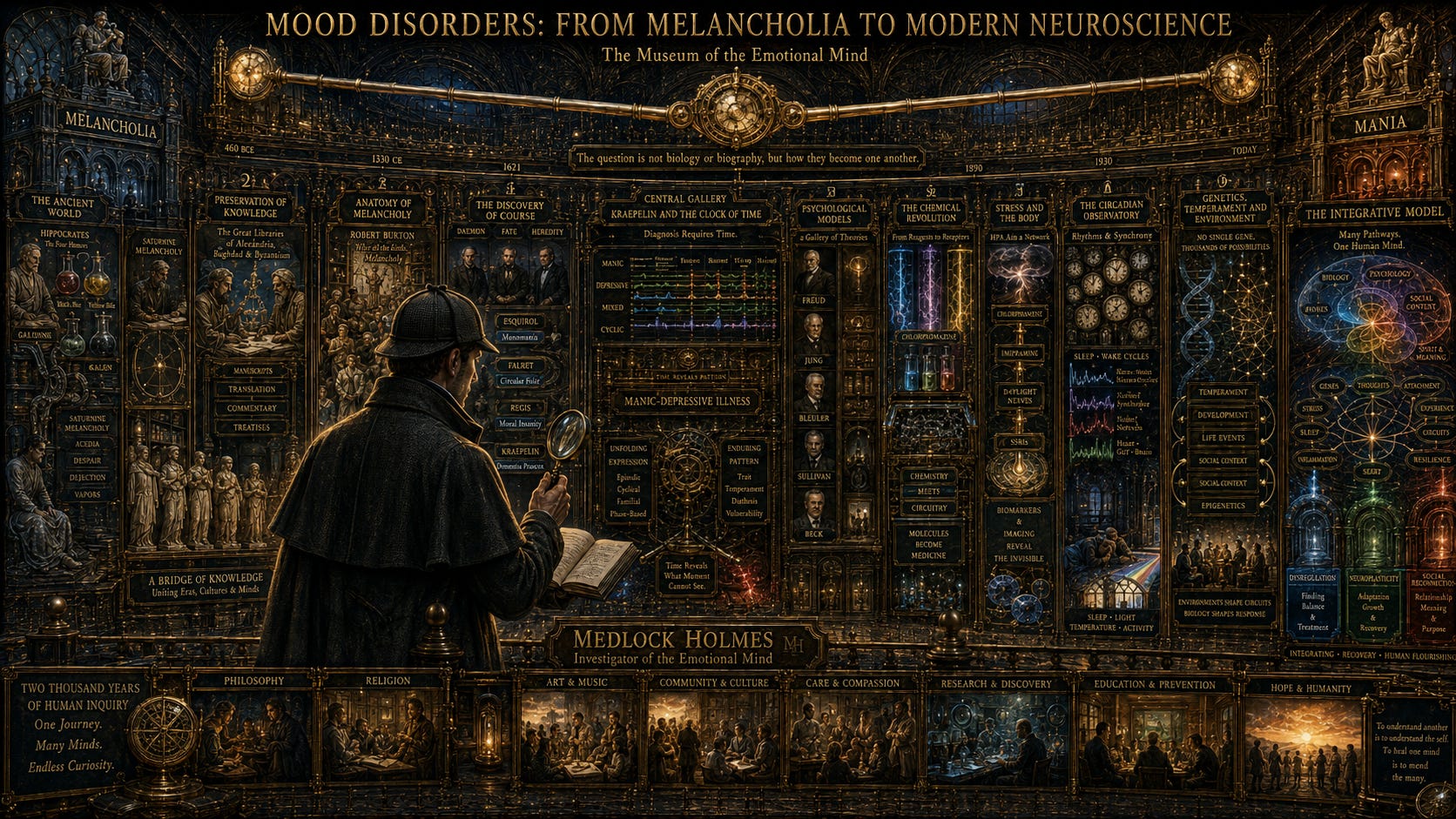
Medlock Holmes enters the Great Museum of the Emotional Mind.It is unlike any museum he has visited before.Instead of paintings, its galleries contain theories.Instead of fossils, there are abandoned explanations of human suffering.And running through the centre of the building is an enormous pendulum.At one extreme is engraved:MELANCHOLIAAt the other:MANIAThe pendulum has been swinging for more than two millennia.Holmes soon discovers that the history of mood disorders is not simply the history of old psychiatric diagnoses.It is the story of psychiatry itself attempting to answer one enduring question:How do biology, temperament, experience, relationships, thought, environment, and time combine to alter human mood?The investigation begins not in a modern laboratory, but in ancient Greece.Hippocrates described melancholia as a state characterised by despondency, disturbed sleep, reduced appetite, irritability, fear, and restlessness.The explanation was black bile.The theory was wrong.But the intellectual move was revolutionary.Mental suffering was being placed within nature rather than attributed solely to supernatural forces.The ancient physicians also recognised something remarkably modern: depression was not simply sadness.It affected sleep.Appetite.Activity.Thought.Emotion.Behaviour.And sometimes the wish to remain alive.They also recognised the relationship between anxiety and melancholia and described agitated forms of depression in which distress, fear, excessive speech, restlessness, and behavioural activation coexisted with depressive mood.The boundaries between depression and mania were already becoming complicated.The Greeks and Romans described mania as a state of excitement, increased activity, altered mood, grandiosity, reduced sleep, disinhibition, aggression, and sometimes psychosis.Aretaeus of Cappadocia made the crucial observation that melancholia and mania might not be separate diseases.They could be different expressions of the same underlying disorder.The pendulum had been discovered.Ancient medicine also introduced another idea that would survive for centuries:temperament.The melancholic temperament was contemplative, brooding, and sombre.The sanguine temperament was energetic, sociable, and active.The choleric temperament was irritable and explosive.The phlegmatic temperament was inhibited and passive.Disease emerged when balance was lost.The four-humour biology disappeared, but the deeper idea survived: enduring temperamental traits might create vulnerability to particular forms of psychopathology.The knowledge then travels through the Islamic Golden Age.Holmes finds manuscripts belonging to scholars including Ishaq Ibn Imran and Avicenna.They preserve and elaborate earlier descriptions of melancholia and temperament.Avicenna describes different combinations of inactivity, anger, restlessness, and excitement and recognises transitions from melancholic states towards mania.Ishaq Ibn Imran considers inherited vulnerability, temperament, mental overexertion, and disturbances of sleeping and waking.The language is ancient.The architecture of the idea is strikingly contemporary:predisposition + environment + disturbed biological rhythms → illness.Holmes moves forward to Oxford in 1621.There he finds Robert Burton’s monumental Anatomy of Melancholy.The actual frontispiece reproduced on page 12 of the source resembles a visual map of melancholia itself: Burton sits centrally, surrounded by symbolic scenes representing solitude, jealousy, superstition, hypochondriasis and madness.Burton’s conception is broad.Melancholia may arise from inheritance, temperament, excessive contemplation, disturbed biological rhythms, diet, alcohol, passions, loneliness, and environment.Once again, psychiatry oscillates between competing explanations.Is depression biological?Psychological?Social?Temperamental?Holmes notices that every generation seems tempted to choose one.The history repeatedly teaches the same lesson:the human mind refuses to fit inside a single explanatory box.The nineteenth century brings a decisive transformation.Psychiatric hospitals allow clinicians to observe patients not merely at one moment but over time.That changes everything.Jean-Philippe Esquirol proposes that disturbance of mood itself may lie beneath forms of melancholia and paranoid illness.Jean-Pierre Falret describes circular insanity.Jules Baillarger describes folie à double forme.Depression and mania are increasingly understood longitudinally rather than as isolated snapshots.Then Emil Kraepelin enters the museum.He carries no new laboratory test.His instrument is something more powerful:time.Kraepelin follows patients across episodes.He notices familial aggregation.He observes transitions between mania and depression.He sees recurrent episodes separated by periods of recovery.He recognises mixed states in which depressive and manic features coexist.And he observes that episodes may emerge against enduring temperamental backgrounds.From these observations he constructs manic-depressive illness.For Kraepelin, depression involves lowered mood accompanied by slowing of mental and physical processes.Mania represents accelerated mental and physical activity with altered or elevated mood.Yet the two can coexist.The apparent opposites belong to the same family.Later investigators increasingly distinguish unipolar depression from bipolar disorder, particularly because bipolar illness demonstrates stronger familial loading.The pendulum is becoming a spectrum.But another question remains.What role does life experience play?Adolf Meyer attempts to bridge the divide between mind and body through psychobiology.Rather than viewing depression as purely endogenous or purely psychological, he considers constitutional and biological vulnerability interacting with a person’s biography and life circumstances.The patient’s story becomes part of the disease model.Then Sigmund Freud and Karl Abraham propose another explanation.Perhaps depression reflects aggression directed inward following conflict involving an internalised loved object.The theory becomes enormously influential.But Holmes places a question mark beside it.Depressed people are not universally deficient in outward aggression.Many are irritable or hostile.Recovery does not necessarily produce greater aggression.The model is historically important, but the source emphasises that evidence does not support it as a universal mechanism of depressive illness.The investigation therefore moves from anger towards loss.John Bowlby’s attachment work provides another framework.Early disruption of attachment may create vulnerability.Later bereavement, separation, rejection, or loss may precipitate illness.But loss alone cannot explain depression.Most bereaved people do not develop major depressive disorder.The crucial question becomes:Why does the same loss overwhelm one person but not another?The answer begins to require predisposition.Genetics.Temperament.Previous experience.Social support.Meaning.And biology.Another gallery is labelled Self-Esteem.Here depression is conceptualised as collapse of the individual’s ability to sustain valued roles, identity, purpose, status, aspirations, or ideals.Then Holmes enters Aaron Beck’s laboratory.Three mirrors surround the patient.One reflects the self.One reflects the world.One reflects the future.All three have darkened.This is the cognitive triad.The person sees themselves as powerless or worthless.Events are interpreted negatively.The future appears hopeless.The model provides something earlier theories struggled to offer:a mechanism that can be identified clinically and deliberately modified through therapy.Nearby, Martin Seligman’s experimental chamber contains an animal that has learnt that escape is impossible.Eventually it stops trying even when escape becomes available.Learned helplessness proposes that repeated uncontrollable adversity can create expectations that personal action is futile.Yet Holmes again refuses reductionism.Helplessness can occur in many forms of adversity and psychopathology.It cannot alone explain the biological richness of melancholia-the profound disturbances of appetite, sleep, circadian rhythm, autonomic function, and psychomotor activity.The next room contains a machine labelled REWARD.Peter Lewinsohn’s behavioural model proposes that inadequate access to meaningful reinforcement may contribute to depressive behaviour.Loss of rewarding relationships.Reduced activity.Poor social skills.Fewer positive experiences.Withdrawal then further reduces reinforcement.A vicious circle develops.Psychology is beginning to converge on something biology will soon rediscover:the circuitry of reward.Holmes enters the twentieth-century neuroscience wing.Three chemical messengers illuminate the ceiling:NOREPINEPHRINESEROTONINDOPAMINEThe biogenic amine hypotheses propose that altered monoaminergic function contributes to mood disorders.The clues originally come partly from pharmacology.Reserpine depletes monoamines and can precipitate depression.Antidepressants modify monoaminergic signalling and can alleviate depressive illness.But Holmes notices an important inscription beneath the display:Correlation is not causation.Decades of research have failed to demonstrate that a simple deficiency or excess of a single monoamine is necessary or sufficient to produce depression.The monoamines remain important.But they are not the whole story.Modern models therefore descend deeper.Receptors.Second-messenger systems.G proteins.Signal transduction.Gene transcription.BDNF.Neuroplasticity.The question changes from:“Which chemical is missing?”to:“How does the brain regulate itself across time, stress and experience?”The next gallery contains an enormous stress-response system.The hypothalamic–pituitary–adrenal axis is activated.Cortisol rises.Feedback regulation becomes disturbed.Corticotropin-releasing factor increases.The endocrine system reveals that depression is not simply an emotion occurring inside the skull.It involves regulatory systems linking brain and body.Holmes enters the Circadian Observatory.Dozens of clocks have drifted out of synchrony.Deep sleep is reduced.Nocturnal awakenings increase.REM sleep arrives earlier.Total sleep time decreases.Core temperature rhythms alter.Mood disorders begin to look like disorders not simply of emotion but of biological timing.Bright light and sleep manipulation can influence certain depressive states.Sleep loss can precipitate mania.The ancient physicians who noticed relationships between mood, seasons, sleep, and rhythms had glimpsed something real long before circadian neuroscience existed.The next room is marked Neuroplasticity.Chronic stress increases glucocorticoid exposure.BDNF expression may decrease.Neurons may undergo atrophic changes.The hippocampus appears particularly vulnerable.Brain imaging reveals abnormalities involving hippocampal, prefrontal, cingulate, striatal, thalamic, amygdala, and other limbic networks.Functional imaging demonstrates altered responses to negative emotional stimuli and disturbances of cortical-limbic regulation.Depression is increasingly understood not as a lesion in one place but as dysregulation across interconnected systems.Then Holmes reaches the genetic archive.Family and twin studies demonstrate familial vulnerability.The source reports an increased odds ratio of 2.84 for major depressive disorder among first-degree relatives and estimates heritability at approximately 37%.Yet there is no single depression gene.The genetic architecture appears complex and polygenic.Many variants may contribute small effects.And genes do not act alone.They influence temperament.Stress responsivity.Environment.Behaviour.Relationships.Perhaps even the likelihood of encountering particular life events.Holmes now sees the investigation differently.Genes may shape temperament.Temperament influences relationships.Relationships generate experiences.Experiences alter stress systems.Stress affects sleep.Sleep influences mood regulation.Mood changes behaviour.Behaviour changes environment.Environment feeds back upon biology.The arrows form a circle.The old question-Nature or nurture?-has become almost meaningless.The final chamber contains an enormous three-dimensional model of the limbic system connected to the prefrontal cortex, endocrine system, circadian clocks, reward pathways, social world, and genetic machinery.Above it appears the integrative model.Psychological and biological processes converge upon neural systems governing pleasure, reward, motivation, arousal, emotion and biological rhythms.Loss can reach those systems.Trauma can reach them.Genes can reach them.Hormones can reach them.Sleep disruption can reach them.Illness can reach them.Thought can reach them.Medication can reach them.Psychotherapy can reach them.Different roads may therefore converge upon a similar clinical syndrome.This is why depression can look recognisably similar in people whose pathways into illness are very different.It also explains why treatment should resist ideological purity.Medication and psychotherapy are not rival philosophies.Somatic treatments may be necessary for severe melancholic or psychotic depression.Psychological treatments can modify demoralisation, attribution, relationships, behaviour, and cortical-limbic functioning.Social interventions can restore support, roles, meaning, and stability.Circadian interventions can protect biological rhythms.Maintenance treatment can reduce recurrence.The correct question is not:“Is this depression biological or psychological?”It is:“Which interacting systems have become dysregulated in this particular person, and what combination of interventions can restore them?”Holmes returns to the great pendulum.Melancholia.Mania.Biology.Biography.Genes.Temperament.Loss.Cognition.Reward.Stress.Sleep.Neuroplasticity.Society.None provides the whole answer.Together they form something far more powerful:a model of mood disorder as dynamic dysregulation within an adaptive human system.The pendulum continues to swing.But Holmes now understands that psychiatry’s task was never merely to stop it.It is to understand what governs its rhythm.Key Takeaways* Mood disorders are syndromes characterised by pathological alterations of mood accompanied by vegetative, cognitive, behavioural and psychomotor disturbances.* Major depressive disorder is common, disabling and frequently recurrent.* The source reports international estimates of 12.9% point prevalence, 7.2% one-year prevalence and 10.8% lifetime prevalence for depression across a large meta-analysis.* Mood disorders account for substantial morbidity, mortality and societal cost.* Mood disorders underlie a large proportion of suicides, making their detection and effective treatment an important public-health intervention.* Depression remains substantially underdetected and undertreated.* Mood disorders can be conceptualised categorically or dimensionally.* The relationship between recurrent depression and bipolar disorder remains important to contemporary concepts of the bipolar spectrum.* Major depressive disorder may occur as a single episode or recurrent episodes.* Bipolar disorders involve hypomanic, manic or mixed episodes, usually alongside depressive episodes across the longitudinal course.* Persistent depressive disorder represents a chronic depressive substrate, while cyclothymia involves alternating subthreshold depressive and hypomanic states.* Subthreshold affective states can produce substantial impairment even without meeting full syndromal thresholds.* Ancient Greek and Roman physicians described recognisable syndromes of melancholia, mania and mixed affective states.* Hippocrates’ black-bile hypothesis was biologically incorrect but historically important because it framed mental illness in naturalistic terms.* Aretaeus recognised an intimate relationship between melancholia and mania.* Ancient medicine introduced the idea that temperament may predispose individuals towards affective illness.* Islamic scholars including Ishaq Ibn Imran and Avicenna preserved and extended classical thinking about melancholia, mania, temperament and biological rhythms.* Robert Burton’s Anatomy of Melancholy integrated inherited, temperamental, behavioural and environmental explanations of melancholia.* Nineteenth-century longitudinal observation transformed understanding of mood disorders.* Falret described circular insanity and Baillarger folie à double forme.* Kraepelin unified many depressive and manic presentations into manic-depressive illness.* Kraepelin emphasised familial aggregation, recurrence, polarity shifts, symptom-free intervals, temperament and mixed states.* Later classification increasingly distinguished unipolar depression from bipolar disorder.* Adolf Meyer introduced psychobiology as an attempt to integrate biological constitution with biography and life experience.* Psychoanalytic models proposed aggression turned inward as a mechanism of depression, although this does not adequately explain all depressive illness.* Object-loss theories emphasise attachment disruption, bereavement and interpersonal separation.* Loss does not inevitably cause depression; vulnerability modifies its effect.* Loss of self-esteem provides another psychological framework involving identity, roles, status, ideals and purpose.* Beck’s cognitive model describes negative views of the self, environment and future.* The cognitive model provided a clinically modifiable mechanism and contributed to cognitive therapy.* Learned helplessness proposes that repeated uncontrollable adversity can create expectations that action is futile.* Reinforcement models emphasise reduced access to rewarding experiences and relationships.* Psychological models cannot alone account for the full biological and psychomotor manifestations of severe melancholia.* Norepinephrine, serotonin and dopamine are involved in functions profoundly altered during mood disorders.* Simple monoamine-deficiency explanations of depression are insufficient.* Monoamines may explain aspects of antidepressant action better than the fundamental cause of depression.* Contemporary biological research increasingly focuses on receptors, intracellular signalling, gene expression and neuroplasticity.* BDNF has an important role in neuronal survival, growth and differentiation.* HPA-axis dysregulation and altered glucocorticoid signalling have been extensively investigated in depression.* Neuroendocrine abnormalities are informative biologically but lack sufficient specificity to function as simple diagnostic tests.* Depression is associated with characteristic disturbances of sleep and circadian regulation.* Reduced REM latency, increased nocturnal awakening, reduced total sleep and reduced slow-wave sleep have been described.* Circadian disruption may persist beyond symptomatic recovery and contribute to recurrence.* Stress can interact with biological vulnerability and influence neurotransmitter, endocrine and neuroplastic systems.* Chronic stress and glucocorticoid exposure may contribute to neuronal atrophy and reduced hippocampal volume.* Brain imaging suggests abnormalities across distributed cortical, limbic and subcortical networks rather than a single depression centre.* Depression aggregates within families.* The source estimates MDD heritability at approximately 37%.* The genetic architecture of depression is likely complex and polygenic rather than attributable to one gene.* Temperament may represent part of inherited vulnerability to mood disorders.* Life events are particularly important when acting upon an underlying affective diathesis.* Stressful events may be more influential during earlier episodes, with some recurrent illnesses becoming increasingly autonomous.* Physical illness and medications can also precipitate depressive or manic episodes in vulnerable individuals.* Women experience a greater burden of depression, with differences emerging around puberty and diminishing later in life.* Hormonal factors, temperament, genetics and psychosocial processes may all contribute to sex differences.* No single psychological or biological model adequately explains mood disorders.* Integrative models conceptualise depression as a final common clinical pathway produced by multiple interacting vulnerabilities and stressors.* Reward, motivation, limbic regulation, circadian rhythms, endocrine function, cognition and interpersonal relationships are interconnected.* Biological and psychosocial treatments should therefore be viewed as complementary rather than competing approaches.* Severe melancholic and psychotic depression often require somatic treatment.* Psychotherapy can address demoralisation, maladaptive attribution, interpersonal difficulties and functional impairment.* Maintenance treatment is important because many mood disorders are recurrent or lifelong.* The history of mood disorders demonstrates a recurring lesson: psychiatric explanations become weakest when one level of understanding is mistaken for the whole person. This is a public episode. If you'd like to discuss this with other subscribers or get access to bonus episodes, visit drmanaankarray.substack.com/subscribe
Embed this episode
Ready to play
PSYCH 109: Mood Disorders - Historical Introduction and Conceptual Overview
No transcript for this episode yet
Similar Episodes
No similar episodes found.
Similar Podcasts
No similar podcasts found.